Geography of Ocean City, Maryland
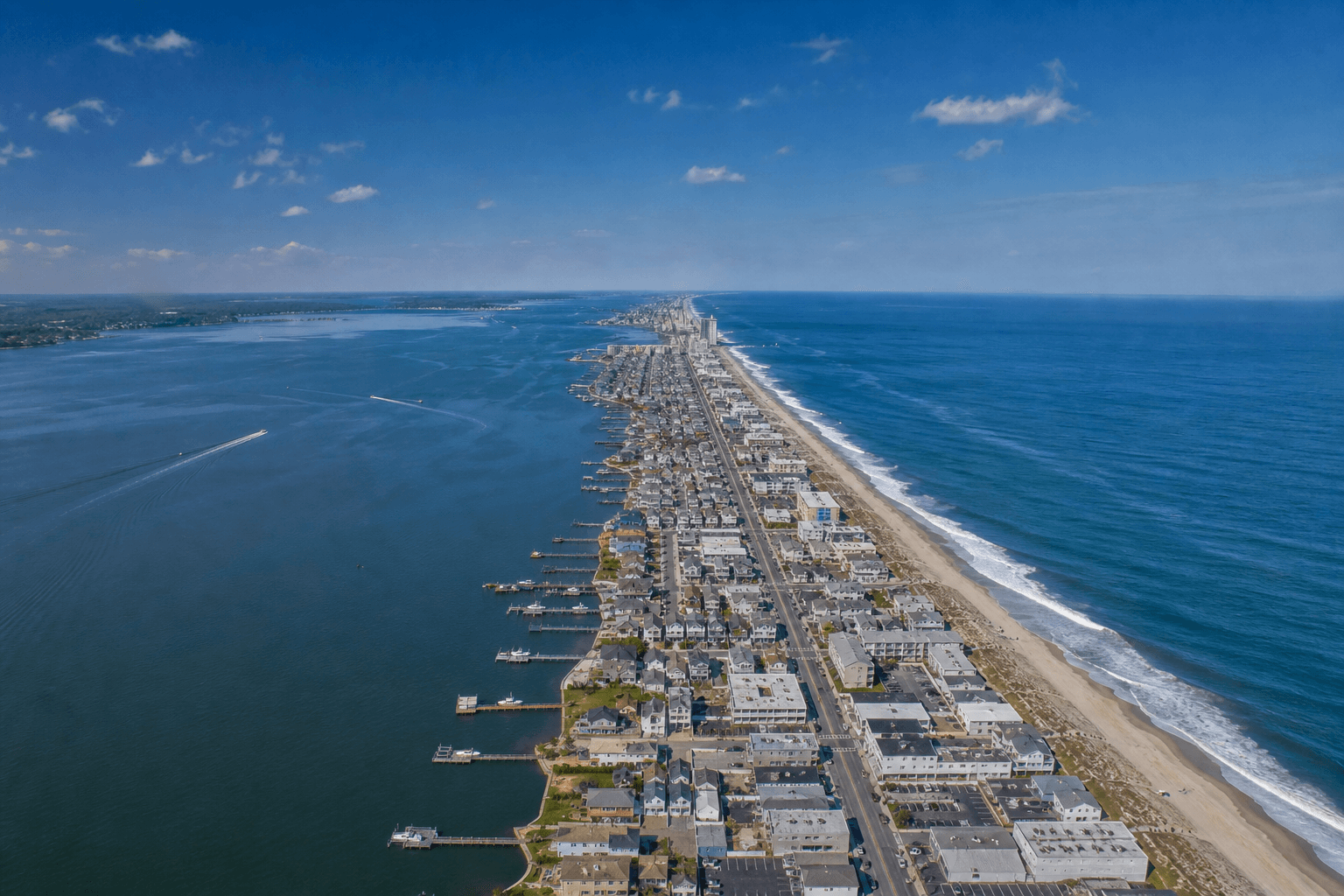
One long resort ribbon between Atlantic surf and Maryland's coastal bays. Understanding the spit, the inlet, and the west-of-bay mainland explains wind, traffic, boating, and why the map rarely matches July drive times.
This page synthesizes physical geography references—encyclopedic summaries of Ocean City and Fenwick Island, Maryland Department of Natural Resources and Maryland Coastal Bays Program materials, U.S. Army Corps of Engineers coastal education pages, and the National Park Service’s Assateague materials—for trip planning context. It does not replace nautical charts, engineering studies, or legal surveys.
For the human timeline (hotels, 1933 inlet, bridges), read Ocean City history — full timeline. For weather behavior built on this landform, use Climate & storms — full guide. For who is here when, see demographics.
Official maps, access, and visitor services (beyond the sand sketch)
Geography explains why the island queues north–south; the Town of Ocean City publishes the operational layer— parking maps, Beach Patrol and beach-access programs, bus routes, and special-event traffic plans—on oceancitymd.gov. Pair that shelf with OC Ocean for Town-run tourism storytelling, OceanCity.com for wide visitor scanning, and the Greater Ocean City Chamber when you need business-directory context. Roles and overlap: Ocean City Info — official portals.
Regional setting: Delmarva, Worcester County, Salisbury metro
Ocean City sits at Maryland’s southeastern corner on the Delmarva Peninsula, within Worcester County and the Salisbury, MD metropolitan area as defined by the Census Bureau. That framing matters because regional services—health care, airports, big-box retail, and much of the year-round labor pool—orbit Salisbury and the Route 50 corridor while the resort strip itself stays linear and coastal.
Fenwick Island: barrier spit, not a classic freestanding island
Encyclopedic sources describe Fenwick Island as a shared barrier spit hosting Ocean City, Maryland, plus Delaware’s South Bethany and Fenwick Island town. Unlike Assateague Island to the south—often described as a migrating barrier island with National Seashore lands—the Fenwick ridge historically stayed attached northward until storms and engineering re-sculpted the south end.
The 1933 inlet and today’s shoreline geometry
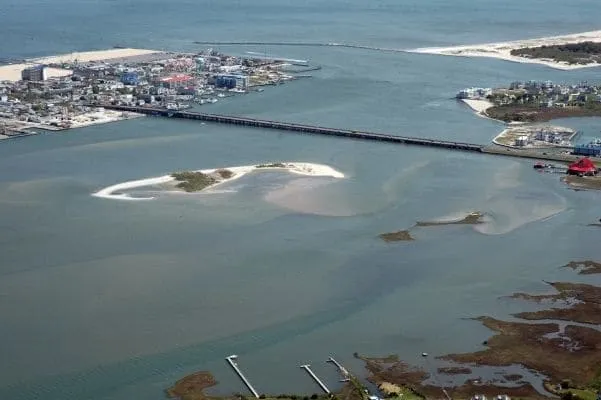
The Ocean City Inlet formed during the August 1933 Chesapeake–Potomac hurricane when bay water and surge breached the narrow barrier. Stabilized with jetties, it now defines the south end of the resort grid, separates Ocean City from Assateague, and feeds Atlantic salt water into the lagoon network behind the beaches. That hydraulic connection is why coastal-bays managers emphasize oceanic flushing through Sinepuxent Bay while also documenting chronic inlet shoaling that demands dredging.
Atlantic Ocean vs Isle of Wight Bay
The developed town occupies a narrow sand ridge: Atlantic Ocean on the east, and—typically—Isle of Wight Bay immediately to the west of the densest hotel and condo wall. The bay side hosts marinas, back-bay homes, restaurant docks, and kiteboarding flats where wind shadows differ from oceanfront exposure. Tidal range is modest compared with New England, but wind-driven setup can still stack water against bulkheads during nor’easters.
Sinepuxent Bay and the coastal-bays watershed
South and west, Sinepuxent Bay connects toward Chincoteague Bay and the broader Maryland–Virginia coastal lagoon system. The Maryland Coastal Bays Program notes that Sinepuxent’s drainage includes northern Assateague and a slice of mainland south of Route 50 (including the Route 611 growth axis), calls it the smallest of five coastal-bays subwatersheds, and stresses urban runoff, septic legacy, and eroding tidal wetlands—even though the footprint looks small on a wall map.
West Ocean City and the commercial harbor
West Ocean City is the mainland shore—marinas, boatyards, seafood distribution, and the big-box strip reached by the Harry W. Kelley Memorial Bridge (Route 50) and related causeways. Visitors cross water twice in spirit: once onto the resort island for the beach week, and repeatedly in practice when provisioning or trailering boats from mainland ramps.
Sediment, nourishment, and longshore transport
Barrier systems survive by moving sand. Longshore drift feeds or starves beaches depending on wave angle, structures, and dredge cuts. Beach nourishment—pumping sand from offshore borrow areas—became a standing management tool after decades of storm losses and narrowing berms. Overwash (storm waves washing sand into the back bay) is natural on Assateague but disruptive when it threatens Coastal Highway infrastructure—another reason engineering and ecology headlines overlap here.
Urban geography: blocks, “South/Mid/North,” and traffic physics
Ocean City’s visitor grid is organized around Coastal Highway (MD 528) and cross streets numbered from the inlet northward toward the Delaware line—roughly nine miles of developed oceanfront in common guidebook shorthand, with midtown and north-end high-rises carrying different density and parking stories. Because the town is long and skinny, summer congestion behaves like a linear queue: detours cannot easily route around the whole resort parallel to the ocean the way they might in inland grid cities.
Climate geography crosswalk
Summarized climate references place Ocean City in a humid subtropical / maritime transition zone with frequent sea breezes, rare but possible hurricanes brushing the coast, and plant-hardiness near USDA 7b. Those facts are unpacked for trip timing on the climate page; here, the important link is that geography sets up the breeze fields and surge pathways that make the same forecast feel different on the ninth-floor oceanfront versus a bayside canal home.
On-the-water planning (beyond this article)
Pair orientation with operational hubs: boating.
Eat the map
Outdoor dining, seafood, food & drink, and Good Eats—same barrier geometry, different patios.
Sources and further reading
Encyclopedias and agency pages sometimes update independently—verify critical facts for navigation or legal use.
- Wikipedia — Ocean City, Maryland (overview with land/water statistics and geography section citations).
- Wikipedia — Fenwick Island (Delaware–Maryland).
- Wikipedia — Isle of Wight Bay.
- Wikipedia — Sinepuxent Bay.
- Wikipedia — Ocean City Inlet.
- Maryland Coastal Bays Program — Sinepuxent Bay.
- Maryland Coastal Bays Program — home (report cards, CCMP, volunteer paths).
- Maryland DNR — Coastal Bays (state management context).
- Maryland DNR — Coastal Bays historical chapter (PDF).
- U.S. Army Corps of Engineers — Barrier system basics (spit vs island, inlets, deltas—educational summary).
- National Park Service — Assateague Island nature (barrier-island dynamics).
- U.S. Census Bureau — TIGER/Line mapping files (official boundaries).
Geography FAQs
- Is Ocean City, Maryland, on a “barrier island”?
- Popular speech says “barrier island,” but technical references usually place the resort on the Fenwick Island barrier spit—a sandy ridge shared with southern Delaware beach towns and tied to the mainland at its northern end. The 1933 hurricane cut the Ocean City Inlet, separating that spit from Assateague Island to the south, which behaves more like a classic migrating barrier island.
- What body of water is directly west of the high-rise strip?
- Most visitors standing on Coastal Highway look west across Isle of Wight Bay—a shallow lagoon complex behind the developed barrier. Channels, marinas, and restaurants line that margin; wind chop and sunsets differ from the open Atlantic surf on the east.
- How does Sinepuxent Bay fit the map?
- South and west of town, Sinepuxent Bay links the larger Maryland–Virginia coastal lagoon system (including Chincoteague Bay) toward the Ocean City Inlet. The Maryland Coastal Bays Program treats it as the smallest coastal-bays subwatershed but notes strong ocean flushing through the inlet—important for salinity, water quality, and boating access patterns.
- What is “West Ocean City” if the ocean is east?
- West Ocean City is the mainland side of Sinepuxent Bay along the Route 50 / Route 611 corridor—marinas, seafood wholesalers, big-box retail, and the commercial harbor. It is part of the visitor economy but not the same incorporated grid as the oceanfront island; geography drives that cross-the-bridge-for-groceries rhythm.
- Why does north–south traffic dominate summer headaches?
- The resort grew as one long ribbon along a barrier spit. Almost all lodging, beaches, and boardwalk energy sit on a few parallel roads (Coastal Highway and alternatives). When volume spikes, there are limited east–west relief valves compared with a grid city—short map distances still queue.
- What is longshore drift and why should a beachgoer care?
- Waves approach the coast at an angle, pushing sand along the beach in a net direction. Structures like jetties and groins interrupt that transport, which is why engineers talk about “sand starving” or accretion on opposite sides of projects. It explains shifting berms, nourishment pipe lines, and why the inlet needs periodic dredging.
- How did stabilizing the inlet change Assateague?
- Coastal science summaries argue the hardened inlet cut off natural sand supply to the northern Assateague shoreline, accelerating westward island migration through overwash while contributing to chronic shoaling at the inlet throat. That is why dredging budgets and Assateague dune dynamics often appear in the same news cycle.
- Why do bayside decks feel different from oceanfront balconies?
- Fetch, humidity, and afternoon sea breezes differ between a wide Atlantic surf zone and a lagoon with marsh edges. Bay restaurants may catch softer chop or gnats near marsh; ocean decks get salt spray and steadier onshore wind. Neither side is “always calmer”—nor’easters can hammer both, from different directions.
- Does “close on the map” mean a quick dinner run in July?
- Not always—bridge lights, draw schedules, event detours, and Saturday turnover can stretch short hops. Treat Coastal Highway mile markers as time estimates, not just distance.
- Where do official land-area statistics come from?
- The U.S. Census Bureau publishes municipal boundaries and land/water splits used in demographics and federal datasets. Published encyclopedia summaries sometimes disagree slightly by vintage or measurement method—use Census cartography when your work requires a citable number.
- Does this page replace NOAA nautical charts or USACE notices?
- No. For navigation, rely on current charts, Local Notice to Mariners, and on-water aids. This article is visitor geography, not piloting law.
- How does physical geography connect to human history here?
- Railroads once crossed the bays; the 1933 inlet ended that alignment and reoriented the town toward marinas and auto tourism. For a narrative timeline with storms and bridges, read the long-form companion on Ocean City history.
- Where do official beach access, parking, and bridge pages fit next to this geography lesson?
- This article explains shape and water bodies; the Town of Ocean City’s government site publishes ADA beach access, parking seasons, and transportation geometry as law and service—not as travel prose. Use /ocean-city-info.html#official-portals to see how oceancitymd.gov, OC Ocean, OceanCity.com, and the Chamber split those answers.




Beach Blog on Geography
Trip reads written for this hub—pacing and advice, not a second directory.