Beach Blog · Beach Weather — Ocean City, Maryland
Rip current flags: teach kids before they ask for waves
Grace Okonkwo on teaching kids Ocean City beach flag colors before the ocean becomes a negotiation—rip currents, calm language, and shore safety that sticks.

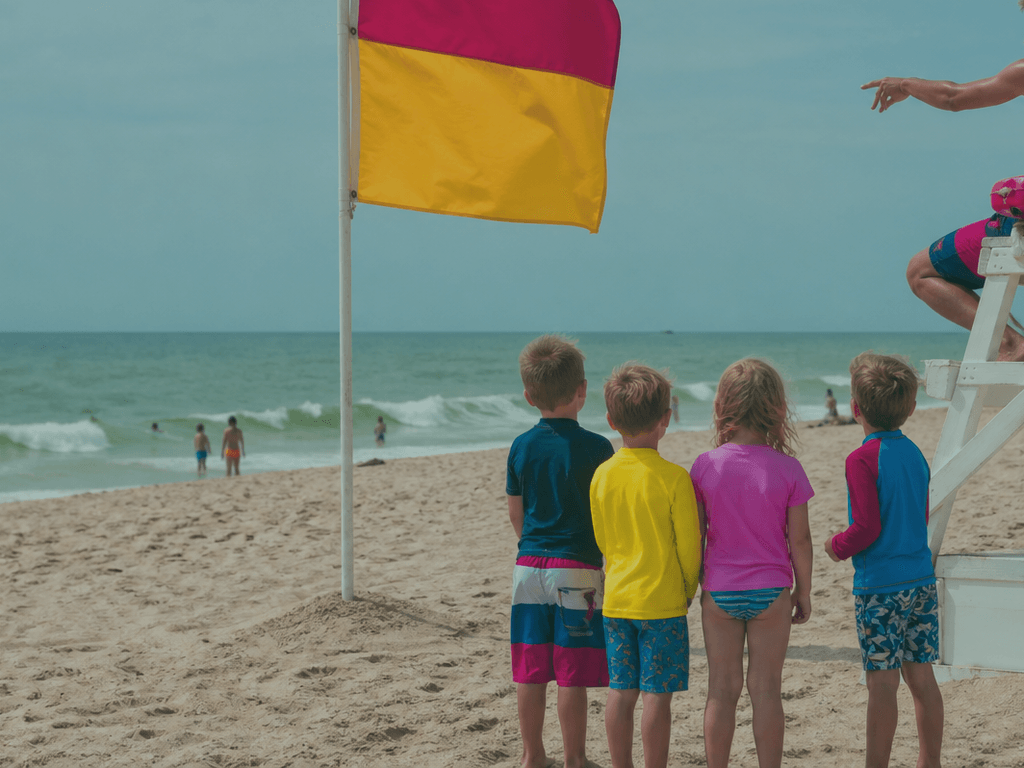
I’m Ryan Shaw. I coach kids who treat caution like a personal insult until the ocean teaches them otherwise. Rip current flags are the curriculum I wish every family ran through in the parking lot—before towels, before boogie boards, before someone says “just this once.”
Flags are not mood décor. They are the beach’s daily syllabus.
Mid-week is when rip current flags show up
Last August I watched a family set up fifty yards from a stand flying yellow. Kids hit the water immediately because the sun was out and the waves looked friendly. Friendly is a visual trick. Yellow means caution—often chop, shore break, or rip risk elevated enough that guards want your attention.
I am not the flag police. I am the guy who pulls his team out of the surf when color changes and makes it boring routine, not punishment. We eat Popsicles on the blanket instead. Nobody dies of missing a body-surf set.
That morning I walked over—not preachy, just human—and mentioned the flag color to the dad while his kid waited in ankle-deep water. He had not looked up. Most people do not until something feels wrong.
Our repeatable rip current flags sequence
We teach three colors like a song, not a lecture:
Green — conditions within normal guard parameters. Still not a pool. Still Atlantic.
Yellow — heightened caution. Smaller kids stay shallow. Weak swimmers reconsider. Everyone knows where the lifeguard stand is.
Red — strong surf or rip current risk. Swimming is restricted or closed depending on local policy. Boogie boards are not loopholes.
Double flags or closures mean listen, full stop. Our beach weather hub links official guidance; I make kids open it once so they see flags are system-wide, not arbitrary.
We add one skill: if pulled seaward, do not fight straight in. Float, signal, swim parallel until the pull eases. Practice on land like a silly drill so muscle memory exists.
A rhythm that works for rip current flags
Scary shark stories make bad teachers. Flags make good ones because they are daily, visible, and impersonal. “The flag is red” beats “I said so.”
Teenagers respond to respect for skill: you may be strong in a pool; the ocean grades on a different scale. Give them a job—flag watcher for the hour, youngest sibling buddy—so compliance is not only top-down.
When flags flip midday, we exit without debate. Pack sand toys once. Return if green returns. Kids remember consistency faster than they remember one perfect wave.
What Ocean City changes about rip current flags
The failure mode is negotiating with color. “Yellow is basically green.” It is not. “Red but we are only going to our knees.” Guards see knees turn into waists.
Model the exit. Kids watching you ignore flags learn that rules are performance. I would rather be the boring coach on the blanket than the headline someone else’s family reads.
Rip currents killed quietly long before social media. Flags exist because the ocean communicates in physics, not English. Teach kids before they ask for waves. The flag was talking the whole time.
Smart crews still fumble rip current flags
We drill parallel swim on green days in knee-deep water—silly walk, serious muscle memory. Kids laugh; I do not care. If they ever need the pattern, they will not invent it from a poster while scared.
Body boards and floats are not life jackets. Flags apply to the whole surf zone, not just swimmers with nothing in their hands.
A smaller rip current flags habit wins
Sunset swims tempt families on vacation clocks. Flags may still be yellow or red when air feels cooler. Cooler air does not cancel afternoon ocean conditions. Check the stand, not the vibe.
Pack rip current flags into the rest of the trip
Kids sometimes think pool “flags” are games. Separate vocabulary early: ocean flags are law-of-the-day; pool rules are a different poster. Mixing them causes dangerous confidence.
We practice finding the stand from our towel spot so kids know where authority lives visually—not just as an abstract adult concept.
Don’t skip this rip current flags detail
Spring and fall can flip flag colors midday when tourists assume calm. Teach that return trips to the beach require a fresh look at the stand, not memory from breakfast.
Remember this about rip current flags
We ask one question at dinner on beach days: what color was the flag, and did we change plans because of it? Kids who rolled their eyes at noon often answer proudly at night. Repetition without shame builds the habit faster than one perfect lecture on arrival day.
If you visit multiple beaches in a week, flags may differ by municipality or guard district. That is not confusion—it is local conditions. Teach kids to read the stand in front of them, not the memory from yesterday’s block.