Sebastes fasciatus , also known as Redfish, Ocean perch, Labrador redfish. Acadian redfish, also called ocean perch, is the only fish in the rockfish/ocean perch family in the Atlantic, compared to the more than 50 Sebastes species in the Pacific. The fis
Source: Species facts, status language, and imagery adapted from the NOAA Fisheries species profile (last updated 06/25/2026). Ocean City charter and Maryland
record notes are editorial orientation for OCEANCITY.MD readers. Always confirm current seasons, sizes, and
bag limits before you fish—rules change.
Acadian redfish, also called ocean perch, is the only fish in the rockfish/ocean perch family in the Atlantic, compared to the more than 50 Sebastes species in the Pacific. The fish is called redfish in New England and Canada, but is not to be confused with redfish (which is not a drum) from the Gulf of America (formerly Gulf of Mexico). Acadian redfish are harvested year-round but harvests are usually largest during spring and summer in the Gulf of Maine.
Maryland record catch
Confirm whether Maryland DNR publishes an Atlantic state-record category for Acadian Redfish on the current sport-fish record board.
Maryland’s Atlantic recreational seasons/sizes/creel summary does not publish a dedicated line for Acadian Redfish. Verify COMAR, DNR public notices, and federal rules for your exact waters before you keep fish.
Rule
Maryland / applicable detail
Maryland minimum size
Not listed — no dedicated Acadian Redfish line on the MD Atlantic recreational table
Maryland daily creel (bag)
Not listed — no MD species-specific bag for Acadian Redfish
Maryland open season
Not listed on the MD Atlantic Ocean / Coastal Bays summary table
Verify
Check DNR eRegulations, COMAR, and NOAA for your date and coordinates before you keep fish.
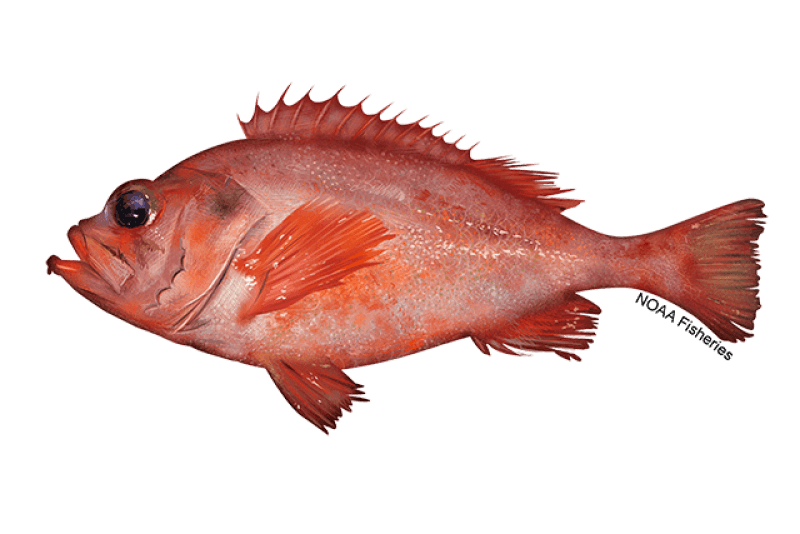
Acadian redfish are orange to flame red, with paler underbellies.
They have a flattened body that is longer than it is deep.
They have large eyes and a large mouth lined with many small teeth.
They have one continuous dorsal fin that runs from the nape of their neck to their caudal peduncle (where the body meets the tail) and a small tail fin.
Young redfish are marked with patches of black and green pigment.
They don’t develop their red pigment until after they move to the ocean bottom.
Appearance
Acadian redfish are slow-growing, long-lived fish.
Redfish can grow up to 18 to 20 inches long and live 50 years or more.
They mature at a late age (5 to 6 years) and have low reproductive rates.
They mate in late autumn and early winter.
Redfish give birth to live young (an unusual feature for fish), and fertilization, incubation, and hatching of eggs all occur within the female’s body.
Eggs are not fertilized until spring and then incubate for 45 to 60 days.
Females release their hatched larvae from late spring through July and August.
Females generally produce between 15,000 and 20,000 larvae per spawning cycle.
Newly hatched redfish can swim well at birth and are soon able to forage for plankton (tiny floating plants and animals).
Their survival rate is relatively high compared with that of egg-laying fish.
Young redfish stay in the upper waters feeding on small crustaceans until they are about 2 inches long.
In the fall, the young settle to the ocean bottom.
Older redfish feed on larger invertebrates and small fish.
Where They Live Range Acadian redfish are found in the Atlantic Ocean from the coast of Norway to Georges Bank.
Habitat Acadian redfish are found over rocky, mud, or clay ocean bottoms.
Off New England they are most common in the deep waters of the Gulf of Maine (to depths of 975 feet).
They tend to move off the bottom at night to feed and move closer to shore in the winter.
Fishery Management We manage a single stock of Acadian redfish in U.S. waters.
NOAA Fisheries and the New England Fishery Management Council manage the fishery.
Redfish, along with other groundfish in New England waters, are managed under the Northeast Multispecies Fishery Management Plan , which includes: Permitting requirements for commercial vessels.
Separate management measures for recreational vessels.
Time/Area Closures to protect spawning fish and habitat.
Minimum fish sizes to prevent harvest of juvenile fish.
Annual catch limits, based on best available science.
An optional sector ( catch share ) program can be used for cod and other groundfish species.
The sector program allows fishermen to form harvesting cooperatives and work together to decide when, where, and how they harvest fish.
Harvest Commercial fishery: In 2024, commercial landings of Acadian redfish totaled 13 million pounds and were valued at $8 million, according to the NOAA Fisheries commercial fishing landings database .
NOAA Fisheries has been working with fishermen to increase opportunities to harvest redfish.
Gear types, habitat impacts, and bycatch: Redfish are most commonly harvested using trawl nets, although they are sometimes also caught using gillnets, bottom longline, and rod and reel.
Area closures and gear restrictions reduce habitat impacts from trawl nets.
Fishermen follow management measures to designed to reduce interactions with marine mammals, including gear modifications, seasonal closures, and use of marine mammal deterrents.
Recreational fishery: Acadian redfish are not a common target of anglers but may be encountered when targeting other groundfish species like cod and haddock.
Regulations are limited to a minimum fish size in federal waters.
Scientific Classification Kingdom Animalia Phylum Chordata Class Actinopterygii Order Scorpaeniformes Family Scorpaenidae Genus Sebastes Species fasciatus Last updated by NOAA Fisheries on 06/25/2026
Biology
Acadian redfish are found in the Atlantic Ocean from the coast of Norway to Georges Bank.
Habitat Acadian redfish are found over rocky, mud, or clay ocean bottoms.
Off New England they are most common in the deep waters of the Gulf of Maine (to depths of 975 feet).
They tend to move off the bottom at night to feed and move closer to shore in the winter.
Fishery Management We manage a single stock of Acadian redfish in U.S. waters.
NOAA Fisheries and the New England Fishery Management Council manage the fishery.
Redfish, along with other groundfish in New England waters, are managed under the Northeast Multispecies Fishery Management Plan , which includes: Permitting requirements for commercial vessels.
Separate management measures for recreational vessels.
Time/Area Closures to protect spawning fish and habitat.
Minimum fish sizes to prevent harvest of juvenile fish.
Annual catch limits, based on best available science.
An optional sector ( catch share ) program can be used for cod and other groundfish species.
The sector program allows fishermen to form harvesting cooperatives and work together to decide when, where, and how they harvest fish.
Harvest Commercial fishery: In 2024, commercial landings of Acadian redfish totaled 13 million pounds and were valued at $8 million, according to the NOAA Fisheries commercial fishing landings database .
NOAA Fisheries has been working with fishermen to increase opportunities to harvest redfish.
Gear types, habitat impacts, and bycatch: Redfish are most commonly harvested using trawl nets, although they are sometimes also caught using gillnets, bottom longline, and rod and reel.
Area closures and gear restrictions reduce habitat impacts from trawl nets.
Fishermen follow management measures to designed to reduce interactions with marine mammals, including gear modifications, seasonal closures, and use of marine mammal deterrents.
Recreational fishery: Acadian redfish are not a common target of anglers but may be encountered when targeting other groundfish species like cod and haddock.
Regulations are limited to a minimum fish size in federal waters.
Scientific Classification Kingdom Animalia Phylum Chordata Class Actinopterygii Order Scorpaeniformes Family Scorpaenidae Genus Sebastes Species fasciatus Last updated by NOAA Fisheries on 06/25/2026
Where they live
Range
Acadian redfish are found in the Atlantic Ocean from the coast of Norway to Georges Bank.
Habitat Acadian redfish are found over rocky, mud, or clay ocean bottoms.
Habitat
We manage a single stock of Acadian redfish in U.S. waters.
NOAA Fisheries and the New England Fishery Management Council manage the fishery.
Redfish, along with other groundfish in New England waters, are managed under the Northeast Multispecies Fishery Management Plan , which includes: Permitting requirements for commercial vessels.
Separate management measures for recreational vessels.
Time/Area Closures to protect spawning fish and habitat.
Minimum fish sizes to prevent harvest of juvenile fish.
Annual catch limits, based on best available science.
An optional sector ( catch share ) program can be used for cod and other groundfish species.
The sector program allows fishermen to form harvesting cooperatives and work together to decide when, where, and how they harvest fish.
Harvest Commercial fishery: In 2024, commercial landings of Acadian redfish totaled 13 million pounds and were valued at $8 million, according to the NOAA Fisheries commercial fishing landings database .
NOAA Fisheries has been working with fishermen to increase opportunities to harvest redfish.
Gear types, habitat impacts, and bycatch: Redfish are most commonly harvested using trawl nets, although they are sometimes also caught using gillnets, bottom longline, and rod and reel.
Area closures and gear restrictions reduce habitat impacts from trawl nets.
Fishermen follow management measures to designed to reduce interactions with marine mammals, including gear modifications, seasonal closures, and use of marine mammal deterrents.
Recreational fishery: Acadian redfish are not a common target of anglers but may be encountered when targeting other groundfish species like cod and haddock.
Regulations are limited to a minimum fish size in federal waters.
Scientific Classification Kingdom Animalia Phylum Chordata Class Actinopterygii Order Scorpaeniformes Family Scorpaenidae Genus Sebastes Species fasciatus Last updated by NOAA Fisheries on 06/25/2026
Ocean City & Mid-Atlantic context
From Ocean City, Maryland, use this Acadian Redfish profile as NOAA Mid-Atlantic directory context—not a promise you will meet the species on every charter.
Always verify current Maryland and federal size, season, and bag rules for your exact date and coordinates before you keep any catch.
Source facts and imagery are adapted from the NOAA Fisheries species profile for Acadian Redfish.
What charter to book from Ocean City
Acadian Redfish may appear on Ocean City trips depending on season and habitat—use the NOAA biology below and book the charter archetype that matches how you will actually fish.
Possible / related
Bay guide — Possible overlap depending on season, water, and boat program.
Inshore charter — Possible overlap depending on season, water, and boat program.
Commercial fishery: In 2024, commercial landings of Acadian redfish totaled 13 million pounds and were valued at $8 million, according to the NOAA Fisheries commercial fishing landings database .
NOAA Fisheries has been working with fishermen to increase opportunities to harvest redfish.
Gear types, habitat impacts, and bycatch: Redfish are most commonly harvested using trawl nets, although they are sometimes also caught using gillnets, bottom longline, and rod and reel.
Area closures and gear restrictions reduce habitat impacts from trawl nets.
Fishermen follow management measures to designed to reduce interactions with marine mammals, including gear modifications, seasonal closures, and use of marine mammal deterrents.
Recreational fishery: Acadian redfish are not a common target of anglers but may be encountered when targeting other groundfish species like cod and haddock.
Regulations are limited to a minimum fish size in federal waters.
Scientific Classification Kingdom Animalia Phylum Chordata Class Actinopterygii Order Scorpaeniformes Family Scorpaenidae Genus Sebastes Species fasciatus Last updated by NOAA Fisheries on 06/25/2026
Harvest
See the NOAA wild-caught fishery section for landings and gear notes when published for this species.
Landings and management details matter most for the waters where Acadian Redfish is actually fished—see the
NOAA species profile
.
Seafood facts
Fact
Detail
Sustainability
U.S. wild-caught Acadian redfish is a smart seafood choice because it is sustainably managed and responsibly harvested under U.S. regulations.
Availability
Year-round.
Source
U.S. wild-caught from Maine to New York.
Taste
Mild and slightly sweet. Redfish can be used as a substitute for haddock and similar fish.
Texture
Medium firm, moist, and flaky.
Color
White.
Health
Redfish is low in saturated fat. It’s a good source of niacin, vitamins B6 and B12, calcium, protein, phosphorus, and selenium.
After a real OC boat day or market stop for Acadian Redfish, Seafood after boat days covers
dock buffer and cook-your-catch pacing.