American Lobster
Homarus americanus , also known as Lobster. The American Lobster fishery occurs from Maine to Cape Hatteras, North Carolina. There are seven Lobster Conservation Management Areas (Areas), which are labeled as Area 1, Area 2,
Not in our directory yet? Browse the committed Charter Boat Directory listings grid (marketplace crosswalk).
Source: Species facts, status language, and imagery adapted from the NOAA Fisheries species profile (last updated 06/26/2026). Ocean City charter and Maryland record notes are editorial orientation for OCEANCITY.MD readers. Always confirm current seasons, sizes, and bag limits before you fish—rules change.
Quick facts
- Region: New England/Mid-Atlantic
- Category: Invertebrate · Mid-Atlantic
- Maryland likelihood: 3★ out of 5
About the species
The American Lobster fishery occurs from Maine to Cape Hatteras, North Carolina. There are seven Lobster Conservation Management Areas (Areas), which are labeled as Area 1, Area 2, Area 3, Area 4, Area 5, Area 6, and Outer Cape Cod Area. The American lobster resource and fishery are cooperatively managed by the states and the NOAA Fisheries under the framework of the Atlantic States Marine Fisheries Commission. The lobster fishery predominantly uses pots and traps, but other gear may include gillnets, trawls, and by hand by divers. The market for lobster is for human consumption and is primarily sold live or frozen. U.S. wild-caught American lobster is a smart seafood choice because it is sustainably managed and responsibly harvested under U.S. regulations. Implementing regulations are found at 50 CFR part 697 Subparts A & B.
Maryland record catch
Confirm whether Maryland DNR publishes an Atlantic state-record category for American Lobster on the current sport-fish record board.
Verify on Maryland DNR — Sport Fish State Records . Record boards change when DNR accepts a new fish.
Maryland size & bag limits
Maryland’s Atlantic recreational seasons/sizes/creel summary does not publish a dedicated line for American Lobster. Verify COMAR, DNR public notices, and federal rules for your exact waters before you keep fish.
| Rule | Maryland / applicable detail |
|---|---|
| Maryland minimum size | Not listed — no dedicated American Lobster line on the MD Atlantic recreational table |
| Maryland daily creel (bag) | Not listed — no MD species-specific bag for American Lobster |
| Maryland open season | Not listed on the MD Atlantic Ocean / Coastal Bays summary table |
| Verify | Check DNR eRegulations, COMAR, and NOAA for your date and coordinates before you keep fish. |
Editorial only — verify before you keep a fish. Confirm current seasons, sizes, and creel on Maryland eRegulations — Atlantic seasons, sizes & limits . Rules change; this page is orientation, not the legal digest. Also see verify regulations.
Population & fishing rate
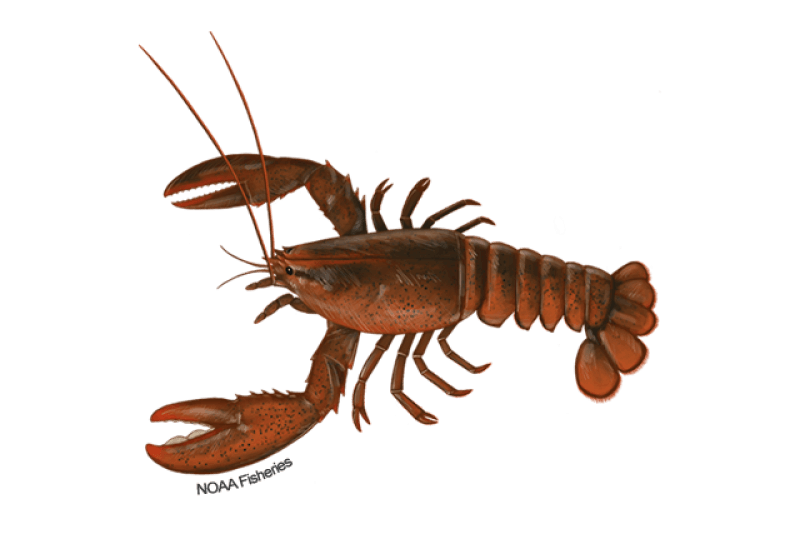
American lobster is a crustacean with a large shrimp-like body and 10 legs, two of which are large, strong claws.
One claw is a big-toothed crusher claw for pulverizing shells, and the other is a finer-edged ripper claw, resembling a steak knife, for tearing soft flesh.
Male and female lobsters (PDF, 1 page) can be distinguished by the first pair of swimmerets (pleopods) on the upper portion of the underside of the tail.
The male swimmerets are larger and more rigid.
The female swimmerets are softer, smaller, and have rounded edges.
Live lobsters are not red like those you see in a restaurant or grocery store, after they have been cooked.
Appearance
- American lobsters have a long life span.
- It’s difficult to determine their exact age because they shed their hard shell when they molt, leaving no evidence of age.
- But scientists believe some American lobsters may live to be 100 years old.
- They can weigh up to 44 pounds.
- Lobsters must periodically molt in order to grow, shedding their hard, external skeleton (shell) when they grow too large for it and forming a new one.
- They eat voraciously after they molt, often devouring their own recently vacated shells.
- Eating their shell replenishes lost calcium and helps harden their new shell.
- Lobsters molt about 20 to 25 times over a period of 5 to 8 years between the time they hatch and when they are able to reproduce and reach the minimum legal size to be harvested.
- Usually, lobsters mate after the females molt.
- Males deposit sperm in the soft-shelled females.
- The female stores the sperm internally for up to a year.
- Females can have 5,000 to more than 100,000 eggs, depending on their size.
- The eggs are fertilized as females release them on the underside of their tails, where they carry the eggs for 9 to 11 months.
- Egg-bearing females move inshore to hatch their eggs during late spring or early summer.
- The pelagic (free-swimming) larvae molt four times before they resemble adults and settle to the bottom.
- Lobsters are opportunistic feeders, feeding on whatever prey is most available, so their diet varies regionally.
- Larvae and postlarvae are carnivorous and eat zooplankton (tiny floating animals) during their first year.
- Adults are omnivorous, feeding on crabs, mollusks, worms, sea urchins, sea stars, fish, and macroalgae.
- In general, a variety of bottom-dwelling species feed on lobster, including fish, sharks, rays, skates, octopuses, and crabs.
- Young lobsters are especially vulnerable to predators.
- Large, hard-shelled lobsters may be immune to predators (except humans).
- Where They Live Range American lobsters are found in the northwest Atlantic Ocean from Labrador to Cape Hatteras.
- They’re most abundant in coastal waters from Maine through New Jersey, and are also common offshore to depths of 2,300 feet from Maine through North Carolina.
- Habitat American lobsters live on the ocean floor.
- They live alone and are very territorial.
- They can live in a variety of habitats as long as there is a burrow or crevice for cover.
- Coastal lobsters like rocky areas where they can readily find shelter, although they’re sometimes found in mud bottoms where they can burrow.
- Offshore populations are most abundant along the edge of the continental shelf near underwater canyons.
- Near the coast, small lobsters do not travel much, but larger ones may travel extensively.
- Offshore lobsters migrate during the spring anywhere from 50 to 190 miles.
- Scientists, managers, and fishermen are concerned about the habitat conditions for American lobster in inshore Southern New England waters, particularly in Long Island Sound.
- Scientists believe that a combination of warmer water temperatures, hypoxia (low dissolved oxygen levels), and other stress factors resulted in lobster die-offs in western Long Island Sound in late 1999 and in 2002.
- If these conditions continue, future die-offs are possible.
- Researchers also believe that increased water temperatures in Southern New England may be driving lobsters to cooler offshore waters and disrupting the settlement of larvae in traditional coastal areas.
- Fishery Management The states and NOAA Fisheries cooperatively manage the American lobster resource and fishery under the framework of the Atlantic States Marine Fisheries Commission (ASMFC).
- Each lobster harvesting state has three members on the ASMFC lobster management board, and NOAA Fisheries has one representative on the board.
- Each state, and NOAA Fisheries, has one vote when deliberating management measures for American lobster.
- The management board looks to industry advisors to provide recommendations for managing the fishery to meet management objectives.
- States have jurisdiction for implementing measures in state waters (within 3 nautical miles of shore), while NOAA Fisheries implements complementary regulations for the American lobster fishery in offshore federal waters (3 to 200 nautical miles from shore).
- The American lobster’s range is divided into two stock areas and seven management areas .
- There are seven Lobster Conservation Management Teams, one for each management area.
- These teams, made up of industry representatives, recommend measures to address the specific needs in their respective management areas.
- Federal waters contain portions of six of the seven management areas.
- Only Area 6 is totally within state waters (Long Island Sound, which consists of New York and Connecticut state waters).
- Managed in state waters (within 3 nautical miles of shore) under the Interstate Fishery Management Plan for American Lobster .
- Each management area has unique regulations that include: Limits on the minimum and maximum size of lobster than can be harvested.
- Trap limits control fishing effort.
- Each lobster vessel is limited to either a vessel-based trap allocation based on its historical fishing practices, or an area-wide trap cap (the maximum number of traps a vessel may fish in a specific area).
- Measures to protect egg-bearing females—fishermen may not harvest them and, in most areas, if one is caught in their trap, they must notch its tail fin in a “v” shape before returning it to the water.
- Prohibition on possession of lobster meat and lobster parts (lobsters must be landed live and whole to ensure they are of legal size).
- Gear restrictions, trap configuration requirements, and prohibition on using spears to fish for lobsters.
- Restrictions on the amount of lobster that can be harvested with non-trap gear.
- Monitoring and reporting requirements.
- A trap transfer program was initiated in 2015 in a subset of the management areas that allows Federal permit holders to purchase partial trap allocation from other authorized permit holders.
- Others may sell allocation to other Federal lobster permit holders to downsize their own fishing operations and allow other permit holders to gain access to the trap fishery in certain management areas.
- Managed in federal waters (3 to 200 nautical miles offshore) under regulations implemented through the Atlantic Coastal Fisheries Cooperative Management Act , including: Fishermen must have a permit to harvest lobster.
- A temporary moratorium on the issuance of federal lobster permits, which limits the amount of available permits to control the number of fishermen harvesting lobster, was extended indefinitely in 1999.
- Limits on the minimum and maximum size of lobsters that can be harvested, which varies by management area.
- Prohibition on possession of lobster meat and lobster parts (lobsters must be landed live and whole to ensure they are of legal size).
- Measures to protect egg-bearing females—fishermen may not harvest them and, in most areas, if one is caught in their trap, they must notch its tail fin in a “v” shape before returning it to the water.
- Gear restrictions (trap size, gear marking requirements, escape vents, and ghost panels).
- Trap limits, which vary among management areas.
- To improve data collection in the fishery, all federal lobster dealers must submit weekly electronic reports for all lobsters they purchase from fishermen with federal permits.
- Federal lobster permit holders are not required to report landings unless they have another Federal fishery permit, in addition to their Federal lobster permit, that requires landings reports (e.g., Northeast multispecies permit).
- Area-specific measures have been approved to reduce fishing exploitation on the Southern New England stock, including biological and effort control management measures.
- Regulations require biodegradable escape panels or hinges on traps to prevent ghost fishing (when lost gear continues to capture lobster and other species).
- Escape panels must be large enough to reduce bycatch of undersized lobsters. Fisheries and Oceans Canada manages the American lobster resource in Canadian territorial waters of the northwest Atlantic Ocean.
- Harvest Commercial fishery: In 2024, commercial landings of American lobster totaled 113 million pounds and were valued at $720 million, according to the NOAA Fisheries commercial fishing landings database .
- The two stocks of American lobster—Gulf of Maine and Georges Bank, and Southern New England—support both inshore and offshore fisheries.
- The Gulf of Maine and Southern New England areas are predominantly inshore fisheries, while the Georges Bank area is predominantly an offshore fishery.
- Most U.S. harvest is caught in inshore waters.
- There’s a reason we associate Maine with lobsters—the state has led American lobster landings for over 3 decades.
- Massachusetts is the second leading producer.
- Together, these two states produce 93 percent of the total U.S.
- American lobster harvest, and 93 percent of the coast-wide landings come from the Gulf of Maine lobster stock.
- Gear types, habitat impacts, and bycatch: Most fishermen use traps to harvest lobster.
- They bait rectangular, wire-mesh traps then lower them to the ocean floor in water 15 to 1,000 feet deep.
- A buoy that marks the trap’s location is attached to the trap line.
- Fishermen haul the traps back to the surface every few days to check their catch, although the frequency varies depending on the season and the location.
- The Northeast/Mid-Atlantic American lobster trap/pot fishery can incidentally entangle large whales.
- To reduce injuries and deaths of large whales due to fisheries interactions, the Atlantic Large Whale Take Reduction Plan was implemented in 1997.
- The plan continues to evolve as we learn more about why whales become entangled and how fishing practices might be modified to reduce the risk of entanglement.
- Lobstermen must follow a number of regulations to protect large whales from fishing gear.
- For example, lobstermen must use sinking groundlines between traps to reduce the amount of line in the water column, which reduces the potential for whales and other protected species to become entangled.
- In addition, lobster permit holders are required to haul their active traps at least once every 30 days.
- Learn more about these and other actions in the North Atlantic Right Whale Road to Recovery , NOAA Fisheries' multi-pronged approach to address threats and monitor progress.
- Traps can incidentally catch finfish and invertebrates (such as crabs and conch).
- Regulations require traps to be configured with biodegradable escape panels or hinges on traps to prevent ghost fishing (lost gear that continues to capture lobster and other species and may pose a hazard to other marine species).
- Escape panels must be large enough to reduce bycatch of undersized lobsters.
- Recreational fishery: Recreational fishermen catch lobsters in coastal waters with pots and by hand while scuba diving.
- Recreational fishermen with a federal lobster permit may harvest lobster in federal waters, but the lobster cannot be sold.
- Scientific Classification Kingdom Animalia Phylum Arthropoda Class Malacostraca Order Decapoda Family Nephropidae Genus Homarus Species americanus Last updated by NOAA Fisheries on 06/26/2026
Biology
- American lobsters are found in the northwest Atlantic Ocean from Labrador to Cape Hatteras.
- They’re most abundant in coastal waters from Maine through New Jersey, and are also common offshore to depths of 2,300 feet from Maine through North Carolina.
- Habitat American lobsters live on the ocean floor.
- They live alone and are very territorial.
- They can live in a variety of habitats as long as there is a burrow or crevice for cover.
- Coastal lobsters like rocky areas where they can readily find shelter, although they’re sometimes found in mud bottoms where they can burrow.
- Offshore populations are most abundant along the edge of the continental shelf near underwater canyons.
- Near the coast, small lobsters do not travel much, but larger ones may travel extensively.
- Offshore lobsters migrate during the spring anywhere from 50 to 190 miles.
- Scientists, managers, and fishermen are concerned about the habitat conditions for American lobster in inshore Southern New England waters, particularly in Long Island Sound.
- Scientists believe that a combination of warmer water temperatures, hypoxia (low dissolved oxygen levels), and other stress factors resulted in lobster die-offs in western Long Island Sound in late 1999 and in 2002.
- If these conditions continue, future die-offs are possible.
- Researchers also believe that increased water temperatures in Southern New England may be driving lobsters to cooler offshore waters and disrupting the settlement of larvae in traditional coastal areas.
- Fishery Management The states and NOAA Fisheries cooperatively manage the American lobster resource and fishery under the framework of the Atlantic States Marine Fisheries Commission (ASMFC).
- Each lobster harvesting state has three members on the ASMFC lobster management board, and NOAA Fisheries has one representative on the board.
- Each state, and NOAA Fisheries, has one vote when deliberating management measures for American lobster.
- The management board looks to industry advisors to provide recommendations for managing the fishery to meet management objectives.
- States have jurisdiction for implementing measures in state waters (within 3 nautical miles of shore), while NOAA Fisheries implements complementary regulations for the American lobster fishery in offshore federal waters (3 to 200 nautical miles from shore).
- The American lobster’s range is divided into two stock areas and seven management areas .
- There are seven Lobster Conservation Management Teams, one for each management area.
- These teams, made up of industry representatives, recommend measures to address the specific needs in their respective management areas.
- Federal waters contain portions of six of the seven management areas.
- Only Area 6 is totally within state waters (Long Island Sound, which consists of New York and Connecticut state waters).
- Managed in state waters (within 3 nautical miles of shore) under the Interstate Fishery Management Plan for American Lobster .
- Each management area has unique regulations that include: Limits on the minimum and maximum size of lobster than can be harvested.
- Trap limits control fishing effort.
- Each lobster vessel is limited to either a vessel-based trap allocation based on its historical fishing practices, or an area-wide trap cap (the maximum number of traps a vessel may fish in a specific area).
- Measures to protect egg-bearing females—fishermen may not harvest them and, in most areas, if one is caught in their trap, they must notch its tail fin in a “v” shape before returning it to the water.
- Prohibition on possession of lobster meat and lobster parts (lobsters must be landed live and whole to ensure they are of legal size).
- Gear restrictions, trap configuration requirements, and prohibition on using spears to fish for lobsters.
- Restrictions on the amount of lobster that can be harvested with non-trap gear.
- Monitoring and reporting requirements.
- A trap transfer program was initiated in 2015 in a subset of the management areas that allows Federal permit holders to purchase partial trap allocation from other authorized permit holders.
- Others may sell allocation to other Federal lobster permit holders to downsize their own fishing operations and allow other permit holders to gain access to the trap fishery in certain management areas.
- Managed in federal waters (3 to 200 nautical miles offshore) under regulations implemented through the Atlantic Coastal Fisheries Cooperative Management Act , including: Fishermen must have a permit to harvest lobster.
- A temporary moratorium on the issuance of federal lobster permits, which limits the amount of available permits to control the number of fishermen harvesting lobster, was extended indefinitely in 1999.
- Limits on the minimum and maximum size of lobsters that can be harvested, which varies by management area.
- Prohibition on possession of lobster meat and lobster parts (lobsters must be landed live and whole to ensure they are of legal size).
- Measures to protect egg-bearing females—fishermen may not harvest them and, in most areas, if one is caught in their trap, they must notch its tail fin in a “v” shape before returning it to the water.
- Gear restrictions (trap size, gear marking requirements, escape vents, and ghost panels).
- Trap limits, which vary among management areas.
- To improve data collection in the fishery, all federal lobster dealers must submit weekly electronic reports for all lobsters they purchase from fishermen with federal permits.
- Federal lobster permit holders are not required to report landings unless they have another Federal fishery permit, in addition to their Federal lobster permit, that requires landings reports (e.g., Northeast multispecies permit).
- Area-specific measures have been approved to reduce fishing exploitation on the Southern New England stock, including biological and effort control management measures.
- Regulations require biodegradable escape panels or hinges on traps to prevent ghost fishing (when lost gear continues to capture lobster and other species).
- Escape panels must be large enough to reduce bycatch of undersized lobsters. Fisheries and Oceans Canada manages the American lobster resource in Canadian territorial waters of the northwest Atlantic Ocean.
- Harvest Commercial fishery: In 2024, commercial landings of American lobster totaled 113 million pounds and were valued at $720 million, according to the NOAA Fisheries commercial fishing landings database .
- The two stocks of American lobster—Gulf of Maine and Georges Bank, and Southern New England—support both inshore and offshore fisheries.
- The Gulf of Maine and Southern New England areas are predominantly inshore fisheries, while the Georges Bank area is predominantly an offshore fishery.
- Most U.S. harvest is caught in inshore waters.
- There’s a reason we associate Maine with lobsters—the state has led American lobster landings for over 3 decades.
- Massachusetts is the second leading producer.
- Together, these two states produce 93 percent of the total U.S.
- American lobster harvest, and 93 percent of the coast-wide landings come from the Gulf of Maine lobster stock.
- Gear types, habitat impacts, and bycatch: Most fishermen use traps to harvest lobster.
- They bait rectangular, wire-mesh traps then lower them to the ocean floor in water 15 to 1,000 feet deep.
- A buoy that marks the trap’s location is attached to the trap line.
- Fishermen haul the traps back to the surface every few days to check their catch, although the frequency varies depending on the season and the location.
- The Northeast/Mid-Atlantic American lobster trap/pot fishery can incidentally entangle large whales.
- To reduce injuries and deaths of large whales due to fisheries interactions, the Atlantic Large Whale Take Reduction Plan was implemented in 1997.
- The plan continues to evolve as we learn more about why whales become entangled and how fishing practices might be modified to reduce the risk of entanglement.
- Lobstermen must follow a number of regulations to protect large whales from fishing gear.
- For example, lobstermen must use sinking groundlines between traps to reduce the amount of line in the water column, which reduces the potential for whales and other protected species to become entangled.
- In addition, lobster permit holders are required to haul their active traps at least once every 30 days.
- Learn more about these and other actions in the North Atlantic Right Whale Road to Recovery , NOAA Fisheries' multi-pronged approach to address threats and monitor progress.
- Traps can incidentally catch finfish and invertebrates (such as crabs and conch).
- Regulations require traps to be configured with biodegradable escape panels or hinges on traps to prevent ghost fishing (lost gear that continues to capture lobster and other species and may pose a hazard to other marine species).
- Escape panels must be large enough to reduce bycatch of undersized lobsters.
- Recreational fishery: Recreational fishermen catch lobsters in coastal waters with pots and by hand while scuba diving.
- Recreational fishermen with a federal lobster permit may harvest lobster in federal waters, but the lobster cannot be sold.
- Scientific Classification Kingdom Animalia Phylum Arthropoda Class Malacostraca Order Decapoda Family Nephropidae Genus Homarus Species americanus Last updated by NOAA Fisheries on 06/26/2026
Where they live
Range
- American lobsters are found in the northwest Atlantic Ocean from Labrador to Cape Hatteras.
- They’re most abundant in coastal waters from Maine through New Jersey, and are also common offshore to depths of 2,300 feet from Maine through North Carolina.
Habitat
- The states and NOAA Fisheries cooperatively manage the American lobster resource and fishery under the framework of the Atlantic States Marine Fisheries Commission (ASMFC).
- Each lobster harvesting state has three members on the ASMFC lobster management board, and NOAA Fisheries has one representative on the board.
- Each state, and NOAA Fisheries, has one vote when deliberating management measures for American lobster.
- The management board looks to industry advisors to provide recommendations for managing the fishery to meet management objectives.
- States have jurisdiction for implementing measures in state waters (within 3 nautical miles of shore), while NOAA Fisheries implements complementary regulations for the American lobster fishery in offshore federal waters (3 to 200 nautical miles from shore).
- The American lobster’s range is divided into two stock areas and seven management areas .
- There are seven Lobster Conservation Management Teams, one for each management area.
- These teams, made up of industry representatives, recommend measures to address the specific needs in their respective management areas.
- Federal waters contain portions of six of the seven management areas.
- Only Area 6 is totally within state waters (Long Island Sound, which consists of New York and Connecticut state waters).
- Managed in state waters (within 3 nautical miles of shore) under the Interstate Fishery Management Plan for American Lobster .
- Each management area has unique regulations that include: Limits on the minimum and maximum size of lobster than can be harvested.
- Trap limits control fishing effort.
- Each lobster vessel is limited to either a vessel-based trap allocation based on its historical fishing practices, or an area-wide trap cap (the maximum number of traps a vessel may fish in a specific area).
- Measures to protect egg-bearing females—fishermen may not harvest them and, in most areas, if one is caught in their trap, they must notch its tail fin in a “v” shape before returning it to the water.
- Prohibition on possession of lobster meat and lobster parts (lobsters must be landed live and whole to ensure they are of legal size).
- Gear restrictions, trap configuration requirements, and prohibition on using spears to fish for lobsters.
- Restrictions on the amount of lobster that can be harvested with non-trap gear.
- Monitoring and reporting requirements.
- A trap transfer program was initiated in 2015 in a subset of the management areas that allows Federal permit holders to purchase partial trap allocation from other authorized permit holders.
- Others may sell allocation to other Federal lobster permit holders to downsize their own fishing operations and allow other permit holders to gain access to the trap fishery in certain management areas.
- Managed in federal waters (3 to 200 nautical miles offshore) under regulations implemented through the Atlantic Coastal Fisheries Cooperative Management Act , including: Fishermen must have a permit to harvest lobster.
- A temporary moratorium on the issuance of federal lobster permits, which limits the amount of available permits to control the number of fishermen harvesting lobster, was extended indefinitely in 1999.
- Limits on the minimum and maximum size of lobsters that can be harvested, which varies by management area.
- Prohibition on possession of lobster meat and lobster parts (lobsters must be landed live and whole to ensure they are of legal size).
- Measures to protect egg-bearing females—fishermen may not harvest them and, in most areas, if one is caught in their trap, they must notch its tail fin in a “v” shape before returning it to the water.
- Gear restrictions (trap size, gear marking requirements, escape vents, and ghost panels).
- Trap limits, which vary among management areas.
- To improve data collection in the fishery, all federal lobster dealers must submit weekly electronic reports for all lobsters they purchase from fishermen with federal permits.
- Federal lobster permit holders are not required to report landings unless they have another Federal fishery permit, in addition to their Federal lobster permit, that requires landings reports (e.g., Northeast multispecies permit).
- Area-specific measures have been approved to reduce fishing exploitation on the Southern New England stock, including biological and effort control management measures.
- Regulations require biodegradable escape panels or hinges on traps to prevent ghost fishing (when lost gear continues to capture lobster and other species).
- Escape panels must be large enough to reduce bycatch of undersized lobsters. Fisheries and Oceans Canada manages the American lobster resource in Canadian territorial waters of the northwest Atlantic Ocean.
- Harvest Commercial fishery: In 2024, commercial landings of American lobster totaled 113 million pounds and were valued at $720 million, according to the NOAA Fisheries commercial fishing landings database .
- The two stocks of American lobster—Gulf of Maine and Georges Bank, and Southern New England—support both inshore and offshore fisheries.
- The Gulf of Maine and Southern New England areas are predominantly inshore fisheries, while the Georges Bank area is predominantly an offshore fishery.
- Most U.S. harvest is caught in inshore waters.
- There’s a reason we associate Maine with lobsters—the state has led American lobster landings for over 3 decades.
- Massachusetts is the second leading producer.
- Together, these two states produce 93 percent of the total U.S.
- American lobster harvest, and 93 percent of the coast-wide landings come from the Gulf of Maine lobster stock.
- Gear types, habitat impacts, and bycatch: Most fishermen use traps to harvest lobster.
- They bait rectangular, wire-mesh traps then lower them to the ocean floor in water 15 to 1,000 feet deep.
- A buoy that marks the trap’s location is attached to the trap line.
- Fishermen haul the traps back to the surface every few days to check their catch, although the frequency varies depending on the season and the location.
- The Northeast/Mid-Atlantic American lobster trap/pot fishery can incidentally entangle large whales.
- To reduce injuries and deaths of large whales due to fisheries interactions, the Atlantic Large Whale Take Reduction Plan was implemented in 1997.
- The plan continues to evolve as we learn more about why whales become entangled and how fishing practices might be modified to reduce the risk of entanglement.
- Lobstermen must follow a number of regulations to protect large whales from fishing gear.
- For example, lobstermen must use sinking groundlines between traps to reduce the amount of line in the water column, which reduces the potential for whales and other protected species to become entangled.
- In addition, lobster permit holders are required to haul their active traps at least once every 30 days.
- Learn more about these and other actions in the North Atlantic Right Whale Road to Recovery , NOAA Fisheries' multi-pronged approach to address threats and monitor progress.
- Traps can incidentally catch finfish and invertebrates (such as crabs and conch).
- Regulations require traps to be configured with biodegradable escape panels or hinges on traps to prevent ghost fishing (lost gear that continues to capture lobster and other species and may pose a hazard to other marine species).
- Escape panels must be large enough to reduce bycatch of undersized lobsters.
- Recreational fishery: Recreational fishermen catch lobsters in coastal waters with pots and by hand while scuba diving.
- Recreational fishermen with a federal lobster permit may harvest lobster in federal waters, but the lobster cannot be sold.
- Scientific Classification Kingdom Animalia Phylum Arthropoda Class Malacostraca Order Decapoda Family Nephropidae Genus Homarus Species americanus Last updated by NOAA Fisheries on 06/26/2026
Ocean City & Mid-Atlantic context
From Ocean City, Maryland, use this American Lobster profile as NOAA Mid-Atlantic directory context—not a promise you will meet the species on every charter.
Always verify current Maryland and federal size, season, and bag rules for your exact date and coordinates before you keep any catch.
Source facts and imagery are adapted from the NOAA Fisheries species profile for American Lobster.
What charter to book from Ocean City
American Lobster is more of a bay, inshore, or specialty harvest story than a typical OC six-pack trolling day—match the trip type to the animal.
Possible / related
- Bay guide — Possible overlap depending on season, water, and boat program.
- Inshore charter — Possible overlap depending on season, water, and boat program.
- Nearshore wreck / bottom — Possible overlap depending on season, water, and boat program.
- Head / party boat — Possible overlap depending on season, water, and boat program.
Not typical from OC
- Casting / light tackle — Not a typical Ocean City casting / light tackle target for American Lobster.
- Trolling charter — Not a typical Ocean City trolling charter target for American Lobster.
- Offshore charter — Not a typical Ocean City offshore charter target for American Lobster.
Start with the charter directory trip-type picker so you compare boats inside the right archetype—not a bay-guide quote against a canyon invoice.
Related reading
- Plan a fishing day in Ocean City — Pick the trip archetype before you chase a species story.
- Charter directory stubs & trip-type picker — Compare boats inside the right archetype.
- Verify Maryland fishing regulations — DNR + NOAA steps before you keep any fish from an OC trip.
- Nearshore wreck fishing hub — Structure days from West Ocean City.
- Offshore sport fishing hub — Canyon and bluewater context from Ocean City.
Fishery management
- Commercial fishery: In 2024, commercial landings of American lobster totaled 113 million pounds and were valued at $720 million, according to the NOAA Fisheries commercial fishing landings database .
- The two stocks of American lobster—Gulf of Maine and Georges Bank, and Southern New England—support both inshore and offshore fisheries.
- The Gulf of Maine and Southern New England areas are predominantly inshore fisheries, while the Georges Bank area is predominantly an offshore fishery.
- Most U.S. harvest is caught in inshore waters.
- There’s a reason we associate Maine with lobsters—the state has led American lobster landings for over 3 decades.
- Massachusetts is the second leading producer.
- Together, these two states produce 93 percent of the total U.S.
- American lobster harvest, and 93 percent of the coast-wide landings come from the Gulf of Maine lobster stock.
Harvest
- See the NOAA wild-caught fishery section for landings and gear notes when published for this species.
Landings and management details matter most for the waters where American Lobster is actually fished—see the NOAA species profile .
Seafood facts
| Fact | Detail |
|---|---|
| Sustainability | U.S. wild-caught American lobster is a smart seafood choice because it is sustainably managed and responsibly harvested under U.S. regulations. |
| Availability | Year-round. In New England, where most lobsters are landed, the peak harvest season extends from May to November. |
| Source | U.S. wild-caught from Maine to North Carolina. |
| Taste | Mild and sweet. |
| Texture | The meat is firm and somewhat fibrous. The tail meat is firmer than the meat from the claws. |
| Color | The meat is white with red tinges. |
| Health | Lobster is low in saturated fat and is a very good source of protein and selenium. The FDA advises consumers to not eat the tomalley, the light-green substance found in the lobster. |
After a real OC boat day or market stop for American Lobster, Seafood after boat days covers dock buffer and cook-your-catch pacing.
Scientific classification
| Rank | Name |
|---|---|
| Kingdom | Animalia |
| Phylum | Arthropoda |
| Class | Malacostraca |
| Order | Decapoda |
| Family | Nephropidae |
| Genus | Homarus |
| Species | americanus |
Plan the rest of the trip




Ocean City fishing videos
All Fishing videos FishingBig Stripers, Red Drum & Bluefish — Nonstop Action4.8
 FishingChasin Tail Charters — Offshore Fishing4.7 6.1K views
 FishingParty Boat Fishing on the Angler — Ocean City4.7 17K views
 FishingCobia Fishing Ocean City Charter4.7
FishingOFFSHORE FISHING BIGEYE TUNA AT POORMANS CANYON
4.6FishingQuickDraw Tuna and Marlin July 3 2015
4.6 FishingFlounder Frenzy — Ocean City Blue Crab & Flounder4.6 6.4K views
 FishingParty Boat Fishing For SEA BASS & FLOUNDER aka FLUKE - Angler - Ocean City, MD4.6
FishingLarry Jock — Ocean City Fishing
5.0FishingMoore Bills Tuna Round-Up
5.0FishingWhite Marlin Open 2019 — Moore Bills
5.0FishingWhite Marlin Open — Aug 6
5.0FishingWeekend White Marlin Open Clips
5.0FishingWhite Marlin Open Clips Part 1
5.0