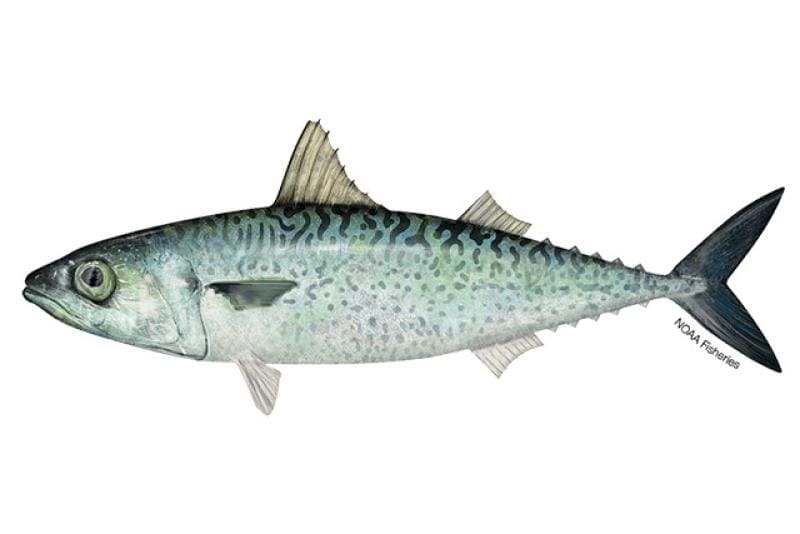
Scomber colias , also known as Mackerel, Chub mackerel, Tinker mackerel. Atlantic chub mackerel are a schooling pelagic species that are found on the continental shelf to depths of about 250 to 300 meters throughout much of the western and eastern Atlan
Source: Species facts, status language, and imagery adapted from the NOAA Fisheries species profile (last updated 06/26/2026). Ocean City charter and Maryland
record notes are editorial orientation for OCEANCITY.MD readers. Always confirm current seasons, sizes, and
bag limits before you fish—rules change.
Atlantic chub mackerel are a schooling pelagic species that are found on the continental shelf to depths of about 250 to 300 meters throughout much of the western and eastern Atlantic Ocean. In the western Atlantic, their range spans from Nova Scotia (where they are rare) through Argentina, including the Gulf of America (formerly Gulf of Mexico).
Migratory patterns in the western North Atlantic are also not well understood. In the northern hemisphere, chub mackerel migrate between northern areas in warmer months and southern areas in cooler months. Adults prefer temperatures of 60 to 70°F. Some studies suggest that juveniles tend to be found closer inshore than adults.
Maryland record catch
Confirm whether Maryland DNR publishes an Atlantic state-record category for Atlantic Chub Mackerel on the current sport-fish record board.
Maryland’s Atlantic recreational seasons/sizes/creel summary does not publish a dedicated line for Atlantic Chub Mackerel. Verify COMAR, DNR public notices, and federal rules for your exact waters before you keep fish.
Rule
Maryland / applicable detail
Maryland minimum size
Not listed — no dedicated Atlantic Chub Mackerel line on the MD Atlantic recreational table
Maryland daily creel (bag)
Not listed — no MD species-specific bag for Atlantic Chub Mackerel
Maryland open season
Not listed on the MD Atlantic Ocean / Coastal Bays summary table
Verify
Check DNR eRegulations, COMAR, and NOAA for your date and coordinates before you keep fish.
Atlantic chub mackerel are elongated and streamlined with deeply forked tails.
They have small spines on the dorsal fin.
They are silvery in color, with greenish-blue backs.
The upper surfaces have dark zigzagging stripes, and the bellies are pale and marked with wavy lines.
Biology Atlantic chub mackerel grow up to 22 inches long and 3.5 pounds.
They have a life span of up to about 7 years.
Appearance
Atlantic chub mackerel grow up to 22 inches long and 3.5 pounds.
They have a life span of up to about 7 years.
They mainly feed on small crustaceans called copepods and tiny aquatic animals known as wheel animals or rotifers.
Where They Live Range Atlantic chub mackerel in the western Atlantic Ocean range from Nova Scotia (where they are rare) through Argentina, including the Gulf of America.
They are a schooling pelagic species that are found on the continental shelf to depths of about 250–300 meters throughout much of the western and eastern Atlantic Ocean.
Habitat Atlantic chub mackerel are a schooling pelagic species.
They are found on the continental shelf to depths of about 250–300 meters throughout much of the western and eastern Atlantic Ocean.
They can be found throughout U.S.
Most Atlantic chub mackerel catches in offshore surveys occur south of the Hudson Shelf Valley in warm waters.
State trawl surveys and recreational catch data suggest that Atlantic chub mackerel are also found in inshore waters.
Fishery Management NOAA Fisheries and the Mid-Atlantic Fishery Management Council manage the Atlantic chub mackerel fishery.
Managed under the Mackerel, Squid, Butterfish Fishery Management Plan : Atlantic chub mackerel was added to the Mackerel, Squid, and Butterfish Fishery Management Plan in 2020.
Atlantic chub mackerel was added to the FMP after a directed commercial fishery developed in federal waters.
Due to that, and other considerations, the Council concluded that this species is in need of specific conservation and management measures of its own.
Atlantic chub mackerel are managed in federal waters.
There are no state management measures for mackerel.
Managed using annual catch limits allocated between the commercial and recreational fisheries.
Managers monitor commercial catch on a weekly basis and will close the fisheries if the limits are reached before the fishing season is over.
Fishermen must have a Mackerel, Squid, and Butterfish permit to harvest Atlantic chub mackerel.
Harvest Commercial Fishery In 2024, commercial landings of Atlantic chub mackerel totaled 89,400 pounds and were valued at $45,000, according to the NOAA Fisheries commercial fishing landings database .
Most commercial vessels fishing for Atlantic chub mackerel are participants in the shortfin squid fishery.
Bottom trawl gear is used to catch Atlantic chub mackerel.
Gear types, habitat impacts, and bycatch: Many habitat areas in the Atlantic chub mackerel fishery have been impacted by fishing activities over many years.
There are gear restricted areas in place for shortfin squid vessels, designed to protect essential fish habitat.
There are mesh size and other restrictions for shortfin squid vessels but no specific gear restrictions for Atlantic chub mackerel.
Recreational fishery: Recreational catch is monitored and included in annual catch levels.
Commercial vessels must possess a charter party permit in order to possess Atlantic chub mackerel.
There are no size or gear limits for the recreational fleet.
Last updated by NOAA Fisheries on 06/26/2026
Biology
Atlantic chub mackerel in the western Atlantic Ocean range from Nova Scotia (where they are rare) through Argentina, including the Gulf of America.
They are a schooling pelagic species that are found on the continental shelf to depths of about 250–300 meters throughout much of the western and eastern Atlantic Ocean.
Habitat Atlantic chub mackerel are a schooling pelagic species.
They are found on the continental shelf to depths of about 250–300 meters throughout much of the western and eastern Atlantic Ocean.
They can be found throughout U.S.
Most Atlantic chub mackerel catches in offshore surveys occur south of the Hudson Shelf Valley in warm waters.
State trawl surveys and recreational catch data suggest that Atlantic chub mackerel are also found in inshore waters.
Fishery Management NOAA Fisheries and the Mid-Atlantic Fishery Management Council manage the Atlantic chub mackerel fishery.
Managed under the Mackerel, Squid, Butterfish Fishery Management Plan : Atlantic chub mackerel was added to the Mackerel, Squid, and Butterfish Fishery Management Plan in 2020.
Atlantic chub mackerel was added to the FMP after a directed commercial fishery developed in federal waters.
Due to that, and other considerations, the Council concluded that this species is in need of specific conservation and management measures of its own.
Atlantic chub mackerel are managed in federal waters.
There are no state management measures for mackerel.
Managed using annual catch limits allocated between the commercial and recreational fisheries.
Managers monitor commercial catch on a weekly basis and will close the fisheries if the limits are reached before the fishing season is over.
Fishermen must have a Mackerel, Squid, and Butterfish permit to harvest Atlantic chub mackerel.
Harvest Commercial Fishery In 2024, commercial landings of Atlantic chub mackerel totaled 89,400 pounds and were valued at $45,000, according to the NOAA Fisheries commercial fishing landings database .
Most commercial vessels fishing for Atlantic chub mackerel are participants in the shortfin squid fishery.
Bottom trawl gear is used to catch Atlantic chub mackerel.
Gear types, habitat impacts, and bycatch: Many habitat areas in the Atlantic chub mackerel fishery have been impacted by fishing activities over many years.
There are gear restricted areas in place for shortfin squid vessels, designed to protect essential fish habitat.
There are mesh size and other restrictions for shortfin squid vessels but no specific gear restrictions for Atlantic chub mackerel.
Recreational fishery: Recreational catch is monitored and included in annual catch levels.
Commercial vessels must possess a charter party permit in order to possess Atlantic chub mackerel.
There are no size or gear limits for the recreational fleet.
Last updated by NOAA Fisheries on 06/26/2026
Where they live
Range
Atlantic chub mackerel in the western Atlantic Ocean range from Nova Scotia (where they are rare) through Argentina, including the Gulf of America.
They are a schooling pelagic species that are found on the continental shelf to depths of about 250–300 meters throughout much of the western and eastern Atlantic Ocean.
Habitat
NOAA Fisheries and the Mid-Atlantic Fishery Management Council manage the Atlantic chub mackerel fishery.
Managed under the Mackerel, Squid, Butterfish Fishery Management Plan : Atlantic chub mackerel was added to the Mackerel, Squid, and Butterfish Fishery Management Plan in 2020.
Atlantic chub mackerel was added to the FMP after a directed commercial fishery developed in federal waters.
Due to that, and other considerations, the Council concluded that this species is in need of specific conservation and management measures of its own.
Atlantic chub mackerel are managed in federal waters.
There are no state management measures for mackerel.
Managed using annual catch limits allocated between the commercial and recreational fisheries.
Managers monitor commercial catch on a weekly basis and will close the fisheries if the limits are reached before the fishing season is over.
Fishermen must have a Mackerel, Squid, and Butterfish permit to harvest Atlantic chub mackerel.
Harvest Commercial Fishery In 2024, commercial landings of Atlantic chub mackerel totaled 89,400 pounds and were valued at $45,000, according to the NOAA Fisheries commercial fishing landings database .
Most commercial vessels fishing for Atlantic chub mackerel are participants in the shortfin squid fishery.
Bottom trawl gear is used to catch Atlantic chub mackerel.
Gear types, habitat impacts, and bycatch: Many habitat areas in the Atlantic chub mackerel fishery have been impacted by fishing activities over many years.
There are gear restricted areas in place for shortfin squid vessels, designed to protect essential fish habitat.
There are mesh size and other restrictions for shortfin squid vessels but no specific gear restrictions for Atlantic chub mackerel.
Recreational fishery: Recreational catch is monitored and included in annual catch levels.
Commercial vessels must possess a charter party permit in order to possess Atlantic chub mackerel.
There are no size or gear limits for the recreational fleet.
Last updated by NOAA Fisheries on 06/26/2026
Ocean City & Mid-Atlantic context
From Ocean City, Maryland, use this Atlantic Chub Mackerel profile as NOAA Mid-Atlantic directory context—not a promise you will meet the species on every charter.
Always verify current Maryland and federal size, season, and bag rules for your exact date and coordinates before you keep any catch.
Source facts and imagery are adapted from the NOAA Fisheries species profile for Atlantic Chub Mackerel.
What charter to book from Ocean City
Atlantic Chub Mackerel may appear on Ocean City trips depending on season and habitat—use the NOAA biology below and book the charter archetype that matches how you will actually fish.
Possible / related
Bay guide — Possible overlap depending on season, water, and boat program.
Inshore charter — Possible overlap depending on season, water, and boat program.
Commercial Fishery In 2024, commercial landings of Atlantic chub mackerel totaled 89,400 pounds and were valued at $45,000, according to the NOAA Fisheries commercial fishing landings database .
Most commercial vessels fishing for Atlantic chub mackerel are participants in the shortfin squid fishery.
Bottom trawl gear is used to catch Atlantic chub mackerel.
Gear types, habitat impacts, and bycatch: Many habitat areas in the Atlantic chub mackerel fishery have been impacted by fishing activities over many years.
There are gear restricted areas in place for shortfin squid vessels, designed to protect essential fish habitat.
There are mesh size and other restrictions for shortfin squid vessels but no specific gear restrictions for Atlantic chub mackerel.
Recreational fishery: Recreational catch is monitored and included in annual catch levels.
Commercial vessels must possess a charter party permit in order to possess Atlantic chub mackerel.
Harvest
See the NOAA wild-caught fishery section for landings and gear notes when published for this species.
Landings and management details matter most for the waters where Atlantic Chub Mackerel is actually fished—see the
NOAA species profile
.
Seafood facts
Fact
Detail
Availability
Year-round.
Source
U.S. wild caught from Southern New England to the Gulf of America (formerly Gulf of Mexico).
Taste
Rich, pronounced flavor.
Texture
Soft, flaky, and moist.
Health
Chub mackerel is high in omega-3 fatty acids.
After a real OC boat day or market stop for Atlantic Chub Mackerel, Seafood after boat days covers
dock buffer and cook-your-catch pacing.