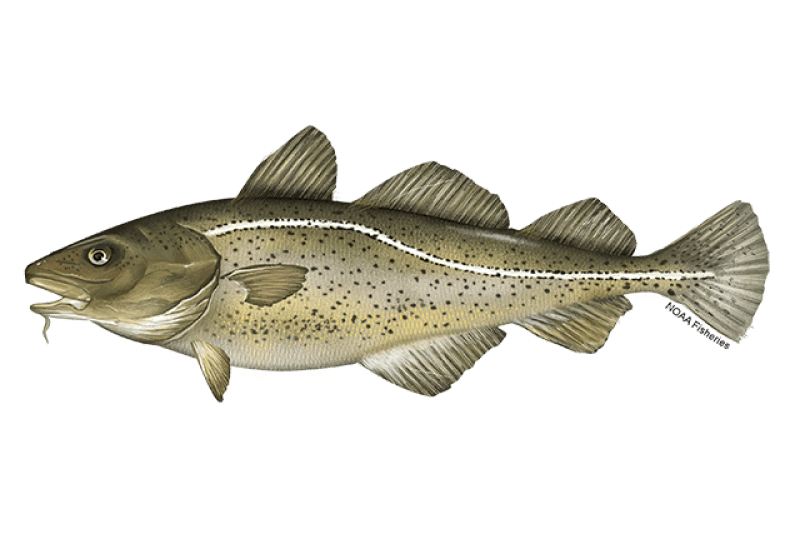
Gadus morhua , also known as Cod, Codling, Scrod cod, Markets, Steakers. In the Northwest Atlantic, cod range from Greenland to Cape Hatteras, North Carolina. In U.S. waters, cod is most common on Georges Bank and in the western Gulf of Maine. Cod is an
Source: Species facts, status language, and imagery adapted from the NOAA Fisheries species profile (last updated 06/25/2026). Ocean City charter and Maryland
record notes are editorial orientation for OCEANCITY.MD readers. Always confirm current seasons, sizes, and
bag limits before you fish—rules change.
In the Northwest Atlantic, cod range from Greenland to Cape Hatteras, North Carolina. In U.S. waters, cod is most common on Georges Bank and in the western Gulf of Maine. Cod is an iconic fish of New England and in recent years, Atlantic cod stocks in our region have declined dramatically. NOAA Fisheries is working to rebuild this population.
Maryland record catch
Confirm whether Maryland DNR publishes an Atlantic state-record category for Atlantic Cod on the current sport-fish record board.
Maryland’s Atlantic recreational seasons/sizes/creel summary does not publish a dedicated line for Atlantic Cod. Verify COMAR, DNR public notices, and federal rules for your exact waters before you keep fish.
Rule
Maryland / applicable detail
Maryland minimum size
Not listed — no dedicated Atlantic Cod line on the MD Atlantic recreational table
Maryland daily creel (bag)
Not listed — no MD species-specific bag for Atlantic Cod
Maryland open season
Not listed on the MD Atlantic Ocean / Coastal Bays summary table
Verify
Check DNR eRegulations, COMAR, and NOAA for your date and coordinates before you keep fish.
Atlantic cod are heavy-bodied with a large head, blunt snout, and a distinct barbel (a whisker-like organ, like on a catfish) under the lower jaw.
Their coloring varies, ranging from light yellowish-green to red and olive, usually with darker speckles on the head, fins, tail, and body.
The belly is light colored and usually spotless.
Individuals can change color readily.
Cod have an obvious lateral line (the faint line that runs lengthwise down each side of the fish).
Biology Atlantic cod can live more than 20 years.
Appearance
Atlantic cod can live more than 20 years.
They can grow up to 51 inches and 77 pounds.
They are capable of reproducing at 2 to 3 years old, when they are between 12 and 16 inches long.
Cod spawn near the ocean floor from winter to early spring.
Larger females can produce 3 to 9 million eggs when they spawn.
They are top predators in the bottom ocean community, feeding on a variety of invertebrates and fish.
Where They Live Range In the Northwest Atlantic, cod range from Greenland to Cape Hatteras, North Carolina.
In U.S. waters, cod is most common on Georges Bank and in the western Gulf of Maine.
Habitat Atlantic cod live near the ocean floor along rocky slopes and ledges.
They prefer to live in cold water, at depths of around 30 to 500 feet, on bottoms with coarse sediments, rather than on finer mud and silt.
Fishery Management There are two stocks of Atlantic cod in U.S. waters, the Gulf of Maine and Georges Bank stocks.
NOAA Fisheries and the New England Fishery Management Council manage Gulf of Maine cod.
NOAA Fisheries and the New England Fishery Management Council collaborate with Canada to jointly manage Georges Bank cod, because the stock spans the international boundary.
Atlantic cod, along with other groundfish in New England waters, are managed under the Northeast Multispecies Fishery Management Plan , which includes: Permitting requirements for commercial vessels.
Separate management measures for recreational vessels.
Year-round and seasonal area closures to protect spawning fish and habitat.
Minimum fish sizes to prevent harvest of juvenile fish.
Annual catch limits, based on best available science.
An optional sector (catch share) program can be used for cod and other groundfish species.
The sector program allows fishermen to form harvesting cooperatives and work together to decide when, where, and how they harvest fish.
A rebuilding plan to rebuild the Gulf of Maine stock to the target population level is in place with a target date of 2033.
A rebuilding plan to rebuild the Georges Bank stock to the target population level is in place with a target date of 2026.
Harvest Commercial fishery: In 2024, commercial landings of Atlantic cod totaled 1.4 million pounds and were valued at $2.8 million, according to the NOAA Fisheries commercial fishing landings database .
Gear types, habitat impacts, and bycatch: Cod are commonly harvested using trawl nets, gillnets, bottom longlines, and rod and reel.
Gillnets, longlines, and rod and reel used to harvest cod have little to no impact on habitat.
Closed areas and gear restrictions reduce habitat impacts from trawl nets.
Fishermen follow management measures designed to reduce interactions with marine mammals, including gear modifications, seasonal closures, and use of marine mammal deterrents.
Recreational fishery: Cod are highly prized by recreational fishermen.
They are commonly harvested by anglers using lures or bait.
In 2024, recreational anglers landed 210,000 pounds of Atlantic cod, according to the NOAA Fisheries recreational fishing landings database .
Regulations include minimum fish sizes, possession limits, and closed seasons.
Scientific Classification Kingdom Animalia Phylum Chordata Class Actinopterygii Order Gadiformes Family Gadidae Genus Gadus Species morhua Last updated by NOAA Fisheries on 06/25/2026
Biology
In the Northwest Atlantic, cod range from Greenland to Cape Hatteras, North Carolina.
In U.S. waters, cod is most common on Georges Bank and in the western Gulf of Maine.
Habitat Atlantic cod live near the ocean floor along rocky slopes and ledges.
They prefer to live in cold water, at depths of around 30 to 500 feet, on bottoms with coarse sediments, rather than on finer mud and silt.
Fishery Management There are two stocks of Atlantic cod in U.S. waters, the Gulf of Maine and Georges Bank stocks.
NOAA Fisheries and the New England Fishery Management Council manage Gulf of Maine cod.
NOAA Fisheries and the New England Fishery Management Council collaborate with Canada to jointly manage Georges Bank cod, because the stock spans the international boundary.
Atlantic cod, along with other groundfish in New England waters, are managed under the Northeast Multispecies Fishery Management Plan , which includes: Permitting requirements for commercial vessels.
Separate management measures for recreational vessels.
Year-round and seasonal area closures to protect spawning fish and habitat.
Minimum fish sizes to prevent harvest of juvenile fish.
Annual catch limits, based on best available science.
An optional sector (catch share) program can be used for cod and other groundfish species.
The sector program allows fishermen to form harvesting cooperatives and work together to decide when, where, and how they harvest fish.
A rebuilding plan to rebuild the Gulf of Maine stock to the target population level is in place with a target date of 2033.
A rebuilding plan to rebuild the Georges Bank stock to the target population level is in place with a target date of 2026.
Harvest Commercial fishery: In 2024, commercial landings of Atlantic cod totaled 1.4 million pounds and were valued at $2.8 million, according to the NOAA Fisheries commercial fishing landings database .
Gear types, habitat impacts, and bycatch: Cod are commonly harvested using trawl nets, gillnets, bottom longlines, and rod and reel.
Gillnets, longlines, and rod and reel used to harvest cod have little to no impact on habitat.
Closed areas and gear restrictions reduce habitat impacts from trawl nets.
Fishermen follow management measures designed to reduce interactions with marine mammals, including gear modifications, seasonal closures, and use of marine mammal deterrents.
Recreational fishery: Cod are highly prized by recreational fishermen.
They are commonly harvested by anglers using lures or bait.
In 2024, recreational anglers landed 210,000 pounds of Atlantic cod, according to the NOAA Fisheries recreational fishing landings database .
Regulations include minimum fish sizes, possession limits, and closed seasons.
Scientific Classification Kingdom Animalia Phylum Chordata Class Actinopterygii Order Gadiformes Family Gadidae Genus Gadus Species morhua Last updated by NOAA Fisheries on 06/25/2026
Where they live
Range
In the Northwest Atlantic, cod range from Greenland to Cape Hatteras, North Carolina.
In U.S. waters, cod is most common on Georges Bank and in the western Gulf of Maine.
Habitat
There are two stocks of Atlantic cod in U.S. waters, the Gulf of Maine and Georges Bank stocks.
NOAA Fisheries and the New England Fishery Management Council manage Gulf of Maine cod.
NOAA Fisheries and the New England Fishery Management Council collaborate with Canada to jointly manage Georges Bank cod, because the stock spans the international boundary.
Atlantic cod, along with other groundfish in New England waters, are managed under the Northeast Multispecies Fishery Management Plan , which includes: Permitting requirements for commercial vessels.
Separate management measures for recreational vessels.
Year-round and seasonal area closures to protect spawning fish and habitat.
Minimum fish sizes to prevent harvest of juvenile fish.
Annual catch limits, based on best available science.
An optional sector (catch share) program can be used for cod and other groundfish species.
The sector program allows fishermen to form harvesting cooperatives and work together to decide when, where, and how they harvest fish.
A rebuilding plan to rebuild the Gulf of Maine stock to the target population level is in place with a target date of 2033.
A rebuilding plan to rebuild the Georges Bank stock to the target population level is in place with a target date of 2026.
Harvest Commercial fishery: In 2024, commercial landings of Atlantic cod totaled 1.4 million pounds and were valued at $2.8 million, according to the NOAA Fisheries commercial fishing landings database .
Gear types, habitat impacts, and bycatch: Cod are commonly harvested using trawl nets, gillnets, bottom longlines, and rod and reel.
Gillnets, longlines, and rod and reel used to harvest cod have little to no impact on habitat.
Closed areas and gear restrictions reduce habitat impacts from trawl nets.
Fishermen follow management measures designed to reduce interactions with marine mammals, including gear modifications, seasonal closures, and use of marine mammal deterrents.
Recreational fishery: Cod are highly prized by recreational fishermen.
They are commonly harvested by anglers using lures or bait.
In 2024, recreational anglers landed 210,000 pounds of Atlantic cod, according to the NOAA Fisheries recreational fishing landings database .
Regulations include minimum fish sizes, possession limits, and closed seasons.
Scientific Classification Kingdom Animalia Phylum Chordata Class Actinopterygii Order Gadiformes Family Gadidae Genus Gadus Species morhua Last updated by NOAA Fisheries on 06/25/2026
Ocean City & Mid-Atlantic context
From Ocean City, Maryland, use this Atlantic Cod profile as NOAA Mid-Atlantic directory context—not a promise you will meet the species on every charter.
Always verify current Maryland and federal size, season, and bag rules for your exact date and coordinates before you keep any catch.
Source facts and imagery are adapted from the NOAA Fisheries species profile for Atlantic Cod.
What charter to book from Ocean City
Atlantic Cod may appear on Ocean City trips depending on season and habitat—use the NOAA biology below and book the charter archetype that matches how you will actually fish.
Possible / related
Bay guide — Possible overlap depending on season, water, and boat program.
Inshore charter — Possible overlap depending on season, water, and boat program.
Commercial fishery: In 2024, commercial landings of Atlantic cod totaled 1.4 million pounds and were valued at $2.8 million, according to the NOAA Fisheries commercial fishing landings database .
Gear types, habitat impacts, and bycatch: Cod are commonly harvested using trawl nets, gillnets, bottom longlines, and rod and reel.
Gillnets, longlines, and rod and reel used to harvest cod have little to no impact on habitat.
Closed areas and gear restrictions reduce habitat impacts from trawl nets.
Fishermen follow management measures designed to reduce interactions with marine mammals, including gear modifications, seasonal closures, and use of marine mammal deterrents.
Recreational fishery: Cod are highly prized by recreational fishermen.
They are commonly harvested by anglers using lures or bait.
In 2024, recreational anglers landed 210,000 pounds of Atlantic cod, according to the NOAA Fisheries recreational fishing landings database .
Harvest
See the NOAA wild-caught fishery section for landings and gear notes when published for this species.
Landings and management details matter most for the waters where Atlantic Cod is actually fished—see the
NOAA species profile
.
Seafood facts
Fact
Detail
Sustainability
Although populations are well below target levels, U.S. wild-caught Atlantic cod is still a smart seafood choice because it is sustainably managed under a rebuilding plan that allows limited harvest by U.S. fishermen.
Availability
Year-round.
Source
Wild-caught from Maine to Virginia.
Taste
Atlantic cod has a mild clean flavor. It is sweeter than Pacific cod.
Texture
Cod has large flakes. It's less firm than haddock.
After a real OC boat day or market stop for Atlantic Cod, Seafood after boat days covers
dock buffer and cook-your-catch pacing.