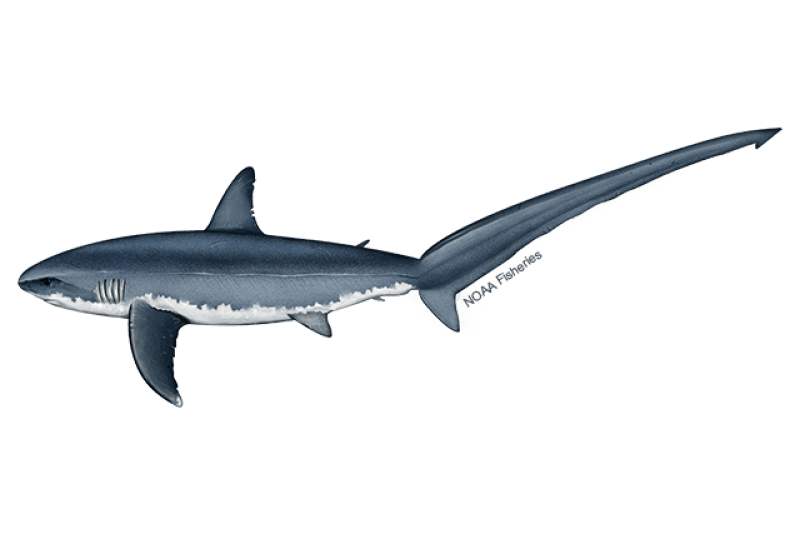
Alopias vulpinus , also known as Thresher shark, Fox shark, Sea fox, Swingletail, Whiptail shark, Thintail shark. U.S. wild-caught Atlantic common thresher shark is a smart seafood choice because it is sustainably managed and responsibly harvested under U.S. regulations.
Source: Species facts, status language, and imagery adapted from the NOAA Fisheries species profile (last updated 06/29/2026). Ocean City charter and Maryland
record notes are editorial orientation for OCEANCITY.MD readers. Always confirm current seasons, sizes, and
bag limits before you fish—rules change.
Illustration/photo: NOAA Fisheries — Atlantic Common Thresher Shark (Alopias vulpinus).
Quick facts
Region: New England/Mid-Atlantic,
Southeast
Category: Shark / ray · Mid-Atlantic
Maryland likelihood: 4★ out of 5
About the species
U.S. wild-caught Atlantic common thresher shark is a smart seafood choice because it is sustainably managed and responsibly harvested under U.S. regulations.
Maryland record catch
Confirm whether Maryland DNR publishes an Atlantic state-record category for Atlantic Common Thresher Shark on the current sport-fish record board.
Maryland’s Atlantic recreational seasons/sizes/creel summary does not publish a dedicated line for Atlantic Common Thresher Shark. Verify COMAR, DNR public notices, and federal rules for your exact waters before you keep fish.
Rule
Maryland / applicable detail
Maryland minimum size
Not listed — no dedicated Atlantic Common Thresher Shark line on the MD Atlantic recreational table
Maryland daily creel (bag)
Not listed — no MD species-specific bag for Atlantic Common Thresher Shark
Maryland open season
Not listed on the MD Atlantic Ocean / Coastal Bays summary table
Verify
Check DNR eRegulations, COMAR, and NOAA for your date and coordinates before you keep fish.
Thresher sharks are brown, gray, blue-gray, or blackish on the back and underside of their snout.
They are lighter on the sides, and fully white below.
Their pectoral, pelvic, and dorsal fins are blackish, and there are sometimes white dots on the tips of the pectoral, pelvic, and tail fins.
Their tail fin is sickle-shaped, and the upper part is extremely long, about half the length of their body.
Biology Common thresher sharks live a long time (19 to 50 years), reproduce late in life, and have only a few young at a time.
They grow slowly, but can reach up to 20 feet long.
Appearance
Common thresher sharks live a long time (19 to 50 years), reproduce late in life, and have only a few young at a time.
They grow slowly, but can reach up to 20 feet long.
Males sexually mature when they’re 8 to 11 feet long and 3 to 6 years old.
Females are able to reproduce when they’re 8 to 9 feet long and 4 to 5 years of age.
Common thresher sharks mate in late summer.
Eggs are fertilized internally and develop within the mother.
Females bear live, fully developed young after a long gestation period (9 months), and only have a few pups.
Common thresher sharks are aggressive predators that feed near the top of the food chain on schooling fish such as herring and mackerel and occasionally on squid and seabirds.
They are named for their long, scythe-like tail, which is used to stun fish before preying on them.
Adult common thresher sharks have few predators, but younger, smaller ones may fall prey to larger sharks.
Where They Live Range Common thresher sharks are found in temperate waters around the world.
In the northwest Atlantic Ocean, they range from Newfoundland to Cuba.
Habitat Common thresher sharks are highly migratory species, often traveling over entire ocean basins.
They’re most common near land and are often found in areas rich with plankton, where their prey is also abundant.
Fishery Management NOAA Fisheries and the Atlantic Highly Migratory Species Division manage the Atlantic common thresher shark fishery in the United States.
Managed under the Consolidated Atlantic Highly Migratory Species Fishery Management Plan : Permits are required, and only a limited number of permits are available.
Commercial quotas and limits on how many sharks can be landed per fishing trip.
Gear restrictions and requirements.
Fishing season is generally year-round, but individual commercial shark fisheries close when the quota is reached.
Shark dealers are required to attend Atlantic shark identification workshops to help them better identify shark species.
Prohibited species—there are more than 20 species of sharks that cannot be landed (e.g., white, dusky, basking, longfin mako, night).
Some of these species look similar to the species that can be landed.
The recreational shark identification can help with identification.
The Shark Conservation Act requires that all sharks, with one exception, be brought to shore with their fins naturally attached.
Compliance guides are available for all commercial and recreational regulations across Atlantic highly migratory species fisheries.
Highly migratory species, such as thresher sharks, have complicated management that requires international cooperation.
A shark that is off the coast of Florida one week could be caught off the coast of Mexico the next.
These resources must be managed both in the United States and at the international level.
The United States negotiates with Regional Fisheries Management Organizations—including the International Commission for the Conservation of Atlantic Tunas , the Food and Agriculture Organization of the United Nations , and the Convention on International Trade in Endangered Species of Wild Fauna and Flora to enhance shark management worldwide.
Harvest Commercial fishery: To commercially harvest Atlantic sharks, vessel owners must obtain a valid Atlantic shark directed or incidental limited access permit or a smoothhound shark open access permit.
More information regarding limited access permits can be found in the Atlantic HMS fishery compliance guides .
Most of this catch comes from New Jersey and North Carolina.
Common thresher sharks are part of the pelagic shark complex.
Gear types, habitat impacts, and bycatch: Atlantic common thresher sharks are primarily caught incidentally in longline fisheries targeting swordfish and tuna.
Gear used to catch common thresher sharks does not impact habitat since it does not contact the ocean floor.
Fishermen are required to use circle hooks on pelagic longlines to reduce bycatch of sea turtles.
All pelagic longline fishing vessels must also carry safe handling and release gear to help in returning any unintentionally caught protected species to the sea safely.
Fishermen using longline or gillnet gear must complete a protected species safe handling, release, and identification workshop .
Certain areas are closed to fishing to protect nursery areas, sensitive habitats, and populations.
Vessel monitoring systems ensure fishermen are complying with area closures.
Recreational fishery: Recreational fishermen fish for common thresher sharks, mainly with rod-and-reel gear.
Recreational fishermen must have an Atlantic HMS permit to harvest Atlantic common thresher sharks in federal waters.
As of January 1, 2018, all HMS recreational permit holders will need a “shark endorsement” to fish for, retain, possess, or land sharks.
In addition to the shark endorsement, fishermen fishing recreationally for sharks will be required to use circle hook in most places.
Circle hooks are less likely to be caught in the thresher shark’s long tail, increasing the survival of sharks that are caught and released.
For more information regarding these requirements, please refer to HMS regulations and the Amendment 5b compliance guide . Sharks must be a minimum size to be caught, and there is a limit on how many sharks can be caught per fishing trip.
Scientific Classification Kingdom Animalia Phylum Chordata Class Chondrichthyes Order Lamniformes Family Alopiidae Genus Alopias Species vulpinus Last updated by NOAA Fisheries on 06/29/2026
Biology
Common thresher sharks are found in temperate waters around the world.
In the northwest Atlantic Ocean, they range from Newfoundland to Cuba.
Habitat Common thresher sharks are highly migratory species, often traveling over entire ocean basins.
They’re most common near land and are often found in areas rich with plankton, where their prey is also abundant.
Fishery Management NOAA Fisheries and the Atlantic Highly Migratory Species Division manage the Atlantic common thresher shark fishery in the United States.
Managed under the Consolidated Atlantic Highly Migratory Species Fishery Management Plan : Permits are required, and only a limited number of permits are available.
Commercial quotas and limits on how many sharks can be landed per fishing trip.
Gear restrictions and requirements.
Fishing season is generally year-round, but individual commercial shark fisheries close when the quota is reached.
Shark dealers are required to attend Atlantic shark identification workshops to help them better identify shark species.
Prohibited species—there are more than 20 species of sharks that cannot be landed (e.g., white, dusky, basking, longfin mako, night).
Some of these species look similar to the species that can be landed.
The recreational shark identification can help with identification.
The Shark Conservation Act requires that all sharks, with one exception, be brought to shore with their fins naturally attached.
Compliance guides are available for all commercial and recreational regulations across Atlantic highly migratory species fisheries.
Highly migratory species, such as thresher sharks, have complicated management that requires international cooperation.
A shark that is off the coast of Florida one week could be caught off the coast of Mexico the next.
These resources must be managed both in the United States and at the international level.
The United States negotiates with Regional Fisheries Management Organizations—including the International Commission for the Conservation of Atlantic Tunas , the Food and Agriculture Organization of the United Nations , and the Convention on International Trade in Endangered Species of Wild Fauna and Flora to enhance shark management worldwide.
Harvest Commercial fishery: To commercially harvest Atlantic sharks, vessel owners must obtain a valid Atlantic shark directed or incidental limited access permit or a smoothhound shark open access permit.
More information regarding limited access permits can be found in the Atlantic HMS fishery compliance guides .
Most of this catch comes from New Jersey and North Carolina.
Common thresher sharks are part of the pelagic shark complex.
Gear types, habitat impacts, and bycatch: Atlantic common thresher sharks are primarily caught incidentally in longline fisheries targeting swordfish and tuna.
Gear used to catch common thresher sharks does not impact habitat since it does not contact the ocean floor.
Fishermen are required to use circle hooks on pelagic longlines to reduce bycatch of sea turtles.
All pelagic longline fishing vessels must also carry safe handling and release gear to help in returning any unintentionally caught protected species to the sea safely.
Fishermen using longline or gillnet gear must complete a protected species safe handling, release, and identification workshop .
Certain areas are closed to fishing to protect nursery areas, sensitive habitats, and populations.
Vessel monitoring systems ensure fishermen are complying with area closures.
Recreational fishery: Recreational fishermen fish for common thresher sharks, mainly with rod-and-reel gear.
Recreational fishermen must have an Atlantic HMS permit to harvest Atlantic common thresher sharks in federal waters.
As of January 1, 2018, all HMS recreational permit holders will need a “shark endorsement” to fish for, retain, possess, or land sharks.
In addition to the shark endorsement, fishermen fishing recreationally for sharks will be required to use circle hook in most places.
Circle hooks are less likely to be caught in the thresher shark’s long tail, increasing the survival of sharks that are caught and released.
For more information regarding these requirements, please refer to HMS regulations and the Amendment 5b compliance guide . Sharks must be a minimum size to be caught, and there is a limit on how many sharks can be caught per fishing trip.
Scientific Classification Kingdom Animalia Phylum Chordata Class Chondrichthyes Order Lamniformes Family Alopiidae Genus Alopias Species vulpinus Last updated by NOAA Fisheries on 06/29/2026
Where they live
Range
Common thresher sharks are found in temperate waters around the world.
In the northwest Atlantic Ocean, they range from Newfoundland to Cuba.
Habitat
NOAA Fisheries and the Atlantic Highly Migratory Species Division manage the Atlantic common thresher shark fishery in the United States.
Managed under the Consolidated Atlantic Highly Migratory Species Fishery Management Plan : Permits are required, and only a limited number of permits are available.
Commercial quotas and limits on how many sharks can be landed per fishing trip.
Gear restrictions and requirements.
Fishing season is generally year-round, but individual commercial shark fisheries close when the quota is reached.
Shark dealers are required to attend Atlantic shark identification workshops to help them better identify shark species.
Prohibited species—there are more than 20 species of sharks that cannot be landed (e.g., white, dusky, basking, longfin mako, night).
Some of these species look similar to the species that can be landed.
The recreational shark identification can help with identification.
The Shark Conservation Act requires that all sharks, with one exception, be brought to shore with their fins naturally attached.
Compliance guides are available for all commercial and recreational regulations across Atlantic highly migratory species fisheries.
Highly migratory species, such as thresher sharks, have complicated management that requires international cooperation.
A shark that is off the coast of Florida one week could be caught off the coast of Mexico the next.
These resources must be managed both in the United States and at the international level.
The United States negotiates with Regional Fisheries Management Organizations—including the International Commission for the Conservation of Atlantic Tunas , the Food and Agriculture Organization of the United Nations , and the Convention on International Trade in Endangered Species of Wild Fauna and Flora to enhance shark management worldwide.
Harvest Commercial fishery: To commercially harvest Atlantic sharks, vessel owners must obtain a valid Atlantic shark directed or incidental limited access permit or a smoothhound shark open access permit.
More information regarding limited access permits can be found in the Atlantic HMS fishery compliance guides .
Most of this catch comes from New Jersey and North Carolina.
Common thresher sharks are part of the pelagic shark complex.
Gear types, habitat impacts, and bycatch: Atlantic common thresher sharks are primarily caught incidentally in longline fisheries targeting swordfish and tuna.
Gear used to catch common thresher sharks does not impact habitat since it does not contact the ocean floor.
Fishermen are required to use circle hooks on pelagic longlines to reduce bycatch of sea turtles.
All pelagic longline fishing vessels must also carry safe handling and release gear to help in returning any unintentionally caught protected species to the sea safely.
Fishermen using longline or gillnet gear must complete a protected species safe handling, release, and identification workshop .
Certain areas are closed to fishing to protect nursery areas, sensitive habitats, and populations.
Vessel monitoring systems ensure fishermen are complying with area closures.
Recreational fishery: Recreational fishermen fish for common thresher sharks, mainly with rod-and-reel gear.
Recreational fishermen must have an Atlantic HMS permit to harvest Atlantic common thresher sharks in federal waters.
As of January 1, 2018, all HMS recreational permit holders will need a “shark endorsement” to fish for, retain, possess, or land sharks.
In addition to the shark endorsement, fishermen fishing recreationally for sharks will be required to use circle hook in most places.
Circle hooks are less likely to be caught in the thresher shark’s long tail, increasing the survival of sharks that are caught and released.
For more information regarding these requirements, please refer to HMS regulations and the Amendment 5b compliance guide . Sharks must be a minimum size to be caught, and there is a limit on how many sharks can be caught per fishing trip.
Scientific Classification Kingdom Animalia Phylum Chordata Class Chondrichthyes Order Lamniformes Family Alopiidae Genus Alopias Species vulpinus Last updated by NOAA Fisheries on 06/29/2026
Ocean City & Mid-Atlantic context
From Ocean City, Maryland, use this Atlantic Common Thresher Shark profile as NOAA Mid-Atlantic directory context—not a promise you will meet the species on every charter.
Always verify current Maryland and federal size, season, and bag rules for your exact date and coordinates before you keep any catch.
Source facts and imagery are adapted from the NOAA Fisheries species profile for Atlantic Common Thresher Shark.
What charter to book from Ocean City
Atlantic Common Thresher Shark may show on Ocean City shark, wreck, or offshore days depending on season and permits—confirm HMS/state rules before you book or keep fish.
Possible / related
Inshore charter — Possible overlap depending on season, water, and boat program.
Commercial fishery: To commercially harvest Atlantic sharks, vessel owners must obtain a valid Atlantic shark directed or incidental limited access permit or a smoothhound shark open access permit.
More information regarding limited access permits can be found in the Atlantic HMS fishery compliance guides .
Most of this catch comes from New Jersey and North Carolina.
Common thresher sharks are part of the pelagic shark complex.
Gear types, habitat impacts, and bycatch: Atlantic common thresher sharks are primarily caught incidentally in longline fisheries targeting swordfish and tuna.
Gear used to catch common thresher sharks does not impact habitat since it does not contact the ocean floor.
Fishermen are required to use circle hooks on pelagic longlines to reduce bycatch of sea turtles.
All pelagic longline fishing vessels must also carry safe handling and release gear to help in returning any unintentionally caught protected species to the sea safely.
Harvest
See the NOAA wild-caught fishery section for landings and gear notes when published for this species.
Landings and management details matter most for the waters where Atlantic Common Thresher Shark is actually fished—see the
NOAA species profile
.
Seafood facts
Fact
Detail
Sustainability
U.S. wild-caught Atlantic common thresher shark is a smart seafood choice because it is sustainably managed and responsibly harvested under U.S. regulations.
Availability
Year-round.
Source
U.S. wild-caught from New York to North Carolina.
Taste
Mild flavor.
Texture
Firm and dense.
Color
Raw meat is white to tan with a pink blood line.
Health
Shark is high in protein and low in fat. It is a good source of niacin, vitamins B6 and B12, phosphorus, and selenium.
After a real OC boat day or market stop for Atlantic Common Thresher Shark, Seafood after boat days covers
dock buffer and cook-your-catch pacing.