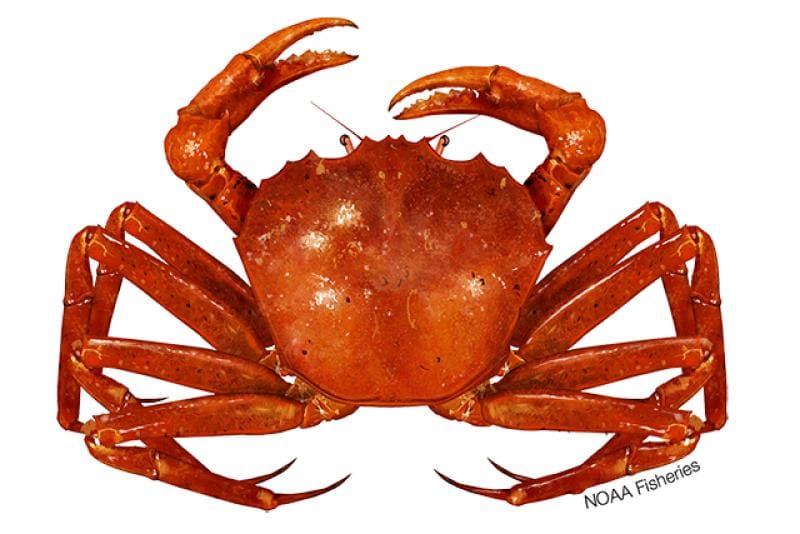
Chaceon quinquedens , also known as Atlantic red crab, Red crab, Red deepsea crab. The Atlantic deep-sea red crab fishery is managed in the U.S. from roughly the latitude of Cape Hatteras Lighthouse, North Carolina, northward to the U.S./Canada border, extending
Source: Species facts, status language, and imagery adapted from the NOAA Fisheries species profile (last updated 06/12/2026). Ocean City charter and Maryland
record notes are editorial orientation for OCEANCITY.MD readers. Always confirm current seasons, sizes, and
bag limits before you fish—rules change.
Illustration/photo: NOAA Fisheries — Atlantic Deep-Sea Red Crab (Chaceon quinquedens).
Quick facts
Length: Up to 5¼ inches carapace width for females and 6.5 inches for males
Region: New England/Mid-Atlantic
Category: Invertebrate · Mid-Atlantic
Maryland likelihood: 2★ out of 5
About the species
The Atlantic deep-sea red crab fishery is managed in the U.S. from roughly the latitude of Cape Hatteras Lighthouse, North Carolina, northward to the U.S./Canada border, extending eastward from the shore to the outer boundary of the exclusive economic zone and northward to the U.S./Canada border. The directed fishery is conducted year-round, uses trap/pot gear, and takes place primarily between 400 to 800 meters along the continental shelf. The market for red crab is picked and packaged crab meat for human consumption. Implementing regulations are found at 50 CFR part 648 subpart M .
Maryland record catch
Confirm whether Maryland DNR publishes an Atlantic state-record category for Atlantic Deep-Sea Red Crab on the current sport-fish record board.
Maryland’s Atlantic recreational seasons/sizes/creel summary does not publish a dedicated line for Atlantic Deep-Sea Red Crab. Verify COMAR, DNR public notices, and federal rules for your exact waters before you keep fish.
Rule
Maryland / applicable detail
Maryland minimum size
Not listed — no dedicated Atlantic Deep-Sea Red Crab line on the MD Atlantic recreational table
Maryland daily creel (bag)
Not listed — no MD species-specific bag for Atlantic Deep-Sea Red Crab
Maryland open season
Not listed on the MD Atlantic Ocean / Coastal Bays summary table
Verify
Check DNR eRegulations, COMAR, and NOAA for your date and coordinates before you keep fish.
Atlantic deep-sea red crabs are large bright red crabs with a square carapace.
They have long legs that extend to the side, so that the entire width of the crab is double the width of the carapace.
Biology Atlantic deep-sea red crab females reach up to 5¼ inches (13.3 cm) carapace width and males reach 6.5 inches (16.5 cm). They reach maturity at less than 4 inches (10.2 cm) carapace width. Mating occurs after the female has molted, with the male carrying the smaller female beneath him for up to several days. They live in a food-limited environment and likely eat a wide range of invertebrates, as well as scavenge carcasses. There is very limited information on growth rate or maximum age.
Where They Live Range Along the eastern United States, red crabs are found from Nova Scotia to North Carolina. They are also found in the Gulf of America (formerly Gulf of Mexico).
Habitat Atlantic deep-sea red crab live in very deep, cold waters on the ocean bottom. Bottom habitat consists of smooth, silty ocean bottom, as well as rocky canyons. Light and plant life are scarce, and food is limited.
Fishery Management NOAA Fisheries and the New England Fishery Management Council manage the Atlantic deep-sea red crab fishery.
Appearance
Atlantic deep-sea red crab females reach up to 5¼ inches (13.3 cm) carapace width and males reach 6.5 inches (16.5 cm). They reach maturity at less than 4 inches (10.2 cm) carapace width. Mating occurs after the female has molted, with the male carrying the smaller female beneath him for up to several days. They live in a food-limited environment and likely eat a wide range of invertebrates, as well as scavenge carcasses. There is very limited information on growth rate or maximum age.
Where They Live Range Along the eastern United States, red crabs are found from Nova Scotia to North Carolina. They are also found in the Gulf of America (formerly Gulf of Mexico).
Habitat Atlantic deep-sea red crab live in very deep, cold waters on the ocean bottom. Bottom habitat consists of smooth, silty ocean bottom, as well as rocky canyons. Light and plant life are scarce, and food is limited.
Fishery Management NOAA Fisheries and the New England Fishery Management Council manage the Atlantic deep-sea red crab fishery.
Atlantic deep-sea red crab is managed under the Atlantic Deep-Sea Red Crab Fishery Management Plan which includes:
Permitting requirements for commercial vessels. Limited to five permitted vessels that fish exclusively in federal waters. Typically only three to four vessels are active. Trap configuration and gear marking requirements. Annual catch limits for commercial catch, based on best available science. Fishing season that runs from March 1 through the end of February. Harvest In 2022, commercial landings of Atlantic deep-sea red crab totaled 1,999.4 mt (4,408,055 lb), according to the final 2022 fishing year quota monitoring report . The majority of landings are from the Northeast and Mid-Atlantic.
Commercial fishermen use conical, or cone-shaped, pots that are wider at the base than the top. The gear consists of up to 150 baited crab pots in a string, and each permitted vessel is limited to fishing 600 pots. Landings of red crab are driven by market demand which can be variable. There is limited bycatch of other species in the red crab fishery.
Scientific Classification Kingdom Animalia Phylum Arthropoda Class Malacostraca Order Decapoda Family Geryonidae Genus Chaceon Species quinquedens Last updated by NOAA Fisheries on 06/12/2026
Biology
Along the eastern United States, red crabs are found from Nova Scotia to North Carolina. They are also found in the Gulf of America (formerly Gulf of Mexico).
Habitat Atlantic deep-sea red crab live in very deep, cold waters on the ocean bottom. Bottom habitat consists of smooth, silty ocean bottom, as well as rocky canyons. Light and plant life are scarce, and food is limited.
Fishery Management NOAA Fisheries and the New England Fishery Management Council manage the Atlantic deep-sea red crab fishery.
Atlantic deep-sea red crab is managed under the Atlantic Deep-Sea Red Crab Fishery Management Plan which includes:
Permitting requirements for commercial vessels. Limited to five permitted vessels that fish exclusively in federal waters. Typically only three to four vessels are active. Trap configuration and gear marking requirements. Annual catch limits for commercial catch, based on best available science. Fishing season that runs from March 1 through the end of February. Harvest In 2022, commercial landings of Atlantic deep-sea red crab totaled 1,999.4 mt (4,408,055 lb), according to the final 2022 fishing year quota monitoring report . The majority of landings are from the Northeast and Mid-Atlantic.
Commercial fishermen use conical, or cone-shaped, pots that are wider at the base than the top. The gear consists of up to 150 baited crab pots in a string, and each permitted vessel is limited to fishing 600 pots. Landings of red crab are driven by market demand which can be variable. There is limited bycatch of other species in the red crab fishery.
Scientific Classification Kingdom Animalia Phylum Arthropoda Class Malacostraca Order Decapoda Family Geryonidae Genus Chaceon Species quinquedens Last updated by NOAA Fisheries on 06/12/2026
Where they live
Range
Along the eastern United States, red crabs are found from Nova Scotia to North Carolina. They are also found in the Gulf of America (formerly Gulf of Mexico).
Habitat Atlantic deep-sea red crab live in very deep, cold waters on the ocean bottom. Bottom habitat consists of smooth, silty ocean bottom, as well as rocky canyons. Light and plant life are scarce, and food is limited.
Habitat
NOAA Fisheries and the New England Fishery Management Council manage the Atlantic deep-sea red crab fishery.
Atlantic deep-sea red crab is managed under the Atlantic Deep-Sea Red Crab Fishery Management Plan which includes:
Permitting requirements for commercial vessels. Limited to five permitted vessels that fish exclusively in federal waters. Typically only three to four vessels are active. Trap configuration and gear marking requirements. Annual catch limits for commercial catch, based on best available science. Fishing season that runs from March 1 through the end of February. Harvest In 2022, commercial landings of Atlantic deep-sea red crab totaled 1,999.4 mt (4,408,055 lb), according to the final 2022 fishing year quota monitoring report . The majority of landings are from the Northeast and Mid-Atlantic.
Commercial fishermen use conical, or cone-shaped, pots that are wider at the base than the top. The gear consists of up to 150 baited crab pots in a string, and each permitted vessel is limited to fishing 600 pots. Landings of red crab are driven by market demand which can be variable. There is limited bycatch of other species in the red crab fishery.
Scientific Classification Kingdom Animalia Phylum Arthropoda Class Malacostraca Order Decapoda Family Geryonidae Genus Chaceon Species quinquedens Last updated by NOAA Fisheries on 06/12/2026
Ocean City & Mid-Atlantic context
From Ocean City, Maryland, use this Atlantic Deep-Sea Red Crab profile as NOAA Mid-Atlantic directory context—not a promise you will meet the species on every charter.
Always verify current Maryland and federal size, season, and bag rules for your exact date and coordinates before you keep any catch.
Source facts and imagery are adapted from the NOAA Fisheries species profile for Atlantic Deep-Sea Red Crab.
What charter to book from Ocean City
Atlantic Deep-Sea Red Crab is more of a bay, inshore, or specialty harvest story than a typical OC six-pack trolling day—match the trip type to the animal.
Possible / related
Bay guide — Possible overlap depending on season, water, and boat program.
Inshore charter — Possible overlap depending on season, water, and boat program.
In 2022, commercial landings of Atlantic deep-sea red crab totaled 1,999.4 mt (4,408,055 lb), according to the final 2022 fishing year quota monitoring report . The majority of landings are from the Northeast and Mid-Atlantic.
Commercial fishermen use conical, or cone-shaped, pots that are wider at the base than the top. The gear consists of up to 150 baited crab pots in a string, and each permitted vessel is limited to fishing 600 pots. Landings of red crab are driven by market demand which can be variable. There is limited bycatch of other species in the red crab fishery.
Scientific Classification Kingdom Animalia Phylum Arthropoda Class Malacostraca Order Decapoda Family Geryonidae Genus Chaceon Species quinquedens Last updated by NOAA Fisheries on 06/12/2026
Harvest
See the NOAA wild-caught fishery section for landings and gear notes when published for this species.
Landings and management details matter most for the waters where Atlantic Deep-Sea Red Crab is actually fished—see the
NOAA species profile
.
Seafood facts
Fact
Detail
Availability
Year-round.
Source
Wild-caught from North Carolina to Massachusetts.
Taste
Sweet and clean.
Texture
Delicate.
Color
White with a pink hue.
Health
Atlantic deep-sea red crab is a great source of protein that is also low in saturated fat.
After a real OC boat day or market stop for Atlantic Deep-Sea Red Crab, Seafood after boat days covers
dock buffer and cook-your-catch pacing.