Atlantic Salmon
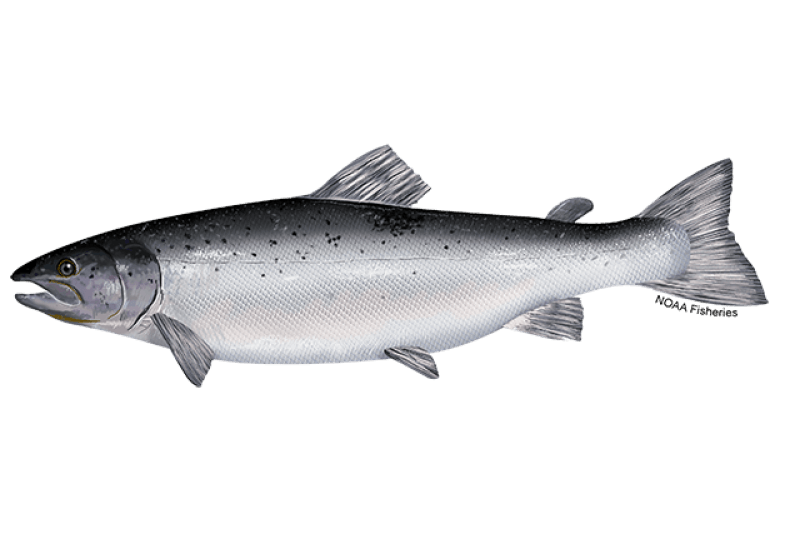
Salmo salar , also known as Salmon, Sea run salmon, Kelts, Black salmon. Atlantic salmon, also known as the “King of Fish,” are an iconic species of the Northeast and once supported fisheries throughout their range. Today, commercial and recreational fi
Not in our directory yet? Browse the committed Charter Boat Directory listings grid (marketplace crosswalk).
Quick facts
About the species
Atlantic salmon, also known as the “King of Fish,” are an iconic species of the Northeast and once supported fisheries throughout their range. Today, commercial and recreational fishing for Atlantic salmon in the United States is prohibited. All Atlantic salmon in the public market is cultured and commercially grown. Only farm-raised Atlantic salmon are found in U.S. seafood markets.
Atlantic salmon are migratory fish that hatch in freshwater rivers, migrate to the ocean where they mature, and then return to their natal freshwater rivers to spawn. This complex life cycle involves transitioning between different environments, requiring significant physiological adaptations to survive in both freshwater and saltwater habitats.
Atlantic salmon in the United States were once native to many coastal rivers northeast of the Hudson River in New York. But dams, pollution, and overfishing reduced their population size until the fisheries closed in 1948. Currently, the only remaining wild populations of U.S. Atlantic salmon are found in rivers in central and eastern Maine. These remaining populations comprise the Gulf of Maine distinct population segment (DPS), which is listed as endangered under the Endangered Species Act .
In addition, the Gulf of Maine DPS is one of 10 Species in the Spotlight . Species in the Spotlight is a NOAA Fisheries initiative to provide immediate, targeted actions to stabilize populations and prevent extinction of highly at-risk endangered species. The 2021–2025 Species in the Spotlight Action Plan for Atlantic Salmon indicates that in order to halt the decline of the Gulf of Maine DPS, we need to prioritize recovery efforts that 1) increase habitat connectivity, 2) increase the number of smolts entering the marine environment, and 3) increase our understanding of and ability to improve marine survival.
Maryland record catch
Confirm whether Maryland DNR publishes an Atlantic state-record category for Atlantic Salmon on the current sport-fish record board.
Maryland size & bag limits
Maryland’s Atlantic recreational seasons/sizes/creel summary does not publish a dedicated line for Atlantic Salmon. Verify COMAR, DNR public notices, and federal rules for your exact waters before you keep fish.
| Rule | Maryland / applicable detail |
|---|---|
| Maryland minimum size | Not listed — no dedicated Atlantic Salmon line on the MD Atlantic recreational table |
| Maryland daily creel (bag) | Not listed — no MD species-specific bag for Atlantic Salmon |
| Maryland open season | Not listed on the MD Atlantic Ocean / Coastal Bays summary table |
| Verify | Check DNR eRegulations, COMAR, and NOAA for your date and coordinates before you keep fish. |
Population & fishing rate
See the NOAA species profile for current stock status language for this entry.
Appearance
Biology
Where they live
Range
Habitat
Ocean City & Mid-Atlantic context
From Ocean City, Maryland, use this Atlantic Salmon profile as NOAA Mid-Atlantic directory context—not a promise you will meet the species on every charter.
Always verify current Maryland and federal size, season, and bag rules for your exact date and coordinates before you keep any catch.
Source facts and imagery are adapted from the NOAA Fisheries species profile for Atlantic Salmon.
What charter to book from Ocean City
Atlantic Salmon may appear on Ocean City trips depending on season and habitat—use the NOAA biology below and book the charter archetype that matches how you will actually fish.
Possible / related
Not typical from OC
Related reading
Fishery management
Harvest
Seafood facts
| Fact | Detail |
|---|---|
| Sustainability | U.S. farmed Atlantic salmon is a smart seafood choice because it is grown and harvested under U.S. state and federal regulations. Commercial and recreational fishing for Atlantic salmon in the United States is prohibited. |
| Availability | Wild-caught Atlantic salmon is not available. Farm-raised Atlantic salmon is available year-round. |
| Source | Atlantic salmon found in the market is from coastal salmon farms, mostly in Maine or Washington. Commercial and recreational fishing for Atlantic salmon in the United States is prohibited. |
| Taste | Buttery, rich taste. |
| Texture | Firm and fatty, rich in omega-3 fatty acids. |
| Color | Like wild-caught salmon, the flesh is reddish-orange or pink. |
| Health | Farmed salmon is low in sodium and contains high levels of omega-3 fatty acids and vitamin B12. |
Scientific classification
| Rank | Name |
|---|---|
| Kingdom | Animalia |
| Phylum | Chordata |
| Class | Actinopterygii |
| Order | Salmoniformes |
| Family | Salmonidae |
| Genus | Salmo |
| Species | salar |