Placopecten magellanicus , also known as Scallop, Sea scallop, Giant scallop. The primary Atlantic sea scallop fishery operates along the Atlantic coast from the Mid-Atlantic to the US/Canada border. The scallop fishery uses predominantly paired or single sc
Source: Species facts, status language, and imagery adapted from the NOAA Fisheries species profile (last updated 06/29/2026). Ocean City charter and Maryland
record notes are editorial orientation for OCEANCITY.MD readers. Always confirm current seasons, sizes, and
bag limits before you fish—rules change.
The primary Atlantic sea scallop fishery operates along the Atlantic coast from the Mid-Atlantic to the US/Canada border. The scallop fishery uses predominantly paired or single scallop dredges throughout the entire range of the fishery. To a lesser extent, and mainly in the Mid-Atlantic region, the scallop fishery uses trawl gear. Most vessels land scallops as shucked meats (the adductor muscle) but some vessels also land whole (in-shell) scallops. U.S. wild-caught Atlantic sea scallop is a smart seafood choice because it is sustainably managed and responsibly harvested under U.S. regulations. Implementing regulations are found at 50 CFR part 648 subpart D.
Maryland record catch
Confirm whether Maryland DNR publishes an Atlantic state-record category for Atlantic Sea Scallop on the current sport-fish record board.
Maryland’s Atlantic recreational seasons/sizes/creel summary does not publish a dedicated line for Atlantic Sea Scallop. Verify COMAR, DNR public notices, and federal rules for your exact waters before you keep fish.
Rule
Maryland / applicable detail
Maryland minimum size
Not listed — no dedicated Atlantic Sea Scallop line on the MD Atlantic recreational table
Maryland daily creel (bag)
Not listed — no MD species-specific bag for Atlantic Sea Scallop
Maryland open season
Not listed on the MD Atlantic Ocean / Coastal Bays summary table
Verify
Check DNR eRegulations, COMAR, and NOAA for your date and coordinates before you keep fish.
Scallops are bivalves (having two shells), like clams and oysters.
The shells are held together by the adductor muscle (the part of the scallop Americans typically eat).
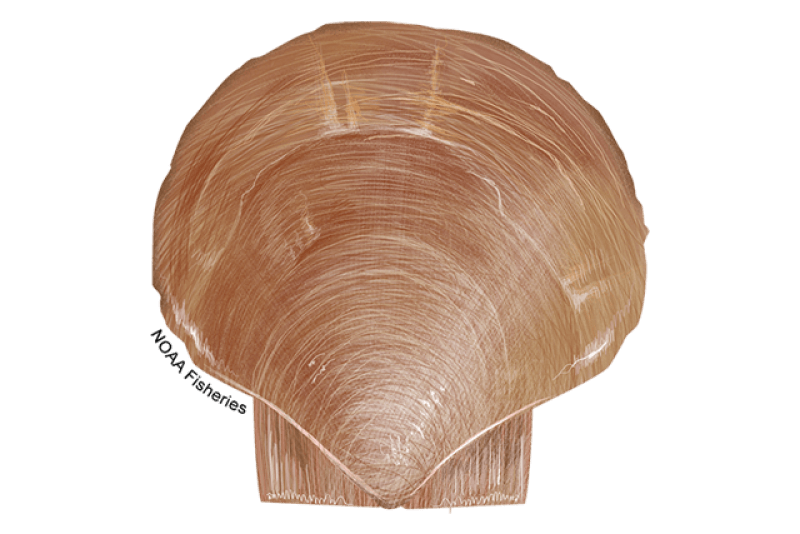
Sea scallops have a saucer-shaped shell with scalloped or fluted edges.
The upper shell is usually reddish-pink or brown in color.
The lower shell is white or cream.
A small percentage (5–10 percent) of sea scallops are albinos, with white upper and lower shells.
Appearance
Sea scallops can live up to 20 years.
They grow quickly for the first few years of their life.
The largest scallop ever reported was about 9 inches in shell height, but they typically don’t grow larger than 6 inches.
Sea scallops can reproduce by age 2, but don’t produce many eggs or sperm until they are about 4 years old.
They are very fertile—a female sea scallop can produce hundreds of millions of eggs per year.
For this reason, scallops may respond more rapidly to management actions than species that reproduce slowly and in small numbers.
Sea scallops usually spawn in late summer or early fall.
They also may spawn in the spring, especially in the Mid-Atlantic Bight.
After hatching, scallop larvae remain in the water column for 4 to 6 weeks before settling on the ocean floor.
Sea scallops feed by filtering phytoplankton or other small organisms out of the water column, which can actually help to improve water quality by removing suspended materials.
Many kinds of pelagic fish and invertebrates eat scallop larvae.
Cod, wolffish, eel pout, flounder, crabs, lobster, sea turtles, and sea stars feed on juvenile and adult scallops.
Using its adductor muscle to snap its top and bottom shells open and shut, a sea scallop can propel itself through the water.
This helps them escape predators, such as sea stars, that other bivalves like mussels, clams, and oysters can’t avoid.
Where They Live Range Atlantic sea scallops are found in the Northwest Atlantic Ocean, from Newfoundland to Cape Hatteras, North Carolina.
Habitat Adult scallops live close together in groups called “beds,” on sandy or gravelly parts of the ocean floor.
They are generally found at depths of about 100 to 300 feet on Georges Bank and in the Mid-Atlantic.
Sea scallops can be found in shallower waters in Maine and Canada.
Fishery Management NOAA Fisheries and the New England Fishery Management Council manage the Atlantic sea scallop fishery.
Managed under the Atlantic Sea Scallop Fishery Management Plan : Managers determine a total allowable catch for the scallop fishery based on estimates of the scallop population.
They allocate this catch amount to different groups of the fishery, depending on their permit type and historical catch, through days-at-sea and number of trips to special access areas.
Other management measures include: Limits on crew size.
Areas closed to scallop dredging to allow young scallops to grow large and reproduce, and to reduce bycatch of non-targeted species.
Vessels harvesting scallops must use vessel monitoring systems (a satellite communications system used to monitor fishing activities).
Individual Fishing Quotas (IFQs), a type of catch share program, for Limited Access General Category permit holders.
There is a sea scallop fishery in the Gulf of Maine that operates in both federal and state waters.
This fishery primarily occurs in Maine state waters and is managed by the state through gear and seasonal restrictions and rotational closures.
The federal component of the fishery is managed through daily catch limits and gear restrictions.
Harvest Commercial fishery: In 2024, commercial landings of Atlantic sea scallop totaled 21.2 million pounds of sea scallop meats and were valued at $332 million, according to the NOAA Fisheries commercial fishing landings database .
Scallop vessels from Massachusetts, Virginia, and New Jersey are responsible for the majority of the U.S. harvest.
The principal U.S. commercial fisheries for sea scallop are in the Mid-Atlantic (from Virginia to Long Island, New York) and on Georges Bank and neighboring areas, such as the Great South Channel and Nantucket Shoals.
There is also a small, primarily inshore fishery for sea scallops in the Gulf of Maine.
The U.S. sea scallop fishery is extremely important to the U.S. economy and is the largest wild scallop fishery in the world.
Gear types, habitat impacts, and bycatch: U.S. commercial fishermen harvest sea scallops year-round, primarily using turtle deflector–style scallop dredges that catch scallops much like rakes collect leaves.
A small number of fishermen use otter trawls, mostly in the Mid-Atlantic.
Divers and Digby dredges are sometimes used in near-shore areas in the Gulf of Maine.
The bottom fishing gears used to harvest scallops, such as dredges and trawls, can remove some bottom habitat–forming organisms, including tubeworms and sponges.
Managers have implemented a variety of measures to protect habitat from potential impacts of fishing gear: Several areas are closed year-round to harvesting scallops to protect sensitive habitat.
Managers have implemented a rotational access area program, which restricts where and when scallop vessels can fish, benefitting both habitat and scallop populations.
Fishermen use 4-inch rings in their scallop dredges that increase the dredges’ efficiency, catching larger scallops and allowing smaller scallops and other small marine life to return to the sea floor by passing through the dredge rings.
The 4-inch rings reduce the amount of time dredges contact the bottom.
Sea turtles, finfish (such as yellowtail flounder, skates, and monkfish), and undersized scallops can be incidentally caught in the scallop fishery.
Managers seasonally prohibit fishing in areas where finfish species congregate, reducing catch of these untargeted species.
Scallop fishermen receive annual allocations of windowpane and yellowtail flounder that they can catch.
If the catches are exceeded, managers will implement measures to minimize catch of these species in a future fishing year (e.g., gear restrictions and seasonal closures).
Scallop vessels in the Mid-Atlantic must use a turtle deflector dredge and chain mat when and where sea turtles occur on scallop grounds.
The turtle deflector dredge excludes sea turtles from being caught in the dredge and prevents serious injuries to the turtles.
Scallop dredges using “twine-tops” must adhere to gear modifications designed to allow fish to escape.
Research and experimentation with different techniques and gears, as well as education efforts, have helped reduce bycatch.
Managers and the fishing industry continue to collaborate to redesign scallop dredges to reduce flounder bycatch and to minimize injuries to and capture of sea turtles.
Scientific Classification Kingdom Animalia Phylum Mollusca Class Bivalvia Order Pectinida Family Pectinidae Genus Placopecten Species magellanicus Last updated by NOAA Fisheries on 06/29/2026
Biology
Atlantic sea scallops are found in the Northwest Atlantic Ocean, from Newfoundland to Cape Hatteras, North Carolina.
Habitat Adult scallops live close together in groups called “beds,” on sandy or gravelly parts of the ocean floor.
They are generally found at depths of about 100 to 300 feet on Georges Bank and in the Mid-Atlantic.
Sea scallops can be found in shallower waters in Maine and Canada.
Fishery Management NOAA Fisheries and the New England Fishery Management Council manage the Atlantic sea scallop fishery.
Managed under the Atlantic Sea Scallop Fishery Management Plan : Managers determine a total allowable catch for the scallop fishery based on estimates of the scallop population.
They allocate this catch amount to different groups of the fishery, depending on their permit type and historical catch, through days-at-sea and number of trips to special access areas.
Other management measures include: Limits on crew size.
Areas closed to scallop dredging to allow young scallops to grow large and reproduce, and to reduce bycatch of non-targeted species.
Vessels harvesting scallops must use vessel monitoring systems (a satellite communications system used to monitor fishing activities).
Individual Fishing Quotas (IFQs), a type of catch share program, for Limited Access General Category permit holders.
There is a sea scallop fishery in the Gulf of Maine that operates in both federal and state waters.
This fishery primarily occurs in Maine state waters and is managed by the state through gear and seasonal restrictions and rotational closures.
The federal component of the fishery is managed through daily catch limits and gear restrictions.
Harvest Commercial fishery: In 2024, commercial landings of Atlantic sea scallop totaled 21.2 million pounds of sea scallop meats and were valued at $332 million, according to the NOAA Fisheries commercial fishing landings database .
Scallop vessels from Massachusetts, Virginia, and New Jersey are responsible for the majority of the U.S. harvest.
The principal U.S. commercial fisheries for sea scallop are in the Mid-Atlantic (from Virginia to Long Island, New York) and on Georges Bank and neighboring areas, such as the Great South Channel and Nantucket Shoals.
There is also a small, primarily inshore fishery for sea scallops in the Gulf of Maine.
The U.S. sea scallop fishery is extremely important to the U.S. economy and is the largest wild scallop fishery in the world.
Gear types, habitat impacts, and bycatch: U.S. commercial fishermen harvest sea scallops year-round, primarily using turtle deflector–style scallop dredges that catch scallops much like rakes collect leaves.
A small number of fishermen use otter trawls, mostly in the Mid-Atlantic.
Divers and Digby dredges are sometimes used in near-shore areas in the Gulf of Maine.
The bottom fishing gears used to harvest scallops, such as dredges and trawls, can remove some bottom habitat–forming organisms, including tubeworms and sponges.
Managers have implemented a variety of measures to protect habitat from potential impacts of fishing gear: Several areas are closed year-round to harvesting scallops to protect sensitive habitat.
Managers have implemented a rotational access area program, which restricts where and when scallop vessels can fish, benefitting both habitat and scallop populations.
Fishermen use 4-inch rings in their scallop dredges that increase the dredges’ efficiency, catching larger scallops and allowing smaller scallops and other small marine life to return to the sea floor by passing through the dredge rings.
The 4-inch rings reduce the amount of time dredges contact the bottom.
Sea turtles, finfish (such as yellowtail flounder, skates, and monkfish), and undersized scallops can be incidentally caught in the scallop fishery.
Managers seasonally prohibit fishing in areas where finfish species congregate, reducing catch of these untargeted species.
Scallop fishermen receive annual allocations of windowpane and yellowtail flounder that they can catch.
If the catches are exceeded, managers will implement measures to minimize catch of these species in a future fishing year (e.g., gear restrictions and seasonal closures).
Scallop vessels in the Mid-Atlantic must use a turtle deflector dredge and chain mat when and where sea turtles occur on scallop grounds.
The turtle deflector dredge excludes sea turtles from being caught in the dredge and prevents serious injuries to the turtles.
Scallop dredges using “twine-tops” must adhere to gear modifications designed to allow fish to escape.
Research and experimentation with different techniques and gears, as well as education efforts, have helped reduce bycatch.
Managers and the fishing industry continue to collaborate to redesign scallop dredges to reduce flounder bycatch and to minimize injuries to and capture of sea turtles.
Scientific Classification Kingdom Animalia Phylum Mollusca Class Bivalvia Order Pectinida Family Pectinidae Genus Placopecten Species magellanicus Last updated by NOAA Fisheries on 06/29/2026
Where they live
Range
Atlantic sea scallops are found in the Northwest Atlantic Ocean, from Newfoundland to Cape Hatteras, North Carolina.
Habitat Adult scallops live close together in groups called “beds,” on sandy or gravelly parts of the ocean floor.
Habitat
NOAA Fisheries and the New England Fishery Management Council manage the Atlantic sea scallop fishery.
Managed under the Atlantic Sea Scallop Fishery Management Plan : Managers determine a total allowable catch for the scallop fishery based on estimates of the scallop population.
They allocate this catch amount to different groups of the fishery, depending on their permit type and historical catch, through days-at-sea and number of trips to special access areas.
Other management measures include: Limits on crew size.
Areas closed to scallop dredging to allow young scallops to grow large and reproduce, and to reduce bycatch of non-targeted species.
Vessels harvesting scallops must use vessel monitoring systems (a satellite communications system used to monitor fishing activities).
Individual Fishing Quotas (IFQs), a type of catch share program, for Limited Access General Category permit holders.
There is a sea scallop fishery in the Gulf of Maine that operates in both federal and state waters.
This fishery primarily occurs in Maine state waters and is managed by the state through gear and seasonal restrictions and rotational closures.
The federal component of the fishery is managed through daily catch limits and gear restrictions.
Harvest Commercial fishery: In 2024, commercial landings of Atlantic sea scallop totaled 21.2 million pounds of sea scallop meats and were valued at $332 million, according to the NOAA Fisheries commercial fishing landings database .
Scallop vessels from Massachusetts, Virginia, and New Jersey are responsible for the majority of the U.S. harvest.
The principal U.S. commercial fisheries for sea scallop are in the Mid-Atlantic (from Virginia to Long Island, New York) and on Georges Bank and neighboring areas, such as the Great South Channel and Nantucket Shoals.
There is also a small, primarily inshore fishery for sea scallops in the Gulf of Maine.
The U.S. sea scallop fishery is extremely important to the U.S. economy and is the largest wild scallop fishery in the world.
Gear types, habitat impacts, and bycatch: U.S. commercial fishermen harvest sea scallops year-round, primarily using turtle deflector–style scallop dredges that catch scallops much like rakes collect leaves.
A small number of fishermen use otter trawls, mostly in the Mid-Atlantic.
Divers and Digby dredges are sometimes used in near-shore areas in the Gulf of Maine.
The bottom fishing gears used to harvest scallops, such as dredges and trawls, can remove some bottom habitat–forming organisms, including tubeworms and sponges.
Managers have implemented a variety of measures to protect habitat from potential impacts of fishing gear: Several areas are closed year-round to harvesting scallops to protect sensitive habitat.
Managers have implemented a rotational access area program, which restricts where and when scallop vessels can fish, benefitting both habitat and scallop populations.
Fishermen use 4-inch rings in their scallop dredges that increase the dredges’ efficiency, catching larger scallops and allowing smaller scallops and other small marine life to return to the sea floor by passing through the dredge rings.
The 4-inch rings reduce the amount of time dredges contact the bottom.
Sea turtles, finfish (such as yellowtail flounder, skates, and monkfish), and undersized scallops can be incidentally caught in the scallop fishery.
Managers seasonally prohibit fishing in areas where finfish species congregate, reducing catch of these untargeted species.
Scallop fishermen receive annual allocations of windowpane and yellowtail flounder that they can catch.
If the catches are exceeded, managers will implement measures to minimize catch of these species in a future fishing year (e.g., gear restrictions and seasonal closures).
Scallop vessels in the Mid-Atlantic must use a turtle deflector dredge and chain mat when and where sea turtles occur on scallop grounds.
The turtle deflector dredge excludes sea turtles from being caught in the dredge and prevents serious injuries to the turtles.
Scallop dredges using “twine-tops” must adhere to gear modifications designed to allow fish to escape.
Research and experimentation with different techniques and gears, as well as education efforts, have helped reduce bycatch.
Managers and the fishing industry continue to collaborate to redesign scallop dredges to reduce flounder bycatch and to minimize injuries to and capture of sea turtles.
Scientific Classification Kingdom Animalia Phylum Mollusca Class Bivalvia Order Pectinida Family Pectinidae Genus Placopecten Species magellanicus Last updated by NOAA Fisheries on 06/29/2026
Ocean City & Mid-Atlantic context
From Ocean City, Maryland, use this Atlantic Sea Scallop profile as NOAA Mid-Atlantic directory context—not a promise you will meet the species on every charter.
Always verify current Maryland and federal size, season, and bag rules for your exact date and coordinates before you keep any catch.
Source facts and imagery are adapted from the NOAA Fisheries species profile for Atlantic Sea Scallop.
What charter to book from Ocean City
Atlantic Sea Scallop is more of a bay, inshore, or specialty harvest story than a typical OC six-pack trolling day—match the trip type to the animal.
Possible / related
Bay guide — Possible overlap depending on season, water, and boat program.
Inshore charter — Possible overlap depending on season, water, and boat program.
Commercial fishery: In 2024, commercial landings of Atlantic sea scallop totaled 21.2 million pounds of sea scallop meats and were valued at $332 million, according to the NOAA Fisheries commercial fishing landings database .
Scallop vessels from Massachusetts, Virginia, and New Jersey are responsible for the majority of the U.S. harvest.
The principal U.S. commercial fisheries for sea scallop are in the Mid-Atlantic (from Virginia to Long Island, New York) and on Georges Bank and neighboring areas, such as the Great South Channel and Nantucket Shoals.
There is also a small, primarily inshore fishery for sea scallops in the Gulf of Maine.
The U.S. sea scallop fishery is extremely important to the U.S. economy and is the largest wild scallop fishery in the world.
Gear types, habitat impacts, and bycatch: U.S. commercial fishermen harvest sea scallops year-round, primarily using turtle deflector–style scallop dredges that catch scallops much like rakes collect leaves.
A small number of fishermen use otter trawls, mostly in the Mid-Atlantic.
Divers and Digby dredges are sometimes used in near-shore areas in the Gulf of Maine.
Harvest
See the NOAA wild-caught fishery section for landings and gear notes when published for this species.
Landings and management details matter most for the waters where Atlantic Sea Scallop is actually fished—see the
NOAA species profile
.
Seafood facts
Fact
Detail
Availability
Year-round.
Source
U.S. wild-caught from Maine to North Carolina.
Taste
Sea scallops have a sweet, rich taste that can be mild or briny.
Texture
Firm and lean.
Color
Raw scallops are shiny and creamy white, sometimes with an orange or pinkish tint (a natural variation that does not affect taste or quality). High-quality scallops have an ivory translucence and should keep their shape.
Health
Scallops are a good low-fat source of protein and are high in selenium and B vitamins.
After a real OC boat day or market stop for Atlantic Sea Scallop, Seafood after boat days covers
dock buffer and cook-your-catch pacing.