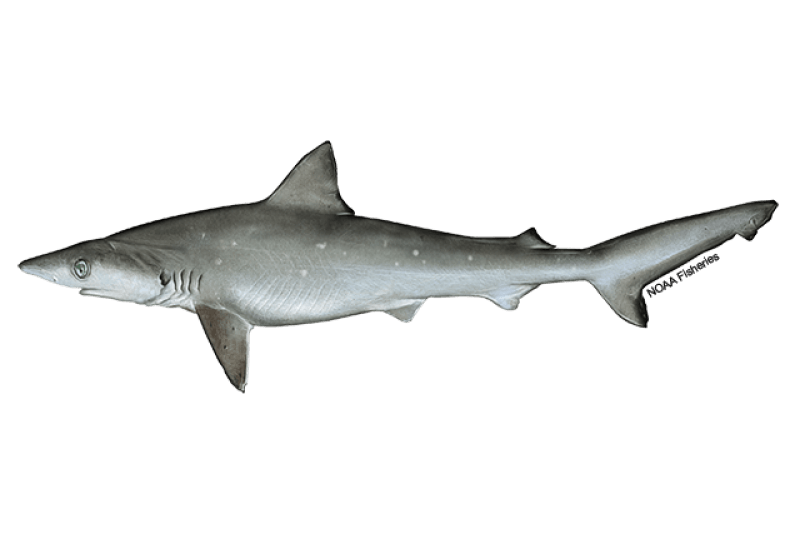
Rhizoprionodon terraenovae , also known as Newfoundland shark, Sharp-nosed shark, White shark. U.S. wild-caught Atlantic sharpnose shark is a smart seafood choice because it is sustainably managed and responsibly harvested under U.S. regulations.
Source: Species facts, status language, and imagery adapted from the NOAA Fisheries species profile (last updated 06/29/2026). Ocean City charter and Maryland
record notes are editorial orientation for OCEANCITY.MD readers. Always confirm current seasons, sizes, and
bag limits before you fish—rules change.
U.S. wild-caught Atlantic sharpnose shark is a smart seafood choice because it is sustainably managed and responsibly harvested under U.S. regulations.
Maryland record catch
Confirm whether Maryland DNR publishes an Atlantic state-record category for Atlantic Sharpnose Shark on the current sport-fish record board.
Maryland’s Atlantic recreational seasons/sizes/creel summary does not publish a dedicated line for Atlantic Sharpnose Shark. Verify COMAR, DNR public notices, and federal rules for your exact waters before you keep fish.
Rule
Maryland / applicable detail
Maryland minimum size
Not listed — no dedicated Atlantic Sharpnose Shark line on the MD Atlantic recreational table
Maryland daily creel (bag)
Not listed — no MD species-specific bag for Atlantic Sharpnose Shark
Maryland open season
Not listed on the MD Atlantic Ocean / Coastal Bays summary table
Verify
Check DNR eRegulations, COMAR, and NOAA for your date and coordinates before you keep fish.
Atlantic sharpnose sharks are small for sharks and have a streamlined body. They get their name from their long, pointy snout. They are several different shades of gray and have a white underside. Adults have white spots on their sides and white along the edges of their pectoral fins. Young sharks have black on their dorsal (back) and caudal (tail) fin edges. The lower and upper jaws of an Atlantic sharpnose shark have 24 or 25 rows of triangular teeth. Biology Atlantic sharpnose sharks can grow to up to 32 inches in length. They grow and mature at different rates in the Atlantic and Gulf of America. Females mature at around 2 years old in the Atlantic when they reach approximately 24 inches in length, and at around 1.3 years old in the Gulf of America when they are approximately 25 inches in length. Atlantic sharpnose sharks have been observed to live up to 18 years. In both the Atlantic and Gulf of America, Atlantic sharpnose sharks mate annually between mid-May and mid-July in inshore waters. After mating they migrate offshore to deeper waters. The mother feeds the pups through a placental sac and after a gestation period of 10 to 11 months the females return to nearshore areas to give birth in June. Litters average approximately four pups in both the Gulf of America and Atlantic. Atlantic sharpnose sharks eat small fish, including menhaden, eels, silversides, wrasses, jacks, toadfish, and filefish. They also eat worms, shrimp, crabs, and mollusks. Large carnivorous fish, including large sharks, eat Atlantic sharpnose sharks. Where They Live Range Atlantic sharpnose sharks are commonly found in the western Atlantic from New Brunswick, Canada through the Gulf of America and are commonly caught in U.S. waters from Virginia to Texas. Habitat Atlantic sharpnose sharks live in both warm-temperate and tropical waters, from the Bay of Fundy to the Yucatan. They can be found as deep as 920 feet, but mostly remain in waters less than 32 feet deep. They are commonly found in bays, estuaries, harbors, and the surf zone (area where waves break, commonly at 16 to 32 feet deep), mostly over mud and sand bottoms. Atlantic sharpnose sharks seasonally migrate between inshore and offshore waters, moving to deeper offshore waters in winter and returning to inshore waters in spring to mate and give birth. During migrations, they form large schools separated by sex. Fishery Management NOAA Fisheries and the Atlantic Highly Migratory Species Division manage the Atlantic sharpnose shark fishery. Managed under the Consolidated Highly Migratory Species Fishery Management Plan : Permits are required, and only a limited number of permits are available. Commercial quotas and limits on how many sharks can be landed per fishing trip. Gear restrictions and requirements. Fishing season is generally year-round, but the sharpnose shark fishery, managed as part of the non-blacknose small coastal shark management group, may close when the landings are projected to reach 80 percent of the quota. Shark dealers are required to attend Atlantic shark identification workshops to help them better identify shark species. There are more than 20 species of sharks that cannot be landed (e.g., white, dusky, basking, longfin mako, night) and some of these species look similar to the species that can be landed. The recreational shark identification can help with identification. The Shark Conservation Act requires that Atlantic sharpnose sharks be brought to shore with their fins naturally attached. Compliance guides are available for all commercial and recreational regulations across Atlantic highly migratory species fisheries. There are no international management measures for Atlantic sharpnose sharks. Harvest Commercial fishery: To commercially harvest Atlantic sharks, vessel owners must obtain a valid Atlantic shark directed or incidental limited access permit or a smoothhound shark open access permit. More information regarding limited access permits can be found in the Atlantic HMS commercial compliance guide . Atlantic sharpnose shark belong to the small coastal shark (SCS) complex. For SCS sharks, there is no retention limit per vessel per trip for commercial fishermen with a directed permit. They are harvested primarily off the east coast of Florida and North Carolina. Their meat is sold as seafood and also used by fishermen as bait for other larger species of shark. Gear types, habitat impacts, and bycatch: Commercial fishermen primarily use gillnet and bottom longline gear, which have minimal impacts on habitat due to how and where they are deployed. These gear types sometimes interact with sea turtles, marine mammals, and the endangered smalltooth sawfish. Several measures are in place to protect species that may be caught unintentionally in Atlantic sharpnose shark fisheries. Fishermen using bottom longline or gillnet gear must complete a protected species safe handling, release, and identification workshop , and all bottom longline vessels must carry sea turtle handling and release gear on board. To reduce bycatch of finfish, including Atlantic sharpnose shark, shrimp trawlers are required to use bycatch reduction devices , which are designed to retain shrimp but allow fish to exit the net. Recreational fishery: Recreational fishermen primarily use rod and reel gear, which have minimal impacts on habitat and bycatch. Recreational fishermen must have an Atlantic HMS permit to harvest Atlantic sharpnose sharks in federal waters. As of January 1, 2018, all HMS recreational permit holders will need a “shark endorsement” to fish for, retain, possess, or land sharks. Fishermen fishing recreationally for sharks will be required to use circle hook in most places. For more information regarding these requirements, please refer to HMS regulations and the Amendment 5b compliance guide . There is no minimum size for Atlantic sharpnose sharks.
*Executive Order 14172, “Restoring Names That Honor American Greatness” (Jan. 20, 2025), directs that the Gulf of Mexico be renamed the Gulf of America. On August 7, 2025, NOAA Fisheries and the National Ocean Service amended regulations in the Code of Federal Regulations to reflect the renaming. The name change did not result in any changes to, and had no effect on the applicability or enforceability of, any existing regulations. This website continues to use “Gulf of Mexico” when quoting statutes or previously published materials.
Scientific Classification Kingdom Animalia Phylum Chordata Class Chondrichthyes Order Carcharhiniformes Family Carcharhinidae Genus Rhizoprionodon Species terraenovae Last updated by NOAA Fisheries on 06/29/2026
Appearance
Atlantic sharpnose sharks can grow to up to 32 inches in length. They grow and mature at different rates in the Atlantic and Gulf of America. Females mature at around 2 years old in the Atlantic when they reach approximately 24 inches in length, and at around 1.3 years old in the Gulf of America when they are approximately 25 inches in length. Atlantic sharpnose sharks have been observed to live up to 18 years. In both the Atlantic and Gulf of America, Atlantic sharpnose sharks mate annually between mid-May and mid-July in inshore waters. After mating they migrate offshore to deeper waters. The mother feeds the pups through a placental sac and after a gestation period of 10 to 11 months the females return to nearshore areas to give birth in June. Litters average approximately four pups in both the Gulf of America and Atlantic. Atlantic sharpnose sharks eat small fish, including menhaden, eels, silversides, wrasses, jacks, toadfish, and filefish. They also eat worms, shrimp, crabs, and mollusks. Large carnivorous fish, including large sharks, eat Atlantic sharpnose sharks. Where They Live Range Atlantic sharpnose sharks are commonly found in the western Atlantic from New Brunswick, Canada through the Gulf of America and are commonly caught in U.S. waters from Virginia to Texas. Habitat Atlantic sharpnose sharks live in both warm-temperate and tropical waters, from the Bay of Fundy to the Yucatan. They can be found as deep as 920 feet, but mostly remain in waters less than 32 feet deep. They are commonly found in bays, estuaries, harbors, and the surf zone (area where waves break, commonly at 16 to 32 feet deep), mostly over mud and sand bottoms. Atlantic sharpnose sharks seasonally migrate between inshore and offshore waters, moving to deeper offshore waters in winter and returning to inshore waters in spring to mate and give birth. During migrations, they form large schools separated by sex. Fishery Management NOAA Fisheries and the Atlantic Highly Migratory Species Division manage the Atlantic sharpnose shark fishery. Managed under the Consolidated Highly Migratory Species Fishery Management Plan : Permits are required, and only a limited number of permits are available. Commercial quotas and limits on how many sharks can be landed per fishing trip. Gear restrictions and requirements. Fishing season is generally year-round, but the sharpnose shark fishery, managed as part of the non-blacknose small coastal shark management group, may close when the landings are projected to reach 80 percent of the quota. Shark dealers are required to attend Atlantic shark identification workshops to help them better identify shark species. There are more than 20 species of sharks that cannot be landed (e.g., white, dusky, basking, longfin mako, night) and some of these species look similar to the species that can be landed. The recreational shark identification can help with identification. The Shark Conservation Act requires that Atlantic sharpnose sharks be brought to shore with their fins naturally attached. Compliance guides are available for all commercial and recreational regulations across Atlantic highly migratory species fisheries. There are no international management measures for Atlantic sharpnose sharks. Harvest Commercial fishery: To commercially harvest Atlantic sharks, vessel owners must obtain a valid Atlantic shark directed or incidental limited access permit or a smoothhound shark open access permit. More information regarding limited access permits can be found in the Atlantic HMS commercial compliance guide . Atlantic sharpnose shark belong to the small coastal shark (SCS) complex. For SCS sharks, there is no retention limit per vessel per trip for commercial fishermen with a directed permit. They are harvested primarily off the east coast of Florida and North Carolina. Their meat is sold as seafood and also used by fishermen as bait for other larger species of shark. Gear types, habitat impacts, and bycatch: Commercial fishermen primarily use gillnet and bottom longline gear, which have minimal impacts on habitat due to how and where they are deployed. These gear types sometimes interact with sea turtles, marine mammals, and the endangered smalltooth sawfish. Several measures are in place to protect species that may be caught unintentionally in Atlantic sharpnose shark fisheries. Fishermen using bottom longline or gillnet gear must complete a protected species safe handling, release, and identification workshop , and all bottom longline vessels must carry sea turtle handling and release gear on board. To reduce bycatch of finfish, including Atlantic sharpnose shark, shrimp trawlers are required to use bycatch reduction devices , which are designed to retain shrimp but allow fish to exit the net. Recreational fishery: Recreational fishermen primarily use rod and reel gear, which have minimal impacts on habitat and bycatch. Recreational fishermen must have an Atlantic HMS permit to harvest Atlantic sharpnose sharks in federal waters. As of January 1, 2018, all HMS recreational permit holders will need a “shark endorsement” to fish for, retain, possess, or land sharks. Fishermen fishing recreationally for sharks will be required to use circle hook in most places. For more information regarding these requirements, please refer to HMS regulations and the Amendment 5b compliance guide . There is no minimum size for Atlantic sharpnose sharks.
*Executive Order 14172, “Restoring Names That Honor American Greatness” (Jan. 20, 2025), directs that the Gulf of Mexico be renamed the Gulf of America. On August 7, 2025, NOAA Fisheries and the National Ocean Service amended regulations in the Code of Federal Regulations to reflect the renaming. The name change did not result in any changes to, and had no effect on the applicability or enforceability of, any existing regulations. This website continues to use “Gulf of Mexico” when quoting statutes or previously published materials.
Scientific Classification Kingdom Animalia Phylum Chordata Class Chondrichthyes Order Carcharhiniformes Family Carcharhinidae Genus Rhizoprionodon Species terraenovae Last updated by NOAA Fisheries on 06/29/2026
Biology
Atlantic sharpnose sharks are commonly found in the western Atlantic from New Brunswick, Canada through the Gulf of America and are commonly caught in U.S. waters from Virginia to Texas. Habitat Atlantic sharpnose sharks live in both warm-temperate and tropical waters, from the Bay of Fundy to the Yucatan. They can be found as deep as 920 feet, but mostly remain in waters less than 32 feet deep. They are commonly found in bays, estuaries, harbors, and the surf zone (area where waves break, commonly at 16 to 32 feet deep), mostly over mud and sand bottoms. Atlantic sharpnose sharks seasonally migrate between inshore and offshore waters, moving to deeper offshore waters in winter and returning to inshore waters in spring to mate and give birth. During migrations, they form large schools separated by sex. Fishery Management NOAA Fisheries and the Atlantic Highly Migratory Species Division manage the Atlantic sharpnose shark fishery. Managed under the Consolidated Highly Migratory Species Fishery Management Plan : Permits are required, and only a limited number of permits are available. Commercial quotas and limits on how many sharks can be landed per fishing trip. Gear restrictions and requirements. Fishing season is generally year-round, but the sharpnose shark fishery, managed as part of the non-blacknose small coastal shark management group, may close when the landings are projected to reach 80 percent of the quota. Shark dealers are required to attend Atlantic shark identification workshops to help them better identify shark species. There are more than 20 species of sharks that cannot be landed (e.g., white, dusky, basking, longfin mako, night) and some of these species look similar to the species that can be landed. The recreational shark identification can help with identification. The Shark Conservation Act requires that Atlantic sharpnose sharks be brought to shore with their fins naturally attached. Compliance guides are available for all commercial and recreational regulations across Atlantic highly migratory species fisheries. There are no international management measures for Atlantic sharpnose sharks. Harvest Commercial fishery: To commercially harvest Atlantic sharks, vessel owners must obtain a valid Atlantic shark directed or incidental limited access permit or a smoothhound shark open access permit. More information regarding limited access permits can be found in the Atlantic HMS commercial compliance guide . Atlantic sharpnose shark belong to the small coastal shark (SCS) complex. For SCS sharks, there is no retention limit per vessel per trip for commercial fishermen with a directed permit. They are harvested primarily off the east coast of Florida and North Carolina. Their meat is sold as seafood and also used by fishermen as bait for other larger species of shark. Gear types, habitat impacts, and bycatch: Commercial fishermen primarily use gillnet and bottom longline gear, which have minimal impacts on habitat due to how and where they are deployed. These gear types sometimes interact with sea turtles, marine mammals, and the endangered smalltooth sawfish. Several measures are in place to protect species that may be caught unintentionally in Atlantic sharpnose shark fisheries. Fishermen using bottom longline or gillnet gear must complete a protected species safe handling, release, and identification workshop , and all bottom longline vessels must carry sea turtle handling and release gear on board. To reduce bycatch of finfish, including Atlantic sharpnose shark, shrimp trawlers are required to use bycatch reduction devices , which are designed to retain shrimp but allow fish to exit the net. Recreational fishery: Recreational fishermen primarily use rod and reel gear, which have minimal impacts on habitat and bycatch. Recreational fishermen must have an Atlantic HMS permit to harvest Atlantic sharpnose sharks in federal waters. As of January 1, 2018, all HMS recreational permit holders will need a “shark endorsement” to fish for, retain, possess, or land sharks. Fishermen fishing recreationally for sharks will be required to use circle hook in most places. For more information regarding these requirements, please refer to HMS regulations and the Amendment 5b compliance guide . There is no minimum size for Atlantic sharpnose sharks.
*Executive Order 14172, “Restoring Names That Honor American Greatness” (Jan. 20, 2025), directs that the Gulf of Mexico be renamed the Gulf of America. On August 7, 2025, NOAA Fisheries and the National Ocean Service amended regulations in the Code of Federal Regulations to reflect the renaming. The name change did not result in any changes to, and had no effect on the applicability or enforceability of, any existing regulations. This website continues to use “Gulf of Mexico” when quoting statutes or previously published materials.
Scientific Classification Kingdom Animalia Phylum Chordata Class Chondrichthyes Order Carcharhiniformes Family Carcharhinidae Genus Rhizoprionodon Species terraenovae Last updated by NOAA Fisheries on 06/29/2026
Where they live
Range
Atlantic sharpnose sharks are commonly found in the western Atlantic from New Brunswick, Canada through the Gulf of America and are commonly caught in U.S. waters from Virginia to Texas. Habitat Atlantic sharpnose sharks live in both warm-temperate and tropical waters, from the Bay of Fundy to the Yucatan. They can be found as deep as 920 feet, but mostly remain in waters less than 32 feet deep. They are commonly found in bays, estuaries, harbors, and the surf zone (area where waves break, commonly at 16 to 32 feet deep), mostly over mud and sand bottoms. Atlantic sharpnose sharks seasonally migrate between inshore and offshore waters, moving to deeper offshore waters in winter and returning to inshore waters in spring to mate and give birth. During migrations, they form large schools separated by sex. Fishery Management NOAA Fisheries and the Atlantic Highly Migratory Species Division manage the Atlantic sharpnose shark fishery. Managed under the Consolidated Highly Migratory Species Fishery Management Plan : Permits are required, and only a limited number of permits are available. Commercial quotas and limits on how many sharks can be landed per fishing trip. Gear restrictions and requirements. Fishing season is generally year-round, but the sharpnose shark fishery, managed as part of the non-blacknose small coastal shark management group, may close when the landings are projected to reach 80 percent of the quota. Shark dealers are required to attend Atlantic shark identification workshops to help them better identify shark species. There are more than 20 species of sharks that cannot be landed (e.g., white, dusky, basking, longfin mako, night) and some of these species look similar to the species that can be landed. The recreational shark identification can help with identification. The Shark Conservation Act requires that Atlantic sharpnose sharks be brought to shore with their fins naturally attached. Compliance guides are available for all commercial and recreational regulations across Atlantic highly migratory species fisheries. There are no international management measures for Atlantic sharpnose sharks. Harvest Commercial fishery: To commercially harvest Atlantic sharks, vessel owners must obtain a valid Atlantic shark directed or incidental limited access permit or a smoothhound shark open access permit. More information regarding limited access permits can be found in the Atlantic HMS commercial compliance guide . Atlantic sharpnose shark belong to the small coastal shark (SCS) complex. For SCS sharks, there is no retention limit per vessel per trip for commercial fishermen with a directed permit. They are harvested primarily off the east coast of Florida and North Carolina. Their meat is sold as seafood and also used by fishermen as bait for other larger species of shark. Gear types, habitat impacts, and bycatch: Commercial fishermen primarily use gillnet and bottom longline gear, which have minimal impacts on habitat due to how and where they are deployed. These gear types sometimes interact with sea turtles, marine mammals, and the endangered smalltooth sawfish. Several measures are in place to protect species that may be caught unintentionally in Atlantic sharpnose shark fisheries. Fishermen using bottom longline or gillnet gear must complete a protected species safe handling, release, and identification workshop , and all bottom longline vessels must carry sea turtle handling and release gear on board. To reduce bycatch of finfish, including Atlantic sharpnose shark, shrimp trawlers are required to use bycatch reduction devices , which are designed to retain shrimp but allow fish to exit the net. Recreational fishery: Recreational fishermen primarily use rod and reel gear, which have minimal impacts on habitat and bycatch. Recreational fishermen must have an Atlantic HMS permit to harvest Atlantic sharpnose sharks in federal waters. As of January 1, 2018, all HMS recreational permit holders will need a “shark endorsement” to fish for, retain, possess, or land sharks. Fishermen fishing recreationally for sharks will be required to use circle hook in most places. For more information regarding these requirements, please refer to HMS regulations and the Amendment 5b compliance guide . There is no minimum size for Atlantic sharpnose sharks.
*Executive Order 14172, “Restoring Names That Honor American Greatness” (Jan. 20, 2025), directs that the Gulf of Mexico be renamed the Gulf of America. On August 7, 2025, NOAA Fisheries and the National Ocean Service amended regulations in the Code of Federal Regulations to reflect the renaming. The name change did not result in any changes to, and had no effect on the applicability or enforceability of, any existing regulations. This website continues to use “Gulf of Mexico” when quoting statutes or previously published materials.
Habitat
NOAA Fisheries and the Atlantic Highly Migratory Species Division manage the Atlantic sharpnose shark fishery. Managed under the Consolidated Highly Migratory Species Fishery Management Plan : Permits are required, and only a limited number of permits are available. Commercial quotas and limits on how many sharks can be landed per fishing trip. Gear restrictions and requirements. Fishing season is generally year-round, but the sharpnose shark fishery, managed as part of the non-blacknose small coastal shark management group, may close when the landings are projected to reach 80 percent of the quota. Shark dealers are required to attend Atlantic shark identification workshops to help them better identify shark species. There are more than 20 species of sharks that cannot be landed (e.g., white, dusky, basking, longfin mako, night) and some of these species look similar to the species that can be landed. The recreational shark identification can help with identification. The Shark Conservation Act requires that Atlantic sharpnose sharks be brought to shore with their fins naturally attached. Compliance guides are available for all commercial and recreational regulations across Atlantic highly migratory species fisheries. There are no international management measures for Atlantic sharpnose sharks. Harvest Commercial fishery: To commercially harvest Atlantic sharks, vessel owners must obtain a valid Atlantic shark directed or incidental limited access permit or a smoothhound shark open access permit. More information regarding limited access permits can be found in the Atlantic HMS commercial compliance guide . Atlantic sharpnose shark belong to the small coastal shark (SCS) complex. For SCS sharks, there is no retention limit per vessel per trip for commercial fishermen with a directed permit. They are harvested primarily off the east coast of Florida and North Carolina. Their meat is sold as seafood and also used by fishermen as bait for other larger species of shark. Gear types, habitat impacts, and bycatch: Commercial fishermen primarily use gillnet and bottom longline gear, which have minimal impacts on habitat due to how and where they are deployed. These gear types sometimes interact with sea turtles, marine mammals, and the endangered smalltooth sawfish. Several measures are in place to protect species that may be caught unintentionally in Atlantic sharpnose shark fisheries. Fishermen using bottom longline or gillnet gear must complete a protected species safe handling, release, and identification workshop , and all bottom longline vessels must carry sea turtle handling and release gear on board. To reduce bycatch of finfish, including Atlantic sharpnose shark, shrimp trawlers are required to use bycatch reduction devices , which are designed to retain shrimp but allow fish to exit the net. Recreational fishery: Recreational fishermen primarily use rod and reel gear, which have minimal impacts on habitat and bycatch. Recreational fishermen must have an Atlantic HMS permit to harvest Atlantic sharpnose sharks in federal waters. As of January 1, 2018, all HMS recreational permit holders will need a “shark endorsement” to fish for, retain, possess, or land sharks. Fishermen fishing recreationally for sharks will be required to use circle hook in most places. For more information regarding these requirements, please refer to HMS regulations and the Amendment 5b compliance guide . There is no minimum size for Atlantic sharpnose sharks.
*Executive Order 14172, “Restoring Names That Honor American Greatness” (Jan. 20, 2025), directs that the Gulf of Mexico be renamed the Gulf of America. On August 7, 2025, NOAA Fisheries and the National Ocean Service amended regulations in the Code of Federal Regulations to reflect the renaming. The name change did not result in any changes to, and had no effect on the applicability or enforceability of, any existing regulations. This website continues to use “Gulf of Mexico” when quoting statutes or previously published materials.
Scientific Classification Kingdom Animalia Phylum Chordata Class Chondrichthyes Order Carcharhiniformes Family Carcharhinidae Genus Rhizoprionodon Species terraenovae Last updated by NOAA Fisheries on 06/29/2026
Ocean City & Mid-Atlantic context
From Ocean City, Maryland, use this Atlantic Sharpnose Shark profile as NOAA Mid-Atlantic directory context—not a promise you will meet the species on every charter.
Always verify current Maryland and federal size, season, and bag rules for your exact date and coordinates before you keep any catch.
Source facts and imagery are adapted from the NOAA Fisheries species profile for Atlantic Sharpnose Shark.
What charter to book from Ocean City
Atlantic Sharpnose Shark may show on Ocean City shark, wreck, or offshore days depending on season and permits—confirm HMS/state rules before you book or keep fish.
Possible / related
Inshore charter — Possible overlap depending on season, water, and boat program.
Commercial fishery: To commercially harvest Atlantic sharks, vessel owners must obtain a valid Atlantic shark directed or incidental limited access permit or a smoothhound shark open access permit. More information regarding limited access permits can be found in the Atlantic HMS commercial compliance guide . Atlantic sharpnose shark belong to the small coastal shark (SCS) complex. For SCS sharks, there is no retention limit per vessel per trip for commercial fishermen with a directed permit. They are harvested primarily off the east coast of Florida and North Carolina. Their meat is sold as seafood and also used by fishermen as bait for other larger species of shark. Gear types, habitat impacts, and bycatch: Commercial fishermen primarily use gillnet and bottom longline gear, which have minimal impacts on habitat due to how and where they are deployed. These gear types sometimes interact with sea turtles, marine mammals, and the endangered smalltooth sawfish. Several measures are in place to protect species that may be caught unintentionally in Atlantic sharpnose shark fisheries. Fishermen using bottom longline or gillnet gear must complete a protected species safe handling, release, and identification workshop , and all bottom longline vessels must carry sea turtle handling and release gear on board. To reduce bycatch of finfish, including Atlantic sharpnose shark, shrimp trawlers are required to use bycatch reduction devices , which are designed to retain shrimp but allow fish to exit the net. Recreational fishery: Recreational fishermen primarily use rod and reel gear, which have minimal impacts on habitat and bycatch. Recreational fishermen must have an Atlantic HMS permit to harvest Atlantic sharpnose sharks in federal waters. As of January 1, 2018, all HMS recreational permit holders will need a “shark endorsement” to fish for, retain, possess, or land sharks. Fishermen fishing recreationally for sharks will be required to use circle hook in most places. For more information regarding these requirements, please refer to HMS regulations and the Amendment 5b compliance guide . There is no minimum size for Atlantic sharpnose sharks.
*Executive Order 14172, “Restoring Names That Honor American Greatness” (Jan. 20, 2025), directs that the Gulf of Mexico be renamed the Gulf of America. On August 7, 2025, NOAA Fisheries and the National Ocean Service amended regulations in the Code of Federal Regulations to reflect the renaming. The name change did not result in any changes to, and had no effect on the applicability or enforceability of, any existing regulations. This website continues to use “Gulf of Mexico” when quoting statutes or previously published materials.
Scientific Classification Kingdom Animalia Phylum Chordata Class Chondrichthyes Order Carcharhiniformes Family Carcharhinidae Genus Rhizoprionodon Species terraenovae Last updated by NOAA Fisheries on 06/29/2026
Harvest
See the NOAA wild-caught fishery section for landings and gear notes when published for this species.
Landings and management details matter most for the waters where Atlantic Sharpnose Shark is actually fished—see the
NOAA species profile
.
Seafood facts
Fact
Detail
Sustainability
U.S. wild-caught Atlantic sharpnose shark is a smart seafood choice because it is sustainably managed and responsibly harvested under U.S. regulations.
Availability
Fresh year-round.
Source
U.S. wild-caught from Virginia to Texas.
Taste
Reported to be quite tasty.
Health
Shark is a low-fat source of protein that is high in selenium and vitamins B6 and B12.
After a real OC boat day or market stop for Atlantic Sharpnose Shark, Seafood after boat days covers
dock buffer and cook-your-catch pacing.