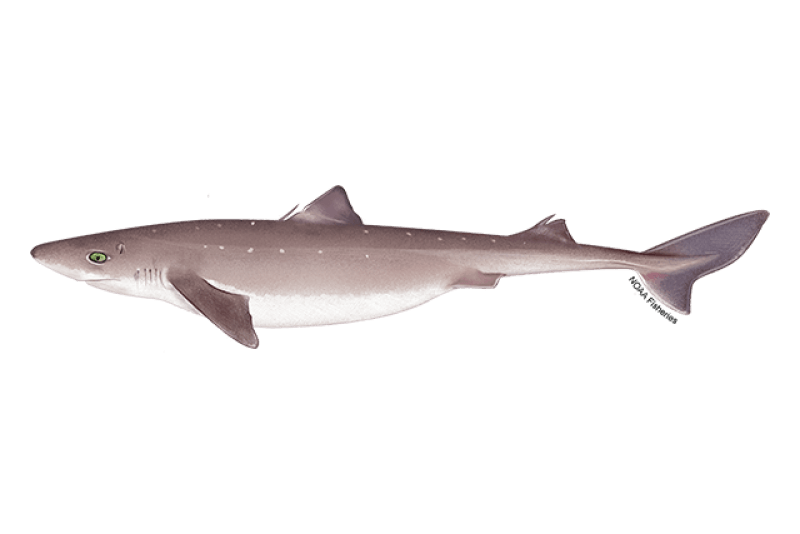
Squalus acanthias , also known as Dogfish shark, Cape dogfish, Cape shark, Spring dogfish, Spiked dogfish, Grayfish, Spur dog, Piked dogfish. The Atlantic spiny dogfish fishery operates from Maine to Florida and from inshore to offshore waters on the edge of the continental shelf. The spiny dogfish fishery uses predomina
Source: Species facts, status language, and imagery adapted from the NOAA Fisheries species profile (last updated 06/25/2026). Ocean City charter and Maryland
record notes are editorial orientation for OCEANCITY.MD readers. Always confirm current seasons, sizes, and
bag limits before you fish—rules change.
The Atlantic spiny dogfish fishery operates from Maine to Florida and from inshore to offshore waters on the edge of the continental shelf. The spiny dogfish fishery uses predominantly bottom gillnets, with lesser amounts caught by trawls and hook gear. There is little consumer demand for spiny dogfish in the United States, but it is commonly used in Europe as the fish in 'fish and chips.' U.S. wild-caught Atlantic spiny dogfish is a smart seafood choice because it is sustainably managed and responsibly harvested under U.S. regulations. Implementing regulations are found at 50 CFR part 648 subpart L.
Maryland record catch
Confirm whether Maryland DNR publishes an Atlantic state-record category for Atlantic Spiny Dogfish on the current sport-fish record board.
Maryland’s Atlantic recreational seasons/sizes/creel summary does not publish a dedicated line for Atlantic Spiny Dogfish. Verify COMAR, DNR public notices, and federal rules for your exact waters before you keep fish.
Rule
Maryland / applicable detail
Maryland minimum size
Not listed — no dedicated Atlantic Spiny Dogfish line on the MD Atlantic recreational table
Maryland daily creel (bag)
Not listed — no MD species-specific bag for Atlantic Spiny Dogfish
Maryland open season
Not listed on the MD Atlantic Ocean / Coastal Bays summary table
Verify
Check DNR eRegulations, COMAR, and NOAA for your date and coordinates before you keep fish.
Spiny dogfish are slim, with a narrow, pointed snout and characteristic white spots.
They are gray above and white below.
They have two dorsal fins with ungrooved large spines.
Males grow up to 3.3 feet, and females grow up to 4 feet.
Biology Like all sharks, dogfish grow slowly, mature late in life, and live a long time (35 to 40 years).
Females grow larger and mature later than males—they’re first able to reproduce at age 12 compared to males at age 6.
Appearance
Like all sharks, dogfish grow slowly, mature late in life, and live a long time (35 to 40 years).
Females grow larger and mature later than males—they’re first able to reproduce at age 12 compared to males at age 6.
They spawn in winter in offshore waters.
Females have between two and 12 eggs per spawning season.
The eggs are fertilized internally and, after a gestation period of 18 to 24 months, female dogfish bear live young (an average of six pups).
They are opportunistic feeders, preying on whatever is most available.
Smaller spiny dogfish tend to feed primarily on crustaceans, while larger dogfish like to eat jellyfish, squid, and schooling fish.
Dogfish are preyed upon by cod, red hake, goosefish, other spiny dogfish, larger sharks, seals, and orcas.
Where They Live Range Spiny dogfish are found in the North Atlantic and North Pacific Oceans, mostly in the temperate and subarctic areas.
In the Northwest Atlantic, they are found from Labrador to Florida and are most abundant between Nova Scotia and Cape Hatteras.
Habitat Spiny dogfish live inshore and offshore, usually near the bottom but also in mid-water and at the surface.
They swim in large schools and migrate seasonally with changes in water temperature.
Much of the population travels north in the spring and summer and south in the fall and winter.
Some spiny dogfish remain in northern waters throughout the year and move offshore during the winter.
Fishery Management NOAA Fisheries , the Mid-Atlantic and New England Fishery Management Councils , and the Atlantic States Marine Fisheries Commission manage the Atlantic spiny dogfish fishery.
The Mid-Atlantic Council leads the joint management of the Spiny Dogfish Fishery Management Plan : Fishermen must have a permit to harvest spiny dogfish.
Annual catch limits and a commercial quota are set.
Trip limits used to control the catch rate.
The Atlantic States Marine Fisheries Commission implements the Interstate Fishery Management Plan for Spiny Dogfish in state waters, establishing complementary regulations to the federal regulations.
Harvest In 2024, commercial landings of spiny dogfish in the Atlantic totaled approximately 8.5 million pounds, and were valued at $1.8 million, according to the NOAA Fisheries commercial fishing landings database .
The U.S. commercial fishery supplies European markets that use dogfish for fish and chips in England, and as a popular beer garden snack called shillerlocken in Germany.
Gear types, habitat impacts, and bycatch: Atlantic spiny dogfish are targeted by gillnet and longline vessels, mainly in state waters.
They are often caught incidentally in trawl, gillnet, and longline fisheries for groundfish species.
Trawls can impact habitat, depending on where they are used.
Managers have implemented a variety of measures for groundfish trawl fisheries to protect habitat, including closing some areas to fishing and modifying fishing gear to reduce contact with habitat.
Trawl and gillnet fisheries for groundfish can incidentally catch other fish and marine mammals (such as large whales, harbor porpoises, bottlenose dolphins) and sea turtles.
Restrictions on gear and fishing effort in these fisheries reduce these interactions.
Scientific Classification Kingdom Animalia Phylum Chordata Class Chondrichthyes Order Squaliformes Family Squalidae Genus Squalus Species acanthias Last updated by NOAA Fisheries on 06/25/2026
Biology
Spiny dogfish are found in the North Atlantic and North Pacific Oceans, mostly in the temperate and subarctic areas.
In the Northwest Atlantic, they are found from Labrador to Florida and are most abundant between Nova Scotia and Cape Hatteras.
Habitat Spiny dogfish live inshore and offshore, usually near the bottom but also in mid-water and at the surface.
They swim in large schools and migrate seasonally with changes in water temperature.
Much of the population travels north in the spring and summer and south in the fall and winter.
Some spiny dogfish remain in northern waters throughout the year and move offshore during the winter.
Fishery Management NOAA Fisheries , the Mid-Atlantic and New England Fishery Management Councils , and the Atlantic States Marine Fisheries Commission manage the Atlantic spiny dogfish fishery.
The Mid-Atlantic Council leads the joint management of the Spiny Dogfish Fishery Management Plan : Fishermen must have a permit to harvest spiny dogfish.
Annual catch limits and a commercial quota are set.
Trip limits used to control the catch rate.
The Atlantic States Marine Fisheries Commission implements the Interstate Fishery Management Plan for Spiny Dogfish in state waters, establishing complementary regulations to the federal regulations.
Harvest In 2024, commercial landings of spiny dogfish in the Atlantic totaled approximately 8.5 million pounds, and were valued at $1.8 million, according to the NOAA Fisheries commercial fishing landings database .
The U.S. commercial fishery supplies European markets that use dogfish for fish and chips in England, and as a popular beer garden snack called shillerlocken in Germany.
Gear types, habitat impacts, and bycatch: Atlantic spiny dogfish are targeted by gillnet and longline vessels, mainly in state waters.
They are often caught incidentally in trawl, gillnet, and longline fisheries for groundfish species.
Trawls can impact habitat, depending on where they are used.
Managers have implemented a variety of measures for groundfish trawl fisheries to protect habitat, including closing some areas to fishing and modifying fishing gear to reduce contact with habitat.
Trawl and gillnet fisheries for groundfish can incidentally catch other fish and marine mammals (such as large whales, harbor porpoises, bottlenose dolphins) and sea turtles.
Restrictions on gear and fishing effort in these fisheries reduce these interactions.
Scientific Classification Kingdom Animalia Phylum Chordata Class Chondrichthyes Order Squaliformes Family Squalidae Genus Squalus Species acanthias Last updated by NOAA Fisheries on 06/25/2026
Where they live
Range
Spiny dogfish are found in the North Atlantic and North Pacific Oceans, mostly in the temperate and subarctic areas.
In the Northwest Atlantic, they are found from Labrador to Florida and are most abundant between Nova Scotia and Cape Hatteras.
Habitat
NOAA Fisheries , the Mid-Atlantic and New England Fishery Management Councils , and the Atlantic States Marine Fisheries Commission manage the Atlantic spiny dogfish fishery.
The Mid-Atlantic Council leads the joint management of the Spiny Dogfish Fishery Management Plan : Fishermen must have a permit to harvest spiny dogfish.
Annual catch limits and a commercial quota are set.
Trip limits used to control the catch rate.
The Atlantic States Marine Fisheries Commission implements the Interstate Fishery Management Plan for Spiny Dogfish in state waters, establishing complementary regulations to the federal regulations.
Harvest In 2024, commercial landings of spiny dogfish in the Atlantic totaled approximately 8.5 million pounds, and were valued at $1.8 million, according to the NOAA Fisheries commercial fishing landings database .
The U.S. commercial fishery supplies European markets that use dogfish for fish and chips in England, and as a popular beer garden snack called shillerlocken in Germany.
Gear types, habitat impacts, and bycatch: Atlantic spiny dogfish are targeted by gillnet and longline vessels, mainly in state waters.
They are often caught incidentally in trawl, gillnet, and longline fisheries for groundfish species.
Trawls can impact habitat, depending on where they are used.
Managers have implemented a variety of measures for groundfish trawl fisheries to protect habitat, including closing some areas to fishing and modifying fishing gear to reduce contact with habitat.
Trawl and gillnet fisheries for groundfish can incidentally catch other fish and marine mammals (such as large whales, harbor porpoises, bottlenose dolphins) and sea turtles.
Restrictions on gear and fishing effort in these fisheries reduce these interactions.
Scientific Classification Kingdom Animalia Phylum Chordata Class Chondrichthyes Order Squaliformes Family Squalidae Genus Squalus Species acanthias Last updated by NOAA Fisheries on 06/25/2026
Ocean City & Mid-Atlantic context
From Ocean City, Maryland, use this Atlantic Spiny Dogfish profile as NOAA Mid-Atlantic directory context—not a promise you will meet the species on every charter.
Always verify current Maryland and federal size, season, and bag rules for your exact date and coordinates before you keep any catch.
Source facts and imagery are adapted from the NOAA Fisheries species profile for Atlantic Spiny Dogfish.
What charter to book from Ocean City
Atlantic Spiny Dogfish may show on Ocean City shark, wreck, or offshore days depending on season and permits—confirm HMS/state rules before you book or keep fish.
Possible / related
Inshore charter — Possible overlap depending on season, water, and boat program.
In 2024, commercial landings of spiny dogfish in the Atlantic totaled approximately 8.5 million pounds, and were valued at $1.8 million, according to the NOAA Fisheries commercial fishing landings database .
The U.S. commercial fishery supplies European markets that use dogfish for fish and chips in England, and as a popular beer garden snack called shillerlocken in Germany.
Gear types, habitat impacts, and bycatch: Atlantic spiny dogfish are targeted by gillnet and longline vessels, mainly in state waters.
They are often caught incidentally in trawl, gillnet, and longline fisheries for groundfish species.
Trawls can impact habitat, depending on where they are used.
Managers have implemented a variety of measures for groundfish trawl fisheries to protect habitat, including closing some areas to fishing and modifying fishing gear to reduce contact with habitat.
Trawl and gillnet fisheries for groundfish can incidentally catch other fish and marine mammals (such as large whales, harbor porpoises, bottlenose dolphins) and sea turtles.
Restrictions on gear and fishing effort in these fisheries reduce these interactions.
Harvest
See the NOAA wild-caught fishery section for landings and gear notes when published for this species.
Landings and management details matter most for the waters where Atlantic Spiny Dogfish is actually fished—see the
NOAA species profile
.
Seafood facts
Fact
Detail
Sustainability
U.S. wild-caught Atlantic spiny dogfish is a smart seafood choice because it is sustainably managed and responsibly harvested under U.S. regulations.
Availability
Year-round.
Source
U.S. wild-caught from Maine to North Carolina.
Taste
Mild and sweet.
Texture
Flaky but firm. It has higher oil content than mako or other sharks.
Color
The raw meat is white. The outer flesh can have a reddish hue, which turns brown when cooked. The rest of the meat remains white when cooked.
Health
Shark is a low-fat source of protein and is high in selenium and vitamins B6 and B12.
After a real OC boat day or market stop for Atlantic Spiny Dogfish, Seafood after boat days covers
dock buffer and cook-your-catch pacing.