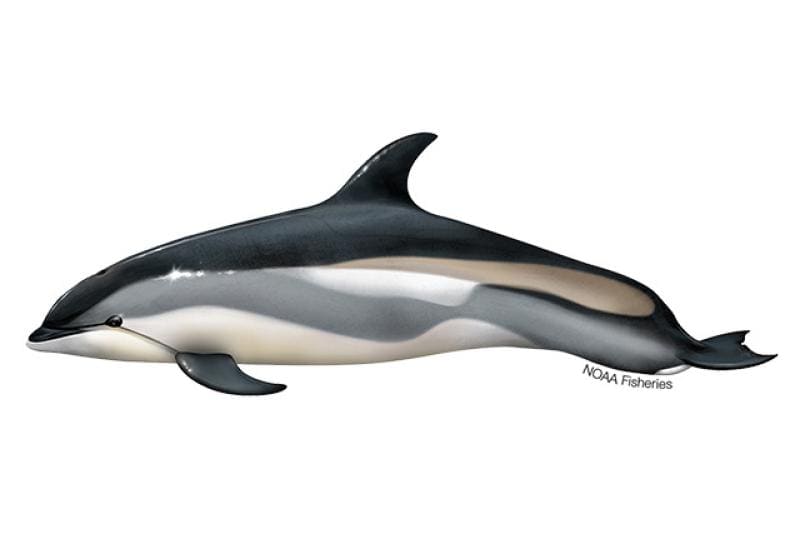
Lagenorhynchus acutus . Atlantic white-sided dolphins are found in the temperate waters of the North Atlantic Ocean. In the United States, they are found off the coast of North Carolina to Maine. They are
Source: Species facts, status language, and imagery adapted from the NOAA Fisheries species profile (last updated 09/15/2022). Ocean City charter and Maryland
record notes are editorial orientation for OCEANCITY.MD readers. Always confirm current seasons, sizes, and
bag limits before you fish—rules change.
Atlantic white-sided dolphins are found in the temperate waters of the North Atlantic Ocean. In the United States, they are found off the coast of North Carolina to Maine. They are named after their distinctive yellowish-tan streak on their sides.
Atlantic white-sided dolphins, like all marine mammals, are protected under the Marine Mammal Protection Act .
NOAA Fisheries is committed to conserving and protecting Atlantic white-sided dolphins. Our scientists and partners use a variety of innovative techniques to study, learn more about, and protect this species.
Maryland record catch
Confirm whether Maryland DNR publishes an Atlantic state-record category for Atlantic White-Sided Dolphin on the current sport-fish record board.
Atlantic White-Sided Dolphin is a protected marine species in U.S. waters. Do not harvest. This guide is biology and Ocean City context only—not a fishing target.
Atlantic white-sided dolphins are relatively small delphinds. They are about 8 to 9 feet in length and weigh 360 to 505 pounds. Males are generally slightly larger than females. The species has a robust streamlined body with a very small beak with a dark upper and white lower lip. They have a distinct prominent, relatively large, tall, falcate dorsal fin, located midway down the back. These dolphins are recognized by a bold complex coloration pattern. They have a dark gray cape with lighter gray sides and a white underside. There is also a bold white patch below a yellow-tan streak on the animal’s flank. Atlantic white-sided dolphins scientific name Lagenorhynchus is derived from the Latin word lagenos for “bottle” or “flask” and rhynchos for “beak” and acutus means “sharp” or “pointed.”
Behavior and Diet Atlantic white-sided dolphins are fast swimming animals that are usually found in social groups that can range from five to 50 animals but have been occasionally seen in larger groups of up to several hundred or thousand animals. Schools can be separated by age and sex. They are sometimes seen in mixed schools associated with smaller cetaceans like white-beaked dolphins , bottlenose dolphins , and pilot whales , and larger rorquals such as fin whales and humpback whales . These gregarious dolphins often engage in acrobatic activity, breaching and jumping at the surface.
Atlantic white-sided dolphins are capable of holding their breathe for at least four minutes and diving to feed on small schooling and bottom fish (e.g., cod, hake, herring, mackerel, smelt, and sand lance), crustaceans (e.g., shrimp), and cephalopods (e.g., squid). This species has been observed cooperatively feeding on schools of fish at the water’s surface. They have 29 to 40 pairs of small conical teeth in each jaw that are useful for grasping prey.
Where They Live Atlantic white-sided dolphins are endemic to the temperate and cooler subpolar waters of the North Atlantic Ocean. They are usually found on or at the edge of the continental shelf and slope in waters with temperatures less than 12 degrees Celsius and usually less than 330 feet. They may also be found in relatively shallow oceanic waters. In the 1970s and 1980s, off the northeastern United States Atlantic coast, the Atlantic white-sided dolphins may have shifted habitats with white-beaked dolphins. During this time, Atlantic white-sided dolphins, which were normally found in offshore waters, moved inshore due to an increase in sand lance on the continental shelf and a decline in herring.
Atlantic white-sided dolphins have a distribution throughout the colder waters of the North Atlantic Ocean from about 38 to 80 degrees North. Their range includes Svalbard, Greenland, Ireland, Europe, Barents Sea, the Azores, and Gulf of Maine. This species has seasonal movements, moving closer inshore and north in the summers, and offshore and south in the winters.
Lifespan & Reproduction Atlantic white-sided dolphin become sexually mature and begin breeding between six to 12 years of age when they reach lengths of 6.5 to 7 feet for females and 7.5 to 8 feet for males. After a gestation period of about ten to 12 months, females give birth to a single calf that is about 3.5 feet in length and weights 45 to 80 pounds. Calving generally takes place between late spring and early autumn, peaking in June to July. Calves may nurse from their mothers for as long as 18 months before being weaned. Their estimated lifespan is at least 27 years.
Appearance
Atlantic white-sided dolphins are fast swimming animals that are usually found in social groups that can range from five to 50 animals but have been occasionally seen in larger groups of up to several hundred or thousand animals. Schools can be separated by age and sex. They are sometimes seen in mixed schools associated with smaller cetaceans like white-beaked dolphins , bottlenose dolphins , and pilot whales , and larger rorquals such as fin whales and humpback whales . These gregarious dolphins often engage in acrobatic activity, breaching and jumping at the surface.
Atlantic white-sided dolphins are capable of holding their breathe for at least four minutes and diving to feed on small schooling and bottom fish (e.g., cod, hake, herring, mackerel, smelt, and sand lance), crustaceans (e.g., shrimp), and cephalopods (e.g., squid). This species has been observed cooperatively feeding on schools of fish at the water’s surface. They have 29 to 40 pairs of small conical teeth in each jaw that are useful for grasping prey.
Where They Live Atlantic white-sided dolphins are endemic to the temperate and cooler subpolar waters of the North Atlantic Ocean. They are usually found on or at the edge of the continental shelf and slope in waters with temperatures less than 12 degrees Celsius and usually less than 330 feet. They may also be found in relatively shallow oceanic waters. In the 1970s and 1980s, off the northeastern United States Atlantic coast, the Atlantic white-sided dolphins may have shifted habitats with white-beaked dolphins. During this time, Atlantic white-sided dolphins, which were normally found in offshore waters, moved inshore due to an increase in sand lance on the continental shelf and a decline in herring.
Atlantic white-sided dolphins have a distribution throughout the colder waters of the North Atlantic Ocean from about 38 to 80 degrees North. Their range includes Svalbard, Greenland, Ireland, Europe, Barents Sea, the Azores, and Gulf of Maine. This species has seasonal movements, moving closer inshore and north in the summers, and offshore and south in the winters.
Lifespan & Reproduction Atlantic white-sided dolphin become sexually mature and begin breeding between six to 12 years of age when they reach lengths of 6.5 to 7 feet for females and 7.5 to 8 feet for males. After a gestation period of about ten to 12 months, females give birth to a single calf that is about 3.5 feet in length and weights 45 to 80 pounds. Calving generally takes place between late spring and early autumn, peaking in June to July. Calves may nurse from their mothers for as long as 18 months before being weaned. Their estimated lifespan is at least 27 years.
Threats Entanglement Atlantic white-sided dolphins have been incidentally taken in fisheries such as driftnets, gillnets, and trawls in the Atlantic Ocean. In waters off of Ireland, significant numbers of these dolphins have been incidentally caught in mid-water trawls.
Ocean Noise Underwater noise pollution interrupts the normal behavior of Atlantic white-sided dolphins that rely on sound to communicate and echolocate. If loud enough, noise can cause permanent or temporary hearing loss. Noise interference from vessels, as well as industrial and military activities, disturbs Atlantic spotted dolphins’ feeding, communication, and orientation.
Hunting They have been directly hunted and killed for food and oil in the drive fisheries of the Faroe Islands, Greenland, Newfoundland (Canada), and Norway.
Scientific Classification Kingdom Animalia Phylum Chordata Class Mammalia Order Cetacea Family Delphinidae Genus Lagenorhynchus Species acutus Last updated by NOAA Fisheries on 09/15/2022
Biology
Atlantic white-sided dolphins are endemic to the temperate and cooler subpolar waters of the North Atlantic Ocean. They are usually found on or at the edge of the continental shelf and slope in waters with temperatures less than 12 degrees Celsius and usually less than 330 feet. They may also be found in relatively shallow oceanic waters. In the 1970s and 1980s, off the northeastern United States Atlantic coast, the Atlantic white-sided dolphins may have shifted habitats with white-beaked dolphins. During this time, Atlantic white-sided dolphins, which were normally found in offshore waters, moved inshore due to an increase in sand lance on the continental shelf and a decline in herring.
Atlantic white-sided dolphins have a distribution throughout the colder waters of the North Atlantic Ocean from about 38 to 80 degrees North. Their range includes Svalbard, Greenland, Ireland, Europe, Barents Sea, the Azores, and Gulf of Maine. This species has seasonal movements, moving closer inshore and north in the summers, and offshore and south in the winters.
Lifespan & Reproduction Atlantic white-sided dolphin become sexually mature and begin breeding between six to 12 years of age when they reach lengths of 6.5 to 7 feet for females and 7.5 to 8 feet for males. After a gestation period of about ten to 12 months, females give birth to a single calf that is about 3.5 feet in length and weights 45 to 80 pounds. Calving generally takes place between late spring and early autumn, peaking in June to July. Calves may nurse from their mothers for as long as 18 months before being weaned. Their estimated lifespan is at least 27 years.
Threats Entanglement Atlantic white-sided dolphins have been incidentally taken in fisheries such as driftnets, gillnets, and trawls in the Atlantic Ocean. In waters off of Ireland, significant numbers of these dolphins have been incidentally caught in mid-water trawls.
Ocean Noise Underwater noise pollution interrupts the normal behavior of Atlantic white-sided dolphins that rely on sound to communicate and echolocate. If loud enough, noise can cause permanent or temporary hearing loss. Noise interference from vessels, as well as industrial and military activities, disturbs Atlantic spotted dolphins’ feeding, communication, and orientation.
Hunting They have been directly hunted and killed for food and oil in the drive fisheries of the Faroe Islands, Greenland, Newfoundland (Canada), and Norway.
Scientific Classification Kingdom Animalia Phylum Chordata Class Mammalia Order Cetacea Family Delphinidae Genus Lagenorhynchus Species acutus Last updated by NOAA Fisheries on 09/15/2022
Where they live
Range
Atlantic white-sided dolphins are endemic to the temperate and cooler subpolar waters of the North Atlantic Ocean. They are usually found on or at the edge of the continental shelf and slope in waters with temperatures less than 12 degrees Celsius and usually less than 330 feet. They may also be found in relatively shallow oceanic waters. In the 1970s and 1980s, off the northeastern United States Atlantic coast, the Atlantic white-sided dolphins may have shifted habitats with white-beaked dolphins. During this time, Atlantic white-sided dolphins, which were normally found in offshore waters, moved inshore due to an increase in sand lance on the continental shelf and a decline in herring.
Atlantic white-sided dolphins have a distribution throughout the colder waters of the North Atlantic Ocean from about 38 to 80 degrees North. Their range includes Svalbard, Greenland, Ireland, Europe, Barents Sea, the Azores, and Gulf of Maine. This species has seasonal movements, moving closer inshore and north in the summers, and offshore and south in the winters.
Habitat
See the NOAA species profile for habitat detail for this entry.
Ocean City & Mid-Atlantic context
From Ocean City, Maryland, use this Atlantic White-Sided Dolphin profile as NOAA Mid-Atlantic directory context—not a promise you will meet the species on every charter.
Atlantic White-Sided Dolphin is protected. Do not harvest. Report unusual strandings or entanglements through official channels.
Source facts and imagery are adapted from the NOAA Fisheries species profile for Atlantic White-Sided Dolphin.
What charter to book from Ocean City
Atlantic White-Sided Dolphin is not a standard Ocean City charter harvest target. Use this profile for NOAA biology and Mid-Atlantic context only.
Not typical from OC
Bay guide — Not a typical Ocean City bay guide target for Atlantic White-Sided Dolphin.
Inshore charter — Not a typical Ocean City inshore charter target for Atlantic White-Sided Dolphin.
Casting / light tackle — Not a typical Ocean City casting / light tackle target for Atlantic White-Sided Dolphin.
Trolling charter — Not a typical Ocean City trolling charter target for Atlantic White-Sided Dolphin.
Nearshore wreck / bottom — Not a typical Ocean City nearshore wreck / bottom target for Atlantic White-Sided Dolphin.
Offshore charter — Not a typical Ocean City offshore charter target for Atlantic White-Sided Dolphin.
Head / party boat — Not a typical Ocean City head / party boat target for Atlantic White-Sided Dolphin.
Start with the charter directory trip-type picker so you compare boats inside the right
archetype—not a bay-guide quote against a canyon invoice.
Overseeing Marine Mammal Health and Stranding Response We work with volunteer networks in all coastal states to respond to marine mammal strandings including all dolphins and porpoises. When stranded animals are found alive, NOAA Fisheries and our partners assess the animal’s health and determine the best course of action. When stranded animals are found dead, our scientists work to understand and investigate the cause of death. Although the cause often remains unknown, scientists can sometimes attribute strandings to disease, harmful algal blooms, vessel strikes, fishing gear entanglements, pollution exposure, and underwater noise. Some strandings can serve as indicators of ocean health, giving insight into larger environmental issues that may also have implications for human health and welfare.
Learn more about the Marine Mammal Health and Stranding Response Program
Marine Mammal Unusual Mortality Events Atlantic white-sided dolphins have been part of a declared unusual mortality event in the past . Under the Marine Mammal Protection Act , an unusual mortality event is defined as "a stranding that is unexpected; involves a significant die-off of any marine mammal population; and demands immediate response." To understand the health of marine mammal populations, scientists study unusual mortality events.
Key Actions and Documents Incidental Take Incidental Take Incidental Take Authorization: United States Navy S50S/LNG and S499 Bulkheads Replacement Project at Naval Station Newport, Rhode Island Incidental Take Authorization: United States Navy S50S/LNG and S499 Bulkheads Replacement Project at Naval Station Newport, Rhode Island Notice of Proposed IHAs Notice of Issued IHAs Notice, New England/Mid-Atlantic
Harvest
See the NOAA wild-caught fishery section for landings and gear notes when published for this species.
Landings and management details matter most for the waters where Atlantic White-Sided Dolphin is actually fished—see the
NOAA species profile
.