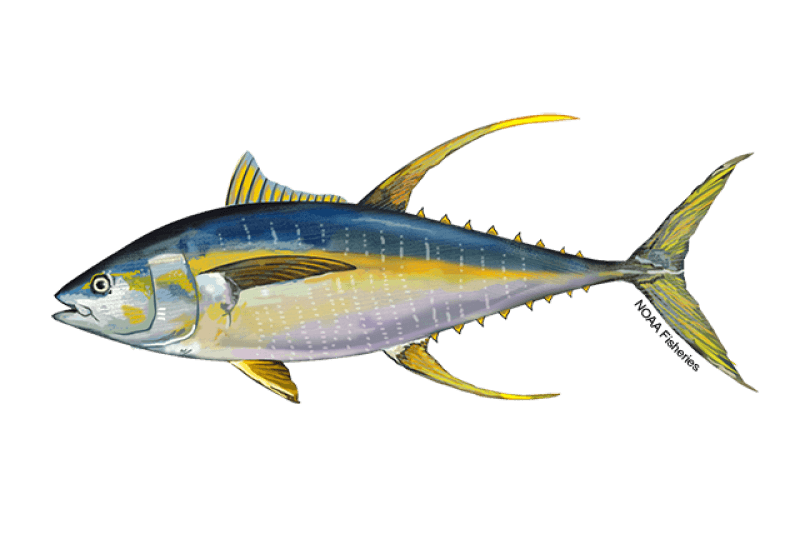
Thunnus albacares , also known as Tuna, Ahi. U.S. wild-caught Atlantic yellowfin tuna is a smart seafood choice because it is sustainably managed and responsibly harvested under U.S. regulations.
Source: Species facts, status language, and imagery adapted from the NOAA Fisheries species profile (last updated 07/02/2026). Ocean City charter and Maryland
record notes are editorial orientation for OCEANCITY.MD readers. Always confirm current seasons, sizes, and
bag limits before you fish—rules change.
Maryland’s Atlantic recreational seasons/sizes/creel summary does not publish a dedicated line for Atlantic Yellowfin Tuna. Verify COMAR, DNR public notices, and federal rules for your exact waters before you keep fish.
Rule
Maryland / applicable detail
Maryland minimum size
Not listed — no dedicated Atlantic Yellowfin Tuna line on the MD Atlantic recreational table
Maryland daily creel (bag)
Not listed — no MD species-specific bag for Atlantic Yellowfin Tuna
Maryland open season
Not listed on the MD Atlantic Ocean / Coastal Bays summary table
Verify
Check DNR eRegulations, COMAR, and NOAA for your date and coordinates before you keep fish.
They are metallic dark blue on the back and upper sides, and change from yellow to silver on the belly.
True to their name, their dorsal and anal fins and finlets are bright yellow.
Yellowfin tuna can be distinguished from other tunas by their long, bright yellow dorsal fin and a yellow strip down the side.
They are also more slender than bluefin tuna.
Biology Yellowfin tuna grow fairly fast, up to 400 pounds, and have a somewhat short life span of about 7 years.
Appearance
Yellowfin tuna grow fairly fast, up to 400 pounds, and have a somewhat short life span of about 7 years.
Most yellowfin tuna are able to reproduce when they reach age 2 or 3.
In the western Atlantic, they spawn from May to August in the Gulf of America (formerly Gulf of Mexico) and from July to November in the southeastern Caribbean.
In the eastern Atlantic, they spawn from October to March in the Gulf of Guinea and from April to June off Senegal.
Females spawn about once every 3 days during the spawning season.
They produce an average of 1 million to 4 million eggs each time they spawn.
Yellowfin tuna feed near the top of the food chain on fish, squid, and crustaceans.
They are prey for top predators such as sharks and large fish.
Where They Live Range Yellowfin tuna are found near the surface of tropical and subtropical oceans around the world.
Habitat Yellowfin tuna are highly migratory and can swim across an entire ocean.
Juvenile yellowfin tuna travel in schools with skipjack and juvenile bigeye tuna.
Fishery Management NOAA Fisheries and the Atlantic Highly Migratory Species Division manage the Atlantic yellowfin tuna fishery in the United States.
Managed under the 2006 Consolidated Atlantic Highly Migratory Species Fishery Management Plan and amendments: Commercial fishermen must have a permit to harvest yellowfin tuna.
Federal management for Atlantic tunas applies to state waters as well, except in Maine, Connecticut, and Mississippi.
NOAA Fisheries periodically reviews these states’ regulations to make sure they’re consistent with federal regulations.
Highly migratory species, such as yellowfin tuna, have complicated management that requires international cooperation.
The United States participates in regional fisheries management organizations, such as the International Commission for the Conservation of Atlantic Tunas (ICCAT), to enhance tuna management worldwide.
NOAA Fisheries sets regulations for the U.S. western Atlantic yellowfin tuna fishery based on our science as well as conservation and management measures adopted by ICCAT.
In 2011, ICCAT adopted new yellowfin tuna management standards that reduced the catch of small yellowfin off West Africa and brought other fishing nations closer to U.S. standards.
In 2013, ICCAT adopted a measure to expand reporting requirements for tropical tuna fisheries using fish aggregating devices (FADs).
The measure will improve data collection and allow ICCAT scientists to better characterize the fishing effort associated with FAD fishing.
In 2000, the United States established the Dolphin-Safe Tuna Tracking and Verification Program to monitor the domestic production and importation of all frozen and processed tuna products nationwide and to authenticate any associated dolphin-safe claim.
Harvest Commercial fishery: U.S. landings of Atlantic yellowfin tuna generally represent a small percentage of the total international landings of Atlantic yellowfin tuna.
Yellowfin tuna is the principal species of tropical tuna landed by U.S. fisheries in the western North Atlantic.
The majority of U.S. commercial landings come from the longline fleet operating in the northwest Atlantic, Gulf of America, and Caribbean.
Gear types, habitat impacts, and bycatch: U.S. commercial fishermen primarily use longline, rod-and-reel, and handline gear to harvest Atlantic yellowfin tuna.
Pelagic longline gear and handgear (handline and rod-and-reel) used to catch yellowfin tuna have no impact on habitat because they’re used in the water column and don’t come into contact with the ocean floor.
Handgear is very selective so bycatch is minimal, but pelagic longlines can incidentally catch other fish and protected species such as marine mammals and sea turtles.
NOAA Fisheries has taken the following additional measures to prevent bycatch and sustainably manage this fishery.
Fishermen are: Required to use large circle hooks and certain types of bait that limit gear interactions with sea turtles.
Circle hooks are specifically designed to minimize the damage caused by hooking, giving animals that are captured and released a better chance at survival.
Trained to use special techniques to safely dehook and release any incidentally caught turtles.
Required to stop fishing and move 1 nautical mile if they encounter a protected species.
Required to protect pilot whales and Risso's dolphins when fishing in the Mid-Atlantic Bight by limiting the length of their lines to 20 nautical miles and posting marine mammal handling/release guidelines on their vessels.
In addition, if fishing in the Cape Hatteras Special Research Area, pelagic longliners must contact NOAA Fisheries at least 48 hours prior to a trip and carry observers if requested.
Required to use weak hooks in the Gulf of America to reduce incidental catch of bluefin tuna and prohibited from using live bait to reduce bycatch of billfish.
Restricted from areas of the Gulf of America to reduce bycatch of all species.
Required to carry vessel monitoring systems onboard their boats to ensure compliance with these closures.
Required to carry at-sea fisheries observers upon request.
NOAA Fisheries reviews observer data to monitor protected species interactions and takes appropriate action as necessary.
Recreational fishery: A high proportion of landings are rod-and-reel catches by recreational anglers.
Recreational fishermen enjoy catching yellowfin tuna because they’re large (up to 400 pounds) and they fight hard.
Recreational fishermen must have a permit to catch yellowfin tuna.
However, catch, tag, and release is allowed.
Recreational fishing for highly migratory species such as yellowfin tuna provides significant economic benefits to coastal communities through individual angler expenditures, recreational charters, tournaments, and the shoreside businesses that support those activities.
Scientific Classification Kingdom Animalia Phylum Chordata Class Actinopterygii Order Scombriformes Family Scombridae Genus Thunnus Species albacares Last updated by NOAA Fisheries on 07/02/2026
Biology
Yellowfin tuna are found near the surface of tropical and subtropical oceans around the world.
Habitat Yellowfin tuna are highly migratory and can swim across an entire ocean.
Juvenile yellowfin tuna travel in schools with skipjack and juvenile bigeye tuna.
Fishery Management NOAA Fisheries and the Atlantic Highly Migratory Species Division manage the Atlantic yellowfin tuna fishery in the United States.
Managed under the 2006 Consolidated Atlantic Highly Migratory Species Fishery Management Plan and amendments: Commercial fishermen must have a permit to harvest yellowfin tuna.
Federal management for Atlantic tunas applies to state waters as well, except in Maine, Connecticut, and Mississippi.
NOAA Fisheries periodically reviews these states’ regulations to make sure they’re consistent with federal regulations.
Highly migratory species, such as yellowfin tuna, have complicated management that requires international cooperation.
The United States participates in regional fisheries management organizations, such as the International Commission for the Conservation of Atlantic Tunas (ICCAT), to enhance tuna management worldwide.
NOAA Fisheries sets regulations for the U.S. western Atlantic yellowfin tuna fishery based on our science as well as conservation and management measures adopted by ICCAT.
In 2011, ICCAT adopted new yellowfin tuna management standards that reduced the catch of small yellowfin off West Africa and brought other fishing nations closer to U.S. standards.
In 2013, ICCAT adopted a measure to expand reporting requirements for tropical tuna fisheries using fish aggregating devices (FADs).
The measure will improve data collection and allow ICCAT scientists to better characterize the fishing effort associated with FAD fishing.
In 2000, the United States established the Dolphin-Safe Tuna Tracking and Verification Program to monitor the domestic production and importation of all frozen and processed tuna products nationwide and to authenticate any associated dolphin-safe claim.
Harvest Commercial fishery: U.S. landings of Atlantic yellowfin tuna generally represent a small percentage of the total international landings of Atlantic yellowfin tuna.
Yellowfin tuna is the principal species of tropical tuna landed by U.S. fisheries in the western North Atlantic.
The majority of U.S. commercial landings come from the longline fleet operating in the northwest Atlantic, Gulf of America, and Caribbean.
Gear types, habitat impacts, and bycatch: U.S. commercial fishermen primarily use longline, rod-and-reel, and handline gear to harvest Atlantic yellowfin tuna.
Pelagic longline gear and handgear (handline and rod-and-reel) used to catch yellowfin tuna have no impact on habitat because they’re used in the water column and don’t come into contact with the ocean floor.
Handgear is very selective so bycatch is minimal, but pelagic longlines can incidentally catch other fish and protected species such as marine mammals and sea turtles.
NOAA Fisheries has taken the following additional measures to prevent bycatch and sustainably manage this fishery.
Fishermen are: Required to use large circle hooks and certain types of bait that limit gear interactions with sea turtles.
Circle hooks are specifically designed to minimize the damage caused by hooking, giving animals that are captured and released a better chance at survival.
Trained to use special techniques to safely dehook and release any incidentally caught turtles.
Required to stop fishing and move 1 nautical mile if they encounter a protected species.
Required to protect pilot whales and Risso's dolphins when fishing in the Mid-Atlantic Bight by limiting the length of their lines to 20 nautical miles and posting marine mammal handling/release guidelines on their vessels.
In addition, if fishing in the Cape Hatteras Special Research Area, pelagic longliners must contact NOAA Fisheries at least 48 hours prior to a trip and carry observers if requested.
Required to use weak hooks in the Gulf of America to reduce incidental catch of bluefin tuna and prohibited from using live bait to reduce bycatch of billfish.
Restricted from areas of the Gulf of America to reduce bycatch of all species.
Required to carry vessel monitoring systems onboard their boats to ensure compliance with these closures.
Required to carry at-sea fisheries observers upon request.
NOAA Fisheries reviews observer data to monitor protected species interactions and takes appropriate action as necessary.
Recreational fishery: A high proportion of landings are rod-and-reel catches by recreational anglers.
Recreational fishermen enjoy catching yellowfin tuna because they’re large (up to 400 pounds) and they fight hard.
Recreational fishermen must have a permit to catch yellowfin tuna.
However, catch, tag, and release is allowed.
Recreational fishing for highly migratory species such as yellowfin tuna provides significant economic benefits to coastal communities through individual angler expenditures, recreational charters, tournaments, and the shoreside businesses that support those activities.
Scientific Classification Kingdom Animalia Phylum Chordata Class Actinopterygii Order Scombriformes Family Scombridae Genus Thunnus Species albacares Last updated by NOAA Fisheries on 07/02/2026
Where they live
Range
Yellowfin tuna are found near the surface of tropical and subtropical oceans around the world.
Habitat Yellowfin tuna are highly migratory and can swim across an entire ocean.
Habitat
NOAA Fisheries and the Atlantic Highly Migratory Species Division manage the Atlantic yellowfin tuna fishery in the United States.
Managed under the 2006 Consolidated Atlantic Highly Migratory Species Fishery Management Plan and amendments: Commercial fishermen must have a permit to harvest yellowfin tuna.
Federal management for Atlantic tunas applies to state waters as well, except in Maine, Connecticut, and Mississippi.
NOAA Fisheries periodically reviews these states’ regulations to make sure they’re consistent with federal regulations.
Highly migratory species, such as yellowfin tuna, have complicated management that requires international cooperation.
The United States participates in regional fisheries management organizations, such as the International Commission for the Conservation of Atlantic Tunas (ICCAT), to enhance tuna management worldwide.
NOAA Fisheries sets regulations for the U.S. western Atlantic yellowfin tuna fishery based on our science as well as conservation and management measures adopted by ICCAT.
In 2011, ICCAT adopted new yellowfin tuna management standards that reduced the catch of small yellowfin off West Africa and brought other fishing nations closer to U.S. standards.
In 2013, ICCAT adopted a measure to expand reporting requirements for tropical tuna fisheries using fish aggregating devices (FADs).
The measure will improve data collection and allow ICCAT scientists to better characterize the fishing effort associated with FAD fishing.
In 2000, the United States established the Dolphin-Safe Tuna Tracking and Verification Program to monitor the domestic production and importation of all frozen and processed tuna products nationwide and to authenticate any associated dolphin-safe claim.
Harvest Commercial fishery: U.S. landings of Atlantic yellowfin tuna generally represent a small percentage of the total international landings of Atlantic yellowfin tuna.
Yellowfin tuna is the principal species of tropical tuna landed by U.S. fisheries in the western North Atlantic.
The majority of U.S. commercial landings come from the longline fleet operating in the northwest Atlantic, Gulf of America, and Caribbean.
Gear types, habitat impacts, and bycatch: U.S. commercial fishermen primarily use longline, rod-and-reel, and handline gear to harvest Atlantic yellowfin tuna.
Pelagic longline gear and handgear (handline and rod-and-reel) used to catch yellowfin tuna have no impact on habitat because they’re used in the water column and don’t come into contact with the ocean floor.
Handgear is very selective so bycatch is minimal, but pelagic longlines can incidentally catch other fish and protected species such as marine mammals and sea turtles.
NOAA Fisheries has taken the following additional measures to prevent bycatch and sustainably manage this fishery.
Fishermen are: Required to use large circle hooks and certain types of bait that limit gear interactions with sea turtles.
Circle hooks are specifically designed to minimize the damage caused by hooking, giving animals that are captured and released a better chance at survival.
Trained to use special techniques to safely dehook and release any incidentally caught turtles.
Required to stop fishing and move 1 nautical mile if they encounter a protected species.
Required to protect pilot whales and Risso's dolphins when fishing in the Mid-Atlantic Bight by limiting the length of their lines to 20 nautical miles and posting marine mammal handling/release guidelines on their vessels.
In addition, if fishing in the Cape Hatteras Special Research Area, pelagic longliners must contact NOAA Fisheries at least 48 hours prior to a trip and carry observers if requested.
Required to use weak hooks in the Gulf of America to reduce incidental catch of bluefin tuna and prohibited from using live bait to reduce bycatch of billfish.
Restricted from areas of the Gulf of America to reduce bycatch of all species.
Required to carry vessel monitoring systems onboard their boats to ensure compliance with these closures.
Required to carry at-sea fisheries observers upon request.
NOAA Fisheries reviews observer data to monitor protected species interactions and takes appropriate action as necessary.
Recreational fishery: A high proportion of landings are rod-and-reel catches by recreational anglers.
Recreational fishermen enjoy catching yellowfin tuna because they’re large (up to 400 pounds) and they fight hard.
Recreational fishermen must have a permit to catch yellowfin tuna.
However, catch, tag, and release is allowed.
Recreational fishing for highly migratory species such as yellowfin tuna provides significant economic benefits to coastal communities through individual angler expenditures, recreational charters, tournaments, and the shoreside businesses that support those activities.
Scientific Classification Kingdom Animalia Phylum Chordata Class Actinopterygii Order Scombriformes Family Scombridae Genus Thunnus Species albacares Last updated by NOAA Fisheries on 07/02/2026
Ocean City & Mid-Atlantic context
From Ocean City, Maryland, use this Atlantic Yellowfin Tuna profile as NOAA Mid-Atlantic directory context—not a promise you will meet the species on every charter.
Always verify current Maryland and federal size, season, and bag rules for your exact date and coordinates before you keep any catch.
Source facts and imagery are adapted from the NOAA Fisheries species profile for Atlantic Yellowfin Tuna.
What charter to book from Ocean City
Atlantic Yellowfin Tuna fits Ocean City offshore and trolling programs more than bay guide mornings—book the trip for the pelagic menu you actually want.
Best fit
Offshore charter — Best OC trip family when you are specifically chasing Atlantic Yellowfin Tuna.
Possible / related
Trolling charter — Possible overlap depending on season, water, and boat program.
Head / party boat — Possible overlap depending on season, water, and boat program.
Not typical from OC
Bay guide — Not a typical Ocean City bay guide target for Atlantic Yellowfin Tuna.
Inshore charter — Not a typical Ocean City inshore charter target for Atlantic Yellowfin Tuna.
Casting / light tackle — Not a typical Ocean City casting / light tackle target for Atlantic Yellowfin Tuna.
Nearshore wreck / bottom — Not a typical Ocean City nearshore wreck / bottom target for Atlantic Yellowfin Tuna.
Start with the charter directory trip-type picker so you compare boats inside the right
archetype—not a bay-guide quote against a canyon invoice.
Commercial fishery: U.S. landings of Atlantic yellowfin tuna generally represent a small percentage of the total international landings of Atlantic yellowfin tuna.
Yellowfin tuna is the principal species of tropical tuna landed by U.S. fisheries in the western North Atlantic.
The majority of U.S. commercial landings come from the longline fleet operating in the northwest Atlantic, Gulf of America, and Caribbean.
Gear types, habitat impacts, and bycatch: U.S. commercial fishermen primarily use longline, rod-and-reel, and handline gear to harvest Atlantic yellowfin tuna.
Pelagic longline gear and handgear (handline and rod-and-reel) used to catch yellowfin tuna have no impact on habitat because they’re used in the water column and don’t come into contact with the ocean floor.
Handgear is very selective so bycatch is minimal, but pelagic longlines can incidentally catch other fish and protected species such as marine mammals and sea turtles.
NOAA Fisheries has taken the following additional measures to prevent bycatch and sustainably manage this fishery.
Fishermen are: Required to use large circle hooks and certain types of bait that limit gear interactions with sea turtles.
Harvest
See the NOAA wild-caught fishery section for landings and gear notes when published for this species.
Landings and management details matter most for the waters where Atlantic Yellowfin Tuna is actually fished—see the
NOAA species profile
.
Seafood facts
Fact
Detail
Sustainability
U.S. wild-caught Atlantic yellowfin tuna is a smart seafood choice because it is sustainably managed and responsibly harvested under U.S. regulations.
Availability
Year-round.
Source
U.S. wild-caught from Massachusetts to Texas.
Taste
Yellowfin tuna has a mild, meaty flavor. It’s more flavorful than albacore, but leaner than bluefin tuna.
Texture
The meat is firm and moist with large flakes.
Color
Meat is bright red when raw and turns brown to grayish-tan when cooked.
Health
Yellowfin tuna is low in saturated fat and sodium and is a very good source of protein, thiamin, selenium, vitamin B6, and omega-3s.
After a real OC boat day or market stop for Atlantic Yellowfin Tuna, Seafood after boat days covers
dock buffer and cook-your-catch pacing.