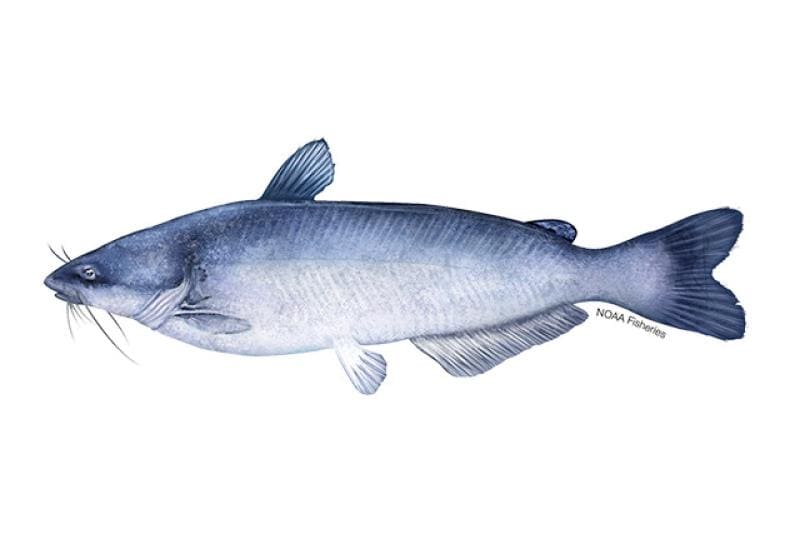
Ictalurus furcatus . Blue catfish can be found in the waters of many states—both coastal and inland. Native to the Mississippi, Missouri, Ohio, and Rio Grande river basins, they have been introduced to
Source: Species facts, status language, and imagery adapted from the NOAA Fisheries species profile (last updated 11/02/2023). Ocean City charter and Maryland
record notes are editorial orientation for OCEANCITY.MD readers. Always confirm current seasons, sizes, and
bag limits before you fish—rules change.
Illustration/photo: NOAA Fisheries — Blue Catfish (Ictalurus furcatus).
Quick facts
Length: Average less than 2 feet in length but can grow to 5 feet
Lifespan: 9 to 10 years, though some have been known to live up to 25 years
Region: New England/Mid-Atlantic,
Southeast
Category: Fish · Mid-Atlantic
Maryland likelihood: 4★ out of 5
About the species
Blue catfish can be found in the waters of many states—both coastal and inland. Native to the Mississippi, Missouri, Ohio, and Rio Grande river basins, they have been introduced to other areas, primarily to serve as a recreational fishing target. Many anglers like fishing for blue catfish because they are strong, savvy fish that are a good challenge.
But in some areas, blue catfish can pose major challenges. Blue catfish were introduced to a few rivers in the Chesapeake Bay watershed decades ago. It was thought that these fish only lived in very fresh water. But they can tolerate water that is not completely fresh. That means that they can swim out of one river, into the more brackish Bay, and then into a different fairly fresh river. As a result, these fish have expanded their range throughout the Chesapeake. They grow large and eat many native species, so they have the potential to cause a lot of harm to the Chesapeake Bay ecosystem.
Lucky for humans, they are quite tasty and a good source of nutrition. States in the Chesapeake Bay watershed are working together to encourage recreational fishing for these catfish—and to develop and grow a commercial fishery as well.
Maryland record catch
Confirm whether Maryland DNR publishes an Atlantic state-record category for Blue Catfish on the current sport-fish record board.
Maryland’s Atlantic recreational seasons/sizes/creel summary does not publish a dedicated line for Blue Catfish. Verify COMAR, DNR public notices, and federal rules for your exact waters before you keep fish.
Rule
Maryland / applicable detail
Maryland minimum size
Not listed — no dedicated Blue Catfish line on the MD Atlantic recreational table
Maryland daily creel (bag)
Not listed — no MD species-specific bag for Blue Catfish
Maryland open season
Not listed on the MD Atlantic Ocean / Coastal Bays summary table
Verify
Check DNR eRegulations, COMAR, and NOAA for your date and coordinates before you keep fish.
Blue catfish have a flat dorsal fin and a deeply forked tail.
They are silvery-blue in color with a white belly.
Their smooth skin lacks scales.
Blue catfish have four pairs of black whisker-like barbels around their mouths.
While adults usually grow to be less than 2 feet long, they can grow to be 5 feet long and weigh more than 100 pounds.
Biology Blue catfish can grow to be larger than 100 pounds.
Appearance
Blue catfish can grow to be larger than 100 pounds.
One caught in an inland lake on the Virginia–North Carolina border weighed 143 pounds.
The Chesapeake Bay record is a blue catfish caught in the James River that was 102 pounds.
Blue catfish are highly productive and create high numbers of offspring each reproductive cycle.
They spawn once a year from late May into June, mostly in lower-salinity streams and smaller tributaries.
Females produce 4,000 to 8,000 eggs per kilogram of body weight—so a 10-pound fish could produce more than 20,000 eggs.
Blue catfish are apex predators of Chesapeake tributaries; they are opportunistic and generalist predators, feeding on important native fish such as menhaden, shad, river herring, as well as blue crabs, plants, and insects.
Adult blue catfish have few natural predators in the Chesapeake Bay.
They are among the preferred prey of osprey and bald eagles.
Blue catfish are native to the Mississippi, Missouri, Ohio, and Rio Grande river basins.
Blue catfish have been stocked as a recreational catch in almost 20 states.
During the 1970s and 1980s, they were introduced to the James, Rappahannock, and York river basins in Virginia as a new recreational fishery.
These catfish have quickly spread throughout the Chesapeake Bay watershed into nearly every major tributary.
They are bottom-dwellers that prefer large rivers with deep channels, swift currents, and sandy bottoms.
Blue catfish prefer fresher water but can thrive in higher salinities as well.
This allows them to move throughout different parts of the Chesapeake Bay where they interact with commercial and ecological important species.
They have been documented interfering with gill net fisheries, such as striped bass.
Fishery Management Because blue catfish—and another invasive fish, the flathead catfish—have the potential to cause substantial harm to the Chesapeake Bay food web, the Chesapeake Bay Program recently developed an Invasive Catfish Management Strategy (PDF, 21 pages).
Their Invasive Catfish Workgroup will continue to work together to focus on this topic.
Blue catfish are a tasty and nutritious fish, so the Management Strategy recommends that the Chesapeake Bay states focus on developing and expanding commercial fisheries for blue catfish.
Blue catfish are currently available for sale to the public in many food outlets.
Scientific Classification Kingdom Animalia Phylum Chordata Class Actinopterygii Order Siluriformes Family Ictaluridae Genus Ictalurus Species furcatus Last updated by NOAA Fisheries on 11/02/2023
Biology
Because blue catfish—and another invasive fish, the flathead catfish—have the potential to cause substantial harm to the Chesapeake Bay food web, the Chesapeake Bay Program recently developed an Invasive Catfish Management Strategy (PDF, 21 pages).
Their Invasive Catfish Workgroup will continue to work together to focus on this topic.
Blue catfish are a tasty and nutritious fish, so the Management Strategy recommends that the Chesapeake Bay states focus on developing and expanding commercial fisheries for blue catfish.
Blue catfish are currently available for sale to the public in many food outlets.
Scientific Classification Kingdom Animalia Phylum Chordata Class Actinopterygii Order Siluriformes Family Ictaluridae Genus Ictalurus Species furcatus Last updated by NOAA Fisheries on 11/02/2023
Where they live
Range
Because blue catfish—and another invasive fish, the flathead catfish—have the potential to cause substantial harm to the Chesapeake Bay food web, the Chesapeake Bay Program recently developed an Invasive Catfish Management Strategy (PDF, 21 pages).
Their Invasive Catfish Workgroup will continue to work together to focus on this topic.
Habitat
See the NOAA species profile for habitat detail for this entry.
Ocean City & Mid-Atlantic context
From Ocean City, Maryland, use this Blue Catfish profile as NOAA Mid-Atlantic directory context—not a promise you will meet the species on every charter.
Always verify current Maryland and federal size, season, and bag rules for your exact date and coordinates before you keep any catch.
Source facts and imagery are adapted from the NOAA Fisheries species profile for Blue Catfish.
What charter to book from Ocean City
Blue Catfish may appear on Ocean City trips depending on season and habitat—use the NOAA biology below and book the charter archetype that matches how you will actually fish.
Possible / related
Bay guide — Possible overlap depending on season, water, and boat program.
Inshore charter — Possible overlap depending on season, water, and boat program.
In the Chesapeake Bay, blue catfish are a popular recreational fishery. They are primarily fished using hook and line. Guide services in the James and Potomac rivers run expeditions that target blue catfish. Regional and national tournaments are held annually on the James River, and the Potomac River is nearly a year-round hotspot for catfish angling.
In some parts of the Chesapeake Bay, catch and release of these fish is discouraged; instead, anglers are encouraged to remove and kill. It is illegal to transport them from one body of water to another.
Recreational fishermen in other areas, particularly those where blue catfish are native, also enjoy angling for these fish.
Harvest
See the NOAA wild-caught fishery section for landings and gear notes when published for this species.
Landings and management details matter most for the waters where Blue Catfish is actually fished—see the
NOAA species profile
.