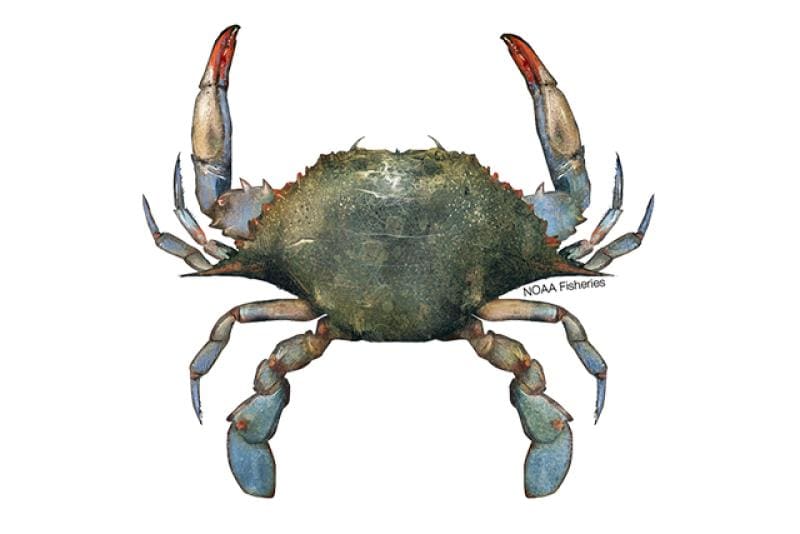
Callinectes sapidus , also known as Hard-shells (not molting), Peelers (about to molt), Busters (started to molt), Soft-shells (just molted, not yet hard), Jimmies (adult males), Sooks (adult females), She-crabs or Sallies (immature females), Sponges/Sponge crabs (females carrying eggs). The blue crab is a highly sought-after shellfish. Blue crabs live up and down the Atlantic Coast and in the Gulf of America (formerly Gulf of Mexico) and are caught by both commerc
Source: Species facts, status language, and imagery adapted from the NOAA Fisheries species profile (last updated 02/10/2026). Ocean City charter and Maryland
record notes are editorial orientation for OCEANCITY.MD readers. Always confirm current seasons, sizes, and
bag limits before you fish—rules change.
Illustration/photo: NOAA Fisheries — Blue Crab (Callinectes sapidus).
Quick facts
Length: Up to 9 inches across the carapace/shell
Lifespan: 3 to 4 years
Region: New England/Mid-Atlantic,
Southeast
Category: Invertebrate · Mid-Atlantic
Maryland likelihood: 5★ out of 5
About the species
The blue crab is a highly sought-after shellfish. Blue crabs live up and down the Atlantic Coast and in the Gulf of America (formerly Gulf of Mexico) and are caught by both commercial and recreational fishermen. Its scientific name— Callinectes sapidus —translated from Latin means 'beautiful savory swimmer.'
Blue crabs are the most valuable fishery in the Chesapeake Bay . They are also major predators of benthic communities and are prey for many other fish species. Blue crabs are so treasured in the region that the blue crab is the Maryland state crustacean.
Maryland record catch
Confirm whether Maryland DNR publishes an Atlantic state-record category for Blue Crab on the current sport-fish record board.
Maryland’s Atlantic recreational seasons/sizes/creel summary does not publish a dedicated line for Blue Crab. Verify COMAR, DNR public notices, and federal rules for your exact waters before you keep fish.
Rule
Maryland / applicable detail
Maryland minimum size
Not listed — no dedicated Blue Crab line on the MD Atlantic recreational table
Maryland daily creel (bag)
Not listed — no MD species-specific bag for Blue Crab
Maryland open season
Not listed on the MD Atlantic Ocean / Coastal Bays summary table
Verify
Check DNR eRegulations, COMAR, and NOAA for your date and coordinates before you keep fish.
The blue crab’s shell—called the “carapace”—is a blue to olive green.
Shells can reach up to 9 inches across.
Blue crab claws are bright blue, and mature females have red tips on their claws too.
They have three pairs of walking legs and rear swimming legs that look like paddles.
Blue crabs have an “apron” that covers their abdomen.
Males’ aprons are thin; females’ are wider.
Appearance
Blue crabs generally live for 3 or 4 years.
They reach maturity in 12 to 18 months.
Growth rates are affected by water temperature—they grow more quickly in warmer water.
In the Gulf of America, crabs may reach maturity within a year.
But in the Chesapeake Bay, it may take 18 months.
Crabs molt—they shed their hard shell—as they grow.
Because they lose hard parts during the molting process, it can be difficult to determine the age of a crab.
Blue crabs can grow to about 9 inches across (from tip to tip) their hard shell (carapace).
However, they are usually harvested before they reach that size.
While a blue crab usually weighs about ⅓ pound, the edible portion is much lower.
The largest blue crab caught in the Chesapeake Bay weighed 1.1 pounds and was 10.72 inches (tip to tip across the carapace).
Blue crabs eat almost anything, including clams, oysters, mussels, smaller crustaceans, freshly dead fish, plant and animal detritus—and smaller and soft-shelled blue crabs.
Crabs are eaten by large fish, some fish-eating birds (like great blue herons), and sea turtles.
To mate, a male crab cradles a female crab in a pose known as a “doubler” for a few days before the female’s terminal molt.
They stay with her after mating until her shell hardens and to ensure another male doesn’t mate with her.
In the Chesapeake Bay, blue crabs mate and spawn from spring to fall.
Females migrate to the mouth of the Bay to spawn and can produce between 750,000 and 3,200,000 eggs per brood.
Eggs hatch into larvae and go through a series of molts in high-salinity coastal waters and then migrate back into the Bay.
Where They Live The blue crab native range is along the Atlantic Coast of the Americas from Nova Scotia to Argentina, including the Gulf of America .
Within the Chesapeake Bay, male crabs tend to prefer the fresher waters of Maryland and the Bay’s upper tributaries, while females like the saltier waters in the main part of the Bay and in Virginia, closer to the ocean.
The blue crab uses multiple habitats in the Chesapeake Bay throughout its life.
Blue crab habitats include underwater grasses and oyster reefs, and they range from shallow, brackish waters to deeper, saltier waters.
Blue crab distribution varies with age, sex, and season.
They tend to be abundant in shallow-water areas during warm weather.
As the water temperature drops each year, they burrow into sediment in the deeper parts of the Bay for the winter.
Blue crabs are bottom-dwellers that use beds of submerged aquatic grasses as sources of food, nursery habitat for young, and shelter during mating and molting.
Fishery Management In the Chesapeake Bay, the blue crab fishery is managed by three jurisdictions: Maryland Department of Natural Resources Virginia Marine Resources Commission Potomac River Fisheries Commission To facilitate coordination between these three agencies, the Chesapeake Bay Program’s Sustainable Fisheries Goal Implementation Team brings scientists and resource managers together to talk through the latest science.
The NOAA Chesapeake Bay Office chairs the Sustainable Fisheries Team.
The “Fisheries GIT” created the Chesapeake Bay Stock Assessment Committee, which includes scientists and experts from management agencies and academic institutions around the Chesapeake.
The Committee discusses the latest blue crab science, reviews and analyzes data for stock assessments, and develops the annual Blue Crab Advisory Report to help inform management decisions.
Scientific Classification Kingdom Animalia Phylum Arthropoda Class Malacostraca Order Decapoda Family Portunidae Genus Callinectes Species sapidus Last updated by NOAA Fisheries on 02/10/2026
Biology
In the Chesapeake Bay, the blue crab fishery is managed by three jurisdictions: Maryland Department of Natural Resources Virginia Marine Resources Commission Potomac River Fisheries Commission To facilitate coordination between these three agencies, the Chesapeake Bay Program’s Sustainable Fisheries Goal Implementation Team brings scientists and resource managers together to talk through the latest science.
The NOAA Chesapeake Bay Office chairs the Sustainable Fisheries Team.
The “Fisheries GIT” created the Chesapeake Bay Stock Assessment Committee, which includes scientists and experts from management agencies and academic institutions around the Chesapeake.
The Committee discusses the latest blue crab science, reviews and analyzes data for stock assessments, and develops the annual Blue Crab Advisory Report to help inform management decisions.
Scientific Classification Kingdom Animalia Phylum Arthropoda Class Malacostraca Order Decapoda Family Portunidae Genus Callinectes Species sapidus Last updated by NOAA Fisheries on 02/10/2026
Where they live
Range
In the Chesapeake Bay, the blue crab fishery is managed by three jurisdictions: Maryland Department of Natural Resources Virginia Marine Resources Commission Potomac River Fisheries Commission To facilitate coordination between these three agencies, the Chesapeake Bay Program’s Sustainable Fisheries Goal Implementation Team brings scientists and resource managers together to talk through the latest science.
The NOAA Chesapeake Bay Office chairs the Sustainable Fisheries Team.
Habitat
See the NOAA species profile for habitat detail for this entry.
Ocean City & Mid-Atlantic context
From Ocean City, Maryland, use this Blue Crab profile as NOAA Mid-Atlantic directory context—not a promise you will meet the species on every charter.
Always verify current Maryland and federal size, season, and bag rules for your exact date and coordinates before you keep any catch.
Source facts and imagery are adapted from the NOAA Fisheries species profile for Blue Crab.
What charter to book from Ocean City
Blue Crab is more of a bay, inshore, or specialty harvest story than a typical OC six-pack trolling day—match the trip type to the animal.
Possible / related
Bay guide — Possible overlap depending on season, water, and boat program.
Inshore charter — Possible overlap depending on season, water, and boat program.
In Maryland, the recreational blue crab season runs from April 1 to December 15. Detailed regulations are set by the Maryland Department of Natural Resources .
In Virginia, recreational crabbers can catch crabs all year long using some methods. Crab pots, trotlines, and other gear are limited to certain times. Detailed regulations are set by the Virginia Marine Resources Commission .
On the Potomac River, the recreational blue crab season runs from April 1 to November 30. Detailed regulations are set by the Potomac River Fisheries Commission .
Harvest
See the NOAA wild-caught fishery section for landings and gear notes when published for this species.
Landings and management details matter most for the waters where Blue Crab is actually fished—see the
NOAA species profile
.