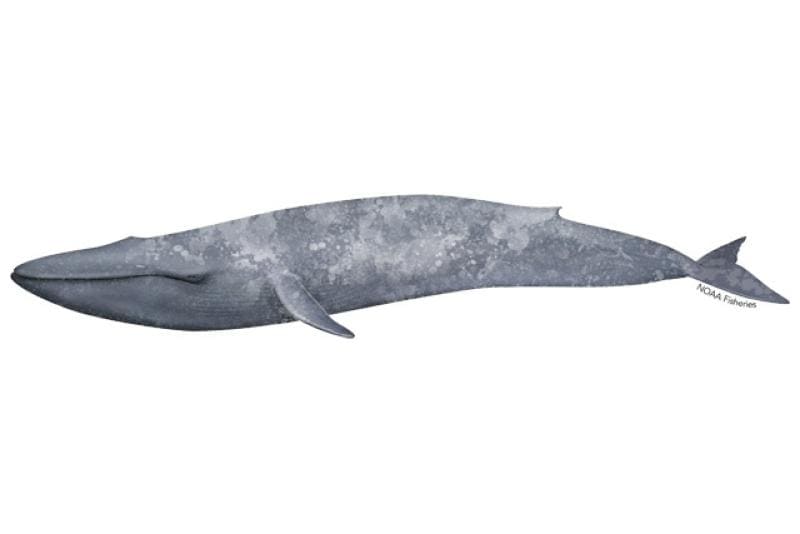
Balaenoptera musculus . Blue whales are members of the baleen or “great” whale family and are not only the largest of the rorquals , but they are the largest animals ever to live on our planet. They feed
Source: Species facts, status language, and imagery adapted from the NOAA Fisheries species profile (last updated 03/23/2026). Ocean City charter and Maryland
record notes are editorial orientation for OCEANCITY.MD readers. Always confirm current seasons, sizes, and
bag limits before you fish—rules change.
Illustration/photo: NOAA Fisheries — Blue Whale (Balaenoptera musculus).
Quick facts
Length: Up to 110 feet
Lifespan: Estimated at around 80 to 90 years
Region: Alaska,
New England/Mid-Atlantic,
Pacific Islands,
Southeast,
West Coast
Category: Protected species · Mid-Atlantic
Maryland likelihood: 1★ out of 5
About the species
Blue whales are members of the baleen or “great” whale family and are not only the largest of the rorquals , but they are the largest animals ever to live on our planet. They feed almost exclusively on krill, straining huge volumes of ocean water through their baleen plates (which hang from the roof of the mouth and work like a sieve). Some of the biggest individuals may eat up to 6 tons of krill a day.
Blue whales are found in all oceans except the Arctic Ocean. There are five currently recognized subspecies of blue whales.
The number of blue whales today is only a small fraction of what it was before modern commercial whaling significantly reduced their numbers during the early 1900s, but populations are increasing globally. The primary threats blue whales currently face are vessel strikes and entanglements in fishing gear.
NOAA Fisheries and its partners are dedicated to conserving and rebuilding blue whale populations worldwide. We use a variety of innovative techniques to study, protect, and rescue these endangered animals. We engage our partners as we develop regulations and management plans that foster healthy fisheries and reduce the risk of entanglements, create whale-safe shipping practices, and reduce ocean noise.
Maryland record catch
Confirm whether Maryland DNR publishes an Atlantic state-record category for Blue Whale on the current sport-fish record board.
Blue whales have a long body and generally slender shape. Their mottled blue-gray color appears light blue under water—hence their name, the blue whale. The mottling pattern is variable and can be used to identify individuals.
Antarctic blue whales are generally larger than other blue whale subspecies. For example, in the North Atlantic and North Pacific, blue whales can grow up to about 90 feet and are over 100,000 pounds, but in the Antarctic, they can reach up to about 110 feet and weigh more than 330,000 pounds. Like many other baleen whales, female blue whales are generally larger than males.
Behavior and Diet Blue whales sometimes swim in small groups but are more often found alone or in pairs. They generally spend summers feeding in polar waters and undertake lengthy migrations towards the equatorial waters as winter arrives.
Blue whales typically swim at about 5 miles an hour while they are feeding and traveling, but can accelerate to more than 20 miles an hour for short bursts. They are among the loudest animals on the planet, emitting a series of pulses, groans, and moans, and it is thought that in the right oceanographic conditions, sounds emitted by blue whales can be heard by other whales up to 1,000 miles away. Scientists think they use these vocalizations to communicate and—along with their excellent hearing—perhaps to sonar-navigate the dark ocean depths.
The primary diet of blue whales is krill—tiny shrimp-like animals, but fish and copepods (tiny crustaceans) may occasionally be part of the blue whale’s diet. When blue whales hunt for food, they filter feed by swimming toward large schools of krill with their mouths open and closing their mouths around the krill while inflating their throat pleats. Once closed, blue whales then push the trapped water out of their mouth with their tongue and use their baleen plates to keep the krill trapped inside.
Where They Live Blue whales are found in all oceans except the Arctic. They generally migrate seasonally between summer feeding grounds and winter breeding grounds, but some evidence suggests that individuals in certain areas might not migrate at all. Information about distribution and movement varies with location, and migratory routes are not well known. In general, distribution is driven largely by food availability—they occur in waters where krill are concentrated.
Appearance
Blue whales sometimes swim in small groups but are more often found alone or in pairs. They generally spend summers feeding in polar waters and undertake lengthy migrations towards the equatorial waters as winter arrives.
Blue whales typically swim at about 5 miles an hour while they are feeding and traveling, but can accelerate to more than 20 miles an hour for short bursts. They are among the loudest animals on the planet, emitting a series of pulses, groans, and moans, and it is thought that in the right oceanographic conditions, sounds emitted by blue whales can be heard by other whales up to 1,000 miles away. Scientists think they use these vocalizations to communicate and—along with their excellent hearing—perhaps to sonar-navigate the dark ocean depths.
The primary diet of blue whales is krill—tiny shrimp-like animals, but fish and copepods (tiny crustaceans) may occasionally be part of the blue whale’s diet. When blue whales hunt for food, they filter feed by swimming toward large schools of krill with their mouths open and closing their mouths around the krill while inflating their throat pleats. Once closed, blue whales then push the trapped water out of their mouth with their tongue and use their baleen plates to keep the krill trapped inside.
Where They Live Blue whales are found in all oceans except the Arctic. They generally migrate seasonally between summer feeding grounds and winter breeding grounds, but some evidence suggests that individuals in certain areas might not migrate at all. Information about distribution and movement varies with location, and migratory routes are not well known. In general, distribution is driven largely by food availability—they occur in waters where krill are concentrated.
In the North Atlantic Ocean, their range extends from the subtropics to the Greenland Sea. Blue whales have been sighted in the waters off eastern Canada and in the shelf waters of the eastern United States.
Along the West Coast of the United States, eastern North Pacific blue whales are believed to spend winters off of Mexico and Central America. They likely feed during summer off the U.S. West Coast and, to a lesser extent, in the Gulf of Alaska and central North Pacific waters.
Blue whales with young calves are regularly observed in the Gulf of California (Sea of Cortez) from December through March. It is believed that this area is an important calving and nursing area for the species.
In the northern Indian Ocean, there is a "resident" population. Blue whale sightings, strandings, and acoustic detections have been reported from the Gulf of Aden, Arabian Sea, and across the Bay of Bengal. The migratory movements of these whales are largely unknown but may be driven by oceanographic changes associated with monsoons.
In the Southern Hemisphere, Antarctic blue whales occur mainly in relatively high latitude waters south of the "Antarctic Convergence" and close to the ice edge in summer. They generally migrate to middle and low latitudes in winter, although not all whales migrate each year. Pygmy blue whales ( Balaenoptera musculus brevicauda )—a subspecies—are typically distributed north of the Antarctic Convergence and are most abundant in waters off Australia, Madagascar, and New Zealand. An unnamed subspecies of blue whale is found in the southeastern Pacific Ocean, particularly in the Chiloense Ecoregion, and migrates to lower latitude areas, including the Galapagos Islands and the eastern tropical Pacific.
World map providing approximate representation of the blue whale's range. Lifespan & Reproduction Blue whales’ average lifespan is estimated at around 80 to 90 years. Scientists can estimate the age of whales by counting the layers of wax-like earplugs collected from deceased animals.
Scientists know little about the life history of the blue whale. The best available science suggests the gestation period is approximately 10 to 12 months. Weaning probably occurs at around 6 to 7 months on, or en route to, summer feeding areas. The age of sexual maturity is thought to be 5 to 15 years. Most reproductive activity, including births and mating, takes place during the winter. The average calving interval is estimated to be 2 to 3 years.
Threats Vessel Strikes Vessel strikes can injure or kill blue whales. Vessel strikes have killed blue whales throughout their range, but the risk is much higher in some coastal areas with heavy vessel traffic, like ports and in shipping lanes, and from larger vessels and vessels traveling at high speeds.
Entanglement in Fishing Gear Blue whales can become entangled in fishing gear, either swimming off with the gear attached or becoming anchored. Blue whales can become entangled in many different gear types, including traps, pots, and nets. Once entangled, whales may drag the attached gear for long distances, ultimately resulting in fatigue, compromised feeding ability, or severe injury, which may lead to reduced reproductive success and death.
Additional Threats Additional possible threats to blue whales that are less understood include ocean noise , habitat degradation, pollution, vessel disturbance, and climate change.
Scientific Classification Kingdom Animalia Phylum Chordata Class Mammalia Order Cetartiodactyla Family Balaenopteridae Genus Balaenoptera Species musculus Last updated by NOAA Fisheries on 03/23/2026
Biology
Blue whales are found in all oceans except the Arctic. They generally migrate seasonally between summer feeding grounds and winter breeding grounds, but some evidence suggests that individuals in certain areas might not migrate at all. Information about distribution and movement varies with location, and migratory routes are not well known. In general, distribution is driven largely by food availability—they occur in waters where krill are concentrated.
In the North Atlantic Ocean, their range extends from the subtropics to the Greenland Sea. Blue whales have been sighted in the waters off eastern Canada and in the shelf waters of the eastern United States.
Along the West Coast of the United States, eastern North Pacific blue whales are believed to spend winters off of Mexico and Central America. They likely feed during summer off the U.S. West Coast and, to a lesser extent, in the Gulf of Alaska and central North Pacific waters.
Blue whales with young calves are regularly observed in the Gulf of California (Sea of Cortez) from December through March. It is believed that this area is an important calving and nursing area for the species.
In the northern Indian Ocean, there is a "resident" population. Blue whale sightings, strandings, and acoustic detections have been reported from the Gulf of Aden, Arabian Sea, and across the Bay of Bengal. The migratory movements of these whales are largely unknown but may be driven by oceanographic changes associated with monsoons.
In the Southern Hemisphere, Antarctic blue whales occur mainly in relatively high latitude waters south of the "Antarctic Convergence" and close to the ice edge in summer. They generally migrate to middle and low latitudes in winter, although not all whales migrate each year. Pygmy blue whales ( Balaenoptera musculus brevicauda )—a subspecies—are typically distributed north of the Antarctic Convergence and are most abundant in waters off Australia, Madagascar, and New Zealand. An unnamed subspecies of blue whale is found in the southeastern Pacific Ocean, particularly in the Chiloense Ecoregion, and migrates to lower latitude areas, including the Galapagos Islands and the eastern tropical Pacific.
World map providing approximate representation of the blue whale's range. Lifespan & Reproduction Blue whales’ average lifespan is estimated at around 80 to 90 years. Scientists can estimate the age of whales by counting the layers of wax-like earplugs collected from deceased animals.
Scientists know little about the life history of the blue whale. The best available science suggests the gestation period is approximately 10 to 12 months. Weaning probably occurs at around 6 to 7 months on, or en route to, summer feeding areas. The age of sexual maturity is thought to be 5 to 15 years. Most reproductive activity, including births and mating, takes place during the winter. The average calving interval is estimated to be 2 to 3 years.
Threats Vessel Strikes Vessel strikes can injure or kill blue whales. Vessel strikes have killed blue whales throughout their range, but the risk is much higher in some coastal areas with heavy vessel traffic, like ports and in shipping lanes, and from larger vessels and vessels traveling at high speeds.
Entanglement in Fishing Gear Blue whales can become entangled in fishing gear, either swimming off with the gear attached or becoming anchored. Blue whales can become entangled in many different gear types, including traps, pots, and nets. Once entangled, whales may drag the attached gear for long distances, ultimately resulting in fatigue, compromised feeding ability, or severe injury, which may lead to reduced reproductive success and death.
Additional Threats Additional possible threats to blue whales that are less understood include ocean noise , habitat degradation, pollution, vessel disturbance, and climate change.
Scientific Classification Kingdom Animalia Phylum Chordata Class Mammalia Order Cetartiodactyla Family Balaenopteridae Genus Balaenoptera Species musculus Last updated by NOAA Fisheries on 03/23/2026
Where they live
Range
Blue whales are found in all oceans except the Arctic. They generally migrate seasonally between summer feeding grounds and winter breeding grounds, but some evidence suggests that individuals in certain areas might not migrate at all. Information about distribution and movement varies with location, and migratory routes are not well known. In general, distribution is driven largely by food availability—they occur in waters where krill are concentrated.
In the North Atlantic Ocean, their range extends from the subtropics to the Greenland Sea. Blue whales have been sighted in the waters off eastern Canada and in the shelf waters of the eastern United States.
Habitat
See the NOAA species profile for habitat detail for this entry.
Ocean City & Mid-Atlantic context
From Ocean City, Maryland, use this Blue Whale profile as NOAA Mid-Atlantic directory context—not a promise you will meet the species on every charter.
Blue Whale is protected. Do not harvest. Report unusual strandings or entanglements through official channels.
Source facts and imagery are adapted from the NOAA Fisheries species profile for Blue Whale.
What charter to book from Ocean City
Blue Whale is not a standard Ocean City charter harvest target. Use this profile for NOAA biology and Mid-Atlantic context only.
Not typical from OC
Bay guide — Not a typical Ocean City bay guide target for Blue Whale.
Inshore charter — Not a typical Ocean City inshore charter target for Blue Whale.
Casting / light tackle — Not a typical Ocean City casting / light tackle target for Blue Whale.
Trolling charter — Not a typical Ocean City trolling charter target for Blue Whale.
Nearshore wreck / bottom — Not a typical Ocean City nearshore wreck / bottom target for Blue Whale.
Offshore charter — Not a typical Ocean City offshore charter target for Blue Whale.
Head / party boat — Not a typical Ocean City head / party boat target for Blue Whale.
Start with the charter directory trip-type picker so you compare boats inside the right
archetype—not a bay-guide quote against a canyon invoice.