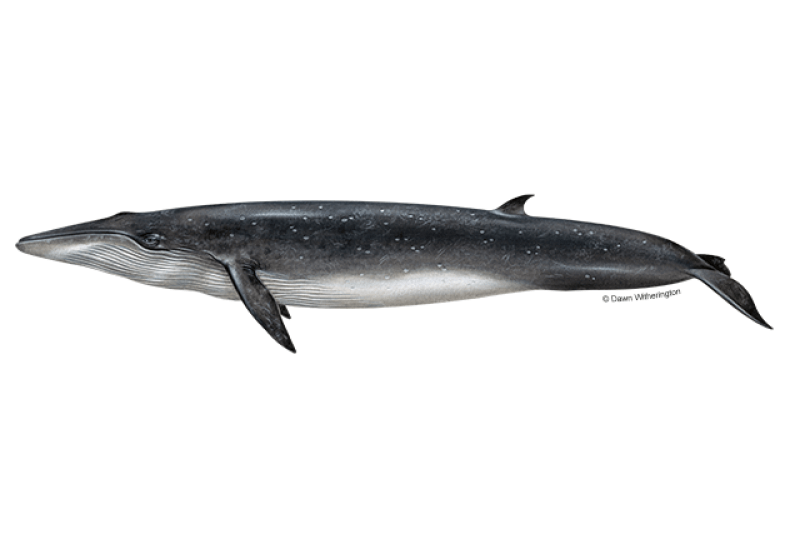
Balaenoptera edeni . Bryde's (pronounced "broodus") whales are members of the baleen whale family. They are considered one of the "great whales," or rorquals, which is a group that also includes blue w
Source: Species facts, status language, and imagery adapted from the NOAA Fisheries species profile (last updated 03/03/2026). Ocean City charter and Maryland
record notes are editorial orientation for OCEANCITY.MD readers. Always confirm current seasons, sizes, and
bag limits before you fish—rules change.
Region: New England/Mid-Atlantic,
Pacific Islands,
Southeast,
West Coast
Category: Protected species · Mid-Atlantic
Maryland likelihood: 1★ out of 5
About the species
Bryde's (pronounced "broodus") whales are members of the baleen whale family. They are considered one of the "great whales," or rorquals, which is a group that also includes blue whales and humpback whales, among others. Bryde’s whales are named for Johan Bryde, a Norwegian who built the first whaling stations in South Africa in the early 20th century.
Bryde’s whales are found in warm, temperate oceans including the Atlantic, Indian, and Pacific. Some populations of Bryde's whales make short migratory movements with the seasons, while others do not migrate, making them unique among other migrating baleen whales.
Bryde’s whales are vulnerable to many stressors and threats, including vessel strikes, ocean noise, and whaling outside the United States.
All Bryde’s whales are protected under the Marine Mammal Protection Act .
Maryland record catch
Confirm whether Maryland DNR publishes an Atlantic state-record category for Bryde’s Whale on the current sport-fish record board.
Bryde’s whales look similar to sei whales but are smaller and prefer warmer waters. Unlike other rorquals, which have a single ridge on their rostrum, Bryde’s whales have three prominent ridges in front of their blowhole. Their bodies are sleek and their flippers are slender and pointed.
The head of a Bryde's whale makes up about one quarter of its entire body length. The whales have a broad fluke, or tail, and a pointed and strongly hooked dorsal fin located about two-thirds back on the body. Bryde’s whales have 40 to 70 throat grooves on their underside that expand while feeding and 250 to 410 gray, coarse baleen plates on each side of their mouths that act as strainers while they feed. Male Bryde’s whales are usually slightly smaller than females.
Behavior and Diet Bryde’s whales are usually seen alone or in pairs. Nonetheless, there have been reports of up to 20 whales loosely grouped together in feeding areas.
Research suggests that Bryde’s whales spend most of the day within 50 feet of the water’s surface. They commonly swim at 1 to 4 miles per hour but can reach speeds of 12 to 15 miles per hour. They dive for about 5 to 15 minutes, with a maximum dive duration of 20 minutes, and can reach depths up to 1,000 feet. They do not display their flukes when diving.
Bryde’s whales eat an estimated 1,320 to 1,450 pounds of food per day. Their diet consists of krill, copepods, red crabs, shrimp, as well as a variety of schooling fish, such as herring, mackerel, pilchards, and sardines. Bryde's whales use different methods to feed in the water column, including skimming the surface, lunging, and creating bubble nets.
Bryde’s whales can blow water 10 to 13 feet into the air when at the water’s surface. They sometimes exhale while underwater as well. Additionally, Bryde’s whales can change directions unexpectedly when swimming. They sometimes generate short, powerful sounds that have low frequencies and sound like "moans." In the central and western North Pacific, Bryde’s whales make a unique, complex sound called a ‘biotwang.’
Appearance
Bryde’s whales are usually seen alone or in pairs. Nonetheless, there have been reports of up to 20 whales loosely grouped together in feeding areas.
Research suggests that Bryde’s whales spend most of the day within 50 feet of the water’s surface. They commonly swim at 1 to 4 miles per hour but can reach speeds of 12 to 15 miles per hour. They dive for about 5 to 15 minutes, with a maximum dive duration of 20 minutes, and can reach depths up to 1,000 feet. They do not display their flukes when diving.
Bryde’s whales eat an estimated 1,320 to 1,450 pounds of food per day. Their diet consists of krill, copepods, red crabs, shrimp, as well as a variety of schooling fish, such as herring, mackerel, pilchards, and sardines. Bryde's whales use different methods to feed in the water column, including skimming the surface, lunging, and creating bubble nets.
Bryde’s whales can blow water 10 to 13 feet into the air when at the water’s surface. They sometimes exhale while underwater as well. Additionally, Bryde’s whales can change directions unexpectedly when swimming. They sometimes generate short, powerful sounds that have low frequencies and sound like "moans." In the central and western North Pacific, Bryde’s whales make a unique, complex sound called a ‘biotwang.’
Where They Live Bryde's whales have a wide distribution and occur in tropical, subtropical, and warm temperate waters (61° to 72°F) around the world. They live in all oceans from 40° south to 40° north. Some populations of Bryde's whales migrate with the seasons, moving away from the equator during the summer and towards the equator during the winter. Other populations of Bryde's whales are residents, meaning that they do not migrate.
World map providing approximate representation of the Bryde's whale range Lifespan & Reproduction Bryde's whales become sexually mature at around nine years of age and can mate year-round. The peak of the breeding and calving season occurs in autumn, and females give birth to a single calf every two to three years. Pregnancy lasts 10 to 12 months, and calves nurse for about 12 months.
Threats Bryde’s whale populations are exposed to a variety of stressors and threats, including vessel strikes, ocean noise, and whaling outside the United States.
Vessel Strikes Accidental vessel strikes can injure or kill Bryde’s whales. They are vulnerable to vessel strikes throughout their range, but the risk is much higher in coastal areas with heavy vessel traffic. Bryde's whales are the third most commonly reported species struck by vessels in the southern hemisphere.
Ocean Noise Low-frequency underwater noise pollution can interrupt Bryde’s whales’ normal behavior by hindering their ability to use sound, causing a disruption of their ability to communicate, choose mates, find food, avoid predators, and navigate.
Whaling (Outside the United States) Historically, Bryde’s whales were not major targets for commercial whaling. However, whalers have recently hunted Bryde’s whales off the coasts of Indonesia and the Philippines. Additionally, some hunters in Japan continue to take Bryde’s whales as part of their scientific research whaling program.
Scientific Classification Kingdom Animalia Phylum Chordata Class Mammalia Order Cetacea Family Balaenopteridae Genus Balaenoptera Species edeni Last updated by NOAA Fisheries on 03/03/2026
Biology
Bryde's whales have a wide distribution and occur in tropical, subtropical, and warm temperate waters (61° to 72°F) around the world. They live in all oceans from 40° south to 40° north. Some populations of Bryde's whales migrate with the seasons, moving away from the equator during the summer and towards the equator during the winter. Other populations of Bryde's whales are residents, meaning that they do not migrate.
World map providing approximate representation of the Bryde's whale range Lifespan & Reproduction Bryde's whales become sexually mature at around nine years of age and can mate year-round. The peak of the breeding and calving season occurs in autumn, and females give birth to a single calf every two to three years. Pregnancy lasts 10 to 12 months, and calves nurse for about 12 months.
Threats Bryde’s whale populations are exposed to a variety of stressors and threats, including vessel strikes, ocean noise, and whaling outside the United States.
Vessel Strikes Accidental vessel strikes can injure or kill Bryde’s whales. They are vulnerable to vessel strikes throughout their range, but the risk is much higher in coastal areas with heavy vessel traffic. Bryde's whales are the third most commonly reported species struck by vessels in the southern hemisphere.
Ocean Noise Low-frequency underwater noise pollution can interrupt Bryde’s whales’ normal behavior by hindering their ability to use sound, causing a disruption of their ability to communicate, choose mates, find food, avoid predators, and navigate.
Whaling (Outside the United States) Historically, Bryde’s whales were not major targets for commercial whaling. However, whalers have recently hunted Bryde’s whales off the coasts of Indonesia and the Philippines. Additionally, some hunters in Japan continue to take Bryde’s whales as part of their scientific research whaling program.
Scientific Classification Kingdom Animalia Phylum Chordata Class Mammalia Order Cetacea Family Balaenopteridae Genus Balaenoptera Species edeni Last updated by NOAA Fisheries on 03/03/2026
Where they live
Range
Bryde's whales have a wide distribution and occur in tropical, subtropical, and warm temperate waters (61° to 72°F) around the world. They live in all oceans from 40° south to 40° north. Some populations of Bryde's whales migrate with the seasons, moving away from the equator during the summer and towards the equator during the winter. Other populations of Bryde's whales are residents, meaning that they do not migrate.
World map providing approximate representation of the Bryde's whale range Lifespan & Reproduction Bryde's whales become sexually mature at around nine years of age and can mate year-round. The peak of the breeding and calving season occurs in autumn, and females give birth to a single calf every two to three years. Pregnancy lasts 10 to 12 months, and calves nurse for about 12 months.
Habitat
See the NOAA species profile for habitat detail for this entry.
Ocean City & Mid-Atlantic context
From Ocean City, Maryland, use this Bryde’s Whale profile as NOAA Mid-Atlantic directory context—not a promise you will meet the species on every charter.
Bryde’s Whale is protected. Do not harvest. Report unusual strandings or entanglements through official channels.
Source facts and imagery are adapted from the NOAA Fisheries species profile for Bryde’s Whale.
What charter to book from Ocean City
Bryde’s Whale is not a standard Ocean City charter harvest target. Use this profile for NOAA biology and Mid-Atlantic context only.
Not typical from OC
Bay guide — Not a typical Ocean City bay guide target for Bryde’s Whale.
Inshore charter — Not a typical Ocean City inshore charter target for Bryde’s Whale.
Casting / light tackle — Not a typical Ocean City casting / light tackle target for Bryde’s Whale.
Trolling charter — Not a typical Ocean City trolling charter target for Bryde’s Whale.
Nearshore wreck / bottom — Not a typical Ocean City nearshore wreck / bottom target for Bryde’s Whale.
Offshore charter — Not a typical Ocean City offshore charter target for Bryde’s Whale.
Head / party boat — Not a typical Ocean City head / party boat target for Bryde’s Whale.
Start with the charter directory trip-type picker so you compare boats inside the right
archetype—not a bay-guide quote against a canyon invoice.