Ziphius cavirostris . Cuvier's beaked whales, sometimes called "goose-beaked whales," are members of the beaked whale family. They are one of the most frequently sighted species of beaked whales in the
Source: Species facts, status language, and imagery adapted from the NOAA Fisheries species profile (last updated 04/03/2026). Ocean City charter and Maryland
record notes are editorial orientation for OCEANCITY.MD readers. Always confirm current seasons, sizes, and
bag limits before you fish—rules change.
Region: Alaska,
New England/Mid-Atlantic,
Pacific Islands,
Southeast,
West Coast
Category: Protected species · Mid-Atlantic
Maryland likelihood: 1★ out of 5
About the species
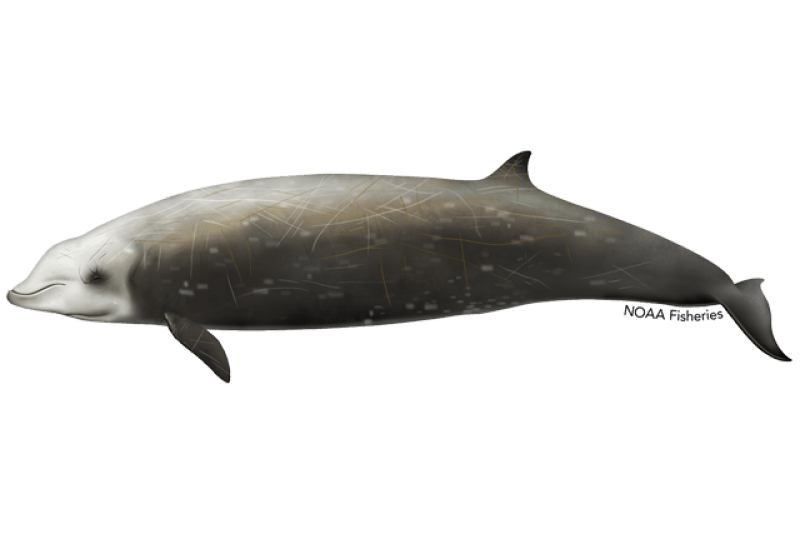
Cuvier's beaked whales, sometimes called "goose-beaked whales," are members of the beaked whale family. They are one of the most frequently sighted species of beaked whales in the world. They are found in most oceans and seas worldwide and have the most extensive range of all beaked whale species. Cuvier’s beaked whales, like all marine mammals, are protected under the Marine Mammal Protection Act .
Maryland record catch
Confirm whether Maryland DNR publishes an Atlantic state-record category for Cuvier's Beaked Whale on the current sport-fish record board.
Cuvier's Beaked Whale is a protected marine species in U.S. waters. Do not harvest. This guide is biology and Ocean City context only—not a fishing target.
Cuvier’s beaked whales can reach lengths of about 15 to 23 feet and weigh 4,000 to 6,800 pounds. There is no significant sexual dimorphism in regards to body size for this species. Cuvier's beaked whale is medium-sized with a round and robust body and a triangular falcate dorsal fin located far down the animal’s back. The head is a sloping concave-shape with no obvious melon, an indistinct beak, and a large slit-like blowhole. The melon becomes more prominent in adult males. The jaw-line is slightly upturned giving the whale a “smiling” appearance. The profile of the head is sometimes described as “goose-like.” Like other beaked whale species, males have two small cone-shaped teeth erupting out of the tip of the bottom jaw that are often used for fighting.
A Cuvier’s beaked whale’s body has variable coloration that ranges from dark gray to a reddish-brown, with a paler counter-shaded underside. The reddish-brown or orange-yellow coloration is caused by the infestation of microscopic diatoms and algae. The body is often covered with linear scratches and oval-shaped scars. The oval-shaped scars are thought to be caused by the bites of cookie-cutter sharks and lampreys. As this species grows older, they become paler, develop a more significant indentation on the top of the head and accumulate more scarring (especially males). There is a whitish coloration to the face and dark-colored patch around the eye.
Many species of beaked whales (especially those in the genus Mesoplodon ) are very difficult to distinguish from one another (even when dead). At sea, they are challenging to observe and identify to the species level due to their cryptic, skittish behavior, a low profile, and a small, inconspicuous blow at the water's surface; therefore, much of the available characterization for beaked whales is to genus level only. Uncertainty regarding species identification of beaked whales often exists because of a lack of easily discernible or distinct physical characteristics.
Behavior and Diet When at the surface, Cuvier’s beaked whales rarely breach or display other active behavior. Their small blow is about 3.3 feet tall, angled slightly forward, and occurs in 20 to 30 second intervals, often making it barely visible to observers. As they swim, their head and body will roll high out of the water. When preparing for a deep, vertical dive, they may arch their back more than normal and usually display their flukes. These whales are typically found individually or in small groups from two to seven animals, but groups of up to 25 animals have been reported. Lone animals are most likely males.
Like other beaked whales, they are deep divers. Cuvier’s beaked whales are capable of diving up to at least 3,300 feet for 20 to 40 minutes to opportunistically feed on mostly cephalopods (e.g., squid and octopus) and sometimes fish and crustaceans. A pair of ventral throat grooves help to create a vacuum within their mouths, allowing the whales to suck in their targeted prey. The deepest known dive for a Cuvier’s beaked whale was 9,816 feet (nearly 2 miles) and the longest known dive lasted 222 minutes!
Where They Live Cuvier’s beaked whales can be found in temperate, subtropical, and tropical waters. They have occasionally been sighted in boreal waters as well. They prefer deep pelagic waters (usually greater than 3,300 feet) of the continental slope and edge, as well as around steep underwater geologic features like banks, seamounts, and submarine canyons. Recent surveys suggest that beaked whales, like this species, may favor oceanographic features such as currents, current boundaries, and core ring features.
Appearance
When at the surface, Cuvier’s beaked whales rarely breach or display other active behavior. Their small blow is about 3.3 feet tall, angled slightly forward, and occurs in 20 to 30 second intervals, often making it barely visible to observers. As they swim, their head and body will roll high out of the water. When preparing for a deep, vertical dive, they may arch their back more than normal and usually display their flukes. These whales are typically found individually or in small groups from two to seven animals, but groups of up to 25 animals have been reported. Lone animals are most likely males.
Like other beaked whales, they are deep divers. Cuvier’s beaked whales are capable of diving up to at least 3,300 feet for 20 to 40 minutes to opportunistically feed on mostly cephalopods (e.g., squid and octopus) and sometimes fish and crustaceans. A pair of ventral throat grooves help to create a vacuum within their mouths, allowing the whales to suck in their targeted prey. The deepest known dive for a Cuvier’s beaked whale was 9,816 feet (nearly 2 miles) and the longest known dive lasted 222 minutes!
Where They Live Cuvier’s beaked whales can be found in temperate, subtropical, and tropical waters. They have occasionally been sighted in boreal waters as well. They prefer deep pelagic waters (usually greater than 3,300 feet) of the continental slope and edge, as well as around steep underwater geologic features like banks, seamounts, and submarine canyons. Recent surveys suggest that beaked whales, like this species, may favor oceanographic features such as currents, current boundaries, and core ring features.
Cuvier’s beaked whales have a cosmopolitan distribution and can be found in most oceans and seas worldwide. Most of the distribution information is based on stranding records . The seasonality and migration patterns of this species are not known. Genetic diversity studies indicate that Cuvier’s beaked whales generally remain in their “home” ocean basins, which may create well-defined populations. In the Northern Hemisphere, they are known to occur near the Aleutian Islands, Bay of Biscay, British Columbia, Canada, Gulf of California, Gulf of America, Massachusetts, Mediterranean Sea, and the Shetlands. In the Southern Hemisphere, they are known to occur near New Zealand, South Africa, and Tierra del Fuego. They have also stranded in tropical environments such as the Bahamas, Caribbean Sea, Mediterranean Sea, and the Galapagos Islands.
World map providing approximate representation of the Cuvier's beaked whale's range. Lifespan & Reproduction Cuvier’s beaked whales reach sexual maturity at lengths of 18 to 20 feet for males and 20 feet for females, which is usually between seven to 11 years of age. Breeding and calving can apparently occur year round, but often during the spring. After a year-long gestation period, females give birth to a single calf every two to three years. Newborn calves, which are dark black or blue in coloration, are about 6.5 to 9 feet long and weigh 550 to 660 pounds. They have an estimated lifespan of up to 60 years.
Threats Entanglement in Fishing Gear Cuvier’s beaked whales can become entangled in fishing gear, either swimming off with the gear attached or becoming anchored. They can become entangled in many different gear types, particularly in gear associated with the California/Oregon drift gillnet fishery, though following the implementation of acoustic pingers in 1996, there have been no beaked whales of any species observed entangled or killed in that fishery. There are also records of this species being entangled in fishing gear in the Caribbean Sea, Chile, Indonesia, Peru, and Taiwan. Once entangled, whales may drag and swim with attached gear for long distances, ultimately resulting in fatigue, compromised feeding ability, or severe injury, which may lead to reduced reproductive success and death.
Hunting This species has been taken in Japanese whaling operations (three to 35 per year) targeting Baird’s beaked whales.
Ocean Noise This species of beaked whale may be sensitive to underwater sounds and anthropogenic noise. Strandings of this species in the Bahamas, Caribbean Sea, Canary Islands, and Mediterranean Sea have been associated with active naval sonar. Anthropogenic noise levels in the world’s oceans are an increasing habitat concern, particularly for deep-diving cetaceans like Cuvier’s beaked whales that use sound to feed, communicate, and navigate in the ocean. Sound pollution can interrupt their normal behavior and drive them away from areas important to their survival.
*Executive Order 14172, “Restoring Names That Honor American Greatness” (Jan. 20, 2025), directs that the Gulf of Mexico be renamed the Gulf of America. Gulf of America references in this website refer to the same area as the Gulf of Mexico in the applicable regulations under 50 CFR parts 216–219, 222–226, and 600–699. The name change did not result in any changes to, and had no effect on the applicability or enforceability of, any existing regulations. This website continues to use “Gulf of Mexico” when quoting statutes, existing regulations, or previously published materials.
Scientific Classification Kingdom Animalia Phylum Chordata Class Mammalia Order Cetacea Family Hyperoodontidae Genus Ziphius Species cavirostris Last updated by NOAA Fisheries on 04/03/2026
Biology
Cuvier’s beaked whales can be found in temperate, subtropical, and tropical waters. They have occasionally been sighted in boreal waters as well. They prefer deep pelagic waters (usually greater than 3,300 feet) of the continental slope and edge, as well as around steep underwater geologic features like banks, seamounts, and submarine canyons. Recent surveys suggest that beaked whales, like this species, may favor oceanographic features such as currents, current boundaries, and core ring features.
Cuvier’s beaked whales have a cosmopolitan distribution and can be found in most oceans and seas worldwide. Most of the distribution information is based on stranding records . The seasonality and migration patterns of this species are not known. Genetic diversity studies indicate that Cuvier’s beaked whales generally remain in their “home” ocean basins, which may create well-defined populations. In the Northern Hemisphere, they are known to occur near the Aleutian Islands, Bay of Biscay, British Columbia, Canada, Gulf of California, Gulf of America, Massachusetts, Mediterranean Sea, and the Shetlands. In the Southern Hemisphere, they are known to occur near New Zealand, South Africa, and Tierra del Fuego. They have also stranded in tropical environments such as the Bahamas, Caribbean Sea, Mediterranean Sea, and the Galapagos Islands.
World map providing approximate representation of the Cuvier's beaked whale's range. Lifespan & Reproduction Cuvier’s beaked whales reach sexual maturity at lengths of 18 to 20 feet for males and 20 feet for females, which is usually between seven to 11 years of age. Breeding and calving can apparently occur year round, but often during the spring. After a year-long gestation period, females give birth to a single calf every two to three years. Newborn calves, which are dark black or blue in coloration, are about 6.5 to 9 feet long and weigh 550 to 660 pounds. They have an estimated lifespan of up to 60 years.
Threats Entanglement in Fishing Gear Cuvier’s beaked whales can become entangled in fishing gear, either swimming off with the gear attached or becoming anchored. They can become entangled in many different gear types, particularly in gear associated with the California/Oregon drift gillnet fishery, though following the implementation of acoustic pingers in 1996, there have been no beaked whales of any species observed entangled or killed in that fishery. There are also records of this species being entangled in fishing gear in the Caribbean Sea, Chile, Indonesia, Peru, and Taiwan. Once entangled, whales may drag and swim with attached gear for long distances, ultimately resulting in fatigue, compromised feeding ability, or severe injury, which may lead to reduced reproductive success and death.
Hunting This species has been taken in Japanese whaling operations (three to 35 per year) targeting Baird’s beaked whales.
Ocean Noise This species of beaked whale may be sensitive to underwater sounds and anthropogenic noise. Strandings of this species in the Bahamas, Caribbean Sea, Canary Islands, and Mediterranean Sea have been associated with active naval sonar. Anthropogenic noise levels in the world’s oceans are an increasing habitat concern, particularly for deep-diving cetaceans like Cuvier’s beaked whales that use sound to feed, communicate, and navigate in the ocean. Sound pollution can interrupt their normal behavior and drive them away from areas important to their survival.
*Executive Order 14172, “Restoring Names That Honor American Greatness” (Jan. 20, 2025), directs that the Gulf of Mexico be renamed the Gulf of America. Gulf of America references in this website refer to the same area as the Gulf of Mexico in the applicable regulations under 50 CFR parts 216–219, 222–226, and 600–699. The name change did not result in any changes to, and had no effect on the applicability or enforceability of, any existing regulations. This website continues to use “Gulf of Mexico” when quoting statutes, existing regulations, or previously published materials.
Scientific Classification Kingdom Animalia Phylum Chordata Class Mammalia Order Cetacea Family Hyperoodontidae Genus Ziphius Species cavirostris Last updated by NOAA Fisheries on 04/03/2026
Where they live
Range
Cuvier’s beaked whales can be found in temperate, subtropical, and tropical waters. They have occasionally been sighted in boreal waters as well. They prefer deep pelagic waters (usually greater than 3,300 feet) of the continental slope and edge, as well as around steep underwater geologic features like banks, seamounts, and submarine canyons. Recent surveys suggest that beaked whales, like this species, may favor oceanographic features such as currents, current boundaries, and core ring features.
Cuvier’s beaked whales have a cosmopolitan distribution and can be found in most oceans and seas worldwide. Most of the distribution information is based on stranding records . The seasonality and migration patterns of this species are not known. Genetic diversity studies indicate that Cuvier’s beaked whales generally remain in their “home” ocean basins, which may create well-defined populations. In the Northern Hemisphere, they are known to occur near the Aleutian Islands, Bay of Biscay, British Columbia, Canada, Gulf of California, Gulf of America, Massachusetts, Mediterranean Sea, and the Shetlands. In the Southern Hemisphere, they are known to occur near New Zealand, South Africa, and Tierra del Fuego. They have also stranded in tropical environments such as the Bahamas, Caribbean Sea, Mediterranean Sea, and the Galapagos Islands.
Habitat
See the NOAA species profile for habitat detail for this entry.
Ocean City & Mid-Atlantic context
From Ocean City, Maryland, use this Cuvier's Beaked Whale profile as NOAA Mid-Atlantic directory context—not a promise you will meet the species on every charter.
Cuvier's Beaked Whale is protected. Do not harvest. Report unusual strandings or entanglements through official channels.
Source facts and imagery are adapted from the NOAA Fisheries species profile for Cuvier's Beaked Whale.
What charter to book from Ocean City
Cuvier's Beaked Whale is not a standard Ocean City charter harvest target. Use this profile for NOAA biology and Mid-Atlantic context only.
Not typical from OC
Bay guide — Not a typical Ocean City bay guide target for Cuvier's Beaked Whale.
Inshore charter — Not a typical Ocean City inshore charter target for Cuvier's Beaked Whale.
Casting / light tackle — Not a typical Ocean City casting / light tackle target for Cuvier's Beaked Whale.
Trolling charter — Not a typical Ocean City trolling charter target for Cuvier's Beaked Whale.
Nearshore wreck / bottom — Not a typical Ocean City nearshore wreck / bottom target for Cuvier's Beaked Whale.
Offshore charter — Not a typical Ocean City offshore charter target for Cuvier's Beaked Whale.
Head / party boat — Not a typical Ocean City head / party boat target for Cuvier's Beaked Whale.
Start with the charter directory trip-type picker so you compare boats inside the right
archetype—not a bay-guide quote against a canyon invoice.