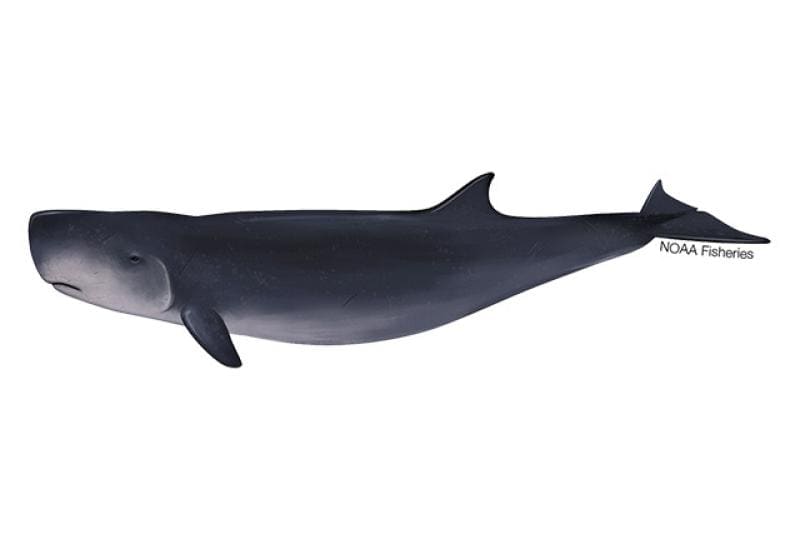
Kogia sima . The dwarf sperm whale is a toothed whale named after the waxy substance, spermaceti, found in its head. This organ is a sac of oil that helps the whales produce sound. Similar to s
Source: Species facts, status language, and imagery adapted from the NOAA Fisheries species profile (last updated 04/03/2026). Ocean City charter and Maryland
record notes are editorial orientation for OCEANCITY.MD readers. Always confirm current seasons, sizes, and
bag limits before you fish—rules change.
Region: New England/Mid-Atlantic,
Pacific Islands,
Southeast,
West Coast
Category: Protected species · Mid-Atlantic
Maryland likelihood: 1★ out of 5
About the species
The dwarf sperm whale is a toothed whale named after the waxy substance, spermaceti, found in its head. This organ is a sac of oil that helps the whales produce sound. Similar to squids, dwarf sperm whales can produce a dark, ink-like liquid that helps them escape from predators.
Dwarf sperm whales are found in temperate and tropical seas worldwide. The dwarf sperm whale appears very similar to the pygmy sperm whale . In the field, it is very difficult to distinguish between the two species because of their similar appearance and behavior. Both species are poorly known due to the limited availability of information and their cryptic appearance at sea.
Dwarf sperm whales, like all marine mammals, are protected under the Marine Mammal Protection Act . NOAA Fisheries and its partners are working to conserve dwarf sperm whales and further our understanding of this species through research and conservation activities.
Maryland record catch
Confirm whether Maryland DNR publishes an Atlantic state-record category for Dwarf Sperm Whale on the current sport-fish record board.
Dwarf Sperm Whale is a protected marine species in U.S. waters. Do not harvest. This guide is biology and Ocean City context only—not a fishing target.
Dwarf sperm whales have a small, compact body with a small dorsal fin located near the middle of their back. Each individual whale’s dorsal fin is a slightly different shape. While on the water’s surface, dwarf sperm whales have a low profile because their head and back are somewhat flat. Their head is sometimes described as shark-like because of its pointed snout and narrow, underslung lower jaw. They have a marking behind the eye that is often called a "false gill" because it looks similar to a fish's gill cover or slit.
Dwarf sperm whales have a brown to blue-gray colored back. Their underside is paler with white or pink tones. They have up to three pairs of teeth in the upper jaw and seven to 13 pairs of teeth in the lower jaw. Their eyes are dark and bulging with a dark ring surrounding them.
Dwarf sperm whales can sometimes be confused with pygmy sperm whales, their closest relative. These two types of whales were not distinguished as separate species until 1966. In the wild, it is very difficult to distinguish between the two species because they have similar appearances, behaviors, and geographic ranges.
Behavior and Diet Dwarf sperm whales are usually seen either alone or in small groups of 10 or fewer individuals. These groups can vary based on age and sex, but little else is known about their social organization.
Dwarf sperm whales spend very little time at the water’s surface and almost never approach vessels. When they are seen at the surface, they are usually either swimming slowly or lying still (also known as logging). Their blows are not visible when they surface. They will slowly sink and disappear from view without showing their flukes before diving back into the water.
Dwarf sperm whales’ use of the "squid tactic" makes them unique among whales. Each dwarf sperm whale has a sac filled with dark liquid in its intestine. The whale can release more than three gallons of dark, reddish-brown liquid—or ink—from this sac. This liquid creates a dark cloud in the water to help protect the whales when they feel threatened or when they are trying to escape predators.
Appearance
Dwarf sperm whales are usually seen either alone or in small groups of 10 or fewer individuals. These groups can vary based on age and sex, but little else is known about their social organization.
Dwarf sperm whales spend very little time at the water’s surface and almost never approach vessels. When they are seen at the surface, they are usually either swimming slowly or lying still (also known as logging). Their blows are not visible when they surface. They will slowly sink and disappear from view without showing their flukes before diving back into the water.
Dwarf sperm whales’ use of the "squid tactic" makes them unique among whales. Each dwarf sperm whale has a sac filled with dark liquid in its intestine. The whale can release more than three gallons of dark, reddish-brown liquid—or ink—from this sac. This liquid creates a dark cloud in the water to help protect the whales when they feel threatened or when they are trying to escape predators.
Dwarf sperm whales can dive at least 1,000 feet deep in search of food. They may feed in slightly shallower waters than pygmy sperm whales. They eat cephalopods (e.g., squid and octopus), crustaceans (e.g., crabs and shrimp), and fish. Like bats, and other toothed whales, dwarf sperm whales use echolocation to locate prey, meaning they use sound to navigate and "see" the world around them. They do so by producing sounds from their melons (or foreheads) that reflect off of the objects around them.
Where They Live Dwarf sperm whales live in temperate and tropical seas around the world.
In the United States, dwarf sperm whales live in the waters of Hawaiʻi, the Pacific Northwest and California, the western North Atlantic, and the northern Gulf of America (formerly Gulf of Mexico). They may be more common off the southeastern coast, as more strandings have happened in this area. Dwarf sperm whales are also the sixth most commonly seen toothed whale around the Hawaiian Islands.
In the Southern Hemisphere, dwarf sperm whales live in the waters around Australia, New Zealand, Indonesia, Chile, southern Brazil, and South Africa. In the Northern Hemisphere besides U.S. waters listed above, they live in the waters around Oman, the Persian Gulf, the Maldives, Japan, British Columbia, the Gulf of California, and northwestern Europe. Their migration patterns are currently unknown.
Lifespan & Reproduction Dwarf sperm whales can live up to 22 years. They reach sexual maturity when they are 2.5 to 5 years old. In the Southern Hemisphere, females give birth between December and March. Females may give birth after a pregnancy that lasts about 1 year. Calves are about 3.3 feet long and weigh about 30 pounds at birth. They are weaned after 1 year.
Threats Entanglement in Fishing Gear One of the main threats to dwarf sperm whales is becoming entangled or captured in commercial fishing gear such as trap lines, pots, and gillnets. Once entangled, they may swim for long distances dragging attached gear, potentially resulting in fatigue, compromised feeding ability, or severe injury. These conditions can lead to reduced reproductive success and death.
Vessel Strikes Accidental vessel strikes can injure or kill dwarf sperm whales. Dwarf sperm whales are vulnerable to vessel strikes throughout their range, but the risk is higher in some areas with heavy ship traffic.
Marine Debris Like many marine animals, dwarf sperm whales can ingest marine debris. Debris in the deep scattering layer where dwarf sperm whales feed could be mistaken for prey and incidentally ingested, leading to possible injury or death.
Some stranded dwarf sperm whales have been found with plastic and other garbage blocking their stomach. Stranded whales have also been found with heart disease, immune system problems, and parasite infestations.
Ocean Noise Underwater noise pollution can interrupt the normal behavior of dwarf sperm whales, which rely on sound to communicate. As ocean noise increases from human sources, communication space decreases—the whales cannot hear each other or discern other signals in their environment as they used to in an undisturbed ocean.
Different levels of sound can disturb important activities, such as feeding, migrating, and socializing. Mounting evidence from scientific research has documented that ocean noise also causes marine mammals to change the frequency or amplitude of calls, decrease foraging behavior, become displaced from preferred habitat, or increase the level of stress hormones in their bodies. If loud enough, noise can cause permanent or temporary hearing loss.
Disease Stranded whales have also been found with heart disease, immune system problems, and parasite infestations.
Scientific Classification Kingdom Animalia Phylum Chordata Class Mammalia Order Cetacea Family Kogiidae Genus Kogia Species sima Last updated by NOAA Fisheries on 04/03/2026
Biology
Dwarf sperm whales live in temperate and tropical seas around the world.
In the United States, dwarf sperm whales live in the waters of Hawaiʻi, the Pacific Northwest and California, the western North Atlantic, and the northern Gulf of America (formerly Gulf of Mexico). They may be more common off the southeastern coast, as more strandings have happened in this area. Dwarf sperm whales are also the sixth most commonly seen toothed whale around the Hawaiian Islands.
In the Southern Hemisphere, dwarf sperm whales live in the waters around Australia, New Zealand, Indonesia, Chile, southern Brazil, and South Africa. In the Northern Hemisphere besides U.S. waters listed above, they live in the waters around Oman, the Persian Gulf, the Maldives, Japan, British Columbia, the Gulf of California, and northwestern Europe. Their migration patterns are currently unknown.
Lifespan & Reproduction Dwarf sperm whales can live up to 22 years. They reach sexual maturity when they are 2.5 to 5 years old. In the Southern Hemisphere, females give birth between December and March. Females may give birth after a pregnancy that lasts about 1 year. Calves are about 3.3 feet long and weigh about 30 pounds at birth. They are weaned after 1 year.
Threats Entanglement in Fishing Gear One of the main threats to dwarf sperm whales is becoming entangled or captured in commercial fishing gear such as trap lines, pots, and gillnets. Once entangled, they may swim for long distances dragging attached gear, potentially resulting in fatigue, compromised feeding ability, or severe injury. These conditions can lead to reduced reproductive success and death.
Vessel Strikes Accidental vessel strikes can injure or kill dwarf sperm whales. Dwarf sperm whales are vulnerable to vessel strikes throughout their range, but the risk is higher in some areas with heavy ship traffic.
Marine Debris Like many marine animals, dwarf sperm whales can ingest marine debris. Debris in the deep scattering layer where dwarf sperm whales feed could be mistaken for prey and incidentally ingested, leading to possible injury or death.
Some stranded dwarf sperm whales have been found with plastic and other garbage blocking their stomach. Stranded whales have also been found with heart disease, immune system problems, and parasite infestations.
Ocean Noise Underwater noise pollution can interrupt the normal behavior of dwarf sperm whales, which rely on sound to communicate. As ocean noise increases from human sources, communication space decreases—the whales cannot hear each other or discern other signals in their environment as they used to in an undisturbed ocean.
Different levels of sound can disturb important activities, such as feeding, migrating, and socializing. Mounting evidence from scientific research has documented that ocean noise also causes marine mammals to change the frequency or amplitude of calls, decrease foraging behavior, become displaced from preferred habitat, or increase the level of stress hormones in their bodies. If loud enough, noise can cause permanent or temporary hearing loss.
Disease Stranded whales have also been found with heart disease, immune system problems, and parasite infestations.
Scientific Classification Kingdom Animalia Phylum Chordata Class Mammalia Order Cetacea Family Kogiidae Genus Kogia Species sima Last updated by NOAA Fisheries on 04/03/2026
Where they live
Range
Dwarf sperm whales live in temperate and tropical seas around the world.
In the United States, dwarf sperm whales live in the waters of Hawaiʻi, the Pacific Northwest and California, the western North Atlantic, and the northern Gulf of America (formerly Gulf of Mexico). They may be more common off the southeastern coast, as more strandings have happened in this area. Dwarf sperm whales are also the sixth most commonly seen toothed whale around the Hawaiian Islands.
Habitat
See the NOAA species profile for habitat detail for this entry.
Ocean City & Mid-Atlantic context
From Ocean City, Maryland, use this Dwarf Sperm Whale profile as NOAA Mid-Atlantic directory context—not a promise you will meet the species on every charter.
Dwarf Sperm Whale is protected. Do not harvest. Report unusual strandings or entanglements through official channels.
Source facts and imagery are adapted from the NOAA Fisheries species profile for Dwarf Sperm Whale.
What charter to book from Ocean City
Dwarf Sperm Whale is not a standard Ocean City charter harvest target. Use this profile for NOAA biology and Mid-Atlantic context only.
Not typical from OC
Bay guide — Not a typical Ocean City bay guide target for Dwarf Sperm Whale.
Inshore charter — Not a typical Ocean City inshore charter target for Dwarf Sperm Whale.
Casting / light tackle — Not a typical Ocean City casting / light tackle target for Dwarf Sperm Whale.
Trolling charter — Not a typical Ocean City trolling charter target for Dwarf Sperm Whale.
Nearshore wreck / bottom — Not a typical Ocean City nearshore wreck / bottom target for Dwarf Sperm Whale.
Offshore charter — Not a typical Ocean City offshore charter target for Dwarf Sperm Whale.
Head / party boat — Not a typical Ocean City head / party boat target for Dwarf Sperm Whale.
Start with the charter directory trip-type picker so you compare boats inside the right
archetype—not a bay-guide quote against a canyon invoice.
Reducing Entanglement in Fishing Gear Entanglement in fishing gear is a primary cause of serious injury and death for many whale species, including dwarf sperm whales.
In the Pacific, we implemented the Pacific Offshore Cetacean Take Reduction Plan to reduce mortalities and serious injuries of several marine mammal stocks, including dwarf sperm whales, incidentally injured in the California thresher shark/swordfish drift gillnet fishery.
Reducing Vessel Strikes Collisions between whales and large vessels can injure or kill whales and damage vessels, but these collisions often go unnoticed and unreported. The most effective way to reduce collision risk is to keep whales and vessels apart. If this is not possible, the second-best option is for vessels to slow down and keep a lookout.
In the Atlantic, we have taken both regulatory and non-regulatory steps to reduce the threat of vessel collisions to North Atlantic right whales , which may also reduce the threat to dwarf sperm whales. The steps include:
Requiring vessels to slow down in specific areas during specific times (Seasonal Management Areas) Advocating for voluntary speed reductions in Dynamic Management Areas Recommending alternative shipping routes and areas to avoid Modifying international shipping lanes Developing mandatory vessel reporting systems Increasing outreach and education Improving our stranding response Learn more about reducing vessel strikes
Overseeing Marine Mammal Health and Stranding Response We work with volunteer networks in all coastal states to respond to marine mammal strandings including all whales. When stranded animals are found alive, NOAA Fisheries and our partners assess the animal’s health and determine the best course of action. When stranded animals are found dead, our scientists work to understand and investigate the cause of death. Although the cause often remains unknown, scientists can sometimes attribute strandings to disease, harmful algal blooms, vessel strikes, fishing gear entanglements, pollution exposure, and underwater noise. Some strandings can serve as indicators of ocean health, giving insight into larger environmental issues that may also have implications for human health and welfare.
Learn more about the Marine Mammal Health and Stranding Response Program
Marine Mammal Unusual Mortality Events Dwarf sperm whales have been part of a declared unusual mortality event in the past . Under the Marine Mammal Protection Act , an unusual mortality event is defined as "a stranding that is unexpected; involves a significant die-off of any marine mammal population; and demands immediate response." To understand the health of marine mammal populations, scientists study unusual mortality events.
Harvest
See the NOAA wild-caught fishery section for landings and gear notes when published for this species.
Landings and management details matter most for the waters where Dwarf Sperm Whale is actually fished—see the
NOAA species profile
.