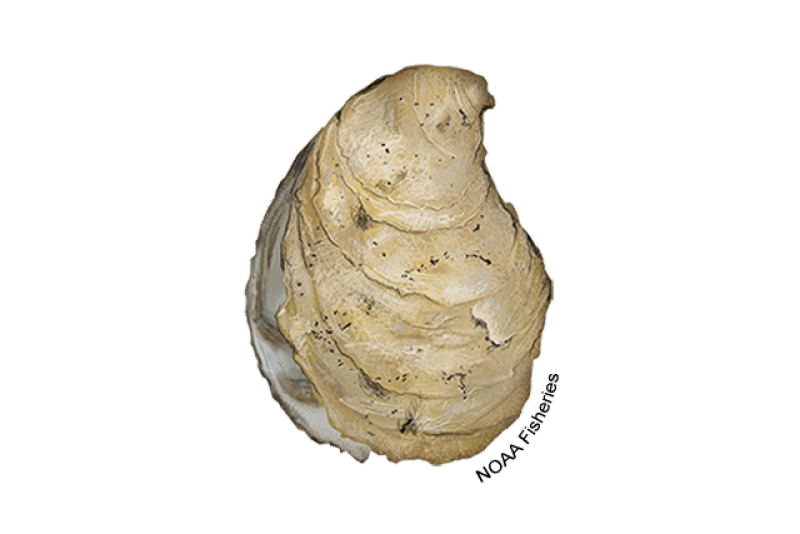
Crassostrea virginica , also known as American oyster, Atlantic oyster, American cupped oyster, Virginia oyster. The Eastern oyster is treasured as food by humans and other species. They are habitat for fish, crabs, and other aquatic life—and because as filter feeders, they help filter the wa
Source: Species facts, status language, and imagery adapted from the NOAA Fisheries species profile (last updated 04/13/2026). Ocean City charter and Maryland
record notes are editorial orientation for OCEANCITY.MD readers. Always confirm current seasons, sizes, and
bag limits before you fish—rules change.
Length: Average 3 to 5 inches in length; can grow up to 8 inches
Lifespan: Up to 20 years
Region: New England/Mid-Atlantic,
Southeast
Category: Invertebrate · Mid-Atlantic
Maryland likelihood: 5★ out of 5
About the species
The Eastern oyster is treasured as food by humans and other species. They are habitat for fish, crabs, and other aquatic life—and because as filter feeders, they help filter the water. Centuries ago, they were plentiful. In some places, reefs were so big that ships had to navigate around them. Since then, in many areas, the populations have dwindled to just a few percent of what they once were. This is due to disease, overharvesting, habitat loss, and poor water quality.
But people, including NOAA scientists, are working hard to rebuild oyster populations. Many people are growing oysters for people to eat. Oyster aquaculture—farming of these tasty shellfish—is a growing industry. And NOAA and our partners are working to restore the healthy oyster reefs that so many other species rely on for habitat. Recreational anglers target healthy reefs for fishing opportunities, too. In the Chesapeake Bay, for example, NOAA and partners are involved in the world’s largest oyster restoration effort . There, they have restored nearly 1,400 acres of oyster reef—that's more than 2 square miles, or 1,055 football fields.
Maryland record catch
Confirm whether Maryland DNR publishes an Atlantic state-record category for Eastern Oyster on the current sport-fish record board.
Maryland’s Atlantic recreational seasons/sizes/creel summary does not publish a dedicated line for Eastern Oyster. Verify COMAR, DNR public notices, and federal rules for your exact waters before you keep fish.
Rule
Maryland / applicable detail
Maryland minimum size
Not listed — no dedicated Eastern Oyster line on the MD Atlantic recreational table
Maryland daily creel (bag)
Not listed — no MD species-specific bag for Eastern Oyster
Maryland open season
Not listed on the MD Atlantic Ocean / Coastal Bays summary table
Verify
Check DNR eRegulations, COMAR, and NOAA for your date and coordinates before you keep fish.
See the NOAA species profile for current stock status language for this entry.
Appearance
Eastern oysters are of the shellfish family. Like mussels, clams and scallops they are bivalve mollusks, and have a hinged shell. They have fast growth rates and high reproduction rates. Each female Eastern oyster can product over 100 million eggs during one spawning event.
Adult Eastern oysters are sessile—they stay in one place—and inhabit both intertidal and subtidal areas. They first mature as males, and then later develop female reproductive capabilities.
Where They Live Range Eastern oysters are found along eastern North America from the Gulf of St. Lawrence to the Gulf of America (formerly Gulf of Mexico). They are found in the middle and lower Chesapeake Bay and its rivers. They are the only species of oyster native to this region.
Habitat Eastern oysters live in brackish and salty waters from 8 to 35 feet deep. In some warmer areas, they are able to live in the intertidal zone. They attach to firm bottom areas, and to each other, to grow into reefs. These reefs provide habitat for fish, crabs, invertebrates, macrofauna, and birds.
Scientific Classification Kingdom Animalia Phylum Mollusca Class Bivalvia Order Ostreida Family Ostreidae Genus Crassostrea Species virginica Last updated by NOAA Fisheries on 04/13/2026
Biology
Eastern oysters are found along eastern North America from the Gulf of St. Lawrence to the Gulf of America (formerly Gulf of Mexico). They are found in the middle and lower Chesapeake Bay and its rivers. They are the only species of oyster native to this region.
Habitat Eastern oysters live in brackish and salty waters from 8 to 35 feet deep. In some warmer areas, they are able to live in the intertidal zone. They attach to firm bottom areas, and to each other, to grow into reefs. These reefs provide habitat for fish, crabs, invertebrates, macrofauna, and birds.
Scientific Classification Kingdom Animalia Phylum Mollusca Class Bivalvia Order Ostreida Family Ostreidae Genus Crassostrea Species virginica Last updated by NOAA Fisheries on 04/13/2026
Where they live
Range
Eastern oysters are found along eastern North America from the Gulf of St. Lawrence to the Gulf of America (formerly Gulf of Mexico). They are found in the middle and lower Chesapeake Bay and its rivers. They are the only species of oyster native to this region.
Habitat Eastern oysters live in brackish and salty waters from 8 to 35 feet deep. In some warmer areas, they are able to live in the intertidal zone. They attach to firm bottom areas, and to each other, to grow into reefs. These reefs provide habitat for fish, crabs, invertebrates, macrofauna, and birds.
Habitat
Are Eastern Oysters Sustainable? U.S. farmed Eastern oysters are a smart seafood choice because they are sustainably grown and harvested under U.S. state and federal regulations.
Ocean City & Mid-Atlantic context
From Ocean City, Maryland, use this Eastern Oyster profile as NOAA Mid-Atlantic directory context—not a promise you will meet the species on every charter.
Always verify current Maryland and federal size, season, and bag rules for your exact date and coordinates before you keep any catch.
Source facts and imagery are adapted from the NOAA Fisheries species profile for Eastern Oyster.
What charter to book from Ocean City
Eastern Oyster is more of a bay, inshore, or specialty harvest story than a typical OC six-pack trolling day—match the trip type to the animal.
Possible / related
Bay guide — Possible overlap depending on season, water, and boat program.
Inshore charter — Possible overlap depending on season, water, and boat program.
NOAA Fisheries and regional fishery management councils manage this species where applicable—see the NOAA profile for plan details.
Harvest
See the NOAA wild-caught fishery section for landings and gear notes when published for this species.
Landings and management details matter most for the waters where Eastern Oyster is actually fished—see the
NOAA species profile
.
Seafood facts
Fact
Detail
Sustainability
Oyster Recipes Looking for some ways to add oysters into your rotation? If you need some cooking inspiration, browse these recipes for bourbon grilled oysters, bacon-wrapped oysters, and more! Read More
Availability
Year-round.
Source
Estuaries, mainly the East Coast or Gulf of America (formerly Gulf of Mexico).
Taste
Ranges from sweet to briny.
Health
Oysters are low in saturated fat and excellent sources of omega-3 fatty acids, iron, and zinc.
After a real OC boat day or market stop for Eastern Oyster, Seafood after boat days covers
dock buffer and cook-your-catch pacing.