Balaenoptera physalus . The fin whale is the second-largest whale species on earth, second only to the blue whale. It is found throughout the world’s oceans. It gets its name from an easy-to-spot fin on i
Source: Species facts, status language, and imagery adapted from the NOAA Fisheries species profile (last updated 06/12/2026). Ocean City charter and Maryland
record notes are editorial orientation for OCEANCITY.MD readers. Always confirm current seasons, sizes, and
bag limits before you fish—rules change.
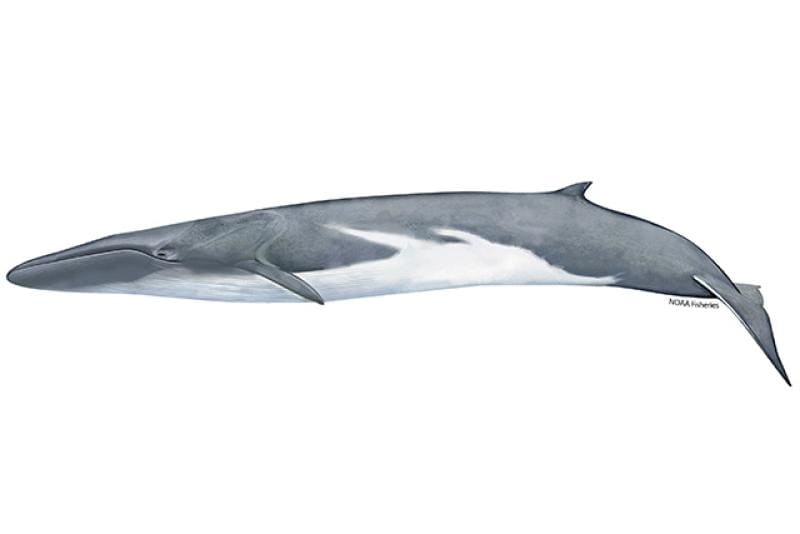
Illustration/photo: NOAA Fisheries — Fin Whale (Balaenoptera physalus).
Quick facts
Length: 75 to 85 feet
Lifespan: 80 to 90 years
Region: Alaska,
New England/Mid-Atlantic,
Pacific Islands,
Southeast,
West Coast
Category: Protected species · Mid-Atlantic
Maryland likelihood: 4★ out of 5
About the species
The fin whale is the second-largest whale species on earth, second only to the blue whale. It is found throughout the world’s oceans. It gets its name from an easy-to-spot fin on its back, near its tail.
Like all large whales, fin whales were hunted by commercial whalers, which severely lowered their populations. Whalers did not target them at first, because they were fast swimmers and lived in open ocean habitats. But, as whaling methods modernized with steam-powered ships and explosive harpoons, and whalers decimated other easy-to-catch species, whaling turned to fin whales. This industry killed a huge number during the mid-1900s—nearly 725,000 in the Southern Hemisphere alone.
Whaling is no longer a threat for fin whales (commercial whaling ended in the 1970s and 1980s, though some subsistence hunting continues today in Greenland under sustainable quotas allowed by the International Whaling Commission ). Currently, the major threat to this species comes from vessel strikes. The fin whale is listed as endangered under the Endangered Species Act and depleted under the Marine Mammal Protection Act .
NOAA Fisheries and its partners are dedicated to conserving and rebuilding fin whale populations. We use innovative techniques to study, protect, and rescue these endangered whales. We engage our partners as we develop regulations and management plans that foster healthy fisheries and reduce the risk of entanglements, create whale-safe shipping practices, and reduce ocean noise.
Maryland record catch
Confirm whether Maryland DNR publishes an Atlantic state-record category for Fin Whale on the current sport-fish record board.
Fin whales have sleek, streamlined bodies with V-shaped heads. They have a tall, hooked dorsal fin, about two-thirds of the way back on the body, that rises at a shallow angle from the back. Fin whales have distinctive coloration—black or dark brownish-gray on the back and sides and white on the underside. Head coloring is asymmetrical—dark on the left side of the lower jaw, white on the right-side lower jaw, and the reverse on the tongue. Many fin whales have several light-gray, V-shaped “chevrons” behind their heads; on many of them, the underside of the tail flukes is white with a gray border. These markings are unique and can be used to identify individual fin whales.
Behavior and Diet Fin whales are fast swimmers and are often found in social groups of two to seven individuals. In the North Atlantic, they are often seen feeding in large groups that include humpback whales , minke whales , and Atlantic white-sided dolphins .
During the summer, fin whales feed on krill, small schooling fish (including herring, capelin, and sand lance), and squid by lunging into schools of prey with their mouth open, using their 50 to 100 accordion-like throat pleats to gulp large amounts of food and water. They then filter the food particles from the water, using the 260 to 480 baleen plates (long, flat plates made of fingernail-like material called keratin) that they have in place of teeth on each side of the mouth. Fin whales fast in the winter while they migrate to warmer waters.
Like other baleen whales, fin whales also skim the water, taking in huge volumes of water. When they close their mouths, the water is pushed out through the baleen and the prey is caught on the inside of the baleen. A fin whale eats up to 2 tons of food daily.
Where They Live Fin whales are typically found in deep, offshore waters of all major oceans, primarily in temperate to polar latitudes. They are less common in the tropics. They occur year-round in a wide range of locations, but the density of individuals in any one area changes seasonally. Most migrate from the Arctic and Antarctic feeding areas in the summer to tropical breeding and calving areas in the winter. The location of winter breeding grounds is not known. Fin whales travel in the open seas, away from the coast, so they are difficult to track. There are three named subspecies of fin whale:
Balaenoptera physalus physalus in the North Atlantic and North Pacific B. physalus quoyi in the Southern Ocean B. physalus patachonica in the mid-latitude Southern Ocean In fact, most experts consider the B. physalus physalus in the North Atlantic and the North Pacific to be separate subspecies. The two populations rarely (if ever) mix, and there are geographical stocks within these ocean basins. Fin whales are migratory, moving seasonally into and out of feeding areas near the poles, but the overall migration pattern is complex and likely varies by region, and specific routes have been documented for some populations. Acoustic recordings from passive-listening hydrophone arrays indicate a southward “flow pattern” in the fall from the Labrador-Newfoundland region, past Bermuda, and into the West Indies. There may be resident groups of fin whales in some areas, such as the Gulf of California, the East China Sea, and the Mediterranean Sea.
Appearance
Fin whales are fast swimmers and are often found in social groups of two to seven individuals. In the North Atlantic, they are often seen feeding in large groups that include humpback whales , minke whales , and Atlantic white-sided dolphins .
During the summer, fin whales feed on krill, small schooling fish (including herring, capelin, and sand lance), and squid by lunging into schools of prey with their mouth open, using their 50 to 100 accordion-like throat pleats to gulp large amounts of food and water. They then filter the food particles from the water, using the 260 to 480 baleen plates (long, flat plates made of fingernail-like material called keratin) that they have in place of teeth on each side of the mouth. Fin whales fast in the winter while they migrate to warmer waters.
Like other baleen whales, fin whales also skim the water, taking in huge volumes of water. When they close their mouths, the water is pushed out through the baleen and the prey is caught on the inside of the baleen. A fin whale eats up to 2 tons of food daily.
Where They Live Fin whales are typically found in deep, offshore waters of all major oceans, primarily in temperate to polar latitudes. They are less common in the tropics. They occur year-round in a wide range of locations, but the density of individuals in any one area changes seasonally. Most migrate from the Arctic and Antarctic feeding areas in the summer to tropical breeding and calving areas in the winter. The location of winter breeding grounds is not known. Fin whales travel in the open seas, away from the coast, so they are difficult to track. There are three named subspecies of fin whale:
Balaenoptera physalus physalus in the North Atlantic and North Pacific B. physalus quoyi in the Southern Ocean B. physalus patachonica in the mid-latitude Southern Ocean In fact, most experts consider the B. physalus physalus in the North Atlantic and the North Pacific to be separate subspecies. The two populations rarely (if ever) mix, and there are geographical stocks within these ocean basins. Fin whales are migratory, moving seasonally into and out of feeding areas near the poles, but the overall migration pattern is complex and likely varies by region, and specific routes have been documented for some populations. Acoustic recordings from passive-listening hydrophone arrays indicate a southward “flow pattern” in the fall from the Labrador-Newfoundland region, past Bermuda, and into the West Indies. There may be resident groups of fin whales in some areas, such as the Gulf of California, the East China Sea, and the Mediterranean Sea.
World map providing approximate representation of the fin whale's range. Lifespan & Reproduction Little is known about the social and mating systems of fin whales. As with other baleen whales, long-term bonds between individuals are rare.
Fin whales have long lives—they reach physical maturity at about 25 years, and their maximum lifespan is about 90 years. Males become sexually mature at 6 to 10 years of age and females at 7 to 12 years of age. After 11 to 12 months of gestation, a pregnant female gives birth to a single calf in tropical and subtropical areas during midwinter. Newborn calves are about 18 feet long, and weigh 4,000 to 6,000 pounds.
Fin whales sometimes mate with blue whales and hybrids have been documented.
Threats Vessel Strikes Vessel strikes can injure or kill fin whales. Fin whales are probably the most vulnerable species to ship strikes after North Atlantic Right Whales . The projected increase in ship traffic arising from the opening of trans-polar shipping routes (as arctic sea ice continues to decline) will increase the risk of vessel strike and also increase ambient noise and pollution.
Entanglement in Fishing Gear Fin whales can become entangled in fishing gear, either swimming off with the gear attached or becoming anchored. They can become entangled in many different gear types, including traps, pots, or gillnets. Once entangled, whales may drag and swim with attached gear for long distances, ultimately resulting in fatigue, compromised feeding ability, or severe injury, which may lead to reduced reproductive success or death.
Ocean Noise Human-made underwater noise negatively affects whale populations, interrupting their normal behavior and driving them away from areas important to their survival. Increasing evidence suggests that exposure to intense underwater sound in some settings may cause some whales to strand and ultimately die.
Changing Climate Conditions The impacts of climate change on baleen whales may result from altered oceanographic conditions, as well as the timing and distribution of sea ice coverage. Changes in prey distribution could lead to changes in foraging behavior, nutritional stress, and diminished reproduction for fin whales. Additionally, changing water temperature and currents could impact the timing of environmental cues important for navigation and foraging.
Scientific Classification Kingdom Animalia Phylum Chordata Class Mammalia Order Cetacea Family Balaenopteridae Genus Balaenoptera Species physalus Last updated by NOAA Fisheries on 06/12/2026
Biology
Fin whales are typically found in deep, offshore waters of all major oceans, primarily in temperate to polar latitudes. They are less common in the tropics. They occur year-round in a wide range of locations, but the density of individuals in any one area changes seasonally. Most migrate from the Arctic and Antarctic feeding areas in the summer to tropical breeding and calving areas in the winter. The location of winter breeding grounds is not known. Fin whales travel in the open seas, away from the coast, so they are difficult to track. There are three named subspecies of fin whale:
Balaenoptera physalus physalus in the North Atlantic and North Pacific B. physalus quoyi in the Southern Ocean B. physalus patachonica in the mid-latitude Southern Ocean In fact, most experts consider the B. physalus physalus in the North Atlantic and the North Pacific to be separate subspecies. The two populations rarely (if ever) mix, and there are geographical stocks within these ocean basins. Fin whales are migratory, moving seasonally into and out of feeding areas near the poles, but the overall migration pattern is complex and likely varies by region, and specific routes have been documented for some populations. Acoustic recordings from passive-listening hydrophone arrays indicate a southward “flow pattern” in the fall from the Labrador-Newfoundland region, past Bermuda, and into the West Indies. There may be resident groups of fin whales in some areas, such as the Gulf of California, the East China Sea, and the Mediterranean Sea.
World map providing approximate representation of the fin whale's range. Lifespan & Reproduction Little is known about the social and mating systems of fin whales. As with other baleen whales, long-term bonds between individuals are rare.
Fin whales have long lives—they reach physical maturity at about 25 years, and their maximum lifespan is about 90 years. Males become sexually mature at 6 to 10 years of age and females at 7 to 12 years of age. After 11 to 12 months of gestation, a pregnant female gives birth to a single calf in tropical and subtropical areas during midwinter. Newborn calves are about 18 feet long, and weigh 4,000 to 6,000 pounds.
Fin whales sometimes mate with blue whales and hybrids have been documented.
Threats Vessel Strikes Vessel strikes can injure or kill fin whales. Fin whales are probably the most vulnerable species to ship strikes after North Atlantic Right Whales . The projected increase in ship traffic arising from the opening of trans-polar shipping routes (as arctic sea ice continues to decline) will increase the risk of vessel strike and also increase ambient noise and pollution.
Entanglement in Fishing Gear Fin whales can become entangled in fishing gear, either swimming off with the gear attached or becoming anchored. They can become entangled in many different gear types, including traps, pots, or gillnets. Once entangled, whales may drag and swim with attached gear for long distances, ultimately resulting in fatigue, compromised feeding ability, or severe injury, which may lead to reduced reproductive success or death.
Ocean Noise Human-made underwater noise negatively affects whale populations, interrupting their normal behavior and driving them away from areas important to their survival. Increasing evidence suggests that exposure to intense underwater sound in some settings may cause some whales to strand and ultimately die.
Changing Climate Conditions The impacts of climate change on baleen whales may result from altered oceanographic conditions, as well as the timing and distribution of sea ice coverage. Changes in prey distribution could lead to changes in foraging behavior, nutritional stress, and diminished reproduction for fin whales. Additionally, changing water temperature and currents could impact the timing of environmental cues important for navigation and foraging.
Scientific Classification Kingdom Animalia Phylum Chordata Class Mammalia Order Cetacea Family Balaenopteridae Genus Balaenoptera Species physalus Last updated by NOAA Fisheries on 06/12/2026
Where they live
Range
Fin whales are typically found in deep, offshore waters of all major oceans, primarily in temperate to polar latitudes. They are less common in the tropics. They occur year-round in a wide range of locations, but the density of individuals in any one area changes seasonally. Most migrate from the Arctic and Antarctic feeding areas in the summer to tropical breeding and calving areas in the winter. The location of winter breeding grounds is not known. Fin whales travel in the open seas, away from the coast, so they are difficult to track. There are three named subspecies of fin whale:
Balaenoptera physalus physalus in the North Atlantic and North Pacific B. physalus quoyi in the Southern Ocean B. physalus patachonica in the mid-latitude Southern Ocean In fact, most experts consider the B. physalus physalus in the North Atlantic and the North Pacific to be separate subspecies. The two populations rarely (if ever) mix, and there are geographical stocks within these ocean basins. Fin whales are migratory, moving seasonally into and out of feeding areas near the poles, but the overall migration pattern is complex and likely varies by region, and specific routes have been documented for some populations. Acoustic recordings from passive-listening hydrophone arrays indicate a southward “flow pattern” in the fall from the Labrador-Newfoundland region, past Bermuda, and into the West Indies. There may be resident groups of fin whales in some areas, such as the Gulf of California, the East China Sea, and the Mediterranean Sea.
Habitat
See the NOAA species profile for habitat detail for this entry.
Ocean City & Mid-Atlantic context
From Ocean City, Maryland, use this Fin Whale profile as NOAA Mid-Atlantic directory context—not a promise you will meet the species on every charter.
Fin Whale is protected. Do not harvest. Report unusual strandings or entanglements through official channels.
Source facts and imagery are adapted from the NOAA Fisheries species profile for Fin Whale.
What charter to book from Ocean City
Fin Whale is not a standard Ocean City charter harvest target. Use this profile for NOAA biology and Mid-Atlantic context only.
Not typical from OC
Bay guide — Not a typical Ocean City bay guide target for Fin Whale.
Inshore charter — Not a typical Ocean City inshore charter target for Fin Whale.
Casting / light tackle — Not a typical Ocean City casting / light tackle target for Fin Whale.
Trolling charter — Not a typical Ocean City trolling charter target for Fin Whale.
Nearshore wreck / bottom — Not a typical Ocean City nearshore wreck / bottom target for Fin Whale.
Offshore charter — Not a typical Ocean City offshore charter target for Fin Whale.
Head / party boat — Not a typical Ocean City head / party boat target for Fin Whale.
Start with the charter directory trip-type picker so you compare boats inside the right
archetype—not a bay-guide quote against a canyon invoice.
Recovery Action Under the ESA, NOAA Fisheries is required to develop and implement recovery plans for the conservation and survival of listed species.
The recovery plan for the fin whale was published in July 2010. Its goal is to recover the species, with an interim goal of down-listing its status from endangered to threatened.
The major actions recommended in the plan are:
Reduce or eliminate injury or death caused by ship collision Reduce or eliminate injury or death caused by fisheries and fishing gear Protect habitats essential to the survival and recovery of the species Minimize effects of vessel disturbance Continue the international ban on hunting and other directed take Monitor the population size and trends in abundance of the species Maximize efforts to free entangled or stranded fin whales and get scientific information from dead specimens Learn more about the recovery plan for fin whales
Implementation NOAA Fisheries is working to minimize effects from human activities that hinder the recovery of fin whale populations in the United States and internationally. Along with our partners, we work to:
Reduce entanglement in fishing gear Respond to stranded and entangled fin whales Rescue collision risk to fin whales Image
Harvest
See the NOAA wild-caught fishery section for landings and gear notes when published for this species.
Landings and management details matter most for the waters where Fin Whale is actually fished—see the
NOAA species profile
.