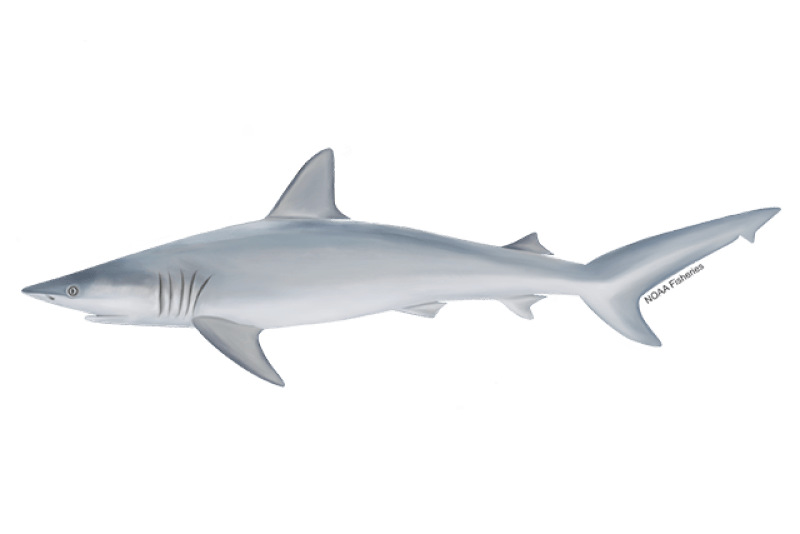
Carcharhinus isodon , also known as Eventooth shark, Night shark, Smoothtooth shark. Finetooth sharks are named for their small, needle-like teeth. They prey primarily on schooling fish and have been known to form schools of their own to hunt.
Source: Species facts, status language, and imagery adapted from the NOAA Fisheries species profile (last updated 07/25/2025). Ocean City charter and Maryland
record notes are editorial orientation for OCEANCITY.MD readers. Always confirm current seasons, sizes, and
bag limits before you fish—rules change.
Finetooth sharks are named for their small, needle-like teeth. They prey primarily on schooling fish and have been known to form schools of their own to hunt.
NOAA Fisheries manages finetooth sharks as part of the small coastal shark complex, which also includes bonnethead , Atlantic sharpnose , and blacknose sharks.
Maryland record catch
Confirm whether Maryland DNR publishes an Atlantic state-record category for Finetooth Shark on the current sport-fish record board.
Maryland’s Atlantic recreational seasons/sizes/creel summary does not publish a dedicated line for Finetooth Shark. Verify COMAR, DNR public notices, and federal rules for your exact waters before you keep fish.
Rule
Maryland / applicable detail
Maryland minimum size
Not listed — no dedicated Finetooth Shark line on the MD Atlantic recreational table
Maryland daily creel (bag)
Not listed — no MD species-specific bag for Finetooth Shark
Maryland open season
Not listed on the MD Atlantic Ocean / Coastal Bays summary table
Verify
Check DNR eRegulations, COMAR, and NOAA for your date and coordinates before you keep fish.
Finetooth sharks are slim and relatively small in size. Their upper body is bluish-gray, blending into a white underside. They have a pointed snout, moderately large eyes, and long gill slits. Their pectoral fins, located on either side of their body, are small and pointed. The primary dorsal fin is small and rounded at the tip.
Biology Female finetooth sharks grow more slowly than males and ultimately reach a larger size. In the Atlantic, the maximum observed age for males and females is about 22 years.
Finetooth shark pups are around 1.5 feet long at birth. Pups are typically born during early summer after a gestation period of about one year. There are approximately 4 pups on average per litter.
Finetooth sharks primarily feed on small bony fish such as menhaden , Spanish mackerel , and mullet. They also eat squid and crustaceans.
Where They Live Range In U.S. waters, finetooth sharks are mostly found south of North Carolina, including the Gulf of America and Caribbean Sea, with occasional sightings as far north as New York. They are also present off the coast of southern Brazil.
Off the East Coast, adults and juveniles follow a seasonal migration, spending the warmer summer months off the Carolinas before migrating south as surface water temperatures fall.
Appearance
Female finetooth sharks grow more slowly than males and ultimately reach a larger size. In the Atlantic, the maximum observed age for males and females is about 22 years.
Finetooth shark pups are around 1.5 feet long at birth. Pups are typically born during early summer after a gestation period of about one year. There are approximately 4 pups on average per litter.
Finetooth sharks primarily feed on small bony fish such as menhaden , Spanish mackerel , and mullet. They also eat squid and crustaceans.
Where They Live Range In U.S. waters, finetooth sharks are mostly found south of North Carolina, including the Gulf of America and Caribbean Sea, with occasional sightings as far north as New York. They are also present off the coast of southern Brazil.
Off the East Coast, adults and juveniles follow a seasonal migration, spending the warmer summer months off the Carolinas before migrating south as surface water temperatures fall.
Habitat Finetooth sharks live close to shore in depths of around 30 feet. They are commonly found in bays, lagoons, and estuaries.
Fishery Management NOAA Fisheries manages finetooth sharks in federal waters under the Consolidated Atlantic Highly Migratory Species (HMS) Fishery Management Plan . Commercial, recreational, and for-hire fishermen must comply with permit requirements, trip limits, gear restrictions, finning prohibitions, closed areas, and reporting requirements to land finetooth sharks.
Finetooth sharks can only be sold to federally permitted shark dealers. Shark dealers are required to attend Atlantic shark identification workshops to help them better identify shark species.
*Executive Order 14172, “Restoring Names That Honor American Greatness” (Jan. 20, 2025), directs that the Gulf of Mexico be renamed the Gulf of America. Gulf of America references in this website refer to the same area as the Gulf of Mexico in the applicable regulations under 50 CFR parts 216–219, 222–226, and 600–699. The name change did not result in any changes to, and had no effect on the applicability or enforceability of, any existing regulations. This website continues to use “Gulf of Mexico” when quoting statutes, existing regulations, or previously published materials.
Scientific Classification Kingdom Animalia Phylum Chordata Class Chondrichthyes Order Carcharhiniformes Family Carcharhinidae Genus Carcharhinus Species isodon Last updated by NOAA Fisheries on 07/25/2025
Biology
In U.S. waters, finetooth sharks are mostly found south of North Carolina, including the Gulf of America and Caribbean Sea, with occasional sightings as far north as New York. They are also present off the coast of southern Brazil.
Off the East Coast, adults and juveniles follow a seasonal migration, spending the warmer summer months off the Carolinas before migrating south as surface water temperatures fall.
Habitat Finetooth sharks live close to shore in depths of around 30 feet. They are commonly found in bays, lagoons, and estuaries.
Fishery Management NOAA Fisheries manages finetooth sharks in federal waters under the Consolidated Atlantic Highly Migratory Species (HMS) Fishery Management Plan . Commercial, recreational, and for-hire fishermen must comply with permit requirements, trip limits, gear restrictions, finning prohibitions, closed areas, and reporting requirements to land finetooth sharks.
Finetooth sharks can only be sold to federally permitted shark dealers. Shark dealers are required to attend Atlantic shark identification workshops to help them better identify shark species.
*Executive Order 14172, “Restoring Names That Honor American Greatness” (Jan. 20, 2025), directs that the Gulf of Mexico be renamed the Gulf of America. Gulf of America references in this website refer to the same area as the Gulf of Mexico in the applicable regulations under 50 CFR parts 216–219, 222–226, and 600–699. The name change did not result in any changes to, and had no effect on the applicability or enforceability of, any existing regulations. This website continues to use “Gulf of Mexico” when quoting statutes, existing regulations, or previously published materials.
Scientific Classification Kingdom Animalia Phylum Chordata Class Chondrichthyes Order Carcharhiniformes Family Carcharhinidae Genus Carcharhinus Species isodon Last updated by NOAA Fisheries on 07/25/2025
Where they live
Range
In U.S. waters, finetooth sharks are mostly found south of North Carolina, including the Gulf of America and Caribbean Sea, with occasional sightings as far north as New York. They are also present off the coast of southern Brazil.
Off the East Coast, adults and juveniles follow a seasonal migration, spending the warmer summer months off the Carolinas before migrating south as surface water temperatures fall.
Habitat
NOAA Fisheries manages finetooth sharks in federal waters under the Consolidated Atlantic Highly Migratory Species (HMS) Fishery Management Plan . Commercial, recreational, and for-hire fishermen must comply with permit requirements, trip limits, gear restrictions, finning prohibitions, closed areas, and reporting requirements to land finetooth sharks.
Finetooth sharks can only be sold to federally permitted shark dealers. Shark dealers are required to attend Atlantic shark identification workshops to help them better identify shark species.
*Executive Order 14172, “Restoring Names That Honor American Greatness” (Jan. 20, 2025), directs that the Gulf of Mexico be renamed the Gulf of America. Gulf of America references in this website refer to the same area as the Gulf of Mexico in the applicable regulations under 50 CFR parts 216–219, 222–226, and 600–699. The name change did not result in any changes to, and had no effect on the applicability or enforceability of, any existing regulations. This website continues to use “Gulf of Mexico” when quoting statutes, existing regulations, or previously published materials.
Scientific Classification Kingdom Animalia Phylum Chordata Class Chondrichthyes Order Carcharhiniformes Family Carcharhinidae Genus Carcharhinus Species isodon Last updated by NOAA Fisheries on 07/25/2025
Ocean City & Mid-Atlantic context
From Ocean City, Maryland, use this Finetooth Shark profile as NOAA Mid-Atlantic directory context—not a promise you will meet the species on every charter.
Always verify current Maryland and federal size, season, and bag rules for your exact date and coordinates before you keep any catch.
Source facts and imagery are adapted from the NOAA Fisheries species profile for Finetooth Shark.
What charter to book from Ocean City
Finetooth Shark may show on Ocean City shark, wreck, or offshore days depending on season and permits—confirm HMS/state rules before you book or keep fish.
Possible / related
Inshore charter — Possible overlap depending on season, water, and boat program.
These regulations apply to anglers targeting finetooth sharks in federal waters off the coast of the eastern United States, in the Gulf of America* (formerly Gulf of Mexico), and in the Caribbean Sea.
Permits Vessels must have a valid Atlantic Highly Migratory Species (HMS) Angling or HMS Charter/Headboat permit to fish for finetooth sharks. The permit covers everyone fishing on that vessel.
Tournament vessels may also fish for finetooth sharks with an Atlantic Tunas General category or Swordfish General Commercial permit.
All HMS permit holders must have a shark endorsement on their permit before they can fish recreationally for finetooth sharks.
Buy an HMS Angling or HMS Charter/Headboat permit
Renew an HMS Angling or HMS Charter/Headboat permit
Gear Restrictions Anglers targeting finetooth sharks must use handline or rod and reel gear with non-offset, non-stainless steel circle hooks, except when fishing with flies or artificial lures.
Minimum Size and Trip Limit Finetooth sharks are grouped in the rules into an “all other sharks” category with several other species. Permitted vessels can land a total of one shark from that category per trip. The fork length of the shark must be at least 54 inches. See the Atlantic HMS Recreational Compliance Guide for full details.
Harvest
See the NOAA wild-caught fishery section for landings and gear notes when published for this species.
Landings and management details matter most for the waters where Finetooth Shark is actually fished—see the
NOAA species profile
.
Seafood facts
Fact
Detail
Sustainability
U.S. wild-caught finetooth shark is a smart seafood choice because it is sustainably managed and responsibly harvested under U.S. regulations.
Availability
Year-round.
Source
U.S. wild-caught from North Carolina through Texas.
Taste
Sweet, meaty taste.
Texture
Thick, large flakes and moist flesh.
Color
Raw meat is white to tan with a pink blood line.
Health
Shark is a low-fat source of protein and is high in selenium and vitamins B6 and B12.
After a real OC boat day or market stop for Finetooth Shark, Seafood after boat days covers
dock buffer and cook-your-catch pacing.