Mobula birostris . The giant manta ray is the world’s largest ray with a wingspan of up to 26 feet. They are filter feeders and eat large quantities of zooplankton. Giant manta rays are slow-growing,
Source: Species facts, status language, and imagery adapted from the NOAA Fisheries species profile (last updated 01/16/2026). Ocean City charter and Maryland
record notes are editorial orientation for OCEANCITY.MD readers. Always confirm current seasons, sizes, and
bag limits before you fish—rules change.
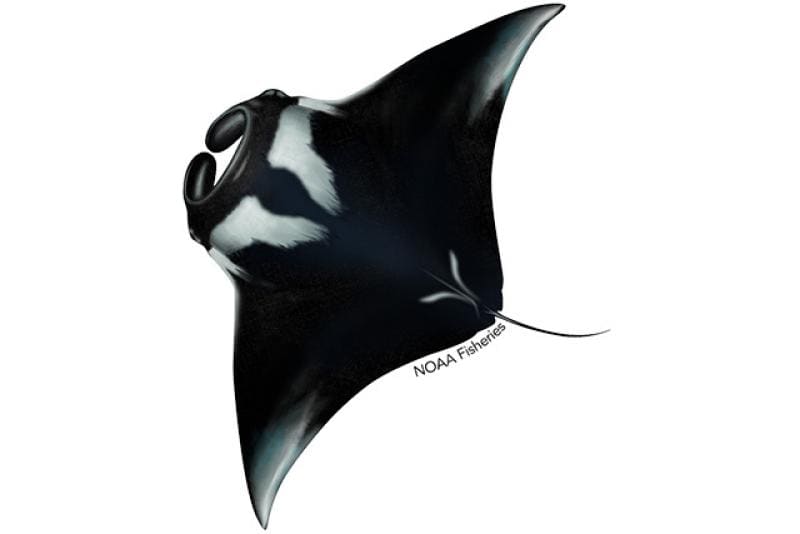
Illustration/photo: NOAA Fisheries — Giant Manta Ray (Mobula birostris).
Quick facts
Length: Disc width up to 26 feet
Lifespan: Up to 45 years
Region: New England/Mid-Atlantic,
Pacific Islands,
Southeast,
West Coast
Category: Protected species · Mid-Atlantic
Maryland likelihood: 3★ out of 5
About the species
The giant manta ray is the world’s largest ray with a wingspan of up to 26 feet. They are filter feeders and eat large quantities of zooplankton. Giant manta rays are slow-growing, migratory animals with small, highly fragmented populations that are sparsely distributed across the world.
The main threat to the giant manta ray is commercial fishing, with the species both targeted and caught as bycatch in a number of global fisheries throughout its range. Manta rays are particularly valued for their gill plates, which are traded internationally. In 2018, NOAA Fisheries listed the species as threatened under the Endangered Species Act .
Maryland record catch
Confirm whether Maryland DNR publishes an Atlantic state-record category for Giant Manta Ray on the current sport-fish record board.
Manta rays are recognized by their large diamond-shaped body with elongated wing-like pectoral fins, ventrally-placed gill slits, laterally-placed eyes, and wide, terminal mouths. In front of the mouth, they have two structures called cephalic lobes which extend and help to channel water into the mouth for feeding activities (making them the only vertebrate animals with three paired appendages).
Manta rays come in two distinct color types: chevron (mostly black back and white belly) and black (almost completely black on both sides). They also have distinct spot patterns on their bellies that can be used to identify individuals. There are two species of manta rays: giant manta rays ( Mobula birostris ) and reef manta rays ( Mobula alfredi ). Giant manta rays are generally larger than reef manta rays, have a caudal thorn, and rough skin appearance. They can also be distinguished from reef manta rays by their coloration.
Behavior and Diet The giant manta ray is a migratory species and seasonal visitor along productive coastlines with regular upwelling, in oceanic island groups, and near offshore pinnacles and seamounts. The timing of these visits varies by region and seems to correspond with the movement of zooplankton, current circulation and tidal patterns, seasonal upwelling, seawater temperature, and possibly mating behavior.
Although the giant manta ray tends to be solitary, they aggregate at cleaning sites and to feed and mate. Manta rays primarily feed on planktonic organisms such as euphausiids, copepods, mysids, decapod larvae, and shrimp, but some studies have noted their consumption of small and moderately sized fish as well. When feeding, mantas hold their cephalic fins in an “O” shape and open their mouths wide, creating a funnel that pushes water and prey through their mouth and over their gill plates. Manta rays use many different types of feeding strategies, such as barrel rolling (doing somersaults over and over again) and creating feeding chains with other mantas to maximize prey intake.
Giant manta rays also appear to exhibit a high degree of plasticity or variation in terms of their use of depths within their habitat. During feeding, giant manta rays may be found aggregating in shallow waters at depths less than 10 meters. However, tagging studies have also shown that the species conducts dives of up to 200 to 450 meters and is capable of diving to depths exceeding 1,000 meters. This diving behavior may be influenced by season and shifts in prey location associated with the thermocline.
Where They Live The giant manta ray is found worldwide in tropical, subtropical, and temperate bodies of water and is commonly found offshore, in oceanic waters, and in productive coastal areas. The species has also been observed in estuarine waters, oceanic inlets, and within bays and intercoastal waterways. As such, giant manta rays can be found in cool water, as low as 19°C, although temperature preference appears to vary by region. For example, off the U.S. East Coast, giant manta rays are commonly found in waters from 19 to 22°C, whereas those off the Yucatan peninsula and Indonesia are commonly found in waters between 25 to 30°C.
Appearance
The giant manta ray is a migratory species and seasonal visitor along productive coastlines with regular upwelling, in oceanic island groups, and near offshore pinnacles and seamounts. The timing of these visits varies by region and seems to correspond with the movement of zooplankton, current circulation and tidal patterns, seasonal upwelling, seawater temperature, and possibly mating behavior.
Although the giant manta ray tends to be solitary, they aggregate at cleaning sites and to feed and mate. Manta rays primarily feed on planktonic organisms such as euphausiids, copepods, mysids, decapod larvae, and shrimp, but some studies have noted their consumption of small and moderately sized fish as well. When feeding, mantas hold their cephalic fins in an “O” shape and open their mouths wide, creating a funnel that pushes water and prey through their mouth and over their gill plates. Manta rays use many different types of feeding strategies, such as barrel rolling (doing somersaults over and over again) and creating feeding chains with other mantas to maximize prey intake.
Giant manta rays also appear to exhibit a high degree of plasticity or variation in terms of their use of depths within their habitat. During feeding, giant manta rays may be found aggregating in shallow waters at depths less than 10 meters. However, tagging studies have also shown that the species conducts dives of up to 200 to 450 meters and is capable of diving to depths exceeding 1,000 meters. This diving behavior may be influenced by season and shifts in prey location associated with the thermocline.
Where They Live The giant manta ray is found worldwide in tropical, subtropical, and temperate bodies of water and is commonly found offshore, in oceanic waters, and in productive coastal areas. The species has also been observed in estuarine waters, oceanic inlets, and within bays and intercoastal waterways. As such, giant manta rays can be found in cool water, as low as 19°C, although temperature preference appears to vary by region. For example, off the U.S. East Coast, giant manta rays are commonly found in waters from 19 to 22°C, whereas those off the Yucatan peninsula and Indonesia are commonly found in waters between 25 to 30°C.
World map providing approximate representation of the giant manta ray's range Lifespan & Reproduction Manta rays have among the lowest fecundity of all elasmobranchs (a subclass of cartilaginous fish), typically giving birth to only one pup every two to three years. Gestation is thought to last around a year. Although manta rays have been reported to live at least 45 years, not much is known about their growth and development.
Threats Overfishing and Bycatch The most significant threat to the giant manta ray is overutilization for commercial purposes. Giant manta rays are both targeted and caught as bycatch in a number of global fisheries throughout their range, and are most susceptible to artisanal/small-scale fisheries and commercial fisheries, particularly purse seines, gill nets, longlines, and trawls.
Efforts to address overutilization of the species through current regulatory measures are inadequate, as targeted fishing and illegal retainment of the species still occurs despite prohibitions in a significant portion of the species’ range. Also, measures to address and minimize bycatch of the species in commercial fisheries are rare.
Harvest for International Trade Demand for the gill plates of manta and other mobula rays has risen dramatically in Asian markets. With this expansion of the international gill plate market and increasing demand for manta ray products, estimated harvest of giant manta rays, particularly in many portions of the Indo-Pacific and Eastern Pacific, has led to massive declines in manta ray populations and fishery collapse.
Other potential threats that should be monitored include entanglement, vessel strikes, marine debris/pollution, climate change , recreational fishing interactions, tourism, and the aquarium trade.
Biology
The giant manta ray is found worldwide in tropical, subtropical, and temperate bodies of water and is commonly found offshore, in oceanic waters, and in productive coastal areas. The species has also been observed in estuarine waters, oceanic inlets, and within bays and intercoastal waterways. As such, giant manta rays can be found in cool water, as low as 19°C, although temperature preference appears to vary by region. For example, off the U.S. East Coast, giant manta rays are commonly found in waters from 19 to 22°C, whereas those off the Yucatan peninsula and Indonesia are commonly found in waters between 25 to 30°C.
World map providing approximate representation of the giant manta ray's range Lifespan & Reproduction Manta rays have among the lowest fecundity of all elasmobranchs (a subclass of cartilaginous fish), typically giving birth to only one pup every two to three years. Gestation is thought to last around a year. Although manta rays have been reported to live at least 45 years, not much is known about their growth and development.
Threats Overfishing and Bycatch The most significant threat to the giant manta ray is overutilization for commercial purposes. Giant manta rays are both targeted and caught as bycatch in a number of global fisheries throughout their range, and are most susceptible to artisanal/small-scale fisheries and commercial fisheries, particularly purse seines, gill nets, longlines, and trawls.
Efforts to address overutilization of the species through current regulatory measures are inadequate, as targeted fishing and illegal retainment of the species still occurs despite prohibitions in a significant portion of the species’ range. Also, measures to address and minimize bycatch of the species in commercial fisheries are rare.
Harvest for International Trade Demand for the gill plates of manta and other mobula rays has risen dramatically in Asian markets. With this expansion of the international gill plate market and increasing demand for manta ray products, estimated harvest of giant manta rays, particularly in many portions of the Indo-Pacific and Eastern Pacific, has led to massive declines in manta ray populations and fishery collapse.
Other potential threats that should be monitored include entanglement, vessel strikes, marine debris/pollution, climate change , recreational fishing interactions, tourism, and the aquarium trade.
Where they live
Range
The giant manta ray is found worldwide in tropical, subtropical, and temperate bodies of water and is commonly found offshore, in oceanic waters, and in productive coastal areas. The species has also been observed in estuarine waters, oceanic inlets, and within bays and intercoastal waterways. As such, giant manta rays can be found in cool water, as low as 19°C, although temperature preference appears to vary by region. For example, off the U.S. East Coast, giant manta rays are commonly found in waters from 19 to 22°C, whereas those off the Yucatan peninsula and Indonesia are commonly found in waters between 25 to 30°C.
World map providing approximate representation of the giant manta ray's range Lifespan & Reproduction Manta rays have among the lowest fecundity of all elasmobranchs (a subclass of cartilaginous fish), typically giving birth to only one pup every two to three years. Gestation is thought to last around a year. Although manta rays have been reported to live at least 45 years, not much is known about their growth and development.
Habitat
See the NOAA species profile for habitat detail for this entry.
Ocean City & Mid-Atlantic context
From Ocean City, Maryland, use this Giant Manta Ray profile as NOAA Mid-Atlantic directory context—not a promise you will meet the species on every charter.
Giant Manta Ray is protected. Do not harvest. Report unusual strandings or entanglements through official channels.
Source facts and imagery are adapted from the NOAA Fisheries species profile for Giant Manta Ray.
What charter to book from Ocean City
Giant Manta Ray is not a standard Ocean City charter harvest target. Use this profile for NOAA biology and Mid-Atlantic context only.
Not typical from OC
Bay guide — Not a typical Ocean City bay guide target for Giant Manta Ray.
Inshore charter — Not a typical Ocean City inshore charter target for Giant Manta Ray.
Casting / light tackle — Not a typical Ocean City casting / light tackle target for Giant Manta Ray.
Trolling charter — Not a typical Ocean City trolling charter target for Giant Manta Ray.
Nearshore wreck / bottom — Not a typical Ocean City nearshore wreck / bottom target for Giant Manta Ray.
Offshore charter — Not a typical Ocean City offshore charter target for Giant Manta Ray.
Head / party boat — Not a typical Ocean City head / party boat target for Giant Manta Ray.
Start with the charter directory trip-type picker so you compare boats inside the right
archetype—not a bay-guide quote against a canyon invoice.
Recovery Outline Under the ESA, NOAA Fisheries is required to develop and implement recovery plans for the conservation and survival of listed species. NOAA Fisheries has developed a recovery outline to serve as an interim guidance document to direct recovery efforts, including recovery planning, for the giant manta ray until a full recovery plan is developed and approved. The recovery outline presents a preliminary strategy for recovery of the species and recommends high priority actions to stabilize and recover the species.
Draft Recovery Plan We developed a Draft Recovery Plan in October 2024 (89 FR 82991). We are soliciting review and comment from the public and all interested parties on the Draft Recovery Plan. We will consider all substantive comments accepted through December 16, 2024 , before submitting the Recovery Plan for final approval.
The Draft Recovery Plan follows the 3-part framework approach to recovery planning, in which recovery planning components are divided into three separate documents. The Draft Recovery Plan provides the foundation and overall road map for achieving the recovery goal. It contains the elements required to be in a recovery plan under the Endangered Species Act: (1) objective, measurable recovery criteria; (2) site-specific management actions necessary to conserve the species; and (3) estimates of the time and costs required to achieve the plan’s goals.
Draft Recovery Implementation Strategy The Draft Recovery Implementation Strategy is a flexible, operational document that steps-down the recovery actions into more specifically defined activities that implement and support the recovery actions. The Recovery Implementation Strategy is intended to assist NOAA Fisheries and other stakeholders in planning and implementing activities to carry out the recovery actions in the recovery plan. The activities identified in the Recovery Implementation Strategy can be modified and adapted over time based on the progress of recovery and the availability of resources or new data or literature.
Recovery Status Review Using the 2017 Status Review Report for the giant manta ray as a foundation, we developed an up-to-date Recovery Status Review for the species. A Recovery Status Review is a stand-alone document that provides all the detailed information on the species' biology, ecology, status and threats, and conservation efforts to date. This document was published in October 2024 and will be updated as necessary with new information. Traditionally, this information was included in the background of a recovery plan and became outdated quickly. As a stand-alone, living document, information can be kept more relevant.
Species Recovery Contacts Adrienne Lohe , Giant Manta Ray Recovery Coordinator For more information on giant manta rays in our regions:
Nicholas Farmer , Southeast Region Chelsey Young , Pacific Islands Region Conservation Efforts At the 2013 meeting of the Conference of the Parties to the Convention on International Trade in Endangered Species of Wild Fauna and Flora (CITES), the Parties agreed to include all manta rays ( Manta spp. ) in Appendix II of CITES, with the listing effective on September 14, 2014. The inclusion of manta rays in CITES Appendix II will help ensure that the international trade in these species is legal and sustainable.
The U.S. Fish and Wildlife Service is the government agency designated under the ESA to carry out the provisions of CITES. NOAA Fisheries provides guidance and scientific support on marine issues given our technical expertise.
Harvest
See the NOAA wild-caught fishery section for landings and gear notes when published for this species.
Landings and management details matter most for the waters where Giant Manta Ray is actually fished—see the
NOAA species profile
.