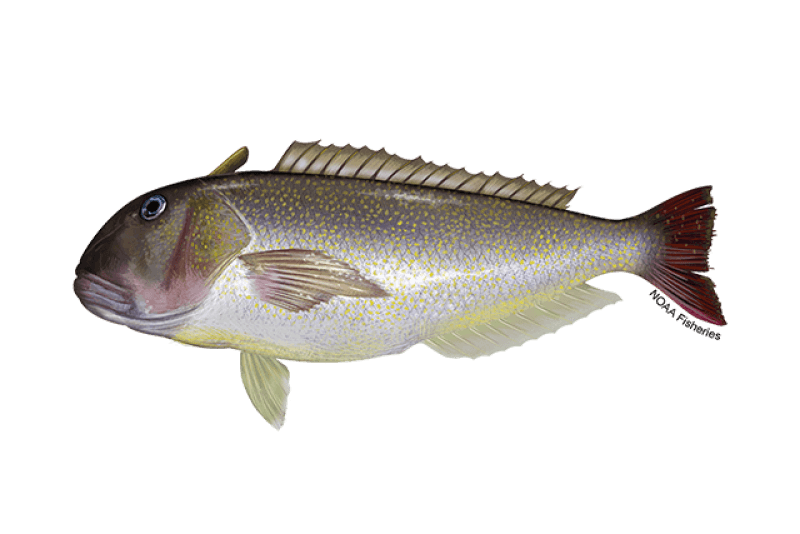
Lopholatilus chamaeleonticeps , also known as Golden bass, Golden snapper, Great northern tilefish, Rainbow tilefish. Golden tilefish are found along the outer continental shelf and slope from Nova Scotia, Canada to Suriname. The golden tilefish fishery in the U.S. is managed from Maine through Vi
Source: Species facts, status language, and imagery adapted from the NOAA Fisheries species profile (last updated 07/02/2026). Ocean City charter and Maryland
record notes are editorial orientation for OCEANCITY.MD readers. Always confirm current seasons, sizes, and
bag limits before you fish—rules change.
Illustration/photo: NOAA Fisheries — Golden Tilefish (Lopholatilus chamaeleonticeps).
Quick facts
Region: New England/Mid-Atlantic,
Southeast
Category: Fish · Mid-Atlantic
Maryland likelihood: 3★ out of 5
About the species
Golden tilefish are found along the outer continental shelf and slope from Nova Scotia, Canada to Suriname. The golden tilefish fishery in the U.S. is managed from Maine through Virginia, with the majority of the fishery concentrated between Nantucket Island, Massachusetts, south to Cape May, New Jersey; more specifically between Hudson and Veatch Canyons. The commercial fishery predominantly uses longline gear, although handline, rod and reel, and trawl gear are also authorized. Only rod and reel gear is allowed in the recreational golden tilefish fishery. The market for golden tilefish is for human consumption and is often used in sushi. U.S. wild-caught golden tilefish is a smart seafood choice because it is sustainably managed and responsibly harvested under U.S. regulations. Implementing regulations are found at 50 CFR part 648 subpart N.
Maryland record catch
Confirm whether Maryland DNR publishes an Atlantic state-record category for Golden Tilefish on the current sport-fish record board.
Tilefish, sometimes known as “the clown of the sea,” are colorful. They are iridescent blue-green on the back, with numerous spots of bright yellow and gold. Their bellies are white, and their heads are rosy with blue under the eyes. Their pectoral fins are sepia-colored, and the edge of their anal fins is purplish-blue. Golden tilefish are easily distinguishable from other members of the tilefish family by the large crest on their head. Biology Tilefish grow slowly, up to 43 inches, although the average size harvested is 24 inches. They have a long life span, up to 46 years (females) and 39 years (males). These are the oldest tilefish on record, but radiometric dating techniques indicate tilefish may live as long as 50 years. Tilefish are able to reproduce when they reach 13 inches long and 3 pounds (approximately 2 to 4 years old). Tilefish spawn from March through November in the Atlantic and from January through June in the Gulf of America. Spawning peaks in June (Mid-Atlantic) and from April to June (South Atlantic and Gulf of America). Females release 2 to 8 million eggs when they spawn. Tilefish feed during the day on the bottom, eating shrimp, crabs, clams, snails, worms, anemones, and sea cucumbers. Monkfish, spiny dogfish, conger eels, large bottom-dwelling sharks (such as dusky and sandbar sharks), and other tilefish prey on juvenile tilefish. Where They Live Range Tilefish are found along the outer continental shelf and upper continental slope of the entire U.S. East Coast and in the Gulf of America. They are most abundant from Nantucket Island, Massachusetts, south to Cape May, New Jersey. Habitat Tilefish live in water from 250 to 1,500 feet deep where bottom temperatures range from 49 to 58 ° F. Individual tilefish are found in and around submarine canyons, where they burrow in mud or sand sediment. Tilefish sometimes concentrate in small groups. Habitats can be classified as rocks and boulders, pueblo habitats, or vertical burrows. Vertical burrows are the most common type of habitat. Pueblo habitats are found in the side of submarine canyon walls and are named because of their resemblance to the pueblo communities of Native Americans in the southwestern United States. Managers have closed four deep water canyons from Georges Bank to the Mid-Atlantic to bottom-tending mobile gear (such as otter trawls) to protect tilefish habitat. Many fish and crustacean species are found in and around tilefish habitat because it provides food and shelter. Fishery Management The Mid-Atlantic , South Atlantic , and Gulf Councils develop management measures for the tilefish fisheries in their respective jurisdictions. NOAA Fisheries is responsible for implementing and enforcing these measures. The Mid-Atlantic/Southern New England Tilefish Fishery Management Plan includes: Annual catch limits. Permit requirements. Individual Fishing Quota (IFQ) program. An overall annual limit on incidental landings of tilefish and a per-trip possession limit. Private recreational vessels are required to have a vessel permit and report each trip they target or retain golden tilefish. Closure of the incidental fishery if the annual limit is reached, prohibiting any additional landings. Prohibition of bottom-tending mobile gear (such as trawls) in certain areas in federal waters to reduce impacts on key tilefish habitats. The South Atlantic Snapper-Grouper Fishery Management Plan includes: Permit requirements, including a limited access endorsement program to harvest golden tilefish with longline. Annual catch limits by commercial gear type (longline and hook-and-line). Commercial trip limits. Prohibition of longline gear in certain areas to protect snapper-grouper species spawning sites and live-bottom habitat. The Gulf of America Reef Fish Fishery Management Plan includes: Annual catch limits for recreational and commercial anglers. A commercial IFQ program. To protect reef fish, sea turtles, and bottom habitat, restrictions on the areas/depths where longlines can be used. The commercial tilefish fisheries in the Mid-Atlantic and the Gulf of America are managed through IFQ programs. Specific details vary by region but, in general, managers allocate a percentage of the annual catch to participating fishermen. Fishermen choose when to fish for their allocation throughout the year, ideally when market and weather conditions are best. This also results in a more consistent supply of fish to the consumer and increased safety at sea. Catch share programs , such as these IFQ programs, offer fishermen a direct incentive to use sustainable fishing practices—the quota may be increased as fish populations grow, leading to an increase in each fisherman's individual allocation and subsequent profits. For more information, see the Mid-Atlantic Tilefish Fishery Management Plan , the Gulf of America Reef Fish Fishery Management Plan , and the South Atlantic Snapper-Grouper Fishery Management Plan . Harvest Commercial fishery: In 2024, commercial landings of tilefish totaled 2.2 million pounds and were valued at $9 million, according to the NOAA Fisheries commercial fishing landings database . The majority of the commercial harvest was landed in New York, Florida, and New Jersey. Most of the commercial harvest of tilefish comes from the Mid-Atlantic/Southern New England stock, the largest of the three U.S. tilefish stocks. Gear types: Bottom longline gear catches the majority of the commercial harvest. A small amount of tilefish are caught with otter trawls in the Mid-Atlantic and with handlines in the South Atlantic and Gulf of America. Recreational fishery: U.S. recreational fisheries for tilefish are smaller than the commercial fisheries, but have been increasing in recent years. In 2024, recreational anglers landed 600,000 pounds of tilefish, according to the NOAA Fisheries recreational fishing landings database . The majority of the recreational harvest was landed in Florida. Regional recreational management measures include: Recreational fishermen can keep a limited number of tilefish per fishing trip in the Mid-Atlantic/Southern New England area. There is a limit on how many tilefish recreational fishermen can keep and a limit on the total amount that can be harvested during the year in the South Atlantic. The South Atlantic recreational fishery is closed when the annual catch limit is projected to be met. In the Gulf of America, tilefish are included in the reef fish aggregate bag limit, along with several other reef fish species, and the fishery is closed when the annual catch limit is projected to be met.
* Executive Order 14172, “Restoring Names That Honor American Greatness” (Jan. 20, 2025), directs that the Gulf of Mexico be renamed the Gulf of America. On August 7, 2025, NOAA Fisheries and the National Ocean Service amended regulations in the Code of Federal Regulations to reflect the renaming. The name change did not result in any changes to, and had no effect on the applicability or enforceability of, any existing regulations. This website continues to use “Gulf of Mexico” when quoting statutes or previously published materials.
Scientific Classification Kingdom Animalia Phylum Chordata Class Actinopterygii Order Perciformes Family Malacanthidae Genus Lopholatilus Species chamaeleonticeps Last updated by NOAA Fisheries on 07/02/2026
Appearance
Tilefish grow slowly, up to 43 inches, although the average size harvested is 24 inches. They have a long life span, up to 46 years (females) and 39 years (males). These are the oldest tilefish on record, but radiometric dating techniques indicate tilefish may live as long as 50 years. Tilefish are able to reproduce when they reach 13 inches long and 3 pounds (approximately 2 to 4 years old). Tilefish spawn from March through November in the Atlantic and from January through June in the Gulf of America. Spawning peaks in June (Mid-Atlantic) and from April to June (South Atlantic and Gulf of America). Females release 2 to 8 million eggs when they spawn. Tilefish feed during the day on the bottom, eating shrimp, crabs, clams, snails, worms, anemones, and sea cucumbers. Monkfish, spiny dogfish, conger eels, large bottom-dwelling sharks (such as dusky and sandbar sharks), and other tilefish prey on juvenile tilefish. Where They Live Range Tilefish are found along the outer continental shelf and upper continental slope of the entire U.S. East Coast and in the Gulf of America. They are most abundant from Nantucket Island, Massachusetts, south to Cape May, New Jersey. Habitat Tilefish live in water from 250 to 1,500 feet deep where bottom temperatures range from 49 to 58 ° F. Individual tilefish are found in and around submarine canyons, where they burrow in mud or sand sediment. Tilefish sometimes concentrate in small groups. Habitats can be classified as rocks and boulders, pueblo habitats, or vertical burrows. Vertical burrows are the most common type of habitat. Pueblo habitats are found in the side of submarine canyon walls and are named because of their resemblance to the pueblo communities of Native Americans in the southwestern United States. Managers have closed four deep water canyons from Georges Bank to the Mid-Atlantic to bottom-tending mobile gear (such as otter trawls) to protect tilefish habitat. Many fish and crustacean species are found in and around tilefish habitat because it provides food and shelter. Fishery Management The Mid-Atlantic , South Atlantic , and Gulf Councils develop management measures for the tilefish fisheries in their respective jurisdictions. NOAA Fisheries is responsible for implementing and enforcing these measures. The Mid-Atlantic/Southern New England Tilefish Fishery Management Plan includes: Annual catch limits. Permit requirements. Individual Fishing Quota (IFQ) program. An overall annual limit on incidental landings of tilefish and a per-trip possession limit. Private recreational vessels are required to have a vessel permit and report each trip they target or retain golden tilefish. Closure of the incidental fishery if the annual limit is reached, prohibiting any additional landings. Prohibition of bottom-tending mobile gear (such as trawls) in certain areas in federal waters to reduce impacts on key tilefish habitats. The South Atlantic Snapper-Grouper Fishery Management Plan includes: Permit requirements, including a limited access endorsement program to harvest golden tilefish with longline. Annual catch limits by commercial gear type (longline and hook-and-line). Commercial trip limits. Prohibition of longline gear in certain areas to protect snapper-grouper species spawning sites and live-bottom habitat. The Gulf of America Reef Fish Fishery Management Plan includes: Annual catch limits for recreational and commercial anglers. A commercial IFQ program. To protect reef fish, sea turtles, and bottom habitat, restrictions on the areas/depths where longlines can be used. The commercial tilefish fisheries in the Mid-Atlantic and the Gulf of America are managed through IFQ programs. Specific details vary by region but, in general, managers allocate a percentage of the annual catch to participating fishermen. Fishermen choose when to fish for their allocation throughout the year, ideally when market and weather conditions are best. This also results in a more consistent supply of fish to the consumer and increased safety at sea. Catch share programs , such as these IFQ programs, offer fishermen a direct incentive to use sustainable fishing practices—the quota may be increased as fish populations grow, leading to an increase in each fisherman's individual allocation and subsequent profits. For more information, see the Mid-Atlantic Tilefish Fishery Management Plan , the Gulf of America Reef Fish Fishery Management Plan , and the South Atlantic Snapper-Grouper Fishery Management Plan . Harvest Commercial fishery: In 2024, commercial landings of tilefish totaled 2.2 million pounds and were valued at $9 million, according to the NOAA Fisheries commercial fishing landings database . The majority of the commercial harvest was landed in New York, Florida, and New Jersey. Most of the commercial harvest of tilefish comes from the Mid-Atlantic/Southern New England stock, the largest of the three U.S. tilefish stocks. Gear types: Bottom longline gear catches the majority of the commercial harvest. A small amount of tilefish are caught with otter trawls in the Mid-Atlantic and with handlines in the South Atlantic and Gulf of America. Recreational fishery: U.S. recreational fisheries for tilefish are smaller than the commercial fisheries, but have been increasing in recent years. In 2024, recreational anglers landed 600,000 pounds of tilefish, according to the NOAA Fisheries recreational fishing landings database . The majority of the recreational harvest was landed in Florida. Regional recreational management measures include: Recreational fishermen can keep a limited number of tilefish per fishing trip in the Mid-Atlantic/Southern New England area. There is a limit on how many tilefish recreational fishermen can keep and a limit on the total amount that can be harvested during the year in the South Atlantic. The South Atlantic recreational fishery is closed when the annual catch limit is projected to be met. In the Gulf of America, tilefish are included in the reef fish aggregate bag limit, along with several other reef fish species, and the fishery is closed when the annual catch limit is projected to be met.
* Executive Order 14172, “Restoring Names That Honor American Greatness” (Jan. 20, 2025), directs that the Gulf of Mexico be renamed the Gulf of America. On August 7, 2025, NOAA Fisheries and the National Ocean Service amended regulations in the Code of Federal Regulations to reflect the renaming. The name change did not result in any changes to, and had no effect on the applicability or enforceability of, any existing regulations. This website continues to use “Gulf of Mexico” when quoting statutes or previously published materials.
Scientific Classification Kingdom Animalia Phylum Chordata Class Actinopterygii Order Perciformes Family Malacanthidae Genus Lopholatilus Species chamaeleonticeps Last updated by NOAA Fisheries on 07/02/2026
Biology
Tilefish are found along the outer continental shelf and upper continental slope of the entire U.S. East Coast and in the Gulf of America. They are most abundant from Nantucket Island, Massachusetts, south to Cape May, New Jersey. Habitat Tilefish live in water from 250 to 1,500 feet deep where bottom temperatures range from 49 to 58 ° F. Individual tilefish are found in and around submarine canyons, where they burrow in mud or sand sediment. Tilefish sometimes concentrate in small groups. Habitats can be classified as rocks and boulders, pueblo habitats, or vertical burrows. Vertical burrows are the most common type of habitat. Pueblo habitats are found in the side of submarine canyon walls and are named because of their resemblance to the pueblo communities of Native Americans in the southwestern United States. Managers have closed four deep water canyons from Georges Bank to the Mid-Atlantic to bottom-tending mobile gear (such as otter trawls) to protect tilefish habitat. Many fish and crustacean species are found in and around tilefish habitat because it provides food and shelter. Fishery Management The Mid-Atlantic , South Atlantic , and Gulf Councils develop management measures for the tilefish fisheries in their respective jurisdictions. NOAA Fisheries is responsible for implementing and enforcing these measures. The Mid-Atlantic/Southern New England Tilefish Fishery Management Plan includes: Annual catch limits. Permit requirements. Individual Fishing Quota (IFQ) program. An overall annual limit on incidental landings of tilefish and a per-trip possession limit. Private recreational vessels are required to have a vessel permit and report each trip they target or retain golden tilefish. Closure of the incidental fishery if the annual limit is reached, prohibiting any additional landings. Prohibition of bottom-tending mobile gear (such as trawls) in certain areas in federal waters to reduce impacts on key tilefish habitats. The South Atlantic Snapper-Grouper Fishery Management Plan includes: Permit requirements, including a limited access endorsement program to harvest golden tilefish with longline. Annual catch limits by commercial gear type (longline and hook-and-line). Commercial trip limits. Prohibition of longline gear in certain areas to protect snapper-grouper species spawning sites and live-bottom habitat. The Gulf of America Reef Fish Fishery Management Plan includes: Annual catch limits for recreational and commercial anglers. A commercial IFQ program. To protect reef fish, sea turtles, and bottom habitat, restrictions on the areas/depths where longlines can be used. The commercial tilefish fisheries in the Mid-Atlantic and the Gulf of America are managed through IFQ programs. Specific details vary by region but, in general, managers allocate a percentage of the annual catch to participating fishermen. Fishermen choose when to fish for their allocation throughout the year, ideally when market and weather conditions are best. This also results in a more consistent supply of fish to the consumer and increased safety at sea. Catch share programs , such as these IFQ programs, offer fishermen a direct incentive to use sustainable fishing practices—the quota may be increased as fish populations grow, leading to an increase in each fisherman's individual allocation and subsequent profits. For more information, see the Mid-Atlantic Tilefish Fishery Management Plan , the Gulf of America Reef Fish Fishery Management Plan , and the South Atlantic Snapper-Grouper Fishery Management Plan . Harvest Commercial fishery: In 2024, commercial landings of tilefish totaled 2.2 million pounds and were valued at $9 million, according to the NOAA Fisheries commercial fishing landings database . The majority of the commercial harvest was landed in New York, Florida, and New Jersey. Most of the commercial harvest of tilefish comes from the Mid-Atlantic/Southern New England stock, the largest of the three U.S. tilefish stocks. Gear types: Bottom longline gear catches the majority of the commercial harvest. A small amount of tilefish are caught with otter trawls in the Mid-Atlantic and with handlines in the South Atlantic and Gulf of America. Recreational fishery: U.S. recreational fisheries for tilefish are smaller than the commercial fisheries, but have been increasing in recent years. In 2024, recreational anglers landed 600,000 pounds of tilefish, according to the NOAA Fisheries recreational fishing landings database . The majority of the recreational harvest was landed in Florida. Regional recreational management measures include: Recreational fishermen can keep a limited number of tilefish per fishing trip in the Mid-Atlantic/Southern New England area. There is a limit on how many tilefish recreational fishermen can keep and a limit on the total amount that can be harvested during the year in the South Atlantic. The South Atlantic recreational fishery is closed when the annual catch limit is projected to be met. In the Gulf of America, tilefish are included in the reef fish aggregate bag limit, along with several other reef fish species, and the fishery is closed when the annual catch limit is projected to be met.
* Executive Order 14172, “Restoring Names That Honor American Greatness” (Jan. 20, 2025), directs that the Gulf of Mexico be renamed the Gulf of America. On August 7, 2025, NOAA Fisheries and the National Ocean Service amended regulations in the Code of Federal Regulations to reflect the renaming. The name change did not result in any changes to, and had no effect on the applicability or enforceability of, any existing regulations. This website continues to use “Gulf of Mexico” when quoting statutes or previously published materials.
Scientific Classification Kingdom Animalia Phylum Chordata Class Actinopterygii Order Perciformes Family Malacanthidae Genus Lopholatilus Species chamaeleonticeps Last updated by NOAA Fisheries on 07/02/2026
Where they live
Range
Tilefish are found along the outer continental shelf and upper continental slope of the entire U.S. East Coast and in the Gulf of America. They are most abundant from Nantucket Island, Massachusetts, south to Cape May, New Jersey. Habitat Tilefish live in water from 250 to 1,500 feet deep where bottom temperatures range from 49 to 58 ° F. Individual tilefish are found in and around submarine canyons, where they burrow in mud or sand sediment. Tilefish sometimes concentrate in small groups. Habitats can be classified as rocks and boulders, pueblo habitats, or vertical burrows. Vertical burrows are the most common type of habitat. Pueblo habitats are found in the side of submarine canyon walls and are named because of their resemblance to the pueblo communities of Native Americans in the southwestern United States. Managers have closed four deep water canyons from Georges Bank to the Mid-Atlantic to bottom-tending mobile gear (such as otter trawls) to protect tilefish habitat. Many fish and crustacean species are found in and around tilefish habitat because it provides food and shelter. Fishery Management The Mid-Atlantic , South Atlantic , and Gulf Councils develop management measures for the tilefish fisheries in their respective jurisdictions. NOAA Fisheries is responsible for implementing and enforcing these measures. The Mid-Atlantic/Southern New England Tilefish Fishery Management Plan includes: Annual catch limits. Permit requirements. Individual Fishing Quota (IFQ) program. An overall annual limit on incidental landings of tilefish and a per-trip possession limit. Private recreational vessels are required to have a vessel permit and report each trip they target or retain golden tilefish. Closure of the incidental fishery if the annual limit is reached, prohibiting any additional landings. Prohibition of bottom-tending mobile gear (such as trawls) in certain areas in federal waters to reduce impacts on key tilefish habitats. The South Atlantic Snapper-Grouper Fishery Management Plan includes: Permit requirements, including a limited access endorsement program to harvest golden tilefish with longline. Annual catch limits by commercial gear type (longline and hook-and-line). Commercial trip limits. Prohibition of longline gear in certain areas to protect snapper-grouper species spawning sites and live-bottom habitat. The Gulf of America Reef Fish Fishery Management Plan includes: Annual catch limits for recreational and commercial anglers. A commercial IFQ program. To protect reef fish, sea turtles, and bottom habitat, restrictions on the areas/depths where longlines can be used. The commercial tilefish fisheries in the Mid-Atlantic and the Gulf of America are managed through IFQ programs. Specific details vary by region but, in general, managers allocate a percentage of the annual catch to participating fishermen. Fishermen choose when to fish for their allocation throughout the year, ideally when market and weather conditions are best. This also results in a more consistent supply of fish to the consumer and increased safety at sea. Catch share programs , such as these IFQ programs, offer fishermen a direct incentive to use sustainable fishing practices—the quota may be increased as fish populations grow, leading to an increase in each fisherman's individual allocation and subsequent profits. For more information, see the Mid-Atlantic Tilefish Fishery Management Plan , the Gulf of America Reef Fish Fishery Management Plan , and the South Atlantic Snapper-Grouper Fishery Management Plan . Harvest Commercial fishery: In 2024, commercial landings of tilefish totaled 2.2 million pounds and were valued at $9 million, according to the NOAA Fisheries commercial fishing landings database . The majority of the commercial harvest was landed in New York, Florida, and New Jersey. Most of the commercial harvest of tilefish comes from the Mid-Atlantic/Southern New England stock, the largest of the three U.S. tilefish stocks. Gear types: Bottom longline gear catches the majority of the commercial harvest. A small amount of tilefish are caught with otter trawls in the Mid-Atlantic and with handlines in the South Atlantic and Gulf of America. Recreational fishery: U.S. recreational fisheries for tilefish are smaller than the commercial fisheries, but have been increasing in recent years. In 2024, recreational anglers landed 600,000 pounds of tilefish, according to the NOAA Fisheries recreational fishing landings database . The majority of the recreational harvest was landed in Florida. Regional recreational management measures include: Recreational fishermen can keep a limited number of tilefish per fishing trip in the Mid-Atlantic/Southern New England area. There is a limit on how many tilefish recreational fishermen can keep and a limit on the total amount that can be harvested during the year in the South Atlantic. The South Atlantic recreational fishery is closed when the annual catch limit is projected to be met. In the Gulf of America, tilefish are included in the reef fish aggregate bag limit, along with several other reef fish species, and the fishery is closed when the annual catch limit is projected to be met.
* Executive Order 14172, “Restoring Names That Honor American Greatness” (Jan. 20, 2025), directs that the Gulf of Mexico be renamed the Gulf of America. On August 7, 2025, NOAA Fisheries and the National Ocean Service amended regulations in the Code of Federal Regulations to reflect the renaming. The name change did not result in any changes to, and had no effect on the applicability or enforceability of, any existing regulations. This website continues to use “Gulf of Mexico” when quoting statutes or previously published materials.
Habitat
The Mid-Atlantic , South Atlantic , and Gulf Councils develop management measures for the tilefish fisheries in their respective jurisdictions. NOAA Fisheries is responsible for implementing and enforcing these measures. The Mid-Atlantic/Southern New England Tilefish Fishery Management Plan includes: Annual catch limits. Permit requirements. Individual Fishing Quota (IFQ) program. An overall annual limit on incidental landings of tilefish and a per-trip possession limit. Private recreational vessels are required to have a vessel permit and report each trip they target or retain golden tilefish. Closure of the incidental fishery if the annual limit is reached, prohibiting any additional landings. Prohibition of bottom-tending mobile gear (such as trawls) in certain areas in federal waters to reduce impacts on key tilefish habitats. The South Atlantic Snapper-Grouper Fishery Management Plan includes: Permit requirements, including a limited access endorsement program to harvest golden tilefish with longline. Annual catch limits by commercial gear type (longline and hook-and-line). Commercial trip limits. Prohibition of longline gear in certain areas to protect snapper-grouper species spawning sites and live-bottom habitat. The Gulf of America Reef Fish Fishery Management Plan includes: Annual catch limits for recreational and commercial anglers. A commercial IFQ program. To protect reef fish, sea turtles, and bottom habitat, restrictions on the areas/depths where longlines can be used. The commercial tilefish fisheries in the Mid-Atlantic and the Gulf of America are managed through IFQ programs. Specific details vary by region but, in general, managers allocate a percentage of the annual catch to participating fishermen. Fishermen choose when to fish for their allocation throughout the year, ideally when market and weather conditions are best. This also results in a more consistent supply of fish to the consumer and increased safety at sea. Catch share programs , such as these IFQ programs, offer fishermen a direct incentive to use sustainable fishing practices—the quota may be increased as fish populations grow, leading to an increase in each fisherman's individual allocation and subsequent profits. For more information, see the Mid-Atlantic Tilefish Fishery Management Plan , the Gulf of America Reef Fish Fishery Management Plan , and the South Atlantic Snapper-Grouper Fishery Management Plan . Harvest Commercial fishery: In 2024, commercial landings of tilefish totaled 2.2 million pounds and were valued at $9 million, according to the NOAA Fisheries commercial fishing landings database . The majority of the commercial harvest was landed in New York, Florida, and New Jersey. Most of the commercial harvest of tilefish comes from the Mid-Atlantic/Southern New England stock, the largest of the three U.S. tilefish stocks. Gear types: Bottom longline gear catches the majority of the commercial harvest. A small amount of tilefish are caught with otter trawls in the Mid-Atlantic and with handlines in the South Atlantic and Gulf of America. Recreational fishery: U.S. recreational fisheries for tilefish are smaller than the commercial fisheries, but have been increasing in recent years. In 2024, recreational anglers landed 600,000 pounds of tilefish, according to the NOAA Fisheries recreational fishing landings database . The majority of the recreational harvest was landed in Florida. Regional recreational management measures include: Recreational fishermen can keep a limited number of tilefish per fishing trip in the Mid-Atlantic/Southern New England area. There is a limit on how many tilefish recreational fishermen can keep and a limit on the total amount that can be harvested during the year in the South Atlantic. The South Atlantic recreational fishery is closed when the annual catch limit is projected to be met. In the Gulf of America, tilefish are included in the reef fish aggregate bag limit, along with several other reef fish species, and the fishery is closed when the annual catch limit is projected to be met.
* Executive Order 14172, “Restoring Names That Honor American Greatness” (Jan. 20, 2025), directs that the Gulf of Mexico be renamed the Gulf of America. On August 7, 2025, NOAA Fisheries and the National Ocean Service amended regulations in the Code of Federal Regulations to reflect the renaming. The name change did not result in any changes to, and had no effect on the applicability or enforceability of, any existing regulations. This website continues to use “Gulf of Mexico” when quoting statutes or previously published materials.
Scientific Classification Kingdom Animalia Phylum Chordata Class Actinopterygii Order Perciformes Family Malacanthidae Genus Lopholatilus Species chamaeleonticeps Last updated by NOAA Fisheries on 07/02/2026
Ocean City & Mid-Atlantic context
From Ocean City, Maryland, use this Golden Tilefish profile as NOAA Mid-Atlantic directory context—not a promise you will meet the species on every charter.
Always verify current Maryland and federal size, season, and bag rules for your exact date and coordinates before you keep any catch.
Source facts and imagery are adapted from the NOAA Fisheries species profile for Golden Tilefish.
What charter to book from Ocean City
Golden Tilefish may appear on Ocean City trips depending on season and habitat—use the NOAA biology below and book the charter archetype that matches how you will actually fish.
Possible / related
Bay guide — Possible overlap depending on season, water, and boat program.
Inshore charter — Possible overlap depending on season, water, and boat program.
Commercial fishery: In 2024, commercial landings of tilefish totaled 2.2 million pounds and were valued at $9 million, according to the NOAA Fisheries commercial fishing landings database . The majority of the commercial harvest was landed in New York, Florida, and New Jersey. Most of the commercial harvest of tilefish comes from the Mid-Atlantic/Southern New England stock, the largest of the three U.S. tilefish stocks. Gear types: Bottom longline gear catches the majority of the commercial harvest. A small amount of tilefish are caught with otter trawls in the Mid-Atlantic and with handlines in the South Atlantic and Gulf of America. Recreational fishery: U.S. recreational fisheries for tilefish are smaller than the commercial fisheries, but have been increasing in recent years. In 2024, recreational anglers landed 600,000 pounds of tilefish, according to the NOAA Fisheries recreational fishing landings database . The majority of the recreational harvest was landed in Florida. Regional recreational management measures include: Recreational fishermen can keep a limited number of tilefish per fishing trip in the Mid-Atlantic/Southern New England area. There is a limit on how many tilefish recreational fishermen can keep and a limit on the total amount that can be harvested during the year in the South Atlantic. The South Atlantic recreational fishery is closed when the annual catch limit is projected to be met. In the Gulf of America, tilefish are included in the reef fish aggregate bag limit, along with several other reef fish species, and the fishery is closed when the annual catch limit is projected to be met.
* Executive Order 14172, “Restoring Names That Honor American Greatness” (Jan. 20, 2025), directs that the Gulf of Mexico be renamed the Gulf of America. On August 7, 2025, NOAA Fisheries and the National Ocean Service amended regulations in the Code of Federal Regulations to reflect the renaming. The name change did not result in any changes to, and had no effect on the applicability or enforceability of, any existing regulations. This website continues to use “Gulf of Mexico” when quoting statutes or previously published materials.
Scientific Classification Kingdom Animalia Phylum Chordata Class Actinopterygii Order Perciformes Family Malacanthidae Genus Lopholatilus Species chamaeleonticeps Last updated by NOAA Fisheries on 07/02/2026
Harvest
See the NOAA wild-caught fishery section for landings and gear notes when published for this species.
Landings and management details matter most for the waters where Golden Tilefish is actually fished—see the
NOAA species profile
.
Seafood facts
Fact
Detail
Sustainability
U.S. wild-caught tilefish is a smart seafood choice because it is sustainably managed and responsibly harvested under U.S. regulations.
Availability
Year-round.
Source
U.S. wild-caught from Massachusetts to Texas.
Taste
Tilefish has a mild flavor, similar to lobster or crab. Almost all tilefish is sold fresh.
Texture
Firm and flaky.
Health
Tilefish are low in sodium. They are a good source of niacin and phosphorus, and a very good source of protein, vitamin B12, and selenium.
After a real OC boat day or market stop for Golden Tilefish, Seafood after boat days covers
dock buffer and cook-your-catch pacing.