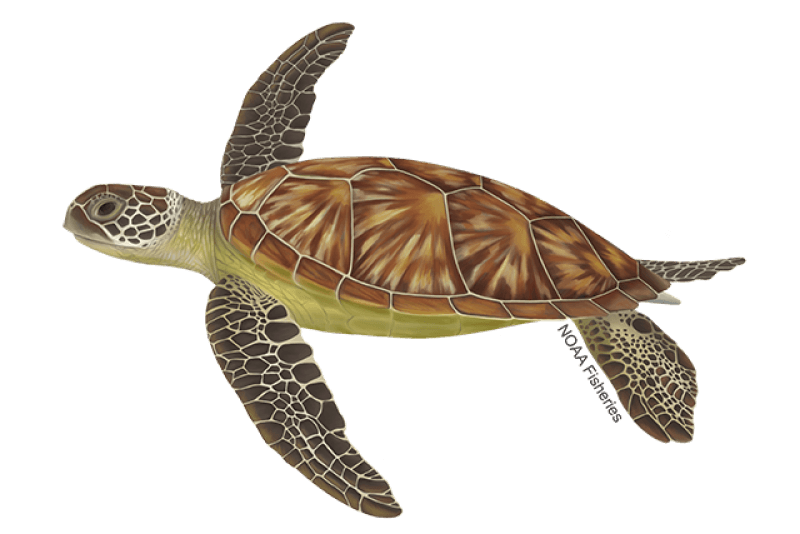
Chelonia mydas . The green sea turtle is the largest hard-shelled sea turtle. They are unique among sea turtles in that they are primarily herbivores , eating mostly seagrasses and algae, although
Source: Species facts, status language, and imagery adapted from the NOAA Fisheries species profile (last updated 07/16/2025). Ocean City charter and Maryland
record notes are editorial orientation for OCEANCITY.MD readers. Always confirm current seasons, sizes, and
bag limits before you fish—rules change.
Illustration/photo: NOAA Fisheries — Green Turtle (Chelonia mydas).
Quick facts
Length: Adult: 3 to 4 feet
Lifespan: Unknown, but estimated to be 70 years or more
Region: New England/Mid-Atlantic,
Pacific Islands,
Southeast,
West Coast
Category: Protected species · Mid-Atlantic
Maryland likelihood: 2★ out of 5
About the species
The green sea turtle is the largest hard-shelled sea turtle. They are unique among sea turtles in that they are primarily herbivores , eating mostly seagrasses and algae, although they may also eat sponges and other invertebrates and discarded fish when available. The name “green turtle” comes from the color of their fat (not their shells), which originally was attributed to their diet; however, other sea turtles have greenish fat as well.
Green turtles are found throughout the world. They nest in over 80 countries and live in the coastal areas of more than 140 countries. Historically, green turtles were exploited for their fat, meat, and eggs, causing global population declines. Many countries, including the United States, prohibit the killing of sea turtles and collection of their eggs. However, in some areas, green turtles are still hunted for their meat or to supply shells to the wildlife trafficking trade, and egg collection for consumption remains a threat to their recovery. Bycatch in commercial and recreational fishing gear, loss of nesting habitat from coastal development, changing environmental conditions (e.g., sea level rise and warming temperatures)e, and vessel strikes are the biggest threats facing green turtles.
NOAA Fisheries and our partners are dedicated to protecting and recovering green turtle populations worldwide. We use a variety of innovative techniques to study, protect, and recover these threatened and endangered populations. We engage our partners as we develop measures and implement recovery plans that foster the conservation and recovery of green turtles and their habitats, and we fund research, monitoring, and conservation projects to implement priorities outlined in recovery plans.
Maryland record catch
Confirm whether Maryland DNR publishes an Atlantic state-record category for Green Turtle on the current sport-fish record board.
See the NOAA species profile for current stock status language for this entry.
Appearance
Green turtles, like all sea turtles, are reptiles and must surface to breathe. Adult female sea turtles return to land to lay their eggs on sandy beaches—they are remarkable navigators and usually return to a beach in the general area where they hatched. Green turtles migrate hundreds to thousands of miles each way between their foraging grounds and nesting beaches. They are solitary, night-time nesters.
The life cycle of green turtles involves a series of stages of development from hatchling to adult. After emerging from the nest, hatchlings swim to offshore areas, where they live for several years in pelagic (open ocean) habitat. Juveniles eventually leave the open ocean habitat and travel to nearshore foraging grounds in shallow coastal habitats, where they mature to adulthood and spend the remainder of their lives. Adults migrate every 2 to 5 years from their coastal foraging areas to the waters off the nesting beaches where they originally hatched to reproduce.
Green turtles are the only herbivorous species of sea turtle. Their diet mainly consists of algae and seagrasses, though they may also eat invertebrates and other animal matter (e.g., discarded fish and bait) if available. The East Pacific green turtle tends to eat more animal prey than other green turtle populations. Prior to recruiting to nearshore foraging areas, pelagic juveniles forage on plant and animal life found in oceanic drift communities (such as pelagic Sargassum communities).
Where They Live Green turtles are found worldwide primarily in subtropical and temperate regions of the Atlantic, Pacific, and Indian Oceans, and in the Mediterranean Sea.
In the U.S. Atlantic and Gulf of America (formerly Gulf of Mexico), green turtles are found in inshore and nearshore waters from Texas to Maine, the U.S. Virgin Islands, and Puerto Rico.
In the eastern Pacific, green turtles have been sighted as far north as southern Alaska, but most commonly occur from southern California to northwestern Mexico. Elsewhere in the U.S. Pacific, green turtles occur in Hawaii, American Samoa, Guam, and the Commonwealth of the Northern Mariana Islands.
Green turtles occur in many countries and undertake long distance oceanic migrations, making it critical to work together for their protection and recovery.
World map providing approximate representation of the green turtle's range. Lifespan & Reproduction Green turtles are long-lived and could live for at least 70 years or more. Female green turtles reach maturity at 25 to 35 years. Every 2 to 5 years adults undertake reproductive migrations and females return to nest on a beach in the general area where they hatched decades earlier.
In the United States, the breeding season begins in late spring. Males mate with females on foraging grounds, along migratory pathways, and off nesting beaches. Green turtles lay about 110 eggs per nest and will nest every 2 weeks over several months before leaving the nesting area and returning to their foraging grounds.
After about two months incubating in the warm sand, the eggs hatch and the hatchlings make their way to the water. Hatchlings orient seaward by moving away from the darkest silhouette of the landward dune or vegetation to crawl towards the brightest horizon. On undeveloped beaches, this is toward the open horizon over the ocean.
Threats Bycatch in Fishing Gear A primary threat to sea turtles is their unintended capture in fishing gear which can result in drowning or cause injuries that lead to death or debilitation (for example, swallowing hooks, or flipper entanglement). The term for this unintended capture is bycatch . Sea turtle bycatch is a worldwide problem. The primary types of gear that result in bycatch of green turtles include trawls, gillnets, longlines, hook and line, and pot/traps.
Direct Harvest of Turtles and Eggs Historically, green turtles were killed in extraordinarily high numbers for their fat, meat, and eggs. This led to the catastrophic global decline of the species. While illegal in the United States, hunting green turtles and collecting and consuming their eggs remains legal in some countries, which can disrupt regional efforts to recover this species.
Loss and Degradation of Nesting Habitat Coastal development and rising seas from changing environmental conditions are leading to the loss of nesting beach habitat for green turtles. Human-related changes associated with coastal development include beachfront lighting, shoreline armoring, and beach driving. Shoreline hardening or armoring (e.g., seawalls) can result in the complete loss of dry sand suitable for successful nesting. Artificial lighting on and near nesting beaches can deter nesting females from coming ashore to nest and can disorient hatchlings trying to find the sea after emerging from their nests.
Vessel Strikes Various types of watercraft can strike green turtles when they are at or near the surface resulting in injury or death. Vessel strikes are a major threat to green turtles, in particular large juveniles and adults near ports, waterways, and developed coastlines throughout their range. High boat traffic areas such as marinas, boat ramps, and inlets present a higher risk to green turtles. Adult green turtles, in particular nesting females, are more susceptible to vessel strikes when making reproductive migrations and while they are nearshore during the nesting season or if they reside in coastal foraging habitats that may overlap in areas with high boat traffic.
Ocean Pollution/Marine Debris Increasing pollution of nearshore and offshore marine habitats threatens all sea turtles and degrades their habitats. The Deepwater Horizon oil spill was the largest offshore oil spill in U.S. history and affected nesting (including nesting females, eggs, and hatchlings), small juvenile, large juvenile, and adult sea turtles throughout the Gulf of America. Ingestion of marine debris is another threat to all species of sea turtles. Green turtles may ingest marine debris such as fishing line, balloons, plastic bags, plastic fragments, floating tar or oil, and other materials discarded by humans which they can mistake for food. They may also become entangled in marine debris, including lost or discarded fishing gear, which can lead to injury or death.
Changing Environmental Conditions For all sea turtles, changing environmental conditions like higher sand temperatures can be lethal to eggs or alter the ratio of male and female hatchlings produced (via temperature-dependent sex determination ). Rising seas and storm events change beach morphology and cause beach erosion, which may flood nests or wash them away. Changes in the temperature of the marine environment are likely to alter habitat suitability, as well as the abundance and distribution of food resources, leading to a shift in the migratory and foraging range and nesting season of green turtles. Environmental conditions also can cause large sea turtle stranding events during the winter months along the east coast of the U.S. and Gulf of America.
Disease Fibropapillomatosis is a disease that causes external and internal tumors in green turtles. These tumors can significantly affect their ability to swim and feed and can lead to death. The disease is most prevalent in green turtles and some evidence has linked the disease prevalence to degraded marine habitats.
Scientific Classification Kingdom Animalia Phylum Chordata Class Reptilia Order Testudines Family Cheloniidae Genus Chelonia Species mydas Last updated by NOAA Fisheries on 07/16/2025
Biology
Green turtles are found worldwide primarily in subtropical and temperate regions of the Atlantic, Pacific, and Indian Oceans, and in the Mediterranean Sea.
In the U.S. Atlantic and Gulf of America (formerly Gulf of Mexico), green turtles are found in inshore and nearshore waters from Texas to Maine, the U.S. Virgin Islands, and Puerto Rico.
In the eastern Pacific, green turtles have been sighted as far north as southern Alaska, but most commonly occur from southern California to northwestern Mexico. Elsewhere in the U.S. Pacific, green turtles occur in Hawaii, American Samoa, Guam, and the Commonwealth of the Northern Mariana Islands.
Green turtles occur in many countries and undertake long distance oceanic migrations, making it critical to work together for their protection and recovery.
World map providing approximate representation of the green turtle's range. Lifespan & Reproduction Green turtles are long-lived and could live for at least 70 years or more. Female green turtles reach maturity at 25 to 35 years. Every 2 to 5 years adults undertake reproductive migrations and females return to nest on a beach in the general area where they hatched decades earlier.
In the United States, the breeding season begins in late spring. Males mate with females on foraging grounds, along migratory pathways, and off nesting beaches. Green turtles lay about 110 eggs per nest and will nest every 2 weeks over several months before leaving the nesting area and returning to their foraging grounds.
After about two months incubating in the warm sand, the eggs hatch and the hatchlings make their way to the water. Hatchlings orient seaward by moving away from the darkest silhouette of the landward dune or vegetation to crawl towards the brightest horizon. On undeveloped beaches, this is toward the open horizon over the ocean.
Threats Bycatch in Fishing Gear A primary threat to sea turtles is their unintended capture in fishing gear which can result in drowning or cause injuries that lead to death or debilitation (for example, swallowing hooks, or flipper entanglement). The term for this unintended capture is bycatch . Sea turtle bycatch is a worldwide problem. The primary types of gear that result in bycatch of green turtles include trawls, gillnets, longlines, hook and line, and pot/traps.
Direct Harvest of Turtles and Eggs Historically, green turtles were killed in extraordinarily high numbers for their fat, meat, and eggs. This led to the catastrophic global decline of the species. While illegal in the United States, hunting green turtles and collecting and consuming their eggs remains legal in some countries, which can disrupt regional efforts to recover this species.
Loss and Degradation of Nesting Habitat Coastal development and rising seas from changing environmental conditions are leading to the loss of nesting beach habitat for green turtles. Human-related changes associated with coastal development include beachfront lighting, shoreline armoring, and beach driving. Shoreline hardening or armoring (e.g., seawalls) can result in the complete loss of dry sand suitable for successful nesting. Artificial lighting on and near nesting beaches can deter nesting females from coming ashore to nest and can disorient hatchlings trying to find the sea after emerging from their nests.
Vessel Strikes Various types of watercraft can strike green turtles when they are at or near the surface resulting in injury or death. Vessel strikes are a major threat to green turtles, in particular large juveniles and adults near ports, waterways, and developed coastlines throughout their range. High boat traffic areas such as marinas, boat ramps, and inlets present a higher risk to green turtles. Adult green turtles, in particular nesting females, are more susceptible to vessel strikes when making reproductive migrations and while they are nearshore during the nesting season or if they reside in coastal foraging habitats that may overlap in areas with high boat traffic.
Ocean Pollution/Marine Debris Increasing pollution of nearshore and offshore marine habitats threatens all sea turtles and degrades their habitats. The Deepwater Horizon oil spill was the largest offshore oil spill in U.S. history and affected nesting (including nesting females, eggs, and hatchlings), small juvenile, large juvenile, and adult sea turtles throughout the Gulf of America. Ingestion of marine debris is another threat to all species of sea turtles. Green turtles may ingest marine debris such as fishing line, balloons, plastic bags, plastic fragments, floating tar or oil, and other materials discarded by humans which they can mistake for food. They may also become entangled in marine debris, including lost or discarded fishing gear, which can lead to injury or death.
Changing Environmental Conditions For all sea turtles, changing environmental conditions like higher sand temperatures can be lethal to eggs or alter the ratio of male and female hatchlings produced (via temperature-dependent sex determination ). Rising seas and storm events change beach morphology and cause beach erosion, which may flood nests or wash them away. Changes in the temperature of the marine environment are likely to alter habitat suitability, as well as the abundance and distribution of food resources, leading to a shift in the migratory and foraging range and nesting season of green turtles. Environmental conditions also can cause large sea turtle stranding events during the winter months along the east coast of the U.S. and Gulf of America.
Disease Fibropapillomatosis is a disease that causes external and internal tumors in green turtles. These tumors can significantly affect their ability to swim and feed and can lead to death. The disease is most prevalent in green turtles and some evidence has linked the disease prevalence to degraded marine habitats.
Scientific Classification Kingdom Animalia Phylum Chordata Class Reptilia Order Testudines Family Cheloniidae Genus Chelonia Species mydas Last updated by NOAA Fisheries on 07/16/2025
Where they live
Range
Green turtles are found worldwide primarily in subtropical and temperate regions of the Atlantic, Pacific, and Indian Oceans, and in the Mediterranean Sea.
In the U.S. Atlantic and Gulf of America (formerly Gulf of Mexico), green turtles are found in inshore and nearshore waters from Texas to Maine, the U.S. Virgin Islands, and Puerto Rico.
Habitat
See the NOAA species profile for habitat detail for this entry.
Ocean City & Mid-Atlantic context
From Ocean City, Maryland, use this Green Turtle profile as NOAA Mid-Atlantic directory context—not a promise you will meet the species on every charter.
Green Turtle is protected. Do not harvest. Report unusual strandings or entanglements through official channels.
Source facts and imagery are adapted from the NOAA Fisheries species profile for Green Turtle.
What charter to book from Ocean City
Green Turtle is not a standard Ocean City charter harvest target. Use this profile for NOAA biology and Mid-Atlantic context only.
Not typical from OC
Bay guide — Not a typical Ocean City bay guide target for Green Turtle.
Inshore charter — Not a typical Ocean City inshore charter target for Green Turtle.
Casting / light tackle — Not a typical Ocean City casting / light tackle target for Green Turtle.
Trolling charter — Not a typical Ocean City trolling charter target for Green Turtle.
Nearshore wreck / bottom — Not a typical Ocean City nearshore wreck / bottom target for Green Turtle.
Offshore charter — Not a typical Ocean City offshore charter target for Green Turtle.
Head / party boat — Not a typical Ocean City head / party boat target for Green Turtle.
Start with the charter directory trip-type picker so you compare boats inside the right
archetype—not a bay-guide quote against a canyon invoice.
Recovery Action To help identify and guide the protection, conservation, and recovery of sea turtles, the ESA requires NOAA Fisheries and the U.S. FWS to develop and implement recovery plans which provide a blueprint for conservation of the species and measurable criteria to gauge progress toward recovery.
The major recovery actions for green turtles include:
Protecting sea turtles on nesting beaches and in marine environments Protecting nesting and foraging habitats Reducing bycatch in commercial, artisanal, and recreational fisheries Reducing the effects of entanglement and ingestion of marine debris Reducing vessel strikes in coastal habitats Studying the impact of diseases on turtles Working with partners internationally to protect turtles in all life-stages Supporting research and conservation projects consistent with Recovery Plan priorities Three recovery plans have been developed to recover and protect green turtle populations found in U.S. waters. Each focuses on the unique needs of green turtles in the various regions.
U.S. Populations of the Atlantic Green Turtle Recovery Plan U.S. Pacific Population of the East Pacific Green Turtle Recovery Plan U.S. Pacific Populations of Green Turtle Recovery Plan The highly migratory behavior of sea turtles makes them shared resources among many nations, so conservation efforts for sea turtle populations must extend beyond national boundaries. This necessitates international collaboration and coordination. Learn more about international conservation efforts below.
Implementation NOAA Fisheries is working to minimize effects from human activities that are detrimental to the recovery of green turtles in the United States and internationally. Together with our partners, we undertake numerous activities to support the goals of the green turtle recovery plans, with the ultimate goal of species recovery.
Efforts to conserve green turtles include:
Protecting habitat and designating critical habitat Reducing bycatch Rescue, disentanglement, and rehabilitation Eliminating the killing of turtles and the collection of their eggs Eliminating the harassment of turtles on beaches and foraging habitats through education and enforcement Consulting with federal agencies to ensure their activities are not likely to jeopardize the continued existence of listed species Conservation efforts over the past several decades are showing success. The protection of nesting beaches, reduction of bycatch in fisheries, and prohibitions on killing sea turtles and collecting their eggs have led to increasing numbers of green turtles nesting in the United States. The number of nests has been trending upward in Florida (North Atlantic DPS) and in Hawaii (Central North Pacific DPS). While threats remain for green sea turtles globally, the increasing numbers of green turtles in Florida, California, and Hawaii show how domestic and international partnerships are making a real difference for some of our planet’s most imperiled marine species.
Harvest
See the NOAA wild-caught fishery section for landings and gear notes when published for this species.
Landings and management details matter most for the waters where Green Turtle is actually fished—see the
NOAA species profile
.