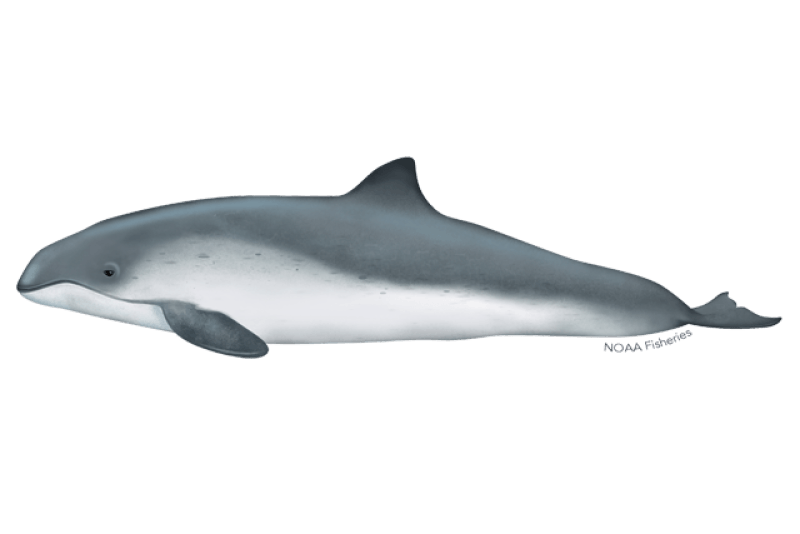
Phocoena phocoena . The harbor porpoise is a shy animal, most often seen in groups of two or three. They prefer coastal areas and are most commonly found in bays, estuaries, harbors, and fjords. Becau
Source: Species facts, status language, and imagery adapted from the NOAA Fisheries species profile (last updated 04/07/2026). Ocean City charter and Maryland
record notes are editorial orientation for OCEANCITY.MD readers. Always confirm current seasons, sizes, and
bag limits before you fish—rules change.
Region: Alaska,
New England/Mid-Atlantic,
Southeast,
West Coast
Category: Protected species · Mid-Atlantic
Maryland likelihood: 3★ out of 5
About the species
The harbor porpoise is a shy animal, most often seen in groups of two or three. They prefer coastal areas and are most commonly found in bays, estuaries, harbors, and fjords. Because they prefer coastal habitats, harbor porpoises are particularly vulnerable to incidental capture in gillnet fisheries, pollution, and other types of human disturbance, such as underwater noise.
Harbor porpoises in the United States are not endangered or threatened. Like all marine mammals, they are protected under the Marine Mammal Protection Act .
NOAA Fisheries helps conserve the harbor porpoise through collaborative management, integrated science, partnerships, and outreach. Our scientists use a variety of innovative techniques to study, protect, and rescue harbor porpoises in distress (e.g., disentanglement and stranding response). Our work helps reduce harmful effects of human activities such as capture in fishing gear, noise, and pollution through effective management actions based on sound science, public input, and public outreach.
Maryland record catch
Confirm whether Maryland DNR publishes an Atlantic state-record category for Harbor Porpoise on the current sport-fish record board.
Harbor porpoises have a small, robust body with a short, blunt beak and a medium-sized triangular dorsal fin. Their back is dark gray fading to lighter intermediate shades of gray on their sides. Their belly and throat are white, with a dark gray chin patch. Females are slightly larger than males.
Behavior and Diet Harbor porpoises mainly eat schooling fish, like herring and mackerel. Occasionally, they will eat squid and octopus.
They are most often seen singly, in pairs, or in groups of up to 10, although there are reports of aggregations of up to 200 harbor porpoises. Most seasonal movements appear to be inshore-offshore and may be influenced by prey availability or the presence of ice-free waters.
Unlike most other porpoises, they do not approach boats to bow-ride and can be very shy, avoiding surfacing near boats. When surfacing for air, they do not splash, they roll from beak to fluke and arch their backs.
Where They Live Harbor porpoises live in northern temperate and subarctic, and Arctic coastal and offshore waters. They are commonly found in bays, estuaries, harbors, and fjords less than 650 feet deep. In the North Atlantic, they range from West Greenland to Cape Hatteras, North Carolina (but do not enter Hudson Bay), and from the Barents Sea to West Africa. In the North Pacific, they are found from Japan north to the Chukchi Sea and from Point Conception off central California north to the Beaufort Sea.
World map providing approximate representation of the Harbor porpoise's range. Lifespan & Reproduction Females reach sexual maturity at 3 to 4 years and may give birth every year for several years in a row. Gestation lasts for 10 to 11 months and lactation lasts for 8 to 12 months.
Appearance
Harbor porpoises mainly eat schooling fish, like herring and mackerel. Occasionally, they will eat squid and octopus.
They are most often seen singly, in pairs, or in groups of up to 10, although there are reports of aggregations of up to 200 harbor porpoises. Most seasonal movements appear to be inshore-offshore and may be influenced by prey availability or the presence of ice-free waters.
Unlike most other porpoises, they do not approach boats to bow-ride and can be very shy, avoiding surfacing near boats. When surfacing for air, they do not splash, they roll from beak to fluke and arch their backs.
Where They Live Harbor porpoises live in northern temperate and subarctic, and Arctic coastal and offshore waters. They are commonly found in bays, estuaries, harbors, and fjords less than 650 feet deep. In the North Atlantic, they range from West Greenland to Cape Hatteras, North Carolina (but do not enter Hudson Bay), and from the Barents Sea to West Africa. In the North Pacific, they are found from Japan north to the Chukchi Sea and from Point Conception off central California north to the Beaufort Sea.
World map providing approximate representation of the Harbor porpoise's range. Lifespan & Reproduction Females reach sexual maturity at 3 to 4 years and may give birth every year for several years in a row. Gestation lasts for 10 to 11 months and lactation lasts for 8 to 12 months.
Little is known of their reproductive biology. Most mating occurs in summer and most births occur between May and July.
Threats Entanglement One of the main threats to harbor porpoises is getting caught in fishing gear. They can become entangled or captured in commercial fishing gear such as gillnets, trawls, and herring weirs.
Ocean Noise Underwater noise pollution interrupts the normal behavior of harbor porpoises and interferes with their communication.
Scientific Classification Kingdom Animalia Phylum Chordata Class Mammalia Order Cetacea Family Phocoenidae Genus Phocoena Species phocoena Last updated by NOAA Fisheries on 04/07/2026
Biology
Harbor porpoises live in northern temperate and subarctic, and Arctic coastal and offshore waters. They are commonly found in bays, estuaries, harbors, and fjords less than 650 feet deep. In the North Atlantic, they range from West Greenland to Cape Hatteras, North Carolina (but do not enter Hudson Bay), and from the Barents Sea to West Africa. In the North Pacific, they are found from Japan north to the Chukchi Sea and from Point Conception off central California north to the Beaufort Sea.
World map providing approximate representation of the Harbor porpoise's range. Lifespan & Reproduction Females reach sexual maturity at 3 to 4 years and may give birth every year for several years in a row. Gestation lasts for 10 to 11 months and lactation lasts for 8 to 12 months.
Little is known of their reproductive biology. Most mating occurs in summer and most births occur between May and July.
Threats Entanglement One of the main threats to harbor porpoises is getting caught in fishing gear. They can become entangled or captured in commercial fishing gear such as gillnets, trawls, and herring weirs.
Ocean Noise Underwater noise pollution interrupts the normal behavior of harbor porpoises and interferes with their communication.
Scientific Classification Kingdom Animalia Phylum Chordata Class Mammalia Order Cetacea Family Phocoenidae Genus Phocoena Species phocoena Last updated by NOAA Fisheries on 04/07/2026
Where they live
Range
Harbor porpoises live in northern temperate and subarctic, and Arctic coastal and offshore waters. They are commonly found in bays, estuaries, harbors, and fjords less than 650 feet deep. In the North Atlantic, they range from West Greenland to Cape Hatteras, North Carolina (but do not enter Hudson Bay), and from the Barents Sea to West Africa. In the North Pacific, they are found from Japan north to the Chukchi Sea and from Point Conception off central California north to the Beaufort Sea.
World map providing approximate representation of the Harbor porpoise's range. Lifespan & Reproduction Females reach sexual maturity at 3 to 4 years and may give birth every year for several years in a row. Gestation lasts for 10 to 11 months and lactation lasts for 8 to 12 months.
Habitat
See the NOAA species profile for habitat detail for this entry.
Ocean City & Mid-Atlantic context
From Ocean City, Maryland, use this Harbor Porpoise profile as NOAA Mid-Atlantic directory context—not a promise you will meet the species on every charter.
Harbor Porpoise is protected. Do not harvest. Report unusual strandings or entanglements through official channels.
Source facts and imagery are adapted from the NOAA Fisheries species profile for Harbor Porpoise.
What charter to book from Ocean City
Harbor Porpoise is not a standard Ocean City charter harvest target. Use this profile for NOAA biology and Mid-Atlantic context only.
Not typical from OC
Bay guide — Not a typical Ocean City bay guide target for Harbor Porpoise.
Inshore charter — Not a typical Ocean City inshore charter target for Harbor Porpoise.
Casting / light tackle — Not a typical Ocean City casting / light tackle target for Harbor Porpoise.
Trolling charter — Not a typical Ocean City trolling charter target for Harbor Porpoise.
Nearshore wreck / bottom — Not a typical Ocean City nearshore wreck / bottom target for Harbor Porpoise.
Offshore charter — Not a typical Ocean City offshore charter target for Harbor Porpoise.
Head / party boat — Not a typical Ocean City head / party boat target for Harbor Porpoise.
Start with the charter directory trip-type picker so you compare boats inside the right
archetype—not a bay-guide quote against a canyon invoice.