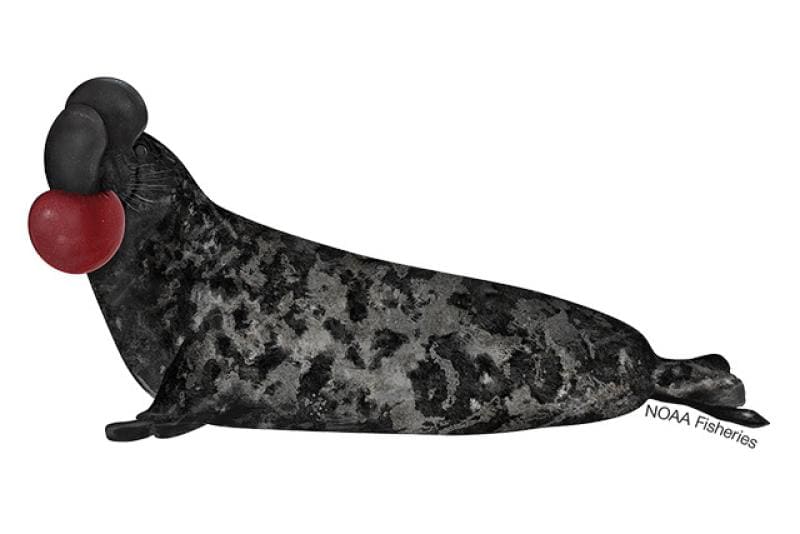
Cystophora cristata . Hooded seals live in the cold waters of the North Atlantic and Arctic Oceans. Adult males are known for the stretchy cavity, or hood, in their nose, which they can inflate so that
Source: Species facts, status language, and imagery adapted from the NOAA Fisheries species profile (last updated 04/10/2025). Ocean City charter and Maryland
record notes are editorial orientation for OCEANCITY.MD readers. Always confirm current seasons, sizes, and
bag limits before you fish—rules change.
Illustration/photo: NOAA Fisheries — Hooded Seal (Cystophora cristata).
Quick facts
Length: 6.6 to 8.5 feet
Lifespan: 25 to 35 years
Region: New England/Mid-Atlantic
Category: Protected species · Mid-Atlantic
Maryland likelihood: 1★ out of 5
About the species
Hooded seals live in the cold waters of the North Atlantic and Arctic Oceans. Adult males are known for the stretchy cavity, or hood, in their nose, which they can inflate so that it looks like a bright red balloon. They have another inflatable nasal cavity in the form of a black bladder on their head. Hooded seals are also known as bladder-nosed seals due to this unique ability.
Hooded seal pups are called “blue-backs” because of the blue-gray fur on their backs. Pups are weaned off their mother’s milk only three to five days after birth, the shortest weaning period of any mammal.
Hooded seals, like all marine mammals, are protected under the Marine Mammal Protection Act . NOAA Fisheries is committed to conserving and protecting hooded seals. Our scientists and partners use a variety of innovative techniques to study, learn more about, and protect this species.
Maryland record catch
Confirm whether Maryland DNR publishes an Atlantic state-record category for Hooded Seal on the current sport-fish record board.
Male hooded seals are about 8.5 feet long and weigh about 423 to 776 pounds, while females are about 6.5 feet long and weigh about 320 to 660 pounds. Both male and female adults have silver-gray fur with darker patches of different sizes and shapes across their bodies.
Hooded seals have a stretchy cavity, or hood, in their nose. This cavity has two sections, or lobes. Adult males can inflate and extend this hood so that it stretches across the length of their face. Sexually mature males have a unique partition in their nose that, when inflated, looks like a pinkish-red balloon. They use this to attract females' attention during mating season and to show aggression toward other males.
Hooded seal pups have blue-gray fur on their backs and whitish bellies. This beautiful pelt earned them the nickname “blue-backs” and once made them a target for hunting. Pups shed their blue-gray coat when they are 14 months old.
Behavior and Diet Hooded seals are not social. They migrate and remain alone for most of the year except during mating season. They are more aggressive and territorial than other seal species.
Hooded seals begin their annual migration cycle once they reach sexual maturity. They gather at their breeding grounds for two to three weeks in the spring. After pups are born, adults stay in the breeding grounds to molt. Once they have molted, they begin their migration period for the rest of the year.
On average, hooded seals dive 325 to 1,950 feet below the surface for about 13 to 15 minutes in search of food, but they are known to dive more than 3,280 feet for up to 1 hour. Factors such as sea surface temperature and depth dictate where they feed. Foraging patterns vary throughout the year; foraging differs between males and females according to depth and geographic region (Anderson et al. 2013).
Appearance
Hooded seals are not social. They migrate and remain alone for most of the year except during mating season. They are more aggressive and territorial than other seal species.
Hooded seals begin their annual migration cycle once they reach sexual maturity. They gather at their breeding grounds for two to three weeks in the spring. After pups are born, adults stay in the breeding grounds to molt. Once they have molted, they begin their migration period for the rest of the year.
On average, hooded seals dive 325 to 1,950 feet below the surface for about 13 to 15 minutes in search of food, but they are known to dive more than 3,280 feet for up to 1 hour. Factors such as sea surface temperature and depth dictate where they feed. Foraging patterns vary throughout the year; foraging differs between males and females according to depth and geographic region (Anderson et al. 2013).
Morphological evidence suggests the use of specialized suction feeding in this species (Kienle and Berta, 2016). They eat squid, starfish, and mussels. They also eat several types of fish, including Greenland halibut, redfish, Atlantic and Arctic cod, capelin, and herring. Newly weaned pups feed on pelagic crustaceans.
Scientific Classification Kingdom Animalia Phylum Chordata Class Mammalia Order Carnivora Family Phocidae Genus Cystophora Species cristata Last updated by NOAA Fisheries on 04/10/2025
Biology
NOAA Fisheries is committed to the protection of hooded seals. Targeted management actions taken to secure protections for these seals include:
Implementing Seal Management Plans in partnership with the Northwest Atlantic Fisheries Organization. Overseeing marine mammal health and stranding response. Engaging stakeholders and the public to increase awareness about hooded seals. Learn more about our conservation efforts Science Our research projects have discovered new aspects of hooded seal biology, behavior, and ecology and have helped us better understand the challenges that all hooded seals face. Our work includes:
Observational studies. Stock assessments. Monitoring population abundance and distribution. Learn more about our research
Where they live
Range
NOAA Fisheries is committed to the protection of hooded seals. Targeted management actions taken to secure protections for these seals include:
Implementing Seal Management Plans in partnership with the Northwest Atlantic Fisheries Organization. Overseeing marine mammal health and stranding response. Engaging stakeholders and the public to increase awareness about hooded seals. Learn more about our conservation efforts Science Our research projects have discovered new aspects of hooded seal biology, behavior, and ecology and have helped us better understand the challenges that all hooded seals face. Our work includes:
Habitat
See the NOAA species profile for habitat detail for this entry.
Ocean City & Mid-Atlantic context
From Ocean City, Maryland, use this Hooded Seal profile as NOAA Mid-Atlantic directory context—not a promise you will meet the species on every charter.
Hooded Seal is protected. Do not harvest. Report unusual strandings or entanglements through official channels.
Source facts and imagery are adapted from the NOAA Fisheries species profile for Hooded Seal.
What charter to book from Ocean City
Hooded Seal is not a standard Ocean City charter harvest target. Use this profile for NOAA biology and Mid-Atlantic context only.
Not typical from OC
Bay guide — Not a typical Ocean City bay guide target for Hooded Seal.
Inshore charter — Not a typical Ocean City inshore charter target for Hooded Seal.
Casting / light tackle — Not a typical Ocean City casting / light tackle target for Hooded Seal.
Trolling charter — Not a typical Ocean City trolling charter target for Hooded Seal.
Nearshore wreck / bottom — Not a typical Ocean City nearshore wreck / bottom target for Hooded Seal.
Offshore charter — Not a typical Ocean City offshore charter target for Hooded Seal.
Head / party boat — Not a typical Ocean City head / party boat target for Hooded Seal.
Start with the charter directory trip-type picker so you compare boats inside the right
archetype—not a bay-guide quote against a canyon invoice.
Overseeing Marine Mammal Health and Stranding Response We work with volunteer networks in all coastal states to respond to marine mammal strandings including all pinnipeds. When stranded animals are found alive, NOAA Fisheries and our partners assess the animal’s health and determine the best course of action. When stranded animals are found dead, our scientists work to understand and investigate the cause of death. Although the cause often remains unknown, scientists can sometimes attribute strandings to disease, harmful algal blooms, vessel strikes, fishing gear entanglements, pollution exposure, and underwater noise. Some strandings can serve as indicators of ocean health, giving insight into larger environmental issues that may also have implications for human health and welfare.
Learn more about the Marine Mammal Health and Stranding Response Program
Marine Mammal Unusual Mortality Events Hooded Seals have been part of a declared unusual mortality event in the past . Under the Marine Mammal Protection Act , an unusual mortality event is defined as "a stranding that is unexpected; involves a significant die-off of any marine mammal population; and demands immediate response." To understand the health of marine mammal populations, scientists study unusual mortality events.
Regulatory History All marine mammals, including hooded seals, are protected in the United States under the MMPA.
Harvest
See the NOAA wild-caught fishery section for landings and gear notes when published for this species.
Landings and management details matter most for the waters where Hooded Seal is actually fished—see the
NOAA species profile
.