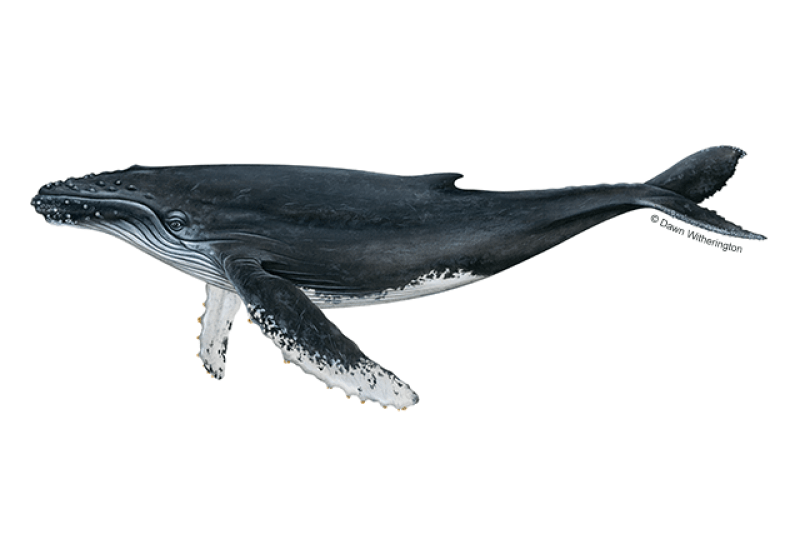
Megaptera novaeangliae . Before a final moratorium on commercial whaling in 1985, all populations of humpback whales were greatly reduced, most by more than 95 percent. The species is increasing in abundan
Source: Species facts, status language, and imagery adapted from the NOAA Fisheries species profile (last updated 04/09/2026). Ocean City charter and Maryland
record notes are editorial orientation for OCEANCITY.MD readers. Always confirm current seasons, sizes, and
bag limits before you fish—rules change.
Region: Alaska,
New England/Mid-Atlantic,
Pacific Islands,
Southeast,
West Coast
Category: Protected species · Mid-Atlantic
Maryland likelihood: 4★ out of 5
About the species
Before a final moratorium on commercial whaling in 1985, all populations of humpback whales were greatly reduced, most by more than 95 percent. The species is increasing in abundance throughout much of its range but faces threats from entanglement in fishing gear, vessel strikes, vessel-based harassment, and underwater noise.
Humpback whales live in all oceans around the world. They travel great distances every year and have one of the longest migrations of any mammal on the planet. Some populations swim 5,000 miles from tropical breeding grounds to colder, more productive feeding grounds. Humpback whales feed on shrimp-like crustaceans (krill) and small fish, straining huge volumes of ocean water through their baleen plates, which act like a sieve.
The humpback whale gets its common name from the distinctive hump on its back. Its long pectoral fins inspired its scientific name, Megaptera , which means “big-winged” and novaeangliae , which means “New England,” in reference to the location where European whalers first encountered them. Humpback whales are a favorite of whale watchers―they are often active, jumping out of the water and slapping the surface with their pectoral fins or tails.
NOAA Fisheries is dedicated to the conservation of humpback whales. Our scientists use a variety of innovative techniques to study, protect, and disentangle humpback whales. We also work with our partners to ensure that regulations and management plans are in place to reduce entanglement in fishing gear, create safer shipping lanes, and protect habitats.
Maryland record catch
Confirm whether Maryland DNR publishes an Atlantic state-record category for Humpback Whale on the current sport-fish record board.
See the NOAA species profile for current stock status language for this entry.
Appearance
Humpback whales are a favorite of whale-watchers, as they can be found close to shore and often display activities near the surface, such as breaching (jumping out of the water) or slapping the surface with their pectoral fins and tails.
During the warmer months (and occasionally into cooler months), humpback whales spend most of their time feeding and building up fat stores (blubber) to sustain them throughout the winter. Humpback whales filter-feed on small crustaceans (mostly krill) and small fish. They use several techniques to help them herd, corral, and disorient prey and that can include using bubbles, sounds, the seafloor, and even their pectoral fins. One specific feeding method, called "group coordinated bubble net feeding," involves using curtains of air bubbles to condense prey. Once the fish are corralled, they are pushed toward the surface and engulfed as the whales lunge upward through the circular bubble net. Different groups of humpback whales use other bubble structures in similar ways, though there appears to be some regional specialization in bubble-feeding behaviors among populations.
Where They Live Humpback whales live throughout the world's major oceans. They can travel great distances during their seasonal migration with some animals migrating 5,000 miles between high-latitude summer feeding grounds and winter mating and calving areas in tropical waters. In the North Pacific, some humpback whales migrate from Alaska to Hawaiߵi—they can complete the 3,000 mile trip in as few as 28 days. While calving, they prefer shallow, warm waters commonly near offshore reef systems or shores. Humpback whale feeding grounds are generally in cold, productive waters.
At least four humpback whale populations occur in the North Pacific:
Mexico population Breeds along the Pacific coast of Mexico and the Revillagigedo Islands Transits the Baja California Peninsula Feeds across a broad range from California to the Aleutian Islands, Alaska Central America population Breeds along the Pacific coast of Central America, including off Costa Rica, Panama, Guatemala, El Salvador, Honduras, and Nicaragua Feeds off the West Coast of the United States and southern British Columbia Hawaiߵi population Breeds in the Hawaiian Islands Feeds in most of the known feeding grounds in the North Pacific, including the Aleutian Islands/ Bering Sea, Gulf of Alaska, Southeast Alaska, and northern British Columbia Western North Pacific population Breeds in the areas of Okinawa, Japan, the Philippines, and the Mariana Archipelago Feeds in the northern Pacific, primarily in the West Bering Sea and off the Russian coast and the Aleutian Islands Also evidence for the existence of a lesser-known breeding area in the western North Pacific In the North Atlantic, two populations of humpback whales feed during spring, summer, and fall throughout a range that extends across the Atlantic Ocean from the Gulf of Maine to Norway. These two populations migrate south during the winter to calve and mate in the West Indies and Cape Verde (off the coast of Africa), and possibly in other areas.
Seven populations of humpback whales are found in the Southern Hemisphere, all of which feed in Antarctic or sub-Antarctic waters.
World map providing approximate representation of the humpback whale's range. Lifespan & Reproduction Humpback whales reach sexual maturity between the ages of 4 and 10 years. Females produce a single calf every 2 to 3 years on average, although annual calving has been documented in some individuals. Calves are born after an 11-month gestation and measure about 13 to 16 feet in length. Calves stay near their mothers for up to 1 year before weaning. Mothers are protective of their calves, swimming closely and often touching them with their flippers. While calves are not believed to maintain long-term associations with their mothers, they are more likely to be found in the same feeding and breeding areas as their mothers.
Threats Vessel Strikes Inadvertent vessel strikes can injure or kill humpback whales. Humpback whales are vulnerable to vessel strikes throughout their range, but the risk is much higher in coastal areas with heavier ship traffic.
Changing Climate Conditions The impacts of climate change on whales are unknown, but it is considered one of the largest threats facing high latitude regions where many humpback whales forage. Most notably, the timing and distribution of sea ice coverage is changing dramatically with altered oceanographic conditions. Any resulting changes in prey distribution could lead to changes in foraging behavior, nutritional stress, and diminished reproduction for humpback whales. Additionally, changing water temperature and currents could impact the timing of environmental cues important for navigation and migration.
Entanglement Humpback whales can become entangled by many different gear types, including moorings, traps, pots, gillnets, or marine debris. Once entangled, if they are able to move the gear, the whale may drag and swim with attached gear for long distances, ultimately resulting in fatigue, compromised feeding ability, or severe injury, which may lead to reduced reproductive success or even death. There is evidence to suggest that most humpback whales experience entanglement over the course of their lives but are often able to shed the gear on their own. However, the portion of whales that become entangled and do not survive is unknown.
Vessel-Based Harassment Whale watching vessels, recreational boats, and other vessels may cause stress and behavioral changes in humpback whales. Because humpback whales are often found close to shore and generally surface in an active state, they tend to be popular whale watching attractions. There are several areas within the United States where humpback whales are the central attraction for the whale watching industry, including the Gulf of Maine (particularly within the Stellwagen Bank National Marine Sanctuary ), California, Alaska (particularly southeast Alaska), and the Hawaiian Islands.
Scientific Classification Kingdom Animalia Phylum Chordata Class Mammalia Order Cetacea Family Balaenopteridae Genus Megaptera Species novaeangliae Last updated by NOAA Fisheries on 04/09/2026
Biology
Humpback whales live throughout the world's major oceans. They can travel great distances during their seasonal migration with some animals migrating 5,000 miles between high-latitude summer feeding grounds and winter mating and calving areas in tropical waters. In the North Pacific, some humpback whales migrate from Alaska to Hawaiߵi—they can complete the 3,000 mile trip in as few as 28 days. While calving, they prefer shallow, warm waters commonly near offshore reef systems or shores. Humpback whale feeding grounds are generally in cold, productive waters.
At least four humpback whale populations occur in the North Pacific:
Mexico population Breeds along the Pacific coast of Mexico and the Revillagigedo Islands Transits the Baja California Peninsula Feeds across a broad range from California to the Aleutian Islands, Alaska Central America population Breeds along the Pacific coast of Central America, including off Costa Rica, Panama, Guatemala, El Salvador, Honduras, and Nicaragua Feeds off the West Coast of the United States and southern British Columbia Hawaiߵi population Breeds in the Hawaiian Islands Feeds in most of the known feeding grounds in the North Pacific, including the Aleutian Islands/ Bering Sea, Gulf of Alaska, Southeast Alaska, and northern British Columbia Western North Pacific population Breeds in the areas of Okinawa, Japan, the Philippines, and the Mariana Archipelago Feeds in the northern Pacific, primarily in the West Bering Sea and off the Russian coast and the Aleutian Islands Also evidence for the existence of a lesser-known breeding area in the western North Pacific In the North Atlantic, two populations of humpback whales feed during spring, summer, and fall throughout a range that extends across the Atlantic Ocean from the Gulf of Maine to Norway. These two populations migrate south during the winter to calve and mate in the West Indies and Cape Verde (off the coast of Africa), and possibly in other areas.
Seven populations of humpback whales are found in the Southern Hemisphere, all of which feed in Antarctic or sub-Antarctic waters.
World map providing approximate representation of the humpback whale's range. Lifespan & Reproduction Humpback whales reach sexual maturity between the ages of 4 and 10 years. Females produce a single calf every 2 to 3 years on average, although annual calving has been documented in some individuals. Calves are born after an 11-month gestation and measure about 13 to 16 feet in length. Calves stay near their mothers for up to 1 year before weaning. Mothers are protective of their calves, swimming closely and often touching them with their flippers. While calves are not believed to maintain long-term associations with their mothers, they are more likely to be found in the same feeding and breeding areas as their mothers.
Threats Vessel Strikes Inadvertent vessel strikes can injure or kill humpback whales. Humpback whales are vulnerable to vessel strikes throughout their range, but the risk is much higher in coastal areas with heavier ship traffic.
Changing Climate Conditions The impacts of climate change on whales are unknown, but it is considered one of the largest threats facing high latitude regions where many humpback whales forage. Most notably, the timing and distribution of sea ice coverage is changing dramatically with altered oceanographic conditions. Any resulting changes in prey distribution could lead to changes in foraging behavior, nutritional stress, and diminished reproduction for humpback whales. Additionally, changing water temperature and currents could impact the timing of environmental cues important for navigation and migration.
Entanglement Humpback whales can become entangled by many different gear types, including moorings, traps, pots, gillnets, or marine debris. Once entangled, if they are able to move the gear, the whale may drag and swim with attached gear for long distances, ultimately resulting in fatigue, compromised feeding ability, or severe injury, which may lead to reduced reproductive success or even death. There is evidence to suggest that most humpback whales experience entanglement over the course of their lives but are often able to shed the gear on their own. However, the portion of whales that become entangled and do not survive is unknown.
Vessel-Based Harassment Whale watching vessels, recreational boats, and other vessels may cause stress and behavioral changes in humpback whales. Because humpback whales are often found close to shore and generally surface in an active state, they tend to be popular whale watching attractions. There are several areas within the United States where humpback whales are the central attraction for the whale watching industry, including the Gulf of Maine (particularly within the Stellwagen Bank National Marine Sanctuary ), California, Alaska (particularly southeast Alaska), and the Hawaiian Islands.
Scientific Classification Kingdom Animalia Phylum Chordata Class Mammalia Order Cetacea Family Balaenopteridae Genus Megaptera Species novaeangliae Last updated by NOAA Fisheries on 04/09/2026
Where they live
Range
Humpback whales live throughout the world's major oceans. They can travel great distances during their seasonal migration with some animals migrating 5,000 miles between high-latitude summer feeding grounds and winter mating and calving areas in tropical waters. In the North Pacific, some humpback whales migrate from Alaska to Hawaiߵi—they can complete the 3,000 mile trip in as few as 28 days. While calving, they prefer shallow, warm waters commonly near offshore reef systems or shores. Humpback whale feeding grounds are generally in cold, productive waters.
At least four humpback whale populations occur in the North Pacific:
Habitat
See the NOAA species profile for habitat detail for this entry.
Ocean City & Mid-Atlantic context
From Ocean City, Maryland, use this Humpback Whale profile as NOAA Mid-Atlantic directory context—not a promise you will meet the species on every charter.
Humpback Whale is protected. Do not harvest. Report unusual strandings or entanglements through official channels.
Source facts and imagery are adapted from the NOAA Fisheries species profile for Humpback Whale.
What charter to book from Ocean City
Humpback Whale is not a standard Ocean City charter harvest target. Use this profile for NOAA biology and Mid-Atlantic context only.
Not typical from OC
Bay guide — Not a typical Ocean City bay guide target for Humpback Whale.
Inshore charter — Not a typical Ocean City inshore charter target for Humpback Whale.
Casting / light tackle — Not a typical Ocean City casting / light tackle target for Humpback Whale.
Trolling charter — Not a typical Ocean City trolling charter target for Humpback Whale.
Nearshore wreck / bottom — Not a typical Ocean City nearshore wreck / bottom target for Humpback Whale.
Offshore charter — Not a typical Ocean City offshore charter target for Humpback Whale.
Head / party boat — Not a typical Ocean City head / party boat target for Humpback Whale.
Start with the charter directory trip-type picker so you compare boats inside the right
archetype—not a bay-guide quote against a canyon invoice.
Recovery Actions Under the ESA, NOAA Fisheries is required to develop and implement recovery plans for the conservation and survival of listed species. NOAA Fisheries originally developed a recovery plan in 1991 to identify actions that would advance the recovery of the global species and protect its habitats. The ultimate goal of the 1991 Humpback Whale Recovery Plan is to help humpback whales thrive, allowing the species to be reclassified from “endangered” to “threatened,” and ultimately removed from the ESA's list of threatened and endangered species.
The major actions recommended in the existing species-wide recovery plan are:
Reduce or eliminate injury and mortality caused by fisheries, fishing gear, and vessel collisions Minimize effects of vessel disturbance Continue the international moratorium on commercial whaling Collect as much data as possible from dead whales through our Marine Mammal Health and Stranding Program Following the 2016 change in the listing status of humpback whales, NOAA Fisheries determined in 2019 that recovery plans would not promote the conservation of the endangered Arabian Sea and the Cape Verde Islands/Northwest Africa DPSs. We are currently developing an updated, DPS-specific recovery plan for the ESA-listed Central America, Mexico, and Western North Pacific DPSs. In the interim, the recovery strategy for these DPSs will be guided by the existing species-wide plan and a new DPS-specific recovery outline .
Read the recovery plan for the humpback whale
Implementation Together with our partners, we undertake numerous activities to support the directives of the humpback whale recovery plan, protect humpbacks, and reduce adverse impacts from human activities.
Efforts to implement recovery for humpback whales include:
Creating marine protected areas for humpback whales Minimizing vessel disturbance Reducing entanglement in fishing gear Reducing vessel strikes Understanding and addressing the effects of ocean noise Collaborating with the Commission on Environmental Cooperation to develop the North America Humpback Whale Conservation Action Plan for the United States, Canada, and Mexico Monitoring Plan NOAA Fisheries collaborated with state and federal agencies to create a monitoring plan for the nine distinct population segments of humpback whales that have recovered and are no longer protected under the ESA. Recently, NOAA Fisheries convened a post-delisting monitoring plan group (PDMP working group) to assemble, review, and discuss any updated data on the nine distinct population segments of humpback whales that no longer meet the definition of a threatened or endangered species and are no longer protected under the ESA. An interim report for the post delisting monitoring plan was published in 2022.
Critical Habitat Although the original listing of this species predated the requirement for critical habitat designations, the 2016 revision to the humpback whale listing under the ESA triggered the requirement for NOAA Fisheries to designate critical habitat to the maximum extent prudent and determinable. A proposed rule to designate critical habitat for the Central America, Mexico, and Western North Pacific DPSs of humpback whales was published in 2019 and a final rule was published on April 21, 2021 .
Harvest
See the NOAA wild-caught fishery section for landings and gear notes when published for this species.
Landings and management details matter most for the waters where Humpback Whale is actually fished—see the
NOAA species profile
.