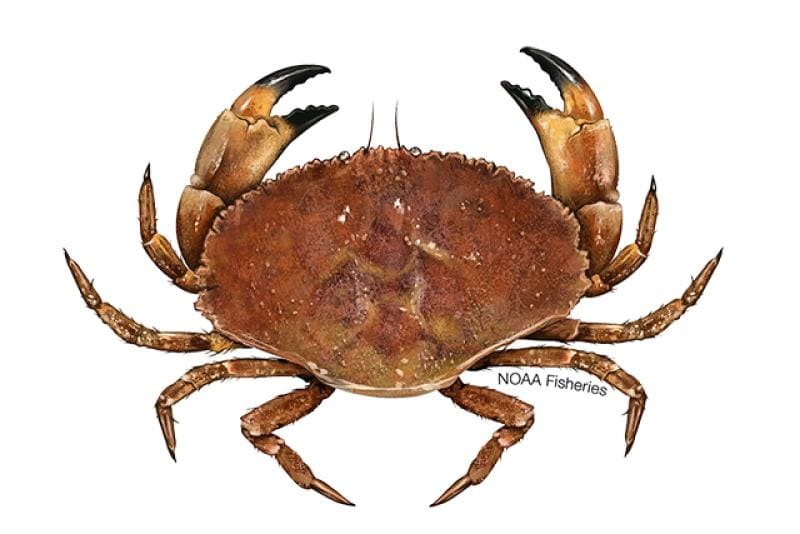
Cancer borealis , also known as White-legger, Peekytoe crab, Atlantic dungeness, Rock crab. Jonah crabs live in the waters of the Northwest Atlantic Ocean, ranging from Canada to Florida. Scientists have limited information about their life cycle and behavior because few
Source: Species facts, status language, and imagery adapted from the NOAA Fisheries species profile (last updated 05/27/2026). Ocean City charter and Maryland
record notes are editorial orientation for OCEANCITY.MD readers. Always confirm current seasons, sizes, and
bag limits before you fish—rules change.
Length: Up to 6 inches (female) and 9 inches (male)
Region: New England/Mid-Atlantic
Category: Invertebrate · Mid-Atlantic
Maryland likelihood: 3★ out of 5
About the species
Jonah crabs live in the waters of the Northwest Atlantic Ocean, ranging from Canada to Florida. Scientists have limited information about their life cycle and behavior because few research studies have been conducted. Female Jonah crabs are believed to move closer to shore in the late spring and summer, then return offshore in the fall and winter.
Historically, Jonah crab was caught as an incidental catch in the American lobster fishery. However, Jonah crabs have become a targeted species and catch (landings) increased significantly in the early 2010s. This increase is linked to two factors: fewer lobsters in Southern New England waters and higher prices for other crab species. As a result, the Atlantic States Marine Fisheries Commission implemented the Interstate Fishery Management Plan for Jonah Crab . To support the plan, and in compliance with the Atlantic Coastal Fisheries Cooperative Management Act (Atlantic Coastal Act), NOAA Fisheries implemented regulations for the Jonah crab fishery in federal waters in 2019.
Maryland record catch
Confirm whether Maryland DNR publishes an Atlantic state-record category for Jonah Crab on the current sport-fish record board.
Maryland’s Atlantic recreational seasons/sizes/creel summary does not publish a dedicated line for Jonah Crab. Verify COMAR, DNR public notices, and federal rules for your exact waters before you keep fish.
Rule
Maryland / applicable detail
Maryland minimum size
Not listed — no dedicated Jonah Crab line on the MD Atlantic recreational table
Maryland daily creel (bag)
Not listed — no MD species-specific bag for Jonah Crab
Maryland open season
Not listed on the MD Atlantic Ocean / Coastal Bays summary table
Verify
Check DNR eRegulations, COMAR, and NOAA for your date and coordinates before you keep fish.
Jonah crabs are characterized by a round, reddish-brown shell with rough-edged teeth and small yellow spots. They are also identified by their large claws which have dark brown/black tips.
Biology The life cycle of Jonah crabs is poorly understood. While little is known about their movements, it is widely believed females migrate in the spring to shallower waters and return offshore to deeper, colder waters during the fall and winter.
Jonah crabs are omnivorous (eating both plants and animals) and consume a variety of species, including snails, mussels, urchins, algae, and arthropods.
Where They Live Range Jonah crabs are found in the Northwest Atlantic, ranging from Canada to Florida. In the United States, there is a commercial Jonah crab fishery that spans from Maine through Virginia. But most are caught by fishermen on the outer continental shelf south of Massachusetts and Rhode Island
Habitat Jonah crabs are generally found from the intertidal zone down to depths of 2,600 feet. Their habitat ranges from rocky substrates in coastal and offshore areas to softer, silt and clay bottoms along the continental slope.
Fishery Management Jonah crab is co-managed by NOAA Fisheries and the coastal states through the Atlantic States Marine Fisheries Commission (ASMFC). The American Lobster Management Board within the ASMFC oversees both American lobster and Jonah crab. Jonah crab were once an unintentional catch in lobster traps, but have increasingly become a targeted species.
Appearance
The life cycle of Jonah crabs is poorly understood. While little is known about their movements, it is widely believed females migrate in the spring to shallower waters and return offshore to deeper, colder waters during the fall and winter.
Jonah crabs are omnivorous (eating both plants and animals) and consume a variety of species, including snails, mussels, urchins, algae, and arthropods.
Where They Live Range Jonah crabs are found in the Northwest Atlantic, ranging from Canada to Florida. In the United States, there is a commercial Jonah crab fishery that spans from Maine through Virginia. But most are caught by fishermen on the outer continental shelf south of Massachusetts and Rhode Island
Habitat Jonah crabs are generally found from the intertidal zone down to depths of 2,600 feet. Their habitat ranges from rocky substrates in coastal and offshore areas to softer, silt and clay bottoms along the continental slope.
Fishery Management Jonah crab is co-managed by NOAA Fisheries and the coastal states through the Atlantic States Marine Fisheries Commission (ASMFC). The American Lobster Management Board within the ASMFC oversees both American lobster and Jonah crab. Jonah crab were once an unintentional catch in lobster traps, but have increasingly become a targeted species.
Recommended measures are implemented by states in state waters and by NOAA Fisheries in federal waters under the Atlantic Coastal Fisheries Cooperative Management Act (Atlantic Coastal Act) .
Harvest In 2024, commercial landings of Jonah crab totaled 11 million pounds and were valued at $9 million, according to the NOAA Fisheries commercial fishing landings database .
Scientific Classification Kingdom Animalia Phylum Arthropoda Class Malacostraca Order Decapoda Family Cancridae Genus Cancer Species borealis Last updated by NOAA Fisheries on 05/27/2026
Biology
Jonah crabs are found in the Northwest Atlantic, ranging from Canada to Florida. In the United States, there is a commercial Jonah crab fishery that spans from Maine through Virginia. But most are caught by fishermen on the outer continental shelf south of Massachusetts and Rhode Island
Habitat Jonah crabs are generally found from the intertidal zone down to depths of 2,600 feet. Their habitat ranges from rocky substrates in coastal and offshore areas to softer, silt and clay bottoms along the continental slope.
Fishery Management Jonah crab is co-managed by NOAA Fisheries and the coastal states through the Atlantic States Marine Fisheries Commission (ASMFC). The American Lobster Management Board within the ASMFC oversees both American lobster and Jonah crab. Jonah crab were once an unintentional catch in lobster traps, but have increasingly become a targeted species.
Recommended measures are implemented by states in state waters and by NOAA Fisheries in federal waters under the Atlantic Coastal Fisheries Cooperative Management Act (Atlantic Coastal Act) .
Harvest In 2024, commercial landings of Jonah crab totaled 11 million pounds and were valued at $9 million, according to the NOAA Fisheries commercial fishing landings database .
Scientific Classification Kingdom Animalia Phylum Arthropoda Class Malacostraca Order Decapoda Family Cancridae Genus Cancer Species borealis Last updated by NOAA Fisheries on 05/27/2026
Where they live
Range
Jonah crabs are found in the Northwest Atlantic, ranging from Canada to Florida. In the United States, there is a commercial Jonah crab fishery that spans from Maine through Virginia. But most are caught by fishermen on the outer continental shelf south of Massachusetts and Rhode Island
Habitat Jonah crabs are generally found from the intertidal zone down to depths of 2,600 feet. Their habitat ranges from rocky substrates in coastal and offshore areas to softer, silt and clay bottoms along the continental slope.
Habitat
Jonah crab is co-managed by NOAA Fisheries and the coastal states through the Atlantic States Marine Fisheries Commission (ASMFC). The American Lobster Management Board within the ASMFC oversees both American lobster and Jonah crab. Jonah crab were once an unintentional catch in lobster traps, but have increasingly become a targeted species.
Recommended measures are implemented by states in state waters and by NOAA Fisheries in federal waters under the Atlantic Coastal Fisheries Cooperative Management Act (Atlantic Coastal Act) .
Harvest In 2024, commercial landings of Jonah crab totaled 11 million pounds and were valued at $9 million, according to the NOAA Fisheries commercial fishing landings database .
Scientific Classification Kingdom Animalia Phylum Arthropoda Class Malacostraca Order Decapoda Family Cancridae Genus Cancer Species borealis Last updated by NOAA Fisheries on 05/27/2026
Ocean City & Mid-Atlantic context
From Ocean City, Maryland, use this Jonah Crab profile as NOAA Mid-Atlantic directory context—not a promise you will meet the species on every charter.
Always verify current Maryland and federal size, season, and bag rules for your exact date and coordinates before you keep any catch.
Source facts and imagery are adapted from the NOAA Fisheries species profile for Jonah Crab.
What charter to book from Ocean City
Jonah Crab is more of a bay, inshore, or specialty harvest story than a typical OC six-pack trolling day—match the trip type to the animal.
Possible / related
Bay guide — Possible overlap depending on season, water, and boat program.
Inshore charter — Possible overlap depending on season, water, and boat program.
In 2024, commercial landings of Jonah crab totaled 11 million pounds and were valued at $9 million, according to the NOAA Fisheries commercial fishing landings database .
Scientific Classification Kingdom Animalia Phylum Arthropoda Class Malacostraca Order Decapoda Family Cancridae Genus Cancer Species borealis Last updated by NOAA Fisheries on 05/27/2026
Harvest
See the NOAA wild-caught fishery section for landings and gear notes when published for this species.
Landings and management details matter most for the waters where Jonah Crab is actually fished—see the
NOAA species profile
.
Seafood facts
Fact
Detail
Availability
Year-round.
Source
U.S. wild-caught from Maine to Virginia.
Taste
Sweet.
Texture
Flaky.
Color
Raw meat is translucent white; cooked meat is white with brownish-red highlights.
Health
Jonah crab is a great source of protein that is also low in saturated fat.
After a real OC boat day or market stop for Jonah Crab, Seafood after boat days covers
dock buffer and cook-your-catch pacing.