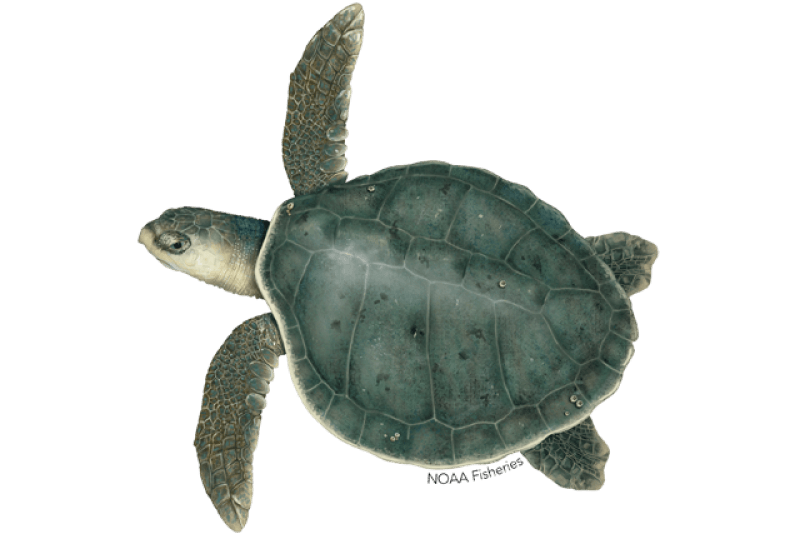
Lepidochelys kempii . Kemp’s ridley sea turtles are the smallest sea turtle in the world. The species is named after Richard M. Kemp, a fisherman from Key West, Florida, who first submitted the species
Source: Species facts, status language, and imagery adapted from the NOAA Fisheries species profile (last updated 05/29/2025). Ocean City charter and Maryland
record notes are editorial orientation for OCEANCITY.MD readers. Always confirm current seasons, sizes, and
bag limits before you fish—rules change.
Lifespan: Unknown, but estimated to be 30 years or more
Region: New England/Mid-Atlantic,
Southeast
Category: Protected species · Mid-Atlantic
Maryland likelihood: 3★ out of 5
About the species
Kemp’s ridley sea turtles are the smallest sea turtle in the world. The species is named after Richard M. Kemp, a fisherman from Key West, Florida, who first submitted the species for identification in 1906. They are primarily found in the Gulf of America (formerly Gulf of Mexico), but juveniles are also found in the Atlantic Ocean as far north as Nova Scotia and sometimes even occur in the eastern North Atlantic Ocean.
Kemp’s ridleys were once abundant in the Gulf of America with tens of thousands of females nesting at Rancho Nuevo, Mexico. The population crashed in the mid-20th century to a low of only several hundred females nesting (representing fewer than 250 nests) in the 1980s. Intensive conservation actions were implemented on nesting beaches and through fisheries management. Bycatch in commercial and recreational fishing gear continues to be the biggest threat facing Kemp’s ridley sea turtles.
NOAA Fisheries and our partners are dedicated to protecting and recovering the Kemp’s ridley sea turtle. We use a variety of innovative techniques to study, protect, and recover this endangered species. We engage our partners as we develop measures and implement recovery plans that foster the conservation and recovery of Kemp’s ridleys and their habitats, and we fund research, monitoring, and conservation projects to implement priorities outlined in recovery plans.
Maryland record catch
Confirm whether Maryland DNR publishes an Atlantic state-record category for Kemp's Ridley Turtle on the current sport-fish record board.
Kemp's Ridley Turtle is a protected marine species in U.S. waters. Do not harvest. This guide is biology and Ocean City context only—not a fishing target.
The Kemp's ridley turtle has a triangular-shaped head with a slightly hooked beak. Hatchlings are darkly colored on both sides. Adults are generally a grayish-green color on top with a pale, yellowish bottom shell. The top shell (carapace) is often as wide as it is long. Each of the front flippers has one claw while the back flippers may have one or two.
Behavior and Diet Kemp’s ridley turtles, like all sea turtles, are marine reptiles and must come to the surface to breathe. Adult female sea turtles return to land to lay their eggs in the sand—they are remarkable navigators and usually return to a beach in the general area where they hatched decades earlier.
The Kemp's ridley is one of two species of sea turtles that engage in "arribada" nesting, where large groups of females gather offshore and come onto the beach to nest all at once. Nesting in large groups may be a defense against predators, or a result of environmental factors influencing nesting. With many turtles coming ashore together and many nests subsequently hatching at the same time, the large numbers of hatchlings entering the ocean may help to overwhelm predators and ensure that more hatchlings survive. The other species of sea turtle that nests en masse is the olive ridley . The Kemp’s ridley is the only species of sea turtle that routinely nests during the day.
After emerging from the nest, hatchlings enter the water and swim rapidly offshore. Some hatchlings remain in currents within the Gulf of America while others may be swept out of the Gulf, around Florida, and into the Atlantic Ocean by the Gulf Stream. Juvenile Kemp’s ridleys associate with floating Sargassum algae, using the Sargassum as an area of refuge, rest, and a place to feed on small animals and plants. This developmental drifting period lasts 1 to 2 years or until the turtle reaches a length of about 8 inches. After this oceanic phase, Kemp’s ridleys migrate to nearshore areas of the Gulf of America or northwestern Atlantic Ocean. After recruiting to shallow coastal areas, crabs are their preferred food.
Depending on their breeding strategy, male Kemp's ridleys occupy many different areas within the Gulf of America. Some males migrate annually between feeding and breeding grounds, yet others may not migrate at all, mating with females encountered at their feeding grounds or near nesting beaches. Female Kemp's ridleys have been tracked migrating to and from nesting beaches in Mexico and south Texas. Females leave breeding and nesting areas and migrate to foraging areas ranging from the Yucatán Peninsula to southern Florida to the north-central Gulf of America. Some females take up residence in specific foraging grounds for months at a time and return to the same foraging grounds in subsequent years.
Where They Live Kemp's ridleys are distributed throughout the Gulf of America and U.S. Atlantic seaboard, from Florida to New England. A few records exist for Kemp's ridleys in Canada, near the Azores, the United Kingdom, waters off Morocco, and within the Mediterranean Sea and they are occasionally found in other areas around the Atlantic Basin. Adult Kemp's ridleys primarily occupy nearshore coastal (neritic) habitats in the Gulf of America that include muddy or sandy bottoms where their preferred prey are found.
Appearance
Kemp’s ridley turtles, like all sea turtles, are marine reptiles and must come to the surface to breathe. Adult female sea turtles return to land to lay their eggs in the sand—they are remarkable navigators and usually return to a beach in the general area where they hatched decades earlier.
The Kemp's ridley is one of two species of sea turtles that engage in "arribada" nesting, where large groups of females gather offshore and come onto the beach to nest all at once. Nesting in large groups may be a defense against predators, or a result of environmental factors influencing nesting. With many turtles coming ashore together and many nests subsequently hatching at the same time, the large numbers of hatchlings entering the ocean may help to overwhelm predators and ensure that more hatchlings survive. The other species of sea turtle that nests en masse is the olive ridley . The Kemp’s ridley is the only species of sea turtle that routinely nests during the day.
After emerging from the nest, hatchlings enter the water and swim rapidly offshore. Some hatchlings remain in currents within the Gulf of America while others may be swept out of the Gulf, around Florida, and into the Atlantic Ocean by the Gulf Stream. Juvenile Kemp’s ridleys associate with floating Sargassum algae, using the Sargassum as an area of refuge, rest, and a place to feed on small animals and plants. This developmental drifting period lasts 1 to 2 years or until the turtle reaches a length of about 8 inches. After this oceanic phase, Kemp’s ridleys migrate to nearshore areas of the Gulf of America or northwestern Atlantic Ocean. After recruiting to shallow coastal areas, crabs are their preferred food.
Depending on their breeding strategy, male Kemp's ridleys occupy many different areas within the Gulf of America. Some males migrate annually between feeding and breeding grounds, yet others may not migrate at all, mating with females encountered at their feeding grounds or near nesting beaches. Female Kemp's ridleys have been tracked migrating to and from nesting beaches in Mexico and south Texas. Females leave breeding and nesting areas and migrate to foraging areas ranging from the Yucatán Peninsula to southern Florida to the north-central Gulf of America. Some females take up residence in specific foraging grounds for months at a time and return to the same foraging grounds in subsequent years.
Where They Live Kemp's ridleys are distributed throughout the Gulf of America and U.S. Atlantic seaboard, from Florida to New England. A few records exist for Kemp's ridleys in Canada, near the Azores, the United Kingdom, waters off Morocco, and within the Mediterranean Sea and they are occasionally found in other areas around the Atlantic Basin. Adult Kemp's ridleys primarily occupy nearshore coastal (neritic) habitats in the Gulf of America that include muddy or sandy bottoms where their preferred prey are found.
World map providing approximate representation of the Kemp's ridley turtle's range. Lifespan & Reproduction No one knows exactly how long Kemp’s ridleys live, but like other sea turtles, they are likely long-lived, reaching maturity at about 13 years of age and have an estimated lifespan of at least 30 years.
Kemp's ridleys display one of the most unique synchronized nesting habits in the natural world. Adult female Kemp's ridleys gather off nesting beaches in northeastern Mexico and come ashore in large groups, called arribadas, which means "arrival" in Spanish. There are many theories on what triggers an arribada, including offshore winds, lunar cycles, and the release of pheromones by females. However, scientists have yet to conclusively determine what triggers an arribada. Arribada nesting is a behavior found only in the genus Lepidochely s which includes the olive ridley sea turtle ( Lepidochelys olivacea ) and Kemp’s ridley.
Nesting occurs from April to July and unlike the other species which nest at night, Kemp’s ridleys nest during daylight hours. They lay an average of 2 to 3 clutches per season, and return to the beach to nest every 1 to 3 years. The females dig an egg chamber in the sand where they lay approximately 100 eggs, which incubate for 50 to 60 days. Hatchlings orient seaward by moving away from the darkest silhouette of the landward dune or vegetation to crawl towards the brightest horizon. On undeveloped beaches, this is toward the open horizon over the ocean.
Threats Bycatch in Fishing Gear A primary threat to sea turtles is their unintended capture in fishing gear which can result in drowning or cause injuries that lead to death or debilitation (for example, swallowing hooks, or flipper entanglement). The term for this unintended capture is bycatch . Sea turtle bycatch is a worldwide problem. Kemp’s ridleys are primarily caught in trawls, gillnets, longlines, hook and lines, pot/traps, and dredges in the Gulf of America and northwest Atlantic.
Direct Harvest of Turtles and Eggs Almost the entire Kemp’s ridley sea turtle population nests on the beaches of the western Gulf, primarily in Tamaulipas, Mexico, just south of the United States-Mexico border. The arribada nesting behavior concentrates females and nests at the same time and in the same place, enabling the taking of an extraordinary number of eggs for human consumption. Historically, egg collection for human consumption was a significant problem in this area, but this threat has been diminished by the protection of nests and turtles in both Mexico and the United States.
Loss and Degradation of Nesting Habitat Coastal development and rising seas are leading to the loss of nesting beach habitat for sea turtles. Human-related changes associated with coastal development include beachfront lighting, shoreline armoring, and beach driving. Shoreline hardening or armoring (e.g., seawalls) can result in the complete loss of dry sand suitable for successful nesting. Artificial lighting on and near nesting beaches can deter nesting females from coming ashore to nest and can disorient hatchlings trying to find the sea after emerging from their nests.
For Kemp’s ridleys, beach driving is a threat to the turtles and the nesting habitat. Driving on nesting beaches can injure or kill nesting turtles, eggs, and hatchlings. Nesting turtles can be difficult to see and they cannot move quickly on land to avoid an approaching vehicle. Beach driving also degrades the nesting habitat by causing sand compaction and creating ruts and ridges in the sand that pose obstacles to nesting turtles and hatchlings attempting to reach the ocean, resulting in an extended period of travel or entrapment.
Predation of Eggs and Hatchlings The destruction and consumption of eggs and hatchlings by non-native and native predators, such as feral pigs, coyotes, raccoons, birds, and crabs is a threat to Kemp’s ridley sea turtles. Predation control is an effective tool to reduce this threat and improve in situ hatching success.
Vessel Strikes Various types of watercraft can strike sea turtles when they are at or near the surface, resulting in injury or death. Vessel strikes are a threat to sea turtles near ports, waterways, and along developed coastlines throughout their range. High boat traffic areas such as marinas, boat ramps, and inlets present a higher risk. Adult sea turtles, in particular nesting females, are more susceptible to vessel strikes when making reproductive migrations and while they are nearshore during the nesting season or if they reside in coastal foraging habitats that may overlap in areas with high boat traffic.
Ocean Pollution/Marine Debris Increasing pollution of nearshore and offshore marine habitats threatens all sea turtles and degrades their habitats. The Deepwater Horizon oil spill was the largest offshore oil spill in U.S. history and affected nesting (including nesting females, eggs, and hatchlings), small juvenile, large juvenile, and adult sea turtles throughout the Gulf of America. Ingestion of marine debris is another threat to all species of sea turtles. Kemp’s ridley turtles may ingest fishing line, balloons, plastic bags, plastic fragments, floating tar or oil, and other materials discarded by humans which they can mistake for food. They may also become entangled in marine debris, including lost or discarded fishing gear, which can lead to injury or death.
Changing Environmental Conditions For all sea turtles, higher sand temperatures can be lethal to eggs or alter the ratio of male and female hatchlings produced (via temperature-dependent sex determination ). Rising seas and storm events change beach morphology and cause beach erosion, which may flood nests or wash them away. Changes in the temperature of the marine environment are likely to alter habitat suitability, as well as the abundance and distribution of food resources, leading to a shift in the migratory and foraging range and nesting season of Kemp's ridleys. Environmental conditions also can cause large sea turtle stranding events during the winter months along the northeast coast of the U.S..
Scientific Classification Kingdom Animalia Phylum Chordata Class Reptilia Order Testudines Family Cheloniidae Genus Lepidochelys Species kempii Last updated by NOAA Fisheries on 05/29/2025
Biology
Kemp's ridleys are distributed throughout the Gulf of America and U.S. Atlantic seaboard, from Florida to New England. A few records exist for Kemp's ridleys in Canada, near the Azores, the United Kingdom, waters off Morocco, and within the Mediterranean Sea and they are occasionally found in other areas around the Atlantic Basin. Adult Kemp's ridleys primarily occupy nearshore coastal (neritic) habitats in the Gulf of America that include muddy or sandy bottoms where their preferred prey are found.
World map providing approximate representation of the Kemp's ridley turtle's range. Lifespan & Reproduction No one knows exactly how long Kemp’s ridleys live, but like other sea turtles, they are likely long-lived, reaching maturity at about 13 years of age and have an estimated lifespan of at least 30 years.
Kemp's ridleys display one of the most unique synchronized nesting habits in the natural world. Adult female Kemp's ridleys gather off nesting beaches in northeastern Mexico and come ashore in large groups, called arribadas, which means "arrival" in Spanish. There are many theories on what triggers an arribada, including offshore winds, lunar cycles, and the release of pheromones by females. However, scientists have yet to conclusively determine what triggers an arribada. Arribada nesting is a behavior found only in the genus Lepidochely s which includes the olive ridley sea turtle ( Lepidochelys olivacea ) and Kemp’s ridley.
Nesting occurs from April to July and unlike the other species which nest at night, Kemp’s ridleys nest during daylight hours. They lay an average of 2 to 3 clutches per season, and return to the beach to nest every 1 to 3 years. The females dig an egg chamber in the sand where they lay approximately 100 eggs, which incubate for 50 to 60 days. Hatchlings orient seaward by moving away from the darkest silhouette of the landward dune or vegetation to crawl towards the brightest horizon. On undeveloped beaches, this is toward the open horizon over the ocean.
Threats Bycatch in Fishing Gear A primary threat to sea turtles is their unintended capture in fishing gear which can result in drowning or cause injuries that lead to death or debilitation (for example, swallowing hooks, or flipper entanglement). The term for this unintended capture is bycatch . Sea turtle bycatch is a worldwide problem. Kemp’s ridleys are primarily caught in trawls, gillnets, longlines, hook and lines, pot/traps, and dredges in the Gulf of America and northwest Atlantic.
Direct Harvest of Turtles and Eggs Almost the entire Kemp’s ridley sea turtle population nests on the beaches of the western Gulf, primarily in Tamaulipas, Mexico, just south of the United States-Mexico border. The arribada nesting behavior concentrates females and nests at the same time and in the same place, enabling the taking of an extraordinary number of eggs for human consumption. Historically, egg collection for human consumption was a significant problem in this area, but this threat has been diminished by the protection of nests and turtles in both Mexico and the United States.
Loss and Degradation of Nesting Habitat Coastal development and rising seas are leading to the loss of nesting beach habitat for sea turtles. Human-related changes associated with coastal development include beachfront lighting, shoreline armoring, and beach driving. Shoreline hardening or armoring (e.g., seawalls) can result in the complete loss of dry sand suitable for successful nesting. Artificial lighting on and near nesting beaches can deter nesting females from coming ashore to nest and can disorient hatchlings trying to find the sea after emerging from their nests.
For Kemp’s ridleys, beach driving is a threat to the turtles and the nesting habitat. Driving on nesting beaches can injure or kill nesting turtles, eggs, and hatchlings. Nesting turtles can be difficult to see and they cannot move quickly on land to avoid an approaching vehicle. Beach driving also degrades the nesting habitat by causing sand compaction and creating ruts and ridges in the sand that pose obstacles to nesting turtles and hatchlings attempting to reach the ocean, resulting in an extended period of travel or entrapment.
Predation of Eggs and Hatchlings The destruction and consumption of eggs and hatchlings by non-native and native predators, such as feral pigs, coyotes, raccoons, birds, and crabs is a threat to Kemp’s ridley sea turtles. Predation control is an effective tool to reduce this threat and improve in situ hatching success.
Vessel Strikes Various types of watercraft can strike sea turtles when they are at or near the surface, resulting in injury or death. Vessel strikes are a threat to sea turtles near ports, waterways, and along developed coastlines throughout their range. High boat traffic areas such as marinas, boat ramps, and inlets present a higher risk. Adult sea turtles, in particular nesting females, are more susceptible to vessel strikes when making reproductive migrations and while they are nearshore during the nesting season or if they reside in coastal foraging habitats that may overlap in areas with high boat traffic.
Ocean Pollution/Marine Debris Increasing pollution of nearshore and offshore marine habitats threatens all sea turtles and degrades their habitats. The Deepwater Horizon oil spill was the largest offshore oil spill in U.S. history and affected nesting (including nesting females, eggs, and hatchlings), small juvenile, large juvenile, and adult sea turtles throughout the Gulf of America. Ingestion of marine debris is another threat to all species of sea turtles. Kemp’s ridley turtles may ingest fishing line, balloons, plastic bags, plastic fragments, floating tar or oil, and other materials discarded by humans which they can mistake for food. They may also become entangled in marine debris, including lost or discarded fishing gear, which can lead to injury or death.
Changing Environmental Conditions For all sea turtles, higher sand temperatures can be lethal to eggs or alter the ratio of male and female hatchlings produced (via temperature-dependent sex determination ). Rising seas and storm events change beach morphology and cause beach erosion, which may flood nests or wash them away. Changes in the temperature of the marine environment are likely to alter habitat suitability, as well as the abundance and distribution of food resources, leading to a shift in the migratory and foraging range and nesting season of Kemp's ridleys. Environmental conditions also can cause large sea turtle stranding events during the winter months along the northeast coast of the U.S..
Scientific Classification Kingdom Animalia Phylum Chordata Class Reptilia Order Testudines Family Cheloniidae Genus Lepidochelys Species kempii Last updated by NOAA Fisheries on 05/29/2025
Where they live
Range
Kemp's ridleys are distributed throughout the Gulf of America and U.S. Atlantic seaboard, from Florida to New England. A few records exist for Kemp's ridleys in Canada, near the Azores, the United Kingdom, waters off Morocco, and within the Mediterranean Sea and they are occasionally found in other areas around the Atlantic Basin. Adult Kemp's ridleys primarily occupy nearshore coastal (neritic) habitats in the Gulf of America that include muddy or sandy bottoms where their preferred prey are found.
World map providing approximate representation of the Kemp's ridley turtle's range. Lifespan & Reproduction No one knows exactly how long Kemp’s ridleys live, but like other sea turtles, they are likely long-lived, reaching maturity at about 13 years of age and have an estimated lifespan of at least 30 years.
Habitat
See the NOAA species profile for habitat detail for this entry.
Ocean City & Mid-Atlantic context
From Ocean City, Maryland, use this Kemp's Ridley Turtle profile as NOAA Mid-Atlantic directory context—not a promise you will meet the species on every charter.
Kemp's Ridley Turtle is protected. Do not harvest. Report unusual strandings or entanglements through official channels.
Source facts and imagery are adapted from the NOAA Fisheries species profile for Kemp's Ridley Turtle.
What charter to book from Ocean City
Kemp's Ridley Turtle is not a standard Ocean City charter harvest target. Use this profile for NOAA biology and Mid-Atlantic context only.
Not typical from OC
Bay guide — Not a typical Ocean City bay guide target for Kemp's Ridley Turtle.
Inshore charter — Not a typical Ocean City inshore charter target for Kemp's Ridley Turtle.
Casting / light tackle — Not a typical Ocean City casting / light tackle target for Kemp's Ridley Turtle.
Trolling charter — Not a typical Ocean City trolling charter target for Kemp's Ridley Turtle.
Nearshore wreck / bottom — Not a typical Ocean City nearshore wreck / bottom target for Kemp's Ridley Turtle.
Offshore charter — Not a typical Ocean City offshore charter target for Kemp's Ridley Turtle.
Head / party boat — Not a typical Ocean City head / party boat target for Kemp's Ridley Turtle.
Start with the charter directory trip-type picker so you compare boats inside the right
archetype—not a bay-guide quote against a canyon invoice.
Recovery Action To help identify and guide the protection, conservation, and recovery of sea turtles, the ESA requires NOAA Fisheries and the U.S. FWS to develop and implement recovery plans which provide a blueprint for conservation of the species and measurable criteria to gauge progress toward recovery.
The major recovery actions for Kemp’s ridley turtles include:
Protecting sea turtles on nesting beaches and in marine environments Protecting nesting and foraging habitats Reducing bycatch in commercial, artisanal, and recreational fisheries Reducing the effects of entanglement and ingestion of marine debris Reducing vessel strikes in coastal habitats Working with partners internationally to protect turtles in all life-stages Supporting research and conservation projects consistent with Recovery Plan priorities In 1991, a recovery plan was developed to recover and protect the Kemp’s ridley turtle population in the U.S. Caribbean, Atlantic Ocean, and Gulf of America (formerly Gulf of Mexico). In 2011, a bi-national recovery plan for the Kemp’s ridley sea turtle was developed in conjunction with the Secretary of Environment and Natural Resources, Mexico (SEMARNAT). The recovery team made additional recommendations in 2014.
The highly migratory behavior of sea turtles makes them shared resources among many nations, so conservation efforts for sea turtle populations must extend beyond national boundaries. This necessitates international collaboration and coordination. Learn more about international conservation efforts below.
Implementation NOAA Fisheries is working to minimize effects from human activities that are detrimental to the recovery of Kemp’s ridley turtles in the United States and internationally. Together with our partners, we undertake numerous activities to support the goals of the Kemp’s ridley turtle recovery plan, with the ultimate goal of species recovery.
Efforts to conserve Kemp’s ridley turtles include:
Protecting habitat Reducing bycatch Rescue, disentanglement, and rehabilitation Eliminating the killing of turtles and the collection of their eggs Eliminating the harassment of turtles on nesting beaches and foraging habitats through education and enforcement Consulting with federal agencies to ensure their activities are not likely to jeopardize the continued existence of listed species Image
Harvest
See the NOAA wild-caught fishery section for landings and gear notes when published for this species.
Landings and management details matter most for the waters where Kemp's Ridley Turtle is actually fished—see the
NOAA species profile
.