Orcinus orca , also known as Orca. The killer whale, also known as orca, is the ocean’s top predator. It is the largest member of the Delphinidae family, or dolphins. Members of this family include all dolphin speci
Source: Species facts, status language, and imagery adapted from the NOAA Fisheries species profile (last updated 03/25/2026). Ocean City charter and Maryland
record notes are editorial orientation for OCEANCITY.MD readers. Always confirm current seasons, sizes, and
bag limits before you fish—rules change.
Region: Alaska,
New England/Mid-Atlantic,
Pacific Islands,
Southeast,
West Coast
Category: Protected species · Mid-Atlantic
Maryland likelihood: 1★ out of 5
About the species
The killer whale, also known as orca, is the ocean’s top predator. It is the largest member of the Delphinidae family, or dolphins. Members of this family include all dolphin species, as well as other larger species, such as long-finned pilot whales and short-finned pilot whales , whose common names also contain "whale" instead of "dolphin."
Found in every ocean in the world, they are the most widely distributed of all cetaceans (whales and dolphins). Scientific studies have revealed many different populations with several distinct ecotypes (or forms) of killer whales worldwide—some of which may be different species or subspecies. They are one of the most recognizable marine mammals, with their distinctive black and white bodies. Globally, killer whales occur in a wide range of habitats, in both open seas and coastal waters. Taken as a whole, the species has the most varied diet of all cetaceans, but different populations are usually specialized in their foraging behavior and diet. They often use a coordinated hunting strategy, working as a team like a pack of wolves.
Hunters and fishermen once targeted killer whales. As a result, historical threats to killer whales included commercial hunting and culling to protect fisheries from killer whales. In addition, although live capture of killer whales for aquarium display and marine parks no longer occurs in the United States, it continues to remain a threat globally. Today, some killer whale populations face many other threats, including food limitations, chemical contaminants, and disturbances from vessel traffic and sound. Efforts to establish critical habitat, set protective regulations, and restore prey stocks are essential to conservation, especially for the endangered Southern Resident killer whale population.
All killer whale populations are protected under the Marine Mammal Protection Act . Only two populations receive additional special protections under federal law:
Maryland record catch
Confirm whether Maryland DNR publishes an Atlantic state-record category for Killer Whale on the current sport-fish record board.
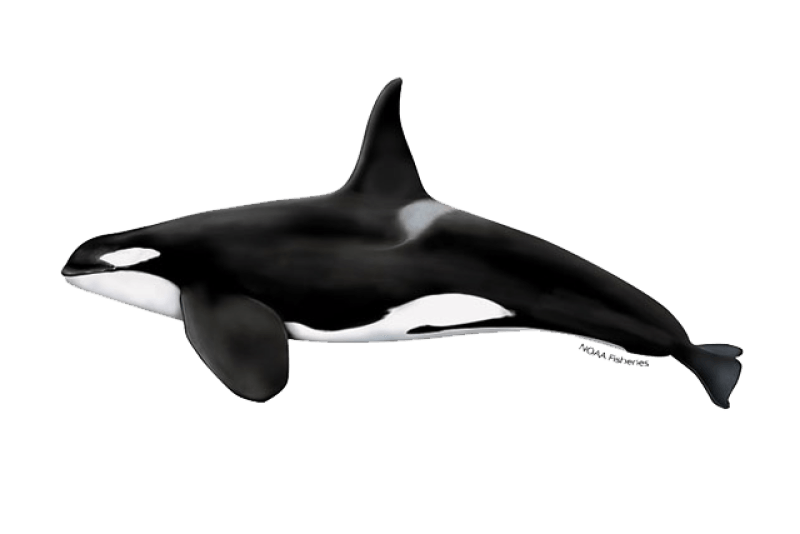
Killer whales are mostly black on top with white undersides and white patches near the eyes. They also have a gray or white saddle patch behind the dorsal fin. These markings vary between individuals and populations. Adult males develop disproportionately larger pectoral flippers, dorsal fins, tail flukes, and girths than females.
Learn more about the physical features of various populations of killer whales (PDF, 1 page)
Behavior and Diet Killer whales are highly social, and most live in social groups called pods (groups of maternally related individuals seen together more than half the time). Individual whales tend to stay closely affiliated with their matrilineal groups. Pods typically consist of a few to 20 or more closely-related individuals, and larger groups sometimes form for temporary social interactions, mating, or seasonal concentrations of prey.
Killer whales rely on underwater sound to feed, communicate, and navigate. Killer whales communicate with each other through clicks, whistles, and pulsed calls - the latter which are unique among populations and are learned and culturally transmitted among individuals. These calls maintain group cohesion and serve as family badges.
Although the diet of killer whales depends to some extent on what is available where they live, it is primarily determined by the culture (i.e., learned hunting tactics) of each ecotype . For example, one ecotype of killer whales in the U.S. Pacific Northwest (called Residents) exclusively eats fish, mainly salmon, and another ecotype in the same area (Transients or Bigg’s killer whales) primarily eats marine mammals and squid.
Killer whales often use a coordinated hunting strategy and work as a team to catch prey. They are considered an apex predator, eating at the top of the food web.
Appearance
Killer whales are highly social, and most live in social groups called pods (groups of maternally related individuals seen together more than half the time). Individual whales tend to stay closely affiliated with their matrilineal groups. Pods typically consist of a few to 20 or more closely-related individuals, and larger groups sometimes form for temporary social interactions, mating, or seasonal concentrations of prey.
Killer whales rely on underwater sound to feed, communicate, and navigate. Killer whales communicate with each other through clicks, whistles, and pulsed calls - the latter which are unique among populations and are learned and culturally transmitted among individuals. These calls maintain group cohesion and serve as family badges.
Although the diet of killer whales depends to some extent on what is available where they live, it is primarily determined by the culture (i.e., learned hunting tactics) of each ecotype . For example, one ecotype of killer whales in the U.S. Pacific Northwest (called Residents) exclusively eats fish, mainly salmon, and another ecotype in the same area (Transients or Bigg’s killer whales) primarily eats marine mammals and squid.
Killer whales often use a coordinated hunting strategy and work as a team to catch prey. They are considered an apex predator, eating at the top of the food web.
Where They Live Killer whales are found in all oceans. While they are most abundant in colder waters like Antarctica, the north Atlantic, and the north Pacific, they are also found in tropical and subtropical waters. The most well-studied killer whale populations occur in the eastern North Pacific Ocean. Resident killer whales have been seen from California to Russia. Offshore killer whales have the largest range of any community, and often occur more than 9 miles offshore. They are not, however, exclusively “offshore”, as they are sometimes seen in coastal nearshore waters. Transient killer whales also occur throughout the eastern North Pacific, and are often seen in coastal waters. Their habitat sometimes overlaps with Resident and Offshore killer whales.
World map providing approximate representation of the killer whale's range. Lifespan & Reproduction The average lifespan for male killer whales in the wild is about 30 years, but they can live up to at least 60 years. Females typically live about 50 years in the wild, but can live up to at least 90 years.
Females reach sexual maturity when they are between 10 and 13 years old. They are typically pregnant for 15 to 18 months and give birth to a single calf. Calves nurse exclusively for at least a year, but remain in close association with their mother for at least the first two years. There is no distinct calving season, so birth can take place in any month. The birth rate for killer whales is not well understood. In some populations, the birth rate is estimated at every 5 years for an average period of 25 years. Killer whales, beluga whales, narwhals, short-finned pilot whales , and humans are the only known species that go through menopause.
Threats Bycatch in Fishing Gear Killer whales are at risk of becoming entangled in fishing gear. Once captured or entangled, whales may drag and swim with attached gear for long distances or be anchored in place and unable to swim or surface to breathe. Events such as these result in fatigue, compromised feeding ability, or severe injury, which may ultimately lead to death. In 2023, NOAA Fisheries released a report documenting 31 years of killer whale entanglement history in Alaska.
Lack of Food Overfishing and habitat loss have decreased the amount of prey available to some killer whales. Without enough prey, killer whales might experience decreased reproductive rates and increased mortality rates. This threat is especially important for Southern Resident killer whales because some populations of their preferred prey, Chinook salmon , are also threatened or endangered.
Contaminants Contaminants enter ocean waters and sediments from many sources, such as wastewater treatment plants, sewer outfalls, and pesticide application. Once in the environment, these substances increase in concentration as they move up the food web and accumulate in top predators, such as killer whales. Killer whales have uniquely high levels of contaminants because of their long lifespan, position at the top of the food chain, and large quantities of blubber where they accumulate contaminants over time. These contaminants can harm killer whales’ immune, nutritional, and reproductive systems.
Despite modern pollution controls, chemical contamination through the food web continues to threaten killer whales. These controls have reduced, but not eliminated, many contaminants in the environment. Additionally, some of these contaminants persist in the marine environment and in the whales for decades and continue to threaten marine life.
Oil Spills The 1989 Exxon Valdez oil spill in Prince William Sound, Alaska, was strongly correlated with the direct loss of individual killer whales. However, oil spills can also have an indirect impact on killer whales by affecting the abundance of prey species. In addition, the bioaccumulation of certain contaminants in the food web, like those found in oil, such as polychlorinated biphenyls (PCBs), can be seen in apex predators like killer whales—and particularly among the transient population.
Disturbance from Vessels and Sound When vessels are present, killer whales hunt less and travel more. Noise interference from vessels, as well as from industrial and military activities, interrupts killer whales’ ability to use sound, which in turn disturbs their feeding, communication, and orientation. Increased vessel noise causes Southern Resident killer whales to call louder, expending more energy in the process.
Scientific Classification Kingdom Animalia Phylum Chordata Class Mammalia Order Cetacea Family Delphinidae Genus Orcinus Species orca Last updated by NOAA Fisheries on 03/25/2026
Biology
Killer whales are found in all oceans. While they are most abundant in colder waters like Antarctica, the north Atlantic, and the north Pacific, they are also found in tropical and subtropical waters. The most well-studied killer whale populations occur in the eastern North Pacific Ocean. Resident killer whales have been seen from California to Russia. Offshore killer whales have the largest range of any community, and often occur more than 9 miles offshore. They are not, however, exclusively “offshore”, as they are sometimes seen in coastal nearshore waters. Transient killer whales also occur throughout the eastern North Pacific, and are often seen in coastal waters. Their habitat sometimes overlaps with Resident and Offshore killer whales.
World map providing approximate representation of the killer whale's range. Lifespan & Reproduction The average lifespan for male killer whales in the wild is about 30 years, but they can live up to at least 60 years. Females typically live about 50 years in the wild, but can live up to at least 90 years.
Females reach sexual maturity when they are between 10 and 13 years old. They are typically pregnant for 15 to 18 months and give birth to a single calf. Calves nurse exclusively for at least a year, but remain in close association with their mother for at least the first two years. There is no distinct calving season, so birth can take place in any month. The birth rate for killer whales is not well understood. In some populations, the birth rate is estimated at every 5 years for an average period of 25 years. Killer whales, beluga whales, narwhals, short-finned pilot whales , and humans are the only known species that go through menopause.
Threats Bycatch in Fishing Gear Killer whales are at risk of becoming entangled in fishing gear. Once captured or entangled, whales may drag and swim with attached gear for long distances or be anchored in place and unable to swim or surface to breathe. Events such as these result in fatigue, compromised feeding ability, or severe injury, which may ultimately lead to death. In 2023, NOAA Fisheries released a report documenting 31 years of killer whale entanglement history in Alaska.
Lack of Food Overfishing and habitat loss have decreased the amount of prey available to some killer whales. Without enough prey, killer whales might experience decreased reproductive rates and increased mortality rates. This threat is especially important for Southern Resident killer whales because some populations of their preferred prey, Chinook salmon , are also threatened or endangered.
Contaminants Contaminants enter ocean waters and sediments from many sources, such as wastewater treatment plants, sewer outfalls, and pesticide application. Once in the environment, these substances increase in concentration as they move up the food web and accumulate in top predators, such as killer whales. Killer whales have uniquely high levels of contaminants because of their long lifespan, position at the top of the food chain, and large quantities of blubber where they accumulate contaminants over time. These contaminants can harm killer whales’ immune, nutritional, and reproductive systems.
Despite modern pollution controls, chemical contamination through the food web continues to threaten killer whales. These controls have reduced, but not eliminated, many contaminants in the environment. Additionally, some of these contaminants persist in the marine environment and in the whales for decades and continue to threaten marine life.
Oil Spills The 1989 Exxon Valdez oil spill in Prince William Sound, Alaska, was strongly correlated with the direct loss of individual killer whales. However, oil spills can also have an indirect impact on killer whales by affecting the abundance of prey species. In addition, the bioaccumulation of certain contaminants in the food web, like those found in oil, such as polychlorinated biphenyls (PCBs), can be seen in apex predators like killer whales—and particularly among the transient population.
Disturbance from Vessels and Sound When vessels are present, killer whales hunt less and travel more. Noise interference from vessels, as well as from industrial and military activities, interrupts killer whales’ ability to use sound, which in turn disturbs their feeding, communication, and orientation. Increased vessel noise causes Southern Resident killer whales to call louder, expending more energy in the process.
Scientific Classification Kingdom Animalia Phylum Chordata Class Mammalia Order Cetacea Family Delphinidae Genus Orcinus Species orca Last updated by NOAA Fisheries on 03/25/2026
Where they live
Range
Killer whales are found in all oceans. While they are most abundant in colder waters like Antarctica, the north Atlantic, and the north Pacific, they are also found in tropical and subtropical waters. The most well-studied killer whale populations occur in the eastern North Pacific Ocean. Resident killer whales have been seen from California to Russia. Offshore killer whales have the largest range of any community, and often occur more than 9 miles offshore. They are not, however, exclusively “offshore”, as they are sometimes seen in coastal nearshore waters. Transient killer whales also occur throughout the eastern North Pacific, and are often seen in coastal waters. Their habitat sometimes overlaps with Resident and Offshore killer whales.
World map providing approximate representation of the killer whale's range. Lifespan & Reproduction The average lifespan for male killer whales in the wild is about 30 years, but they can live up to at least 60 years. Females typically live about 50 years in the wild, but can live up to at least 90 years.
Habitat
See the NOAA species profile for habitat detail for this entry.
Ocean City & Mid-Atlantic context
From Ocean City, Maryland, use this Killer Whale profile as NOAA Mid-Atlantic directory context—not a promise you will meet the species on every charter.
Killer Whale is protected. Do not harvest. Report unusual strandings or entanglements through official channels.
Source facts and imagery are adapted from the NOAA Fisheries species profile for Killer Whale.
What charter to book from Ocean City
Killer Whale is not a standard Ocean City charter harvest target. Use this profile for NOAA biology and Mid-Atlantic context only.
Not typical from OC
Bay guide — Not a typical Ocean City bay guide target for Killer Whale.
Inshore charter — Not a typical Ocean City inshore charter target for Killer Whale.
Casting / light tackle — Not a typical Ocean City casting / light tackle target for Killer Whale.
Trolling charter — Not a typical Ocean City trolling charter target for Killer Whale.
Nearshore wreck / bottom — Not a typical Ocean City nearshore wreck / bottom target for Killer Whale.
Offshore charter — Not a typical Ocean City offshore charter target for Killer Whale.
Head / party boat — Not a typical Ocean City head / party boat target for Killer Whale.
Start with the charter directory trip-type picker so you compare boats inside the right
archetype—not a bay-guide quote against a canyon invoice.
Recovery Action Under the ESA, NOAA Fisheries develops and implements recovery plans for the conservation and survival of listed species. The ultimate goal of the Southern Resident killer whale recovery plan is to recover the species, with an interim goal of down-listing its status from endangered to threatened. The major actions recommended in the plan are:
Support salmon restoration efforts in the region to ensure an adequate prey base Reduce existing and monitor emerging contaminants Reduce vessel effects by improving whale watching guidelines and establishing regulations or protected areas as needed Prevent oil spills and improve response preparation Use available protections to minimize effects from human-caused sound Enhance public awareness and education Improve responses to live and dead killer whales Coordinate efforts with Canadian agencies, and with U.S. federal and state partners Conduct research to facilitate conservation efforts Read the recovery plan for Southern Resident killer whales
Learn how NOAA Fisheries and partners have been implementing the recovery actions identified in the plan
Harvest
See the NOAA wild-caught fishery section for landings and gear notes when published for this species.
Landings and management details matter most for the waters where Killer Whale is actually fished—see the
NOAA species profile
.