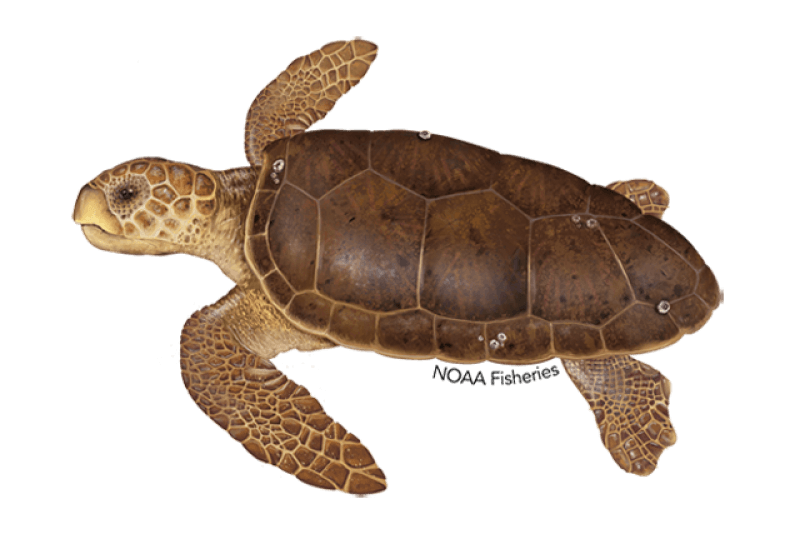
Caretta caretta . The loggerhead turtle is named for its large head, which supports powerful jaw muscles that enable them to feed on hard-shelled prey, such as whelks and conch. Loggerheads are the
Source: Species facts, status language, and imagery adapted from the NOAA Fisheries species profile (last updated 06/09/2026). Ocean City charter and Maryland
record notes are editorial orientation for OCEANCITY.MD readers. Always confirm current seasons, sizes, and
bag limits before you fish—rules change.
Lifespan: Unknown, but estimated to be 70 years or more
Region: New England/Mid-Atlantic,
Pacific Islands,
Southeast,
West Coast
Category: Protected species · Mid-Atlantic
Maryland likelihood: 4★ out of 5
About the species
The loggerhead turtle is named for its large head, which supports powerful jaw muscles that enable them to feed on hard-shelled prey, such as whelks and conch. Loggerheads are the most abundant species of sea turtle that nests in the United States. Juvenile and adult loggerheads live in U.S. coastal waters, but many adults that nest on U.S. beaches migrate from neighboring nations like the Bahamas, Cuba, and Mexico.
Loggerhead populations in the United States declined due to bycatch in fishing gear such as trawls, gillnets, and longlines. The use of turtle excluder devices (TEDs) in shrimp trawls, large circle hooks/fish bait in longline gear, gillnet bans, and other gear modifications and reduction in fishing effort have reduced sea turtle bycatch in some fisheries, but bycatch in fishing gear remains a primary threat facing loggerheads.
NOAA Fisheries and our partners are dedicated to protecting and recovering sea turtle populations worldwide. We use a variety of innovative techniques to study, protect, and recover these threatened and endangered species. We engage our partners as we develop measures and recovery plans that foster the conservation and implement recovery of loggerhead turtles and their habitats, and we fund research, monitoring, and conservation projects to implement priorities outlined in recovery plans.
Maryland record catch
Confirm whether Maryland DNR publishes an Atlantic state-record category for Loggerhead Turtle on the current sport-fish record board.
Loggerhead Turtle is a protected marine species in U.S. waters. Do not harvest. This guide is biology and Ocean City context only—not a fishing target.
Loggerheads have large heads with powerful jaws. The top shell (carapace) is slightly heart-shaped and reddish-brown in adults and sub-adults, while the bottom shell (plastron) is generally a pale yellowish color. The neck and flippers are usually dull brown to reddish brown on top and medium to pale yellow on the sides and bottom. Unlike freshwater turtles and tortoises, sea turtles cannot withdraw their head or flippers into their shells. Hatchlings are mostly dark brown, their flippers have white to white-gray margins, and the bottom shell is generally yellowish to tan.
Behavior and Diet Loggerheads, like all sea turtles, are marine reptiles and must come to the surface to breathe. Adult female sea turtles return to land to lay their eggs on sandy beaches—they are remarkable navigators and usually return to a beach in the general area where they hatched decades earlier.
The life cycle of loggerheads involves a series of stages of development from hatchling to adult. Hatchlings and juveniles spend the first 7 to 15 years of their lives in the open ocean. Then they migrate to nearshore coastal areas where they will forage and continue to grow for another decade or more before reaching maturity. Adult loggerhead turtles migrate hundreds to thousands of miles from their foraging grounds to their nesting beaches.
Through satellite tracking, researchers have discovered that loggerheads in the Pacific Ocean may undertake a trans-Pacific migration. Hatchlings from nesting beaches in Japan and Australia have been tracked migrating across the Pacific to feed off the coast of Baja California, Mexico, Peru and Chile—nearly 8,000 miles away! They spend many years (possibly up to 20 years) growing to maturity and then migrate back to the beaches where they hatched in the Western Pacific Ocean to mate, nest, and live out the remainder of their lives.
Loggerheads are carnivores, only occasionally consuming plant material. During their open ocean phase, they feed on a wide variety of floating items. Unfortunately, trash and other debris discarded by humans also tends to accumulate in their habitat. Small fragments of plastic are often mistaken for food and eaten by turtles. Juveniles and adults in coastal waters eat mostly bottom-dwelling invertebrates including mollusks, crustaceans, and horseshoe crabs. Their powerful jaws are designed to crush their prey.
Where They Live Loggerhead turtles are found worldwide primarily in subtropical and temperate regions of the Atlantic, Pacific, and Indian oceans, and in the Mediterranean Sea. In the Atlantic, loggerheads range from Newfoundland, Canada to Argentina. In the eastern Pacific, loggerheads have been reported from Alaska to Chile.
Appearance
Loggerheads, like all sea turtles, are marine reptiles and must come to the surface to breathe. Adult female sea turtles return to land to lay their eggs on sandy beaches—they are remarkable navigators and usually return to a beach in the general area where they hatched decades earlier.
The life cycle of loggerheads involves a series of stages of development from hatchling to adult. Hatchlings and juveniles spend the first 7 to 15 years of their lives in the open ocean. Then they migrate to nearshore coastal areas where they will forage and continue to grow for another decade or more before reaching maturity. Adult loggerhead turtles migrate hundreds to thousands of miles from their foraging grounds to their nesting beaches.
Through satellite tracking, researchers have discovered that loggerheads in the Pacific Ocean may undertake a trans-Pacific migration. Hatchlings from nesting beaches in Japan and Australia have been tracked migrating across the Pacific to feed off the coast of Baja California, Mexico, Peru and Chile—nearly 8,000 miles away! They spend many years (possibly up to 20 years) growing to maturity and then migrate back to the beaches where they hatched in the Western Pacific Ocean to mate, nest, and live out the remainder of their lives.
Loggerheads are carnivores, only occasionally consuming plant material. During their open ocean phase, they feed on a wide variety of floating items. Unfortunately, trash and other debris discarded by humans also tends to accumulate in their habitat. Small fragments of plastic are often mistaken for food and eaten by turtles. Juveniles and adults in coastal waters eat mostly bottom-dwelling invertebrates including mollusks, crustaceans, and horseshoe crabs. Their powerful jaws are designed to crush their prey.
Where They Live Loggerhead turtles are found worldwide primarily in subtropical and temperate regions of the Atlantic, Pacific, and Indian oceans, and in the Mediterranean Sea. In the Atlantic, loggerheads range from Newfoundland, Canada to Argentina. In the eastern Pacific, loggerheads have been reported from Alaska to Chile.
World map providing approximate representation of the loggerhead turtle's range. Lifespan & Reproduction Loggerheads can live up to 80 years or more. Female loggerheads reach maturity at about 35 years of age. Every 2 to 3 years they migrate to breed in the general area where they hatched decades earlier.
In the northern hemisphere, mating occurs in late March to early June and females lay eggs between late April and early September. Loggerheads are solitary, night-time nesters, and they generally prefer high energy, relatively narrow, steeply sloped, coarse-grained beaches for nesting. Adult females lay three to five nests, sometimes more, two weeks apart during a single nesting season. Each nest contains about 100 eggs. The sex of hatchlings is determined by the temperature of the sand—cooler temperatures produce males and warmer temperatures produce females. After about two months incubating in the warm sand, the eggs hatch and the hatchlings make their way to the sea. Eggs and hatchlings are susceptible to tidal inundation and beach predators.
Hatchlings are particularly threatened by artificial beachfront lighting, which can disorient them and prevent them from finding the sea. Hatchlings orient by moving away from the darkest silhouette of the landward dune or vegetation to crawl towards the brightest horizon. On undeveloped beaches, this is toward the open horizon over the ocean. However, in areas with artificial lighting hatchlings are disoriented and often crawl landward instead of toward the ocean. Artificial light can similarly disorient nesting female turtles.
Threats Bycatch in Fishing Gear A primary threat to sea turtles is their unintended capture in fishing gear which can result in drowning or cause injuries that lead to death or debilitation (for example, swallowing hooks). The term for this unintended capture is bycatch . Sea turtle bycatch is a worldwide problem. The greatest continuing primary threat to loggerhead populations worldwide is bycatch in fishing gear, primarily in trawls, longlines, gillnets, and hook and lines, but also in pound nets, pot/traps, and dredge fisheries.
Direct Harvest of Turtles and Eggs Historically, loggerheads were killed for their meat and their eggs which are collected for consumption and/or sale in some countries. Presently, loggerheads are protected in many countries where they occur, but in some places, hunting of loggerheads and collection and consumption of their eggs continue to be a threat.
Loss and Degradation of Nesting Habitat Coastal development and rising seas from changing environmental conditions are leading to the loss of critical nesting beach habitat for loggerheads. Human-related changes associated with coastal development include beachfront lighting, shoreline armoring, and beach driving. Shoreline hardening or armoring (e.g., seawalls) can result in the complete loss of dry sand suitable for successful nesting. Artificial lighting on and near nesting beaches can deter nesting females from coming ashore to nest and can disorient hatchlings trying to find the sea after emerging from their nests.
Vessel Strikes Vessel strikes are a major threat to loggerheads near developed coastlines throughout their range. Various types of watercraft can strike loggerheads when they are at or near the surface resulting in injury or death. In the Atlantic Ocean and Gulf of America , the number of loggerhead deaths due to vessel strikes are increasing. High traffic boat areas such as marinas, boat ramps, and inlets present a higher risk. Adult loggerheads, in particular nesting females, are more susceptible to vessel strikes when making reproductive migrations and while they are nearshore during the nesting season or if they reside in coastal foraging habitats that may overlap in areas with high boat traffic.
Ocean Pollution/Marine Debris Increasing pollution of nearshore and offshore marine habitats threatens all sea turtles and degrades their habitats. The Deepwater Horizon oil spill was the largest offshore oil spill in U.S. history and affected nesting (including nesting females, eggs, and hatchlings), small juvenile, large juvenile, and adult sea turtles throughout the Gulf of America. Ingestion of marine debris is another threat to all species of sea turtles. Loggerheads may ingest fishing line, balloons, plastic bags, plastic fragments, floating tar or oil, and other materials discarded by humans which they can mistake for food. They may also become entangled in marine debris, including lost or discarded fishing gear, which can lead to injury or death.
Changing Environmental Conditions For all sea turtles, changing environmental conditions like higher sand temperatures can be lethal to eggs, or alter the ratio of male and female hatchlings produced (via temperature-dependent sex determination ). Rising seas and storm events can change beach morphology and cause beach erosion which may flood nests or wash them away. Changes in the temperature of the marine environment are likely to alter habitat suitability, as well as the abundance and distribution of food resources, leading to a shift in the migratory and foraging range and nesting season of loggerheads.
Scientific Classification Kingdom Animalia Phylum Chordata Class Reptilia Order Testudines Family Cheloniidae Genus Caretta Species caretta Last updated by NOAA Fisheries on 06/09/2026
Biology
Loggerhead turtles are found worldwide primarily in subtropical and temperate regions of the Atlantic, Pacific, and Indian oceans, and in the Mediterranean Sea. In the Atlantic, loggerheads range from Newfoundland, Canada to Argentina. In the eastern Pacific, loggerheads have been reported from Alaska to Chile.
World map providing approximate representation of the loggerhead turtle's range. Lifespan & Reproduction Loggerheads can live up to 80 years or more. Female loggerheads reach maturity at about 35 years of age. Every 2 to 3 years they migrate to breed in the general area where they hatched decades earlier.
In the northern hemisphere, mating occurs in late March to early June and females lay eggs between late April and early September. Loggerheads are solitary, night-time nesters, and they generally prefer high energy, relatively narrow, steeply sloped, coarse-grained beaches for nesting. Adult females lay three to five nests, sometimes more, two weeks apart during a single nesting season. Each nest contains about 100 eggs. The sex of hatchlings is determined by the temperature of the sand—cooler temperatures produce males and warmer temperatures produce females. After about two months incubating in the warm sand, the eggs hatch and the hatchlings make their way to the sea. Eggs and hatchlings are susceptible to tidal inundation and beach predators.
Hatchlings are particularly threatened by artificial beachfront lighting, which can disorient them and prevent them from finding the sea. Hatchlings orient by moving away from the darkest silhouette of the landward dune or vegetation to crawl towards the brightest horizon. On undeveloped beaches, this is toward the open horizon over the ocean. However, in areas with artificial lighting hatchlings are disoriented and often crawl landward instead of toward the ocean. Artificial light can similarly disorient nesting female turtles.
Threats Bycatch in Fishing Gear A primary threat to sea turtles is their unintended capture in fishing gear which can result in drowning or cause injuries that lead to death or debilitation (for example, swallowing hooks). The term for this unintended capture is bycatch . Sea turtle bycatch is a worldwide problem. The greatest continuing primary threat to loggerhead populations worldwide is bycatch in fishing gear, primarily in trawls, longlines, gillnets, and hook and lines, but also in pound nets, pot/traps, and dredge fisheries.
Direct Harvest of Turtles and Eggs Historically, loggerheads were killed for their meat and their eggs which are collected for consumption and/or sale in some countries. Presently, loggerheads are protected in many countries where they occur, but in some places, hunting of loggerheads and collection and consumption of their eggs continue to be a threat.
Loss and Degradation of Nesting Habitat Coastal development and rising seas from changing environmental conditions are leading to the loss of critical nesting beach habitat for loggerheads. Human-related changes associated with coastal development include beachfront lighting, shoreline armoring, and beach driving. Shoreline hardening or armoring (e.g., seawalls) can result in the complete loss of dry sand suitable for successful nesting. Artificial lighting on and near nesting beaches can deter nesting females from coming ashore to nest and can disorient hatchlings trying to find the sea after emerging from their nests.
Vessel Strikes Vessel strikes are a major threat to loggerheads near developed coastlines throughout their range. Various types of watercraft can strike loggerheads when they are at or near the surface resulting in injury or death. In the Atlantic Ocean and Gulf of America , the number of loggerhead deaths due to vessel strikes are increasing. High traffic boat areas such as marinas, boat ramps, and inlets present a higher risk. Adult loggerheads, in particular nesting females, are more susceptible to vessel strikes when making reproductive migrations and while they are nearshore during the nesting season or if they reside in coastal foraging habitats that may overlap in areas with high boat traffic.
Ocean Pollution/Marine Debris Increasing pollution of nearshore and offshore marine habitats threatens all sea turtles and degrades their habitats. The Deepwater Horizon oil spill was the largest offshore oil spill in U.S. history and affected nesting (including nesting females, eggs, and hatchlings), small juvenile, large juvenile, and adult sea turtles throughout the Gulf of America. Ingestion of marine debris is another threat to all species of sea turtles. Loggerheads may ingest fishing line, balloons, plastic bags, plastic fragments, floating tar or oil, and other materials discarded by humans which they can mistake for food. They may also become entangled in marine debris, including lost or discarded fishing gear, which can lead to injury or death.
Changing Environmental Conditions For all sea turtles, changing environmental conditions like higher sand temperatures can be lethal to eggs, or alter the ratio of male and female hatchlings produced (via temperature-dependent sex determination ). Rising seas and storm events can change beach morphology and cause beach erosion which may flood nests or wash them away. Changes in the temperature of the marine environment are likely to alter habitat suitability, as well as the abundance and distribution of food resources, leading to a shift in the migratory and foraging range and nesting season of loggerheads.
Scientific Classification Kingdom Animalia Phylum Chordata Class Reptilia Order Testudines Family Cheloniidae Genus Caretta Species caretta Last updated by NOAA Fisheries on 06/09/2026
Where they live
Range
Loggerhead turtles are found worldwide primarily in subtropical and temperate regions of the Atlantic, Pacific, and Indian oceans, and in the Mediterranean Sea. In the Atlantic, loggerheads range from Newfoundland, Canada to Argentina. In the eastern Pacific, loggerheads have been reported from Alaska to Chile.
World map providing approximate representation of the loggerhead turtle's range. Lifespan & Reproduction Loggerheads can live up to 80 years or more. Female loggerheads reach maturity at about 35 years of age. Every 2 to 3 years they migrate to breed in the general area where they hatched decades earlier.
Habitat
See the NOAA species profile for habitat detail for this entry.
Ocean City & Mid-Atlantic context
From Ocean City, Maryland, use this Loggerhead Turtle profile as NOAA Mid-Atlantic directory context—not a promise you will meet the species on every charter.
Loggerhead Turtle is protected. Do not harvest. Report unusual strandings or entanglements through official channels.
Source facts and imagery are adapted from the NOAA Fisheries species profile for Loggerhead Turtle.
What charter to book from Ocean City
Loggerhead Turtle is not a standard Ocean City charter harvest target. Use this profile for NOAA biology and Mid-Atlantic context only.
Not typical from OC
Bay guide — Not a typical Ocean City bay guide target for Loggerhead Turtle.
Inshore charter — Not a typical Ocean City inshore charter target for Loggerhead Turtle.
Casting / light tackle — Not a typical Ocean City casting / light tackle target for Loggerhead Turtle.
Trolling charter — Not a typical Ocean City trolling charter target for Loggerhead Turtle.
Nearshore wreck / bottom — Not a typical Ocean City nearshore wreck / bottom target for Loggerhead Turtle.
Offshore charter — Not a typical Ocean City offshore charter target for Loggerhead Turtle.
Head / party boat — Not a typical Ocean City head / party boat target for Loggerhead Turtle.
Start with the charter directory trip-type picker so you compare boats inside the right
archetype—not a bay-guide quote against a canyon invoice.
Recovery Action To help identify and guide the protection, conservation, and recovery of sea turtles, the ESA requires NOAA Fisheries and the U.S. FWS to develop and implement recovery plans which provide a blueprint for conservation of the species and measurable criteria to gauge progress toward recovery.
The major recovery actions for loggerhead turtles include:
Protecting sea turtles on nesting beaches and in marine environments Protecting nesting and foraging habitats Reducing bycatch in commercial, artisanal, and recreational fisheries Reducing the effects of entanglement and ingestion of marine debris Reducing vessel strikes in coastal habitats Working with partners internationally to protect turtles in all life-stages Supporting research and conservation projects consistent with Recovery Plan priorities Two recovery plans have been developed to recover and protect loggerhead turtle populations that are found in U.S. waters. Each is focused on the unique needs of turtles in the various regions.
Recovery Plan for the Northwest Atlantic Population of Loggerhead Sea Turtle Recovery Plan for the U.S. Pacific Populations of Loggerhead Sea Turtle The highly migratory behavior of sea turtles makes them shared resources among many nations, so conservation efforts for sea turtle populations must extend beyond national boundaries. This necessitates international collaboration and coordination. Learn more about international conservation efforts below.
Harvest
See the NOAA wild-caught fishery section for landings and gear notes when published for this species.
Landings and management details matter most for the waters where Loggerhead Turtle is actually fished—see the
NOAA species profile
.