Globicephala melas . Long-finned pilot whales are very social, living in large groups of hundreds of animals separated into close-knit pods of about 50 to 100 whales. This structure made them easy targ
Source: Species facts, status language, and imagery adapted from the NOAA Fisheries species profile (last updated 03/26/2026). Ocean City charter and Maryland
record notes are editorial orientation for OCEANCITY.MD readers. Always confirm current seasons, sizes, and
bag limits before you fish—rules change.
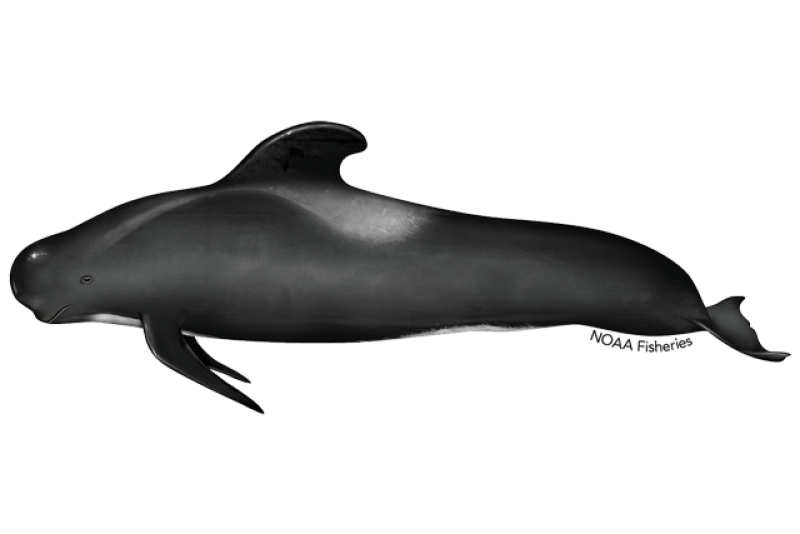
Illustration/photo: NOAA Fisheries — Long-Finned Pilot Whale (Globicephala melas).
Quick facts
Length: 19 to 25 feet
Lifespan: 35 to 60 years
Region: New England/Mid-Atlantic,
Southeast
Category: Protected species · Mid-Atlantic
Maryland likelihood: 2★ out of 5
About the species
Long-finned pilot whales are very social, living in large groups of hundreds of animals separated into close-knit pods of about 50 to 100 whales. This structure made them easy targets for whaling in the 19th and 20th centuries. Whalers would drive and herd pilot whales together into tight groups to harpoon them, hunting them for their meat, oil, and blubber.
Long-finned pilot whales are one of two species of pilot whale, along with short-finned pilot whales . In the field and at sea, it is very difficult to distinguish the two species, which differ only slightly in physical size, flipper lengths, and coloration patterns.
Maryland record catch
Confirm whether Maryland DNR publishes an Atlantic state-record category for Long-Finned Pilot Whale on the current sport-fish record board.
Long-Finned Pilot Whale is a protected marine species in U.S. waters. Do not harvest. This guide is biology and Ocean City context only—not a fishing target.
Long-finned pilot whales are wide-ranging, medium-sized animals that have a stocky, sturdy body. They have a large bulbous or squarish forehead, known as a melon, that varies with age and sex. In some animals, the melon can develop a prominent crease. Long-finned pilot whales have 16 to 26 peg-like teeth in each jaw, which may be an evolutionary adaptation to consuming large amounts of soft squid. Their thick dorsal fin is located about a third of the body length behind the head. As they mature, their dorsal fin becomes broader and rounder.
This species gets its common name from the pair of long, tapered, sickle-shaped flippers on either side of its body. Long-finned pilot whales are dark black in color, but can sometimes appear dark gray or brownish. They have pale grayish or whitish marks, such as a diagonal eye-stripe, or a blaze, that extends from behind the eye and up towards the dorsal fin. They also have a large saddle behind the dorsal fin and an anchor-shaped patch that starts at the throat and extends down their underside.
Behavior and Diet Long-finned pilot whales are commonly seen in pods of about 20-100 individuals (usually containing more females than males),but can also contain groupings of several hundred or even up to a thousand animals. Studies have shown that these established pods are maternally based. The strong social structure of these animals has been suggested to be why this species in particular is often involved in mass strandings on beaches. Long-finned pilot whales are known to associate with a variety of other dolphin and whale species and sometimes even sharks.
At the surface, these whales will often display various active behaviors such as raising their heads above the surface or lifting their flukes out of the water and splashing them down against the surface. They are also regularly seen resting or logging at the surface in a chorus-line or stacked formation and sometimes approach vessels moving at slow speeds. This species has a small, strong, low, bushy blow that is often visible.
Long-finned pilot whales can dive to depths of about 2,000 feet for 10 to 16 minutes to feed on fish (e.g., cod, dogfish, hake, herring, mackerel and turbot), cephalopods (e.g., squid and octopus) and crustaceans (e.g., shrimp). Most feeding occurs at night in deep water between depths of 650 and 1,650 feet. Like other members of the delphinid family, long-finned pilot whales echolocate when foraging for prey.
Where They Live Long-finned pilot whales prefer deep temperate to subpolar oceanic waters, but they have been known to occur in coastal waters in some areas. Larger groupings of animals have been documented on the continental edge and slope, depending on the season. This species has been described as "anti-tropical." Three distinct populations or subspecies of long-finned pilot whales are recognized:
Appearance
Long-finned pilot whales are commonly seen in pods of about 20-100 individuals (usually containing more females than males),but can also contain groupings of several hundred or even up to a thousand animals. Studies have shown that these established pods are maternally based. The strong social structure of these animals has been suggested to be why this species in particular is often involved in mass strandings on beaches. Long-finned pilot whales are known to associate with a variety of other dolphin and whale species and sometimes even sharks.
At the surface, these whales will often display various active behaviors such as raising their heads above the surface or lifting their flukes out of the water and splashing them down against the surface. They are also regularly seen resting or logging at the surface in a chorus-line or stacked formation and sometimes approach vessels moving at slow speeds. This species has a small, strong, low, bushy blow that is often visible.
Long-finned pilot whales can dive to depths of about 2,000 feet for 10 to 16 minutes to feed on fish (e.g., cod, dogfish, hake, herring, mackerel and turbot), cephalopods (e.g., squid and octopus) and crustaceans (e.g., shrimp). Most feeding occurs at night in deep water between depths of 650 and 1,650 feet. Like other members of the delphinid family, long-finned pilot whales echolocate when foraging for prey.
Where They Live Long-finned pilot whales prefer deep temperate to subpolar oceanic waters, but they have been known to occur in coastal waters in some areas. Larger groupings of animals have been documented on the continental edge and slope, depending on the season. This species has been described as "anti-tropical." Three distinct populations or subspecies of long-finned pilot whales are recognized:
Southern Hemisphere North Atlantic An unnamed extinct form in the western North Pacific In the Southern Hemisphere, their range extends from 19° S to 60° S, but they have been regularly sighted in the Antarctic Convergence Zone (47° to 62° south) and in the Central and South Pacific as far south as 68° south. They have been documented near the Antarctic sea ice and associated with the colder Benguela and Humboldt Currents, which may extend their normal range, as well as the Falklands. The southern subspecies range includes Cape Province, South Africa; Chile; southern Australia; New Zealand; and Sao Paulo, Brazil. In the Northern Hemisphere, their range includes the U.S. east coast, Gulf of St. Lawrence, the Azores, Madeira, North Africa, western Mediterranean Sea, North Sea, Greenland and the Barents Sea. In the winter and spring, they are more likely to occur in offshore oceanic waters or on the continental slope. In the summer and autumn, long-finned pilot whales generally follow their favorite foods farther inshore and on to the continental shelf.
World map providing approximate representation of the long-finned pilot whale's range. Lifespan & Reproduction Males become sexually mature at 12 to 13 years and females at 8 years. Breeding and mating usually takes place between the months of April and September in the Western North Atlantic and between October and April in the Southern Hemisphere. Every 3 to 6 years a single calf is born after a gestation period of 12 to 16 months. This is one of the longest known birth intervals of all cetaceans. At birth, calves measure about 5 to 6.5 feet and weigh about 165 pounds. After 18 to 44 months, the calf stops nursing and is weaned by the cow. Older and/or non reproductive females help care for calves in the social group. The lifespan of long-finned pilot whales is 35 to 45 years for males and at least 60 years for females.
Threats Entanglement Long-finned pilot whales can become entangled or hooked in fishing gear, either swimming off with the gear attached or becoming captured in the gear. They can get hooked, captured or entangled in many different gear types, including gillnets, pelagic longlines, and trawls. Hooked whales may swim off with attached gear that can compromise feeding ability or lead to severe injury, which may result in reduced reproductive success and death. Whales captured in trawl nets often drown as they cannot reach the surface to breathe.
Whaling Historically, whalers benefited from pilot whales’ strong social structure and would drive and herd them together into tight groups during hunts. In the 19th and 20th centuries, American sperm whalers in the North Atlantic harpooned them, while a drive fishery in Newfoundland targeted them for meat, blubber, and oil. Drive fisheries for this species also historically occurred in the Falkland Islands, Greenland, Iceland, Norway, Scotland (Orkney Islands and Hebrides Islands), and the United States (Cape Cod, Massachusetts). Currently, shore-based hunters in the Faroe Islands (Denmark) continue to directly target long-finned pilot whales.
Disease Morbillivirus has affected pilot whales in the North Atlantic and certain strains of the virus may be native to specific areas. The historical prevalence of morbillivirus in the blood of these whales suggests that they may have increased contact with the virus. This increased exposure means that enough of the population is immune to the virus to prevent serious outbreaks of infectious disease from occurring in areas of the western Atlantic.
Contaminants Contaminants enter ocean waters and sediments from many sources, such as wastewater treatment plants, sewer outfalls, and pesticide application. Once in the environment, these substances move up the food chain and accumulate in species such as long-finned pilot whales. Pollutants and various contaminants in the marine environment have been found in their blubber. These pollutants can harm their immune and reproductive systems.
Despite modern pollution controls, chemical contamination through the food chain continues to threaten long-finned pilot whales. These controls have reduced, but not eliminated, many contaminants in the environment. Additionally, some of these contaminants persist in the marine environment for decades and continue to threaten marine life.
Scientific Classification Kingdom Animalia Phylum Chordata Class Mammalia Order Cetacea Family Delphinidae Genus Globicephala Species melas Last updated by NOAA Fisheries on 03/26/2026
Biology
Long-finned pilot whales prefer deep temperate to subpolar oceanic waters, but they have been known to occur in coastal waters in some areas. Larger groupings of animals have been documented on the continental edge and slope, depending on the season. This species has been described as "anti-tropical." Three distinct populations or subspecies of long-finned pilot whales are recognized:
Southern Hemisphere North Atlantic An unnamed extinct form in the western North Pacific In the Southern Hemisphere, their range extends from 19° S to 60° S, but they have been regularly sighted in the Antarctic Convergence Zone (47° to 62° south) and in the Central and South Pacific as far south as 68° south. They have been documented near the Antarctic sea ice and associated with the colder Benguela and Humboldt Currents, which may extend their normal range, as well as the Falklands. The southern subspecies range includes Cape Province, South Africa; Chile; southern Australia; New Zealand; and Sao Paulo, Brazil. In the Northern Hemisphere, their range includes the U.S. east coast, Gulf of St. Lawrence, the Azores, Madeira, North Africa, western Mediterranean Sea, North Sea, Greenland and the Barents Sea. In the winter and spring, they are more likely to occur in offshore oceanic waters or on the continental slope. In the summer and autumn, long-finned pilot whales generally follow their favorite foods farther inshore and on to the continental shelf.
World map providing approximate representation of the long-finned pilot whale's range. Lifespan & Reproduction Males become sexually mature at 12 to 13 years and females at 8 years. Breeding and mating usually takes place between the months of April and September in the Western North Atlantic and between October and April in the Southern Hemisphere. Every 3 to 6 years a single calf is born after a gestation period of 12 to 16 months. This is one of the longest known birth intervals of all cetaceans. At birth, calves measure about 5 to 6.5 feet and weigh about 165 pounds. After 18 to 44 months, the calf stops nursing and is weaned by the cow. Older and/or non reproductive females help care for calves in the social group. The lifespan of long-finned pilot whales is 35 to 45 years for males and at least 60 years for females.
Threats Entanglement Long-finned pilot whales can become entangled or hooked in fishing gear, either swimming off with the gear attached or becoming captured in the gear. They can get hooked, captured or entangled in many different gear types, including gillnets, pelagic longlines, and trawls. Hooked whales may swim off with attached gear that can compromise feeding ability or lead to severe injury, which may result in reduced reproductive success and death. Whales captured in trawl nets often drown as they cannot reach the surface to breathe.
Whaling Historically, whalers benefited from pilot whales’ strong social structure and would drive and herd them together into tight groups during hunts. In the 19th and 20th centuries, American sperm whalers in the North Atlantic harpooned them, while a drive fishery in Newfoundland targeted them for meat, blubber, and oil. Drive fisheries for this species also historically occurred in the Falkland Islands, Greenland, Iceland, Norway, Scotland (Orkney Islands and Hebrides Islands), and the United States (Cape Cod, Massachusetts). Currently, shore-based hunters in the Faroe Islands (Denmark) continue to directly target long-finned pilot whales.
Disease Morbillivirus has affected pilot whales in the North Atlantic and certain strains of the virus may be native to specific areas. The historical prevalence of morbillivirus in the blood of these whales suggests that they may have increased contact with the virus. This increased exposure means that enough of the population is immune to the virus to prevent serious outbreaks of infectious disease from occurring in areas of the western Atlantic.
Contaminants Contaminants enter ocean waters and sediments from many sources, such as wastewater treatment plants, sewer outfalls, and pesticide application. Once in the environment, these substances move up the food chain and accumulate in species such as long-finned pilot whales. Pollutants and various contaminants in the marine environment have been found in their blubber. These pollutants can harm their immune and reproductive systems.
Despite modern pollution controls, chemical contamination through the food chain continues to threaten long-finned pilot whales. These controls have reduced, but not eliminated, many contaminants in the environment. Additionally, some of these contaminants persist in the marine environment for decades and continue to threaten marine life.
Scientific Classification Kingdom Animalia Phylum Chordata Class Mammalia Order Cetacea Family Delphinidae Genus Globicephala Species melas Last updated by NOAA Fisheries on 03/26/2026
Where they live
Range
Long-finned pilot whales prefer deep temperate to subpolar oceanic waters, but they have been known to occur in coastal waters in some areas. Larger groupings of animals have been documented on the continental edge and slope, depending on the season. This species has been described as "anti-tropical." Three distinct populations or subspecies of long-finned pilot whales are recognized:
Southern Hemisphere North Atlantic An unnamed extinct form in the western North Pacific In the Southern Hemisphere, their range extends from 19° S to 60° S, but they have been regularly sighted in the Antarctic Convergence Zone (47° to 62° south) and in the Central and South Pacific as far south as 68° south. They have been documented near the Antarctic sea ice and associated with the colder Benguela and Humboldt Currents, which may extend their normal range, as well as the Falklands. The southern subspecies range includes Cape Province, South Africa; Chile; southern Australia; New Zealand; and Sao Paulo, Brazil. In the Northern Hemisphere, their range includes the U.S. east coast, Gulf of St. Lawrence, the Azores, Madeira, North Africa, western Mediterranean Sea, North Sea, Greenland and the Barents Sea. In the winter and spring, they are more likely to occur in offshore oceanic waters or on the continental slope. In the summer and autumn, long-finned pilot whales generally follow their favorite foods farther inshore and on to the continental shelf.
Habitat
See the NOAA species profile for habitat detail for this entry.
Ocean City & Mid-Atlantic context
From Ocean City, Maryland, use this Long-Finned Pilot Whale profile as NOAA Mid-Atlantic directory context—not a promise you will meet the species on every charter.
Long-Finned Pilot Whale is protected. Do not harvest. Report unusual strandings or entanglements through official channels.
Source facts and imagery are adapted from the NOAA Fisheries species profile for Long-Finned Pilot Whale.
What charter to book from Ocean City
Long-Finned Pilot Whale is not a standard Ocean City charter harvest target. Use this profile for NOAA biology and Mid-Atlantic context only.
Not typical from OC
Bay guide — Not a typical Ocean City bay guide target for Long-Finned Pilot Whale.
Inshore charter — Not a typical Ocean City inshore charter target for Long-Finned Pilot Whale.
Casting / light tackle — Not a typical Ocean City casting / light tackle target for Long-Finned Pilot Whale.
Trolling charter — Not a typical Ocean City trolling charter target for Long-Finned Pilot Whale.
Nearshore wreck / bottom — Not a typical Ocean City nearshore wreck / bottom target for Long-Finned Pilot Whale.
Offshore charter — Not a typical Ocean City offshore charter target for Long-Finned Pilot Whale.
Head / party boat — Not a typical Ocean City head / party boat target for Long-Finned Pilot Whale.
Start with the charter directory trip-type picker so you compare boats inside the right
archetype—not a bay-guide quote against a canyon invoice.
Reducing Bycatch in Fishing Gear Bycatch in fishing gear is a leading cause of long-finned pilot whale mortalities and serious injuries in U.S. waters.
Long-finned pilot whales were originally included in the Atlantic Pelagic Longline Take Reduction Plan. However, in 2023, long-finned pilot whales were removed from the scope of the Plan since their average annual mortality and serious injury incidental to the Atlantic pelagic longline fishery was below the insignificance threshold of 10 percent of the PBR level for the species.
Although long-finned pilot whales have been removed from the Plan, fisheries bycatch continues to be a threat to the species. Efforts such as updated safe handling and release protocols and increased fisheries observer effort continue to help mitigate and monitor long-finned pilot whale interactions with fishing gear.
Learn more about bycatch and fisheries interactions
Addressing Ocean Noise Underwater noise threatens whale populations, interrupting their normal behavior and driving them away from areas important to their survival. Increasing evidence suggests that exposure to intense underwater sound in some settings may cause some whales to strand and ultimately die. NOAA Fisheries is investigating all aspects of acoustic communication and hearing in marine animals, as well as the effects of sound on whale behavior and hearing. In 2016, we issued technical guidance for assessing the effects of anthropogenic (human-caused) sound on marine mammal hearing.
Overseeing Marine Mammal Health and Stranding Response We work with volunteer networks in all coastal states to respond to marine mammal strandings including all whales. When stranded animals are found alive, NOAA Fisheries and our partners assess the animal’s health and determine the best course of action. When stranded animals are found dead, our scientists work to understand and investigate the cause of death. Although the cause often remains unknown, scientists can sometimes attribute strandings to disease, harmful algal blooms, vessel strikes, fishing gear entanglements, pollution exposure, and underwater noise. Some strandings can serve as indicators of ocean health, giving insight into larger environmental issues that may also have implications for human health and welfare.
Learn more about the Marine Mammal Health and Stranding Response Program
Marine Mammal Unusual Mortality Events Long-finned pilot whales have been part of a declared unusual mortality event in the past . Under the Marine Mammal Protection Act , an unusual mortality event is defined as "a stranding that is unexpected; involves a significant die-off of any marine mammal population; and demands immediate response." To understand the health of marine mammal populations, scientists study unusual mortality events.
Harvest
See the NOAA wild-caught fishery section for landings and gear notes when published for this species.
Landings and management details matter most for the waters where Long-Finned Pilot Whale is actually fished—see the
NOAA species profile
.