Peponocephala electra . Melon-headed whales are a robust small whale found primarily in deep, tropical waters worldwide. They are social animals and often occur in groups of hundreds to over 1,000 individ
Source: Species facts, status language, and imagery adapted from the NOAA Fisheries species profile (last updated 03/23/2026). Ocean City charter and Maryland
record notes are editorial orientation for OCEANCITY.MD readers. Always confirm current seasons, sizes, and
bag limits before you fish—rules change.
Region: New England/Mid-Atlantic,
Pacific Islands,
Southeast,
West Coast
Category: Protected species · Mid-Atlantic
Maryland likelihood: 1★ out of 5
About the species
Melon-headed whales are a robust small whale found primarily in deep, tropical waters worldwide. They are social animals and often occur in groups of hundreds to over 1,000 individuals. They likely maintain a matrilineal social structure, where females remain in groups with their mother and sisters, and males move between groups. At birth, melon-headed whales are approximately 3 feet long and grow to 9 feet long, with males reaching greater lengths than females.
Melon-headed whales can be confused with pygmy killer whales and false killer whales , to whom they are closely related.
Melon-headed whales, like all marine mammals, are protected under the Marine Mammal Protection Act .
Maryland record catch
Confirm whether Maryland DNR publishes an Atlantic state-record category for Melon-Headed Whale on the current sport-fish record board.
Melon-Headed Whale is a protected marine species in U.S. waters. Do not harvest. This guide is biology and Ocean City context only—not a fishing target.
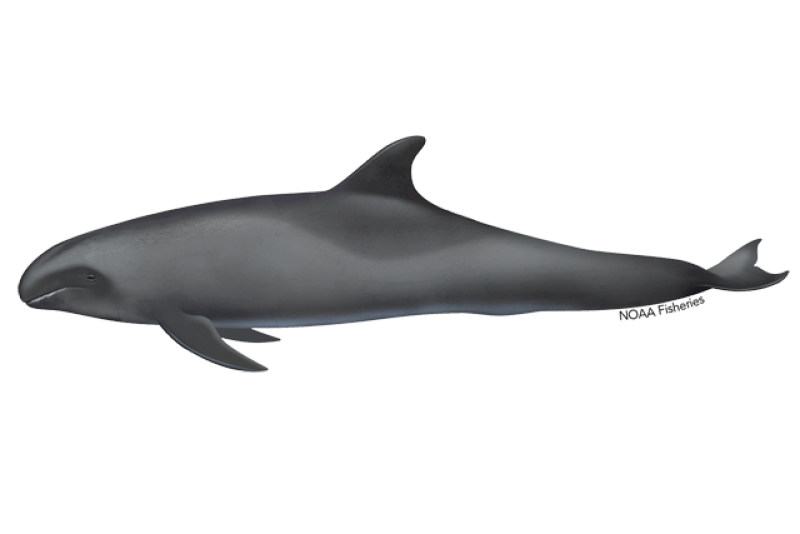
Melon-headed whales have a small head with a rounded melon and no discernible beak. Their dorsal fin is relatively large and they have pointed, tapering flippers (pectoral fins). Their body color is dark with a large dorsal cape and dark areas on the side of the face that are not always easy to see.
Behavior and Diet Melon-headed whales often occur in groups of hundreds to over 1,000 animals. Smaller, coordinated subgroups are common within the larger groups. They are often associated with schools of Fraser's dolphins and have been sighted in mixed schools with spinner dolphins , bottlenose dolphins , rough toothed dolphins , short-finned pilot whales , and spotted dolphins .
Melon-headed whales make fast, low leaps from the water as they swim. This species tends to rest in the morning, socialize in the afternoon, and forage at night on fish, squid, cuttlefish, and shrimp.
Where They Live Melon-headed whales are found primarily in deep waters throughout tropical areas of the world. In the United States, there are four distinct populations. Based on photo identification, satellite telemetry tag, and genetic research, we believe there are two populations of melon-headed whales in Hawaii—a large population that moves frequently among the islands that uses deep waters (4,600 to 6,000 feet deep), and a small population resident to the island of Hawaii that uses shallower waters (500 to 1,300 feet deep). There is also a population that lives in the Gulf of America (formerly Gulf of Mexico) and the offshore waters of the southeastern United States.
Lifespan & Reproduction Female melon-headed whales reach sexual maturity at approximately 7 years of age while males mature later, between 12 and 15 years of age. The gestation period is approximately 12 months and females give birth every 3 to 4 years. Melon-headed whales can live up to 45 years.
Threats Fisheries Interactions Small numbers of melon-headed whales have been killed in directed harpoon or drive fisheries in the Philippines and Japan, respectively. They are also occasionally caught incidentally in tuna purse seine nets in the eastern tropical Pacific and in drift net fisheries in the Philippines, Indonesia, India, Malaysia, West Africa, and the Caribbean.
Appearance
Melon-headed whales often occur in groups of hundreds to over 1,000 animals. Smaller, coordinated subgroups are common within the larger groups. They are often associated with schools of Fraser's dolphins and have been sighted in mixed schools with spinner dolphins , bottlenose dolphins , rough toothed dolphins , short-finned pilot whales , and spotted dolphins .
Melon-headed whales make fast, low leaps from the water as they swim. This species tends to rest in the morning, socialize in the afternoon, and forage at night on fish, squid, cuttlefish, and shrimp.
Where They Live Melon-headed whales are found primarily in deep waters throughout tropical areas of the world. In the United States, there are four distinct populations. Based on photo identification, satellite telemetry tag, and genetic research, we believe there are two populations of melon-headed whales in Hawaii—a large population that moves frequently among the islands that uses deep waters (4,600 to 6,000 feet deep), and a small population resident to the island of Hawaii that uses shallower waters (500 to 1,300 feet deep). There is also a population that lives in the Gulf of America (formerly Gulf of Mexico) and the offshore waters of the southeastern United States.
Lifespan & Reproduction Female melon-headed whales reach sexual maturity at approximately 7 years of age while males mature later, between 12 and 15 years of age. The gestation period is approximately 12 months and females give birth every 3 to 4 years. Melon-headed whales can live up to 45 years.
Threats Fisheries Interactions Small numbers of melon-headed whales have been killed in directed harpoon or drive fisheries in the Philippines and Japan, respectively. They are also occasionally caught incidentally in tuna purse seine nets in the eastern tropical Pacific and in drift net fisheries in the Philippines, Indonesia, India, Malaysia, West Africa, and the Caribbean.
Ocean Noise Underwater noise threatens whale populations, interrupting their normal behavior and driving them away from areas important to their survival, such as feeding and breeding grounds. Increasing evidence suggests that exposure to intense underwater sound in some settings may cause some whales to strand and ultimately die.
Pollution In Japan, heavy metal and man-made chemical concentrations (e.g., perfluorocarbons and flame retardants) in melon-headed whales have increased over time. Concentrations of polychlorinated biphenyls (PCBs) in melon-headed whales in Hawaii and Japan are at levels thought to cause toxic effects.
Scientific Classification Kingdom Animalia Phylum Chordata Class Mammalia Order Cetacea Family Delphinidae Genus Peponocephala Species electra Last updated by NOAA Fisheries on 03/23/2026
Biology
Melon-headed whales are found primarily in deep waters throughout tropical areas of the world. In the United States, there are four distinct populations. Based on photo identification, satellite telemetry tag, and genetic research, we believe there are two populations of melon-headed whales in Hawaii—a large population that moves frequently among the islands that uses deep waters (4,600 to 6,000 feet deep), and a small population resident to the island of Hawaii that uses shallower waters (500 to 1,300 feet deep). There is also a population that lives in the Gulf of America (formerly Gulf of Mexico) and the offshore waters of the southeastern United States.
Lifespan & Reproduction Female melon-headed whales reach sexual maturity at approximately 7 years of age while males mature later, between 12 and 15 years of age. The gestation period is approximately 12 months and females give birth every 3 to 4 years. Melon-headed whales can live up to 45 years.
Threats Fisheries Interactions Small numbers of melon-headed whales have been killed in directed harpoon or drive fisheries in the Philippines and Japan, respectively. They are also occasionally caught incidentally in tuna purse seine nets in the eastern tropical Pacific and in drift net fisheries in the Philippines, Indonesia, India, Malaysia, West Africa, and the Caribbean.
Ocean Noise Underwater noise threatens whale populations, interrupting their normal behavior and driving them away from areas important to their survival, such as feeding and breeding grounds. Increasing evidence suggests that exposure to intense underwater sound in some settings may cause some whales to strand and ultimately die.
Pollution In Japan, heavy metal and man-made chemical concentrations (e.g., perfluorocarbons and flame retardants) in melon-headed whales have increased over time. Concentrations of polychlorinated biphenyls (PCBs) in melon-headed whales in Hawaii and Japan are at levels thought to cause toxic effects.
Scientific Classification Kingdom Animalia Phylum Chordata Class Mammalia Order Cetacea Family Delphinidae Genus Peponocephala Species electra Last updated by NOAA Fisheries on 03/23/2026
Where they live
Range
Melon-headed whales are found primarily in deep waters throughout tropical areas of the world. In the United States, there are four distinct populations. Based on photo identification, satellite telemetry tag, and genetic research, we believe there are two populations of melon-headed whales in Hawaii—a large population that moves frequently among the islands that uses deep waters (4,600 to 6,000 feet deep), and a small population resident to the island of Hawaii that uses shallower waters (500 to 1,300 feet deep). There is also a population that lives in the Gulf of America (formerly Gulf of Mexico) and the offshore waters of the southeastern United States.
Lifespan & Reproduction Female melon-headed whales reach sexual maturity at approximately 7 years of age while males mature later, between 12 and 15 years of age. The gestation period is approximately 12 months and females give birth every 3 to 4 years. Melon-headed whales can live up to 45 years.
Habitat
See the NOAA species profile for habitat detail for this entry.
Ocean City & Mid-Atlantic context
From Ocean City, Maryland, use this Melon-Headed Whale profile as NOAA Mid-Atlantic directory context—not a promise you will meet the species on every charter.
Melon-Headed Whale is protected. Do not harvest. Report unusual strandings or entanglements through official channels.
Source facts and imagery are adapted from the NOAA Fisheries species profile for Melon-Headed Whale.
What charter to book from Ocean City
Melon-Headed Whale is not a standard Ocean City charter harvest target. Use this profile for NOAA biology and Mid-Atlantic context only.
Not typical from OC
Bay guide — Not a typical Ocean City bay guide target for Melon-Headed Whale.
Inshore charter — Not a typical Ocean City inshore charter target for Melon-Headed Whale.
Casting / light tackle — Not a typical Ocean City casting / light tackle target for Melon-Headed Whale.
Trolling charter — Not a typical Ocean City trolling charter target for Melon-Headed Whale.
Nearshore wreck / bottom — Not a typical Ocean City nearshore wreck / bottom target for Melon-Headed Whale.
Offshore charter — Not a typical Ocean City offshore charter target for Melon-Headed Whale.
Head / party boat — Not a typical Ocean City head / party boat target for Melon-Headed Whale.
Start with the charter directory trip-type picker so you compare boats inside the right
archetype—not a bay-guide quote against a canyon invoice.
Reducing Vessel Strikes Collisions between whales and large vessels can injure or kill the whales and damage the vessels, but they often go unnoticed and unreported. The most effective way to reduce collision risk is to keep whales and vessels apart. If this is not possible, the second best strategy is for vessels to slow down and monitor for the presence of these animals.
Addressing Ocean Noise Underwater noise threatens whale populations, interrupting their normal behavior and driving them away from areas important to their survival. Increasing evidence suggests that exposure to intense underwater noise in some settings may cause some whales to strand and ultimately die. NOAA Fisheries is investigating all aspects of acoustic communication and hearing in marine animals, as well as the effects of sound on whale behavior and hearing. In 2016, we issued technical guidance for assessing the effects of anthropogenic sound on marine mammals’ hearing.
Harvest
See the NOAA wild-caught fishery section for landings and gear notes when published for this species.
Landings and management details matter most for the waters where Melon-Headed Whale is actually fished—see the
NOAA species profile
.