Balaenoptera acutorostrata . Minke whales are members of the baleen or “great” whale family and are the smallest of the rorquals . They are one of the most abundant rorqual in the world, and their population s
Source: Species facts, status language, and imagery adapted from the NOAA Fisheries species profile (last updated 09/17/2025). Ocean City charter and Maryland
record notes are editorial orientation for OCEANCITY.MD readers. Always confirm current seasons, sizes, and
bag limits before you fish—rules change.
Region: Alaska,
New England/Mid-Atlantic,
Pacific Islands,
Southeast,
West Coast
Category: Protected species · Mid-Atlantic
Maryland likelihood: 3★ out of 5
About the species
Minke whales are members of the baleen or “great” whale family and are the smallest of the rorquals . They are one of the most abundant rorqual in the world, and their population status is considered stable throughout almost their entire range (especially when compared to other species of large whales).
Commercial whaling practices may have reduced minke whale populations in the western North Pacific and in the northeastern North Atlantic. Commercial whaling’s overexploitation of other larger whale species, however, may have allowed minke whales to prosper from the lessened competition and increased availability of food resources.
The scientific names for minke whales translate to: "winged whale" ( Balaenoptera ), "sharp snout" ( acutorostrata ). They received their common name from a Norwegian novice whaling spotter named Meincke, who supposedly mistook a minke whale for a blue whale.
Minke whales in the United States are not endangered or threatened, but they are protected under the Marine Mammal Protection Act . NOAA Fisheries and its partners are dedicated to conserving minke whales. We use a variety of innovative techniques to study and protect this species.
Maryland record catch
Confirm whether Maryland DNR publishes an Atlantic state-record category for Minke Whale on the current sport-fish record board.
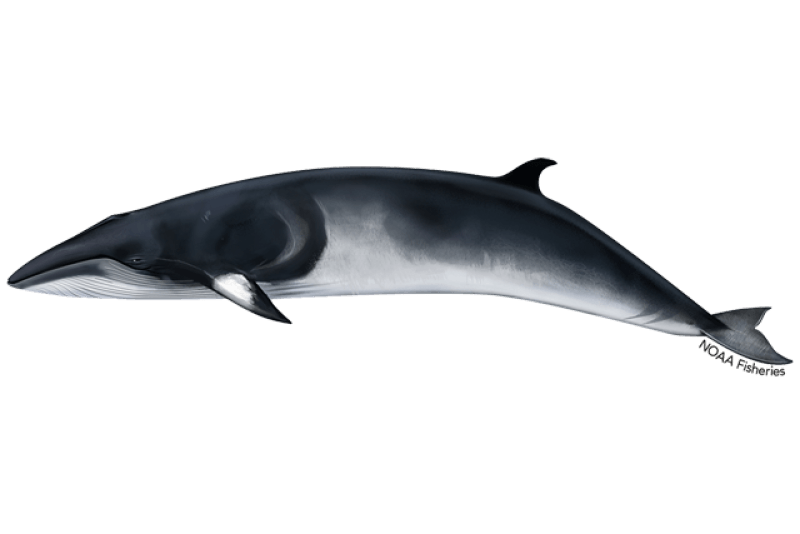
The common minke whale is the smallest baleen whale in North American waters. These rorquals have a relatively small, dark, sleek body that can reach lengths of up to about 35 feet and weigh up to 20,000 pounds. Females may be slightly larger than males. Minke whales have a fairly tall, sickle-shaped dorsal fin located about two-thirds down their back. Their body is black to dark grayish/brownish, with a pale chevron on the back behind the head and above the flippers, as well as a white underside. Calves are usually darker in coloration than adults.
Common minke whales vary in body size, patterns, coloration, and baleen (long, flat keratin plates that hang from the whale’s mouth in place of teeth) based on geographical location. They may vary individually as well. Northern Hemisphere minke whales are distinguished from other rorquals by their relatively small size and a well-defined white band located in the middle of their dark flippers. They have 230 to 360 short, white/cream colored baleen plates on each side of their mouth and 50 to 70 abdominal pleats are located along their throat.
Dwarf minke whales are significantly smaller in size, growing up to lengths of about 26 feet and weighing up to 14,000 pounds. Their baleen plates have a thin black border. Dwarf minke whales can also be distinguished from other minke whales by a bright white patch on the upper part of their dark pectoral fin that extends up towards the shoulder and back area. They also have a dark half-collar that wraps around the head and reaches the throat grooves.
Antarctic minke whales have 200 to 300 baleen plates on each side of their mouths. Their pectoral flippers are usually solid gray with a white leading edge, and the noticeable band seen in the northern and dwarf form is generally absent. Unlike other minke whales, the color of their baleen is asymmetrical, with fewer white baleen plates on the left side than on the right side of the forward part of their mouth. The rest of their baleen plates are dark gray. Antarctic minke whales also have 22 to 38 abdominal pleats located along their throat.
Behavior and Diet Minke whales are usually sighted individually or in small groups of 2 to three, but loose groupings of up to 400 animals have been seen in feeding areas closer to the poles. The segregation and distribution of the Northern Hemisphere whales suggests a complex social and population structure, but less is known about the dwarf minke whale in the Southern Hemisphere.
Minke whales feed by side-lunging into schools of prey and gulping large amounts of water. Sea birds, attracted to the concentrated prey just below the surface, are sometimes associated with minke whale feeding and foraging. Minke whales opportunistically feed on crustaceans, plankton, and small schooling fish (e.g., anchovies, dogfish, capelin, coal fish, cod, eels, herring, mackerel, salmon, sand lance, saury, and wolfish). In the Southern Hemisphere, the dwarf minke whale subspecies feeds on a combination of krill and myctophid fish.
Appearance
Minke whales are usually sighted individually or in small groups of 2 to three, but loose groupings of up to 400 animals have been seen in feeding areas closer to the poles. The segregation and distribution of the Northern Hemisphere whales suggests a complex social and population structure, but less is known about the dwarf minke whale in the Southern Hemisphere.
Minke whales feed by side-lunging into schools of prey and gulping large amounts of water. Sea birds, attracted to the concentrated prey just below the surface, are sometimes associated with minke whale feeding and foraging. Minke whales opportunistically feed on crustaceans, plankton, and small schooling fish (e.g., anchovies, dogfish, capelin, coal fish, cod, eels, herring, mackerel, salmon, sand lance, saury, and wolfish). In the Southern Hemisphere, the dwarf minke whale subspecies feeds on a combination of krill and myctophid fish.
Minke whales are known to vocalize and create sounds that include clicks, grunts, pulse trains, ratchets, thumps, and recently discovered "boings." These distinct vocalizations can vary depending on species and geographic area.
Minke whales are often recognized in the field by surfacing snout-first, with a small and weak—but visible—bushy blow that is about 6.5 to 10 feet high. Unlike other rorqual species, they do not raise their flukes out of the water when they are diving. When surfacing, they have a quick fluid movement, which creates spray (sometimes described as a "roostertail") when traveling at high speeds. Before deep dives, they may arch and expose much of their back and body in a high roll above the surface. These whales can dive for at least 15 minutes but regularly submerge for 6 to 12 minutes at a time. Minke whales are often active at the surface, and are commonly seen breaching. They frequently poke their heads above the surface (or “spyhop”) in areas of mobile ice. At sea, these animals may be curious and approach vessels, especially those that are stationary.
Where They Live Common minke whales prefer temperate to boreal waters but are also found in tropical and subtropical areas. They feed most often in cooler waters at higher latitudes and can be found in both coastal/inshore and oceanic/offshore areas. Their distribution is considered cosmopolitan because they can occur in polar, temperate, and tropical waters in most seas and areas worldwide. Minke whales, like some other species of cetaceans, migrate seasonally and can travel long distances. Some animals and stocks of this species have resident home ranges and are not highly migratory. The distribution of minke whales varies by age, reproductive status, and sex. Older mature males are commonly found in the polar regions in and near the ice edge—often in small social groups—during the summer feeding season. Mature females will also migrate farther into the higher latitudes, but generally remain in coastal waters. Immature animals are more solitary and usually stay in lower latitudes during the summer. Minke whales in Alaskan waters are migratory, but animals in the inland waters of California/Oregon/Washington are considered "residents" because they establish home ranges. Northern minke whales have a widespread distribution in the Northern Hemisphere and are found throughout the northern Atlantic and Pacific Oceans. Their range extends from the ice edge in the Arctic during the summer to near the equator during winter. Dwarf minke whales are distributed close to the polar region in the Southern Hemisphere, especially during the summer months, but are more common in temperate and warmer waters of middle and lower latitudes. They are frequently reported in areas off of Australia (such as the Great Barrier Reef), South America, and South Africa. The dwarf minke whales are usually found between 20° and 60° South, but immature individuals generally do not travel past 42° South. These whales migrate far distances seasonally, feeding in high latitudes during the summer and moving to mating/calving grounds during the winter (7° to 35° South).
World map providing approximate representation of the common minke whale's range. Lifespan & Reproduction Minke whales become sexually mature at around 3 to 8 years of age, which is about when they reach 23 feet in size. Mating and calving most likely occurs during the winter. After a gestation period of 10 to 11 months, females give birth to a single calf that is about 8 to 11.5 feet in length and weighs 700 to 1,000 pounds. The calf is weaned from nursing after 4 to 6 months. The reproductive interval for females is estimated at 10 to 11 months, but calving may occur annually. Mother-calf pairs are usually sighted in the lower latitudes of the wintering grounds, but they are much rarer in the summer feeding grounds closer to the poles. The estimated lifespan of minke whales is up to 50 years.
Threats Whaling Historically, whalers have exploited minke whales since at least the 1930s. Hunters had previously overlooked them because of their relatively small size. Since commercial whalers started targeting minke whales, several thousand have been hunted in the Northern Hemisphere. In the Southern Hemisphere, just a few dwarf minke whales were hunted because whalers were more interested in the larger Antarctic minke whales. In the past, these minke were commercially hunted by whalers from China, Iceland, Korea, Russia, and Taiwan.
Today, whaling countries such as Greenland, Japan, and Norway still take common minke whales for food and for scientific research.
Entanglement in Fishing Gear Minke whales get entangled in fishing gear, including groundfish trawls in Alaska, as well as drift and set gillnets off California/Oregon/Washington. They also become entangled in driftnets, gillnets, herring weirs, lobster traps, and tuna purse seine nets from numerous fisheries in waters of the Northeast and Mid-Atlantic United States and Canada.
Ocean Noise Underwater sounds and anthropogenic noise are an increasing concern for baleen whales, such as minke whales, which use low-frequency sounds to communicate with one another and to locate prey.
Vessel Strikes Vessel strikes can injure or kill minke whales. Minke whales are vulnerable to vessel strikes throughout their range, but the risk is much higher in some coastal areas with heavy ship traffic. The projected increase in vessel traffic arising from the opening of trans-polar shipping routes (as Arctic sea ice continues to decline) likely will increase the risk of vessel strikes, ambient noise, and pollution in the Arctic.
Climate Change The impacts of climate change on baleen whales may result from altered oceanographic conditions, as well as the timing and distribution of sea ice coverage. Changes in prey distribution could lead to changes in foraging behavior, nutritional stress, and diminished reproduction for minke whales. Additionally, changing water temperature and currents could impact the timing of environmental cues important for navigation and foraging.
Scientific Classification Kingdom Animalia Phylum Chordata Class Mammalia Order Cetacea Family Balaenopteridae Genus Balaenoptera Species acutorostrata Last updated by NOAA Fisheries on 09/17/2025
Biology
Common minke whales prefer temperate to boreal waters but are also found in tropical and subtropical areas. They feed most often in cooler waters at higher latitudes and can be found in both coastal/inshore and oceanic/offshore areas. Their distribution is considered cosmopolitan because they can occur in polar, temperate, and tropical waters in most seas and areas worldwide. Minke whales, like some other species of cetaceans, migrate seasonally and can travel long distances. Some animals and stocks of this species have resident home ranges and are not highly migratory. The distribution of minke whales varies by age, reproductive status, and sex. Older mature males are commonly found in the polar regions in and near the ice edge—often in small social groups—during the summer feeding season. Mature females will also migrate farther into the higher latitudes, but generally remain in coastal waters. Immature animals are more solitary and usually stay in lower latitudes during the summer. Minke whales in Alaskan waters are migratory, but animals in the inland waters of California/Oregon/Washington are considered "residents" because they establish home ranges. Northern minke whales have a widespread distribution in the Northern Hemisphere and are found throughout the northern Atlantic and Pacific Oceans. Their range extends from the ice edge in the Arctic during the summer to near the equator during winter. Dwarf minke whales are distributed close to the polar region in the Southern Hemisphere, especially during the summer months, but are more common in temperate and warmer waters of middle and lower latitudes. They are frequently reported in areas off of Australia (such as the Great Barrier Reef), South America, and South Africa. The dwarf minke whales are usually found between 20° and 60° South, but immature individuals generally do not travel past 42° South. These whales migrate far distances seasonally, feeding in high latitudes during the summer and moving to mating/calving grounds during the winter (7° to 35° South).
World map providing approximate representation of the common minke whale's range. Lifespan & Reproduction Minke whales become sexually mature at around 3 to 8 years of age, which is about when they reach 23 feet in size. Mating and calving most likely occurs during the winter. After a gestation period of 10 to 11 months, females give birth to a single calf that is about 8 to 11.5 feet in length and weighs 700 to 1,000 pounds. The calf is weaned from nursing after 4 to 6 months. The reproductive interval for females is estimated at 10 to 11 months, but calving may occur annually. Mother-calf pairs are usually sighted in the lower latitudes of the wintering grounds, but they are much rarer in the summer feeding grounds closer to the poles. The estimated lifespan of minke whales is up to 50 years.
Threats Whaling Historically, whalers have exploited minke whales since at least the 1930s. Hunters had previously overlooked them because of their relatively small size. Since commercial whalers started targeting minke whales, several thousand have been hunted in the Northern Hemisphere. In the Southern Hemisphere, just a few dwarf minke whales were hunted because whalers were more interested in the larger Antarctic minke whales. In the past, these minke were commercially hunted by whalers from China, Iceland, Korea, Russia, and Taiwan.
Today, whaling countries such as Greenland, Japan, and Norway still take common minke whales for food and for scientific research.
Entanglement in Fishing Gear Minke whales get entangled in fishing gear, including groundfish trawls in Alaska, as well as drift and set gillnets off California/Oregon/Washington. They also become entangled in driftnets, gillnets, herring weirs, lobster traps, and tuna purse seine nets from numerous fisheries in waters of the Northeast and Mid-Atlantic United States and Canada.
Ocean Noise Underwater sounds and anthropogenic noise are an increasing concern for baleen whales, such as minke whales, which use low-frequency sounds to communicate with one another and to locate prey.
Vessel Strikes Vessel strikes can injure or kill minke whales. Minke whales are vulnerable to vessel strikes throughout their range, but the risk is much higher in some coastal areas with heavy ship traffic. The projected increase in vessel traffic arising from the opening of trans-polar shipping routes (as Arctic sea ice continues to decline) likely will increase the risk of vessel strikes, ambient noise, and pollution in the Arctic.
Climate Change The impacts of climate change on baleen whales may result from altered oceanographic conditions, as well as the timing and distribution of sea ice coverage. Changes in prey distribution could lead to changes in foraging behavior, nutritional stress, and diminished reproduction for minke whales. Additionally, changing water temperature and currents could impact the timing of environmental cues important for navigation and foraging.
Scientific Classification Kingdom Animalia Phylum Chordata Class Mammalia Order Cetacea Family Balaenopteridae Genus Balaenoptera Species acutorostrata Last updated by NOAA Fisheries on 09/17/2025
Where they live
Range
Common minke whales prefer temperate to boreal waters but are also found in tropical and subtropical areas. They feed most often in cooler waters at higher latitudes and can be found in both coastal/inshore and oceanic/offshore areas. Their distribution is considered cosmopolitan because they can occur in polar, temperate, and tropical waters in most seas and areas worldwide. Minke whales, like some other species of cetaceans, migrate seasonally and can travel long distances. Some animals and stocks of this species have resident home ranges and are not highly migratory. The distribution of minke whales varies by age, reproductive status, and sex. Older mature males are commonly found in the polar regions in and near the ice edge—often in small social groups—during the summer feeding season. Mature females will also migrate farther into the higher latitudes, but generally remain in coastal waters. Immature animals are more solitary and usually stay in lower latitudes during the summer. Minke whales in Alaskan waters are migratory, but animals in the inland waters of California/Oregon/Washington are considered "residents" because they establish home ranges. Northern minke whales have a widespread distribution in the Northern Hemisphere and are found throughout the northern Atlantic and Pacific Oceans. Their range extends from the ice edge in the Arctic during the summer to near the equator during winter. Dwarf minke whales are distributed close to the polar region in the Southern Hemisphere, especially during the summer months, but are more common in temperate and warmer waters of middle and lower latitudes. They are frequently reported in areas off of Australia (such as the Great Barrier Reef), South America, and South Africa. The dwarf minke whales are usually found between 20° and 60° South, but immature individuals generally do not travel past 42° South. These whales migrate far distances seasonally, feeding in high latitudes during the summer and moving to mating/calving grounds during the winter (7° to 35° South).
World map providing approximate representation of the common minke whale's range. Lifespan & Reproduction Minke whales become sexually mature at around 3 to 8 years of age, which is about when they reach 23 feet in size. Mating and calving most likely occurs during the winter. After a gestation period of 10 to 11 months, females give birth to a single calf that is about 8 to 11.5 feet in length and weighs 700 to 1,000 pounds. The calf is weaned from nursing after 4 to 6 months. The reproductive interval for females is estimated at 10 to 11 months, but calving may occur annually. Mother-calf pairs are usually sighted in the lower latitudes of the wintering grounds, but they are much rarer in the summer feeding grounds closer to the poles. The estimated lifespan of minke whales is up to 50 years.
Habitat
See the NOAA species profile for habitat detail for this entry.
Ocean City & Mid-Atlantic context
From Ocean City, Maryland, use this Minke Whale profile as NOAA Mid-Atlantic directory context—not a promise you will meet the species on every charter.
Minke Whale is protected. Do not harvest. Report unusual strandings or entanglements through official channels.
Source facts and imagery are adapted from the NOAA Fisheries species profile for Minke Whale.
What charter to book from Ocean City
Minke Whale is not a standard Ocean City charter harvest target. Use this profile for NOAA biology and Mid-Atlantic context only.
Not typical from OC
Bay guide — Not a typical Ocean City bay guide target for Minke Whale.
Inshore charter — Not a typical Ocean City inshore charter target for Minke Whale.
Casting / light tackle — Not a typical Ocean City casting / light tackle target for Minke Whale.
Trolling charter — Not a typical Ocean City trolling charter target for Minke Whale.
Nearshore wreck / bottom — Not a typical Ocean City nearshore wreck / bottom target for Minke Whale.
Offshore charter — Not a typical Ocean City offshore charter target for Minke Whale.
Head / party boat — Not a typical Ocean City head / party boat target for Minke Whale.
Start with the charter directory trip-type picker so you compare boats inside the right
archetype—not a bay-guide quote against a canyon invoice.
Reducing Vessel Strikes Collisions between whales and large vessels can injure or kill the whales and damage the vessels, but they often go unnoticed and unreported. The most effective way to reduce the collision risk is for vessels to avoid areas used by whales. If this is not possible, the second-best option is for vessels to slow down and keep a lookout when transiting whale waters.
Learn more about vessel strikes and marine animals
Minimizing Whale Watching Harassment NOAA Fisheries supports responsible viewing of marine mammals in the wild and has adopted a guideline to observe all large whales from a safe distance of at least 100 yards by sea or land.
WhaleSENSE is a voluntary education and recognition program in the U.S. Atlantic and Alaska regions developed by NOAA Fisheries and partners in collaboration with the whale watching industry to recognize whale watching companies committed to responsible practices.
Companies participating in the WhaleSENSE program agree to:
Stick to the regional whale watching guidelines Educate naturalists, captains, and passengers to have “SENSE” while watching whales Notify and report whales in distress Set an example for other boaters Encourage ocean stewardship Addressing Ocean Noise Underwater noise threatens whale populations, interrupting their normal behavior and driving them away from areas important to their survival. Increasing evidence suggests that exposure to intense underwater sound in some settings may cause some whales to strand and ultimately die. NOAA Fisheries is investigating all aspects of acoustic communication and hearing in marine animals, as well as the effects of sound on whale behavior and hearing. In 2018, we revised technical guidance for assessing the effects of anthropogenic (human-caused) sound on marine mammal hearing .
Overseeing Marine Mammal Health and Stranding Response We work with volunteer networks in all coastal states to respond to marine mammal strandings including all whales. When stranded animals are found alive, NOAA Fisheries and our partners assess the animal’s health and determine the best course of action. When stranded animals are found dead, our scientists work to understand and investigate the cause of death. Although the cause often remains unknown, scientists can sometimes attribute strandings to disease, harmful algal blooms, vessel strikes, fishing gear entanglements, pollution exposure, and underwater noise. Some strandings can serve as indicators of ocean health, giving insight into larger environmental issues that may also have implications for human health and welfare.
Learn more about the Marine Mammal Health and Stranding Response Program
Harvest
See the NOAA wild-caught fishery section for landings and gear notes when published for this species.
Landings and management details matter most for the waters where Minke Whale is actually fished—see the
NOAA species profile
.