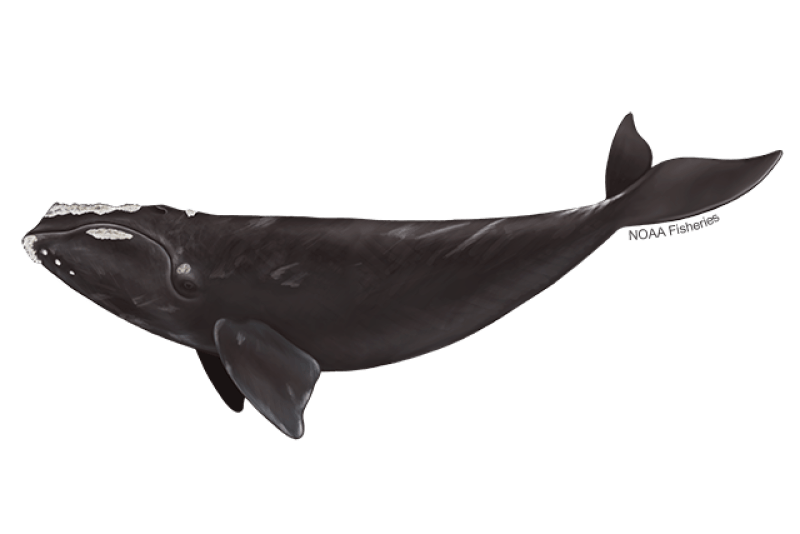
Source: Species facts, status language, and imagery adapted from the NOAA Fisheries species profile (last updated 06/26/2026). Ocean City charter and Maryland
record notes are editorial orientation for OCEANCITY.MD readers. Always confirm current seasons, sizes, and
bag limits before you fish—rules change.
Illustration/photo: NOAA Fisheries — North Atlantic Right Whale (Eubalaena glacialis).
Quick facts
Length: Up to 52 feet
Lifespan: Up to 70 years
Region: New England/Mid-Atlantic,
Southeast
Category: Protected species · Mid-Atlantic
Maryland likelihood: 2★ out of 5
About the species
The North Atlantic right whale is one of the world’s most endangered large whale species.
Two other species of right whales exist: the North Pacific right whale , which is found in the North Pacific Ocean, and the Southern right whale , which is found in the southern hemisphere. Right whales are baleen whales, feeding on copepods (tiny crustaceans) by straining huge volumes of ocean water through their baleen plates, which act like a sieve.
By the early 1890s, commercial whalers had hunted North Atlantic right whales to the brink of extinction. (They got their name from being the "right" whales to hunt because they floated when they were killed.) Whaling is no longer a threat, but they have never recovered to pre-whaling numbers, and human interactions still present a danger to this species. Entanglement in fishing gear and vessel strikes are the leading causes of North Atlantic right whale mortality. Increasing ocean noise levels from human activities are also a concern because the noise may interfere with right whale communication and increase their stress levels.
NOAA Fisheries and our partners are dedicated to recovering the North Atlantic right whale population and minimizing conflict with human activities. We use innovative techniques to learn more about these endangered whales and what can be done to reduce threats. We engage our partners, including the fishing, boating, and shipping industries, as we develop and implement measures that foster healthy fisheries and thriving marine economies and support the species' recovery.
Maryland record catch
Confirm whether Maryland DNR publishes an Atlantic state-record category for North Atlantic Right Whale on the current sport-fish record board.
North Atlantic Right Whale is a protected marine species in U.S. waters. Do not harvest. This guide is biology and Ocean City context only—not a fishing target.
See the NOAA species profile for current stock status language for this entry.
Appearance
When viewing right whales on their feeding grounds in the Northeast United States and Canada, you might see these enormous creatures breaching and then crashing back down with a thunderous splash. You might also see them swimming along with their rostrum out of the water as they skim feed on dense patches of plankton. Right whales feed by opening their mouths while swimming slowly through large patches of copepods and other zooplankton. They filter out these tiny organisms from the water through their baleen, where the copepods become trapped in a tangle of hair-like material that acts like a sieve. Right whales feed anywhere from the water’s surface to the bottom of the water column.
Groups of right whales may be seen actively socializing at the water’s surface, known as surface-active groups, or SAGs. Mating and socializing occurs in SAGs, which are observed during all seasons and in all habitats.
Right whales also exhibit behaviors that make them hard to see. They tend to swim and rest just at or below the surface of the water with very little of their body showing. Environmental conditions like bad weather, poor sea state, murky water, and low light can further impact the ability to see right whales or recognize specific physical and behavioral characteristics.
In the southeastern United States, where right whales regularly give birth, new mothers use most of their energy on nursing and supporting their calves. They tend to exhibit more energy-conserving behaviors like resting and shallow breathing.
Right whales communicate using low-frequency moans, groans, and pulses, which may maintain contact between individuals, communicate threats, signal aggression, or be used for other social reasons.
Where They Live North Atlantic right whales primarily occur in Atlantic coastal waters on the continental shelf, although they also are known to travel far offshore, over deep water.
Right whales migrate seasonally and may travel alone or in small groups. In the spring, summer, and into fall, many of these whales can be found in waters off New England and further north into Canadian waters, where they feed and mate. Acoustic data show that right whales are found in waters off New England and the Mid-Atlantic year-round.
Each fall, some right whales travel more than 1,000 miles from these feeding grounds to the shallow, coastal waters of their calving grounds off of North Carolina, South Carolina, Georgia, and Florida, though migration patterns vary.
NOAA Fisheries has designated two areas as critical habitat for North Atlantic right whales . These areas provide important feeding, nursery, and calving habitat:
Off the coast of New England (foraging area) Off the southeast U.S. coast from Cape Fear, North Carolina, to below Cape Canaveral, Florida (calving area) World map providing approximate representation of the North Atlantic right whale's range. Lifespan & Reproduction In the northern hemisphere, right whales can live to at least 70 years. Some studies suggest the closely related southern right whale may live more than 100 years. Data on their average lifespan is limited since scientific monitoring of the species is fairly recent. Ear wax can be used to estimate age in right whales after they have died. Another way to determine lifespan is to look at groups of closely related species. There are indications that some species closely related to right whales may live more than 100 years. However, female North Atlantic right whales are now only living to around 45 years old and males only to around 65 years old. Such reduced lifespans are due to human-caused mortality, not old age. In recent years, researchers have recorded more deaths among adult females than adult males, leading to a population with more males than females. Females that undergo energetic stress from reproduction may be more susceptible than males to dying from chronic injuries such as those from entanglement or vessel strikes.
Female right whales become sexually mature at about age 10. They give birth to a single calf after a pregnancy lasting over a year. Three years is considered a normal or healthy interval between right whale births. But now, on average, females are having calves every 7 to 10 years. Biologists believe that the additional stress caused by entanglement is one of the reasons that females are calving less often.
Threats North Atlantic right whales face many threats, including entanglement in fishing gear, vessel strikes, changing environmental conditions—which may alter their migratory patterns and feeding areas—and the impacts of ocean noise on their ability to communicate, find food, and navigate.
Biology
North Atlantic right whales primarily occur in Atlantic coastal waters on the continental shelf, although they also are known to travel far offshore, over deep water.
Right whales migrate seasonally and may travel alone or in small groups. In the spring, summer, and into fall, many of these whales can be found in waters off New England and further north into Canadian waters, where they feed and mate. Acoustic data show that right whales are found in waters off New England and the Mid-Atlantic year-round.
Each fall, some right whales travel more than 1,000 miles from these feeding grounds to the shallow, coastal waters of their calving grounds off of North Carolina, South Carolina, Georgia, and Florida, though migration patterns vary.
NOAA Fisheries has designated two areas as critical habitat for North Atlantic right whales . These areas provide important feeding, nursery, and calving habitat:
Off the coast of New England (foraging area) Off the southeast U.S. coast from Cape Fear, North Carolina, to below Cape Canaveral, Florida (calving area) World map providing approximate representation of the North Atlantic right whale's range. Lifespan & Reproduction In the northern hemisphere, right whales can live to at least 70 years. Some studies suggest the closely related southern right whale may live more than 100 years. Data on their average lifespan is limited since scientific monitoring of the species is fairly recent. Ear wax can be used to estimate age in right whales after they have died. Another way to determine lifespan is to look at groups of closely related species. There are indications that some species closely related to right whales may live more than 100 years. However, female North Atlantic right whales are now only living to around 45 years old and males only to around 65 years old. Such reduced lifespans are due to human-caused mortality, not old age. In recent years, researchers have recorded more deaths among adult females than adult males, leading to a population with more males than females. Females that undergo energetic stress from reproduction may be more susceptible than males to dying from chronic injuries such as those from entanglement or vessel strikes.
Female right whales become sexually mature at about age 10. They give birth to a single calf after a pregnancy lasting over a year. Three years is considered a normal or healthy interval between right whale births. But now, on average, females are having calves every 7 to 10 years. Biologists believe that the additional stress caused by entanglement is one of the reasons that females are calving less often.
Threats North Atlantic right whales face many threats, including entanglement in fishing gear, vessel strikes, changing environmental conditions—which may alter their migratory patterns and feeding areas—and the impacts of ocean noise on their ability to communicate, find food, and navigate.
Where they live
Range
North Atlantic right whales primarily occur in Atlantic coastal waters on the continental shelf, although they also are known to travel far offshore, over deep water.
Right whales migrate seasonally and may travel alone or in small groups. In the spring, summer, and into fall, many of these whales can be found in waters off New England and further north into Canadian waters, where they feed and mate. Acoustic data show that right whales are found in waters off New England and the Mid-Atlantic year-round.
Habitat
See the NOAA species profile for habitat detail for this entry.
Ocean City & Mid-Atlantic context
From Ocean City, Maryland, use this North Atlantic Right Whale profile as NOAA Mid-Atlantic directory context—not a promise you will meet the species on every charter.
North Atlantic Right Whale is protected. Do not harvest. Report unusual strandings or entanglements through official channels.
Source facts and imagery are adapted from the NOAA Fisheries species profile for North Atlantic Right Whale.
What charter to book from Ocean City
North Atlantic Right Whale is not a standard Ocean City charter harvest target. Use this profile for NOAA biology and Mid-Atlantic context only.
Not typical from OC
Bay guide — Not a typical Ocean City bay guide target for North Atlantic Right Whale.
Inshore charter — Not a typical Ocean City inshore charter target for North Atlantic Right Whale.
Casting / light tackle — Not a typical Ocean City casting / light tackle target for North Atlantic Right Whale.
Trolling charter — Not a typical Ocean City trolling charter target for North Atlantic Right Whale.
Nearshore wreck / bottom — Not a typical Ocean City nearshore wreck / bottom target for North Atlantic Right Whale.
Offshore charter — Not a typical Ocean City offshore charter target for North Atlantic Right Whale.
Head / party boat — Not a typical Ocean City head / party boat target for North Atlantic Right Whale.
Start with the charter directory trip-type picker so you compare boats inside the right
archetype—not a bay-guide quote against a canyon invoice.
Reducing Vessel Strikes Collisions between whales and large vessels often go unnoticed and unreported, even though whales can be injured or killed and vessels can sustain damage. Collisions with boats as small as 30 feet in length can be lethal to right whales, especially calves, and dangerous for boat passengers. The most common vessel-related injuries to right whales are blunt force trauma and propeller cuts.
We have taken steps to reduce the threat of vessel collisions to North Atlantic right whales, including:
Requiring vessels to slow down in specific areas, known as Seasonal Management Areas, during specific times Implementing voluntary speed reductions in Dynamic Management Areas and Right Whale Slow Zones Implementing a 500-yard “no-approach” safety zone around right whales Recommending alternative shipping routes and areas to be avoided Modifying international shipping lanes Developing right whale alert systems Developing mandatory vessel reporting systems Increasing outreach and education Improving our stranding response Vessel Speed Restrictions The most effective way to reduce collision risk is to keep whales and vessels apart. If that is not possible, vessels can slow down and keep a lookout. The slower a vessel travels, the more time the whale has to get out of the way, and the less likely a collision is to result in serious injury or death.
In Seasonal Management Areas , along the East Coast, most vessels 65 feet or longer must slow to 10 knots or less during times of the year when right whales are likely to be present.
Outside of these areas, if three or more right whales are sighted within close proximity, we implement temporary voluntary speed reduction areas called Dynamic Management Areas . We also implement similar measures known as Right Whale Slow Zones when right whales are detected by underwater acoustic receivers.
As part of the Administration’s ongoing efforts to evaluate and improve regulations, NOAA has announced an advance notice of proposed rulemaking considering deregulatory action to modify the North Atlantic Right Whale Vessel Speed Rule.
Some states also regulate vessels to help minimize impacts. The Massachusetts Division of Marine Fisheries requires all vessels (including those less than 65 feet) to travel at speeds no greater than 10 knots in Cape Cod Bay during specific times of the year.
Mandatory Vessel Reporting System To further reduce the number of vessel strikes, NOAA Fisheries and the U.S. Coast Guard developed and implemented a mandatory vessel reporting system for North Atlantic right whales. When large vessels enter one of two key right whale habitats—feeding areas off the U.S. northeast coast and calving habitat off the U.S. southeast coast—they must report to a shore-based station. The vessel then receives a message about right whales, their vulnerability to vessel strikes, precautionary measures to avoid hitting a whale, and locations of recent sightings.
Harvest
See the NOAA wild-caught fishery section for landings and gear notes when published for this species.
Landings and management details matter most for the waters where North Atlantic Right Whale is actually fished—see the
NOAA species profile
.