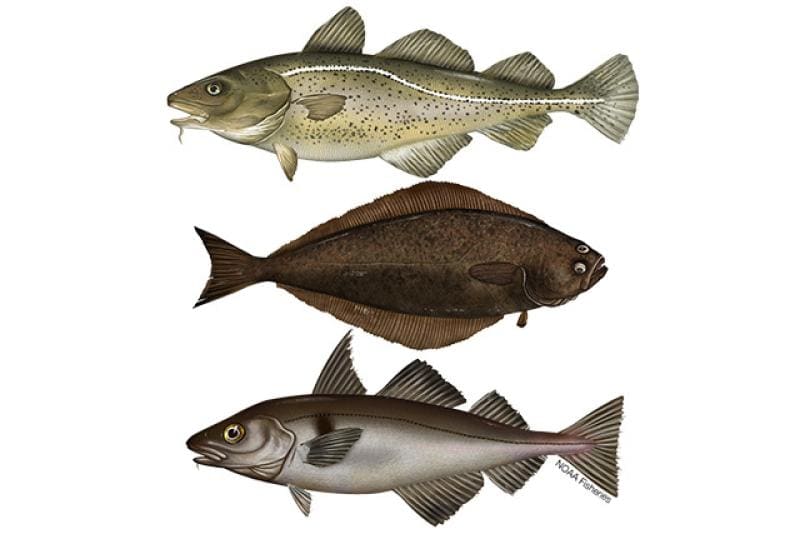
Source: Species facts, status language, and imagery adapted from the NOAA Fisheries species profile (last updated 07/01/2026). Ocean City charter and Maryland
record notes are editorial orientation for OCEANCITY.MD readers. Always confirm current seasons, sizes, and
bag limits before you fish—rules change.
The Northeast multispecies (groundfish) complex consists of 13 species:
Atlantic cod ( Gadus morhua ) Haddock ( Melanogrammus aeglefinus ) Yellowtail flounder ( Limanda ferruginea ) Pollock ( Pollachius virens ) American plaice ( Hippoglossoides platessoides) Witch flounder ( Glyptocephalus cynoglossus ) White hake ( Urophycis tenuis ) Windowpane flounder ( Scophthalmus aquosus ) Winter flounder ( Pseudopleuronectes americanus ) Acadian redfish ( Sebastes fasciatus ) Atlantic halibut ( Hippoglossus hippoglossus ) Atlantic wolffish ( Anarhichas lupus ) Ocean pout ( Macrozoarces americanus ) Groundfish are distributed throughout the Greater Atlantic region, from Cape Hatteras, North Carolina, to the U.S./Canada border. Some species of groundfish are typically found on (flounders) or near (cod, haddock) the seafloor, while others (redfish, white hake) may only spend a portion of their time near the bottom of the ocean.
The majority of the groundfish that are landed in the Greater Atlantic Region are harvested in the Gulf of Maine and on Georges Bank. Fishermen primarily use bottom trawl, sink gillnet, and hook gear to target groundfish. Historically, many of the vessels that actively fish for groundfish have hailed from ports from New Jersey to Maine. Atlantic cod, haddock, and yellowtail flounder have traditionally been the highest-value groundfish species.
Last updated by Greater Atlantic Regional Fisheries Office on 09/26/2019
Maryland record catch
Confirm whether Maryland DNR publishes an Atlantic state-record category for Northeast Multispecies (Groundfish) on the current sport-fish record board.
Northeast Multispecies (Groundfish) is a management complex, not a single fish. Use the linked NOAA profile and Maryland/federal tables for the individual stocks you actually catch.
Rule
Maryland / applicable detail
Maryland note
Complex page — verify each species you keep on DNR/NOAA tables
See the NOAA species profile for current stock status language for this entry.
Appearance
See the NOAA illustration and profile for Northeast Multispecies (Groundfish) identification characters.
Biology
See the NOAA species profile for biology notes on Northeast Multispecies (Groundfish).
Where they live
Range
See the NOAA species profile for range notes on Northeast Multispecies (Groundfish).
Habitat
See the NOAA species profile for habitat detail for this entry.
Ocean City & Mid-Atlantic context
From Ocean City, Maryland, use this Northeast Multispecies (Groundfish) profile as NOAA Mid-Atlantic directory context—not a promise you will meet the species on every charter.
Always verify current Maryland and federal size, season, and bag rules for your exact date and coordinates before you keep any catch.
Source facts and imagery are adapted from the NOAA Fisheries species profile for Northeast Multispecies (Groundfish).
What charter to book from Ocean City
Northeast Multispecies (Groundfish) is not a standard Ocean City charter harvest target. Use this profile for NOAA biology and Mid-Atlantic context only.
Not typical from OC
Bay guide — Not a typical Ocean City bay guide target for Northeast Multispecies (Groundfish).
Inshore charter — Not a typical Ocean City inshore charter target for Northeast Multispecies (Groundfish).
Casting / light tackle — Not a typical Ocean City casting / light tackle target for Northeast Multispecies (Groundfish).
Trolling charter — Not a typical Ocean City trolling charter target for Northeast Multispecies (Groundfish).
Nearshore wreck / bottom — Not a typical Ocean City nearshore wreck / bottom target for Northeast Multispecies (Groundfish).
Offshore charter — Not a typical Ocean City offshore charter target for Northeast Multispecies (Groundfish).
Head / party boat — Not a typical Ocean City head / party boat target for Northeast Multispecies (Groundfish).
Start with the charter directory trip-type picker so you compare boats inside the right
archetype—not a bay-guide quote against a canyon invoice.
This list contains a brief summary of selected management actions in the groundfish fishery. For more information about these actions, or to learn more about additional actions not mentioned in this list, please visit the New England Fishery Management Council's groundfish page .
1976 – the Magnuson-Stevens Fishery Conservation and Management Act (Magnuson-Stevens Act) is enacted to conserve and manage fishery resources in U.S. federal waters 1977 – NOAA Fisheries and the New England Fishery Management Council implement a joint groundfish plan that relies on hard quotas to manage Atlantic cod, haddock, and yellowtail flounder 1982 – the Interim Groundfish Plan replaces the joint groundfish plan and implements mesh size restrictions and minimum fish sizes to regulate fishing mortality 1986 – the Northeast Multispecies Fishery Management Plan replaces the Interim Groundfish Plan and establishes biological targets to maximize spawning potential of groundfish stocks 1987 – Amendment 1 revises the silver hake exempted fishery area, revises the large mesh area, and strengthens existing mesh size regulations 1989 – Amendment 2 cancels a scheduled increase in codend minimum mesh size requirements and implements a suite of additional effort control regulations 1989 – Amendment 3 creates the Flexible Areas Action System 1991 – Amendment 4 adds 3 species (silver hake, ocean pout, and red hake) to the groundfish management plan, implements small mesh regulations, and creates a process for the Council to recommend alterations to shrimp fishing gear 1993 – Amendment 5 establishes a moratorium on new groundfish permits, implements a days-at-sea effort reduction program, creates additional gear restrictions, implements minimum fish size restrictions, and creates a mandatory landings reporting system 1996 – The Sustainable Fisheries Act revises the Magnuson-Stevens Act, introducing additional requirements designed to prevent overfishing, rebuild overfished stocks, and protect essential fish habitat 1996 – Amendment 7 establishes target total allowable catches for regulated species, expedites the days-at-sea effort reduction program, introduces new closed areas, creates additional limited access and open access permit categories, imposes new recreational fishing regulations, and establishes the Nantucket Shoals dogfish exempted fishery 1997 – Framework Adjustment 20 sets Atlantic cod trip limits for vessels fishing north of 42°00’N , increases trip limits for Georges Bank haddock, implements additional gillnet restrictions, and modifies and adds several exempted fisheries 1998 – Framework Adjustment 24 adjusts the Atlantic cod trip limit days-at-sea provisions, enables active vessels to carry over up to 10 unused days-at-sea into the next fishing year, and implements additional regulatory exemptions for vessels fishing in the Northwest Atlantic Fisheries Organization Regulatory Area 1998 – Framework Adjustment 25 implements a suite of measures intended to reduce fishing effort on Gulf of Maine cod, including a reduced Gulf of Maine cod trip limit, additional area closures in the Gulf of Maine, and an increased Georges Bank haddock trip limit 1998 – Framework Adjustment 26 modifies the April Gulf of Maine Inshore Closure Area and adds additional inshore and offshore closures in February to protect spawning cod 1999 – Amendment 9 specifies optimum yield for regulated species and adds Atlantic halibut to the groundfish management plan 1999 – Framework Adjustment 27 implements Georges Bank cod possession limits and authorizes the Regional Administrator to make in-season adjustments to these possession limits to prevent catch from exceeding the target total allowable catch 1999 – Framework Adjustment 30 sets Georges Bank cod possession limits for vessels enrolled in the Gulf of Maine Cod Trip Limit Exemption Program 1999 – Amendment 11 identifies and describes essential fish habitat for regulated species and establishes the Small-Mesh Multispecies Fishery Management Plan 2000 – Framework Adjustment 31 increases the Gulf of Maine cod landing limits, creates an additional Gulf of Maine area closure, and restricts the use of the days-at-sea program running clock 2000 – Framework Adjustment 33 maintains the Western Gulf of Maine closed area, creates two additional conditional closure areas, maintains the Gulf of Maine and Georges Bank cod possession limits, increases the Georges Bank haddock possession limits, and implements additional recreational management measures 2003 – Framework Adjustments 37 and 38 implement a suite of additional small-mesh multispecies regulations 2004 – Framework Adjustment 39 creates Scallop Access Areas in groundfish Closed Area I, Closed Area II, and the Nantucket Lightship Closed Area 2006 – Amendment 13 establishes sector management, creates the Handgear A permit category, and implements a collection of effort reduction measures geared towards ending overfishing and rebuilding overfished stocks 2004 – Framework Adjustment 40 A implements the Regular B Days-At-Sea Program, the Closed Area I Hook Gear Haddock Special Access Program, and the Eastern U.S./Canada Haddock Special Access Program 2005 – Framework Adjustment 40 B modifies the Days-At-Sea Leasing and Transfer Programs, revises the Closed Area II Yellowtail Flounder Special Access Program, modifies the Georges Bank Cod Hook Gear Sector, updates notification requirements for the herring fishery , removes restrictions for trip gillnet vessels, and creates a days-at-sea credit for vessels standing by an entangled whale 2005 – Framework Adjustment 41 modifies the Closed Area I Hook Gear Haddock Special Access Program to allow all limited access days-at-sea groundfish vessels fishing with hook gear to participate 2006 - Framework Adjustment 42 implements a rebuilding plan for Georges Bank yellowtail flounder, adjusts rebuilding plans for 6 other stocks , and establishes measures to alleviate the socioeconomic impacts of Amendment 13 2006 – Framework Adjustment 43 implements a suite of regulations pertaining to the Atlantic herring fishery 2010 – Amendment 16 implements a collection of management measures designed to end overfishing and rebuild overfished stocks, including expanding the sector management program and establishing annual catch limits for all regulated stocks 2010 – Framework Adjustment 44 revises the pollock and Gulf of Maine cod trip limits, sets fishing year 2010-2012 specifications all groundfish stocks, and grants the Regional Administrator the authority to implement in-season measures (differential days-at-sea counting or trip limits) for any stock to prevent catch from exceeding that stock’s annual catch limit 2011 – Framework 45 modifies annual catch limits and status determination criteria for several stocks, updates monitoring requirements, establishes the Gulf of Maine Cod Spawning Protection Area, updates handgear regulations, and approves 5 new sectors 2011 – Amendment 17 approves the formation of NOAA-sponsored state permit banks 2011 – Framework 46 modifies regulations pertaining to haddock catch in the midwater trawl Atlantic herring fishery 2012 – Framework Adjustment 47 sets specifications for several groundfish stocks, modifies the definition of the Ruhle trawl, revises or modifies accountability measures for several groundfish stocks, modifies common pool management measures, and clarifies charter/party closed area regulations 2013 – Framework Adjustment 48 establishes new status determination criteria for several stocks, revises sub-annual catch limit allocations, clarifies the goals of the at-sea monitoring program, revises accountability measures for several stocks, and implements a number of additional recreational and commercial groundfish management measures 2013 – Framework Adjustment 50 sets specifications for several groundfish stocks and announces changes to Eastern U.S./Canada Area monitoring and reporting requirements 2013 – Framework Adjustment 49 implements a suite of management measures for the scallop fishery 2014 – Framework 51 establishes catch limits for regulated stocks, updates the Gulf of Maine cod and American plaice rebuilding plans, and modifies U.S./Canada Management Area regulations 2015 – Framework Adjustment 52 revises windowpane flounder accountability measures 2015 – Framework Adjustment 53 sets specifications for several groundfish stocks, revises management measures for Gulf of Maine cod, implements a process for setting default catch limits in years when management actions are delayed, and modifies sector carryover provisions 2016 – Framework Adjustment 54 modifies monkfish possession limits in the Northern and Southern Fishery Management Areas, and revises minimum mesh size requirements in the Southern Fishery Management Area 2016 – Framework Adjustment 55 sets specifications for all groundfish stocks, revises the at-sea monitoring program, adjusts the sector approval process, modifies trawl gear requirements, and implements a process for converting Eastern Georges Bank haddock quota to Western Georges Bank haddock quota 2017 – Amendment 18 implements measures to encourage fleet diversity and prevent the accumulation of excessive shares in the fishery 2017 – Framework Adjustment 56 sets catch limits for 4 groundfish stocks, allocates a northern windowpane flounder sub-ACL for the scallop fishery, modifies the Georges Bank yellowtail flounder and northern windowpane flounder accountability measures for the scallop fishery, and increases the Georges Bank haddock midwater trawl fishery sub-annual catch limit 2018 – Framework Adjustment 57 sets catch limits for all groundfish stocks, adjusts trimester total allowable catch allocations for several stocks, revises accountability measures for 3 stocks, and grants the Regional Administrator authority to make adjustments to recreational Georges Bank cod management measures 2019 – Framework Adjustment 58 sets catch limits for 7 regulated stocks, establishes or updates rebuilding plans for 5 stocks, and revises the Georges Bank yellowtail flounder accountability measure for scallop vessels 2020 – Framework Adjustment 59 sets or adjusts catch limits for 19 regulated stocks and makes minor changes to groundfish management measures. 2021 – Framework Adjustment 61 sets or adjusts catch limits for 17 regulated stocks. Additionally revises the status determination criteria for Georges Bank and Southern New England-Mid Atlantic winter flounder, implements a revised rebuilding plan for white hake, and implements a universal exemption for sectors to target Acadian redfish. 2022 – Framework Adjustment 63 sets or adjusts catch limits for 5 of the 20 multispecies (groundfish) stocks, adjusts recreational measures for Georges Bank cod, and revises the default specifications process. 2022 – Amendment 23 adjusts the industry-funded at-sea monitoring program for groundfish sectors to improve the accuracy of collected catch data (landings and discards) and catch accounting. 2023 – Framework Adjustment 65 revises the rebuilding plan for Gulf of Maine cod, sets catch limits for 16 of the 20 multispecies (groundfish) stocks, and makes a temporary modification to the accountability measures for Georges Bank cod. This action also corrects erroneous regulations and removes outdated regulations. This action also implements an emergency action to set fishing year 2023 catch limits for Gulf of Maine haddock. 2024 – Framework Adjustment 66 set catch limits for 8 of the 20 multispecies stocks, modifies the accountability measure trigger for Atlantic halibut, and makes a temporary modification to the accountability trigger for the scallop fishery for Georges Bank yellowtail flounder. 2026 – Framework Adjustment 69 implemented specifications, approved Northeast multispecies (groundfish) sectors and allocations; established recreational measures for several stocks; updated common pool possession limits; and clarified and corrected existing regulations. 2026 – Amendment 25 implements regulations to incorporate revised Atlantic cod stock units into the Northeast Multispecies Fishery Management Plan (FMP), and set status determination criteria (SDC), specifications, and commercial and recreational management measures, for the four new cod stocks, as proposed. This action also sets other recreational cod measures necessary for the fishery. Last updated by Greater Atlantic Regional Fisheries Office on 03/18/2026.
Harvest
See the NOAA wild-caught fishery section for landings and gear notes when published for this species.
Landings and management details matter most for the waters where Northeast Multispecies (Groundfish) is actually fished—see the
NOAA species profile
.