Hyperoodon ampullatus . Northern bottlenose whales are the largest members of the beaked whale family in the North Atlantic Ocean, where they prefer cold, deep, temperate to sub-arctic oceanic waters. The
Source: Species facts, status language, and imagery adapted from the NOAA Fisheries species profile (last updated 11/27/2024). Ocean City charter and Maryland
record notes are editorial orientation for OCEANCITY.MD readers. Always confirm current seasons, sizes, and
bag limits before you fish—rules change.
Length: Estimated up to 28.2 feet (females) and 36.7 feet (males)
Lifespan: At least 37 years
Region: New England/Mid-Atlantic
Category: Protected species · Mid-Atlantic
Maryland likelihood: 1★ out of 5
About the species
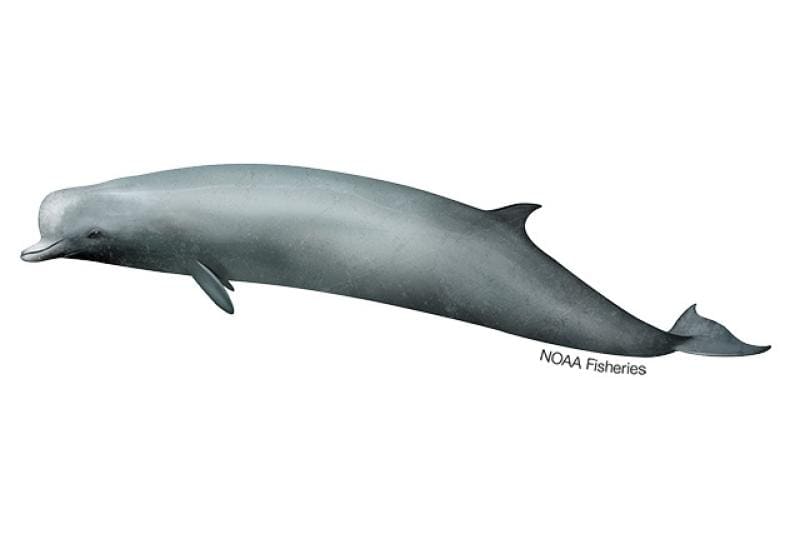
Northern bottlenose whales are the largest members of the beaked whale family in the North Atlantic Ocean, where they prefer cold, deep, temperate to sub-arctic oceanic waters. Their scientific name ( Hyperoodon ampullatus ) is derived from the Latin word ampulla for the bottle shape of their beak.
Overall, the beaked whale family is cryptic and skittish, making it difficult to distinguish between them. Northern bottlenose whales, however, are the most extensively studied of the beaked whales because they used to be heavily hunted, making carcasses available for scientists to examine.
Although they were easy targets for whalers long ago and currently face threats from human-caused noise, northern bottlenose whales in the United States are not endangered or threatened. Like all marine mammals, they are protected under the Marine Mammal Protection Act .
Maryland record catch
Confirm whether Maryland DNR publishes an Atlantic state-record category for Northern Bottlenose Whale on the current sport-fish record board.
Northern Bottlenose Whale is a protected marine species in U.S. waters. Do not harvest. This guide is biology and Ocean City context only—not a fishing target.
As adults, northern bottlenose whales can reach lengths of approximately 36.7 feet and weigh up to 16,534 pounds. Males may be slightly larger than females. Northern bottlenose whales have a large, long, robust body with a small, triangular, hooked dorsal fin that is located about two-thirds down their back. They have a distinctive, bulbous forehead (known as a melon) that is lighter in color and a well-defined, bottle-shaped beak; however, these characteristics may vary with sex and age. The melon becomes steeper and flatter as the whale ages. Adult males have a pair of relatively small, conical teeth that angle slightly forward and are visible on the tip of the lower jaw. A second pair of teeth is sometimes hidden in the gums behind the exposed pair of teeth, and 10 to 20 additional vestigial teeth can be found in the gums of the upper and lower jaw.
While at the ocean surface, northern bottlenose whales produce fairly small, bushy blows every 30 to 40 seconds that are about 3.3 feet tall and visible from a significant distance. Their coloration varies from dark gray to brownish to olive, and their skin may appear lightly mottled and covered with scars and/or other markings. The dorsal side is darker than the ventral side, giving it a counter-shading appearance. The face and melon often appear light gray to white. Mature females often have a white band around the neck.
Behavior and Diet Northern bottlenose whales are usually found individually or in social groups averaging between four and ten individuals, but they have been occasionally seen in larger groups and loose aggregations of up to 50 animals. Groups may consist of various combinations and/or be segregated depending on age, sex, or life stage. Males are known to be combative, using their large heads to hit one another. This species does not tooth rake during aggressive encounters, unlike other species of beaked whales.
Regular dives of northern bottlenose whales range from less than 10 minutes to 60 minutes, commonly reaching depths of at least 2,600 to 5,000 feet, but they are likely capable of diving and holding their breath for up to two hours. While diving, they feed near the ocean bottom mostly on deep-sea cephalopods (e.g., squid), fish (e.g., herring), shrimp, sea cucumbers, and sea stars. Juvenile animals may feed on prey closer to the surface.
Where They Live Northern bottlenose whales prefer cold, deep, temperate to sub-arctic oceanic waters usually greater than 6,500 feet. They are often associated with steep underwater geologic structures such as submarine canyons, seamounts, and continental slopes.
Northern bottlenose whales can be found throughout the North Atlantic Ocean and range from New England, Canada, Greenland, Iceland, England, and Europe up to Spitzbergen and down to the Azores and northern Africa (Canary Islands). They have been sighted from 30 degrees North to close to the ice edge in the Arctic. Scientists have conducted long-term studies of a resident group off of Nova Scotia, Canada (a large submarine canyon called the “Gully”), and strandings have occurred in the Baltic Sea, Bay of Fundy, and Rhode Island. This species can travel more than 620 miles.
Appearance
Northern bottlenose whales are usually found individually or in social groups averaging between four and ten individuals, but they have been occasionally seen in larger groups and loose aggregations of up to 50 animals. Groups may consist of various combinations and/or be segregated depending on age, sex, or life stage. Males are known to be combative, using their large heads to hit one another. This species does not tooth rake during aggressive encounters, unlike other species of beaked whales.
Regular dives of northern bottlenose whales range from less than 10 minutes to 60 minutes, commonly reaching depths of at least 2,600 to 5,000 feet, but they are likely capable of diving and holding their breath for up to two hours. While diving, they feed near the ocean bottom mostly on deep-sea cephalopods (e.g., squid), fish (e.g., herring), shrimp, sea cucumbers, and sea stars. Juvenile animals may feed on prey closer to the surface.
Where They Live Northern bottlenose whales prefer cold, deep, temperate to sub-arctic oceanic waters usually greater than 6,500 feet. They are often associated with steep underwater geologic structures such as submarine canyons, seamounts, and continental slopes.
Northern bottlenose whales can be found throughout the North Atlantic Ocean and range from New England, Canada, Greenland, Iceland, England, and Europe up to Spitzbergen and down to the Azores and northern Africa (Canary Islands). They have been sighted from 30 degrees North to close to the ice edge in the Arctic. Scientists have conducted long-term studies of a resident group off of Nova Scotia, Canada (a large submarine canyon called the “Gully”), and strandings have occurred in the Baltic Sea, Bay of Fundy, and Rhode Island. This species can travel more than 620 miles.
Lifespan & Reproduction Northern bottlenose whales reach sexual maturity between seven and 11 years. A sexually mature female will give birth to a single calf every two or more years during the spring or summer (usually between the months of April and August). Gestation lasts about 12 months. Newborn calves are about 10 to 11.5 feet in length and weigh 660 pounds. These whales have an estimated lifespan of at least 37 years.
Threats Hunting Fishermen discovered spermaceti (a waxy substance used in oil lamps, lubricants, and candles) in Northern bottlenose whales in the 1850s, which started a commercial whaling fishery for the species. The species was also hunted for pet food. Whalers exploited the curiosity and social bonds of these animals, which were often attracted to stationary vessels and stayed with wounded or injured members of their pod. The fishery closed in the 1970s. During this time, whalers killed more than 80,000 Northern bottlenose whales.
For the last several decades, northern bottlenose whales have remained unexploited, except for the animals killed in the Faroe Islands drive fishery. In Canada and Norway, these whales were hunted for meat and oil until the population was depleted.
Ocean Noise This species may be sensitive to underwater sounds and man-made noise. Deep-diving cetaceans like northern bottlenose whales use sound to feed, communicate, and navigate in the ocean. Sound pollution threatens them by interrupting their normal behavior and driving them away from areas important to their survival.
Scientific Classification Kingdom Animalia Phylum Chordata Class Mammalia Order Cetacea Family Ziphiidae Genus Hyperoodon Species ampullatus Last updated by NOAA Fisheries on 11/27/2024
Biology
Northern bottlenose whales prefer cold, deep, temperate to sub-arctic oceanic waters usually greater than 6,500 feet. They are often associated with steep underwater geologic structures such as submarine canyons, seamounts, and continental slopes.
Northern bottlenose whales can be found throughout the North Atlantic Ocean and range from New England, Canada, Greenland, Iceland, England, and Europe up to Spitzbergen and down to the Azores and northern Africa (Canary Islands). They have been sighted from 30 degrees North to close to the ice edge in the Arctic. Scientists have conducted long-term studies of a resident group off of Nova Scotia, Canada (a large submarine canyon called the “Gully”), and strandings have occurred in the Baltic Sea, Bay of Fundy, and Rhode Island. This species can travel more than 620 miles.
Lifespan & Reproduction Northern bottlenose whales reach sexual maturity between seven and 11 years. A sexually mature female will give birth to a single calf every two or more years during the spring or summer (usually between the months of April and August). Gestation lasts about 12 months. Newborn calves are about 10 to 11.5 feet in length and weigh 660 pounds. These whales have an estimated lifespan of at least 37 years.
Threats Hunting Fishermen discovered spermaceti (a waxy substance used in oil lamps, lubricants, and candles) in Northern bottlenose whales in the 1850s, which started a commercial whaling fishery for the species. The species was also hunted for pet food. Whalers exploited the curiosity and social bonds of these animals, which were often attracted to stationary vessels and stayed with wounded or injured members of their pod. The fishery closed in the 1970s. During this time, whalers killed more than 80,000 Northern bottlenose whales.
For the last several decades, northern bottlenose whales have remained unexploited, except for the animals killed in the Faroe Islands drive fishery. In Canada and Norway, these whales were hunted for meat and oil until the population was depleted.
Ocean Noise This species may be sensitive to underwater sounds and man-made noise. Deep-diving cetaceans like northern bottlenose whales use sound to feed, communicate, and navigate in the ocean. Sound pollution threatens them by interrupting their normal behavior and driving them away from areas important to their survival.
Scientific Classification Kingdom Animalia Phylum Chordata Class Mammalia Order Cetacea Family Ziphiidae Genus Hyperoodon Species ampullatus Last updated by NOAA Fisheries on 11/27/2024
Where they live
Range
Northern bottlenose whales prefer cold, deep, temperate to sub-arctic oceanic waters usually greater than 6,500 feet. They are often associated with steep underwater geologic structures such as submarine canyons, seamounts, and continental slopes.
Northern bottlenose whales can be found throughout the North Atlantic Ocean and range from New England, Canada, Greenland, Iceland, England, and Europe up to Spitzbergen and down to the Azores and northern Africa (Canary Islands). They have been sighted from 30 degrees North to close to the ice edge in the Arctic. Scientists have conducted long-term studies of a resident group off of Nova Scotia, Canada (a large submarine canyon called the “Gully”), and strandings have occurred in the Baltic Sea, Bay of Fundy, and Rhode Island. This species can travel more than 620 miles.
Habitat
See the NOAA species profile for habitat detail for this entry.
Ocean City & Mid-Atlantic context
From Ocean City, Maryland, use this Northern Bottlenose Whale profile as NOAA Mid-Atlantic directory context—not a promise you will meet the species on every charter.
Northern Bottlenose Whale is protected. Do not harvest. Report unusual strandings or entanglements through official channels.
Source facts and imagery are adapted from the NOAA Fisheries species profile for Northern Bottlenose Whale.
What charter to book from Ocean City
Northern Bottlenose Whale is not a standard Ocean City charter harvest target. Use this profile for NOAA biology and Mid-Atlantic context only.
Not typical from OC
Bay guide — Not a typical Ocean City bay guide target for Northern Bottlenose Whale.
Inshore charter — Not a typical Ocean City inshore charter target for Northern Bottlenose Whale.
Casting / light tackle — Not a typical Ocean City casting / light tackle target for Northern Bottlenose Whale.
Trolling charter — Not a typical Ocean City trolling charter target for Northern Bottlenose Whale.
Nearshore wreck / bottom — Not a typical Ocean City nearshore wreck / bottom target for Northern Bottlenose Whale.
Offshore charter — Not a typical Ocean City offshore charter target for Northern Bottlenose Whale.
Head / party boat — Not a typical Ocean City head / party boat target for Northern Bottlenose Whale.
Start with the charter directory trip-type picker so you compare boats inside the right
archetype—not a bay-guide quote against a canyon invoice.
Overseeing Marine Mammal Health and Stranding Response We work with volunteer networks in all coastal states to respond to marine mammal strandings including all whales. When stranded animals are found alive, NOAA Fisheries and our partners assess the animal’s health and determine the best course of action. When stranded animals are found dead, our scientists work to understand and investigate the cause of death. Although the cause often remains unknown, scientists can sometimes attribute strandings to disease, harmful algal blooms, vessel strikes, fishing gear entanglements, pollution exposure, and underwater noise. Some strandings can serve as indicators of ocean health, giving insight into larger environmental issues that may also have implications for human health and welfare.
Learn more about the Marine Mammal Health and Stranding Response Program
Harvest
See the NOAA wild-caught fishery section for landings and gear notes when published for this species.
Landings and management details matter most for the waters where Northern Bottlenose Whale is actually fished—see the
NOAA species profile
.