Arctica islandica , also known as Clam, Quahog, Black clam, Mahogany quahog. Ocean quahogs are distributed from Newfoundland to Cape Hatteras, NC. The U.S. fishery focuses on two regions: Maine and Long Island, New York. Dredge and hand harvest are authoriz
Source: Species facts, status language, and imagery adapted from the NOAA Fisheries species profile (last updated 06/25/2026). Ocean City charter and Maryland
record notes are editorial orientation for OCEANCITY.MD readers. Always confirm current seasons, sizes, and
bag limits before you fish—rules change.
Ocean quahogs are distributed from Newfoundland to Cape Hatteras, NC. The U.S. fishery focuses on two regions: Maine and Long Island, New York. Dredge and hand harvest are authorized in the commercial fishery, with hydraulic clam dredges being the primary gear type used. The recreational fishery is limited to hand harvest. Ocean quahogs are generally processed for human consumption in soups, chowders, and stews; while a small portion of landings are also sold in the bait market. U.S. wild-caught ocean quahog is a smart seafood choice because it is sustainably managed and responsibly harvested under U.S. regulations. Implementing regulations are found at 50 CFR part 648 subpart E.
Maryland record catch
Confirm whether Maryland DNR publishes an Atlantic state-record category for Ocean Quahog on the current sport-fish record board.
Maryland’s Atlantic recreational seasons/sizes/creel summary does not publish a dedicated line for Ocean Quahog. Verify COMAR, DNR public notices, and federal rules for your exact waters before you keep fish.
Rule
Maryland / applicable detail
Maryland minimum size
Not listed — no dedicated Ocean Quahog line on the MD Atlantic recreational table
Maryland daily creel (bag)
Not listed — no MD species-specific bag for Ocean Quahog
Maryland open season
Not listed on the MD Atlantic Ocean / Coastal Bays summary table
Verify
Check DNR eRegulations, COMAR, and NOAA for your date and coordinates before you keep fish.
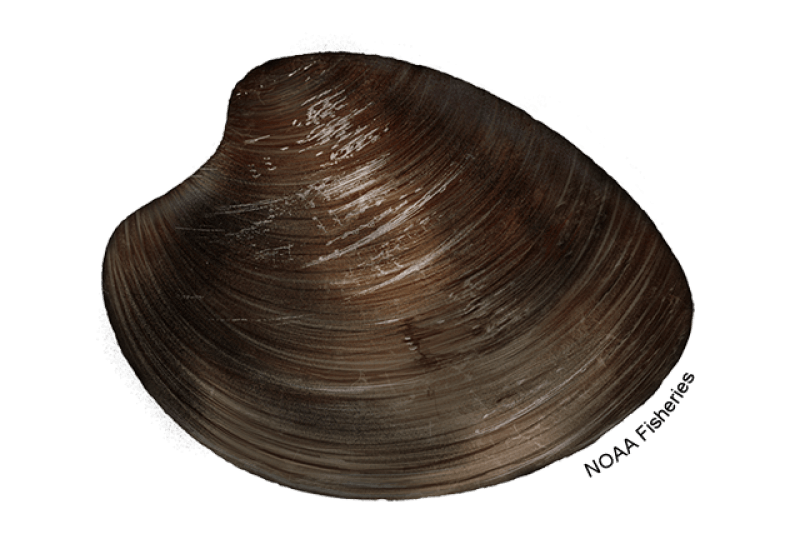
Ocean quahogs are bivalve mollusks—they have two hinged shells that enclose their body.
Shells are thick and oval-shaped.
Outside is a dull gray with growth rings that can be used to determine its age.
Interior is white with a purple border.
Most quahogs in U.S. waters are 2.8 to 4.3 inches in shell length.
Biology Ocean quahogs spawn by releasing eggs and sperm into the water column where the eggs are fertilized.
Appearance
Ocean quahogs spawn by releasing eggs and sperm into the water column where the eggs are fertilized.
Larvae drift with the currents for at least 30 days until they develop into juveniles and settle to the bottom.
Ocean quahogs spawn once a year, either in the summer or fall.
The spawning season is sometimes extended over a number of months as quahogs release eggs and sperm a little at a time.
Ocean quahogs are among the longest-lived marine organisms in the world.
East Coast, where the fishery takes place, ocean quahogs can live for at least 200 years.
They grow very slowly and do not start to reproduce until around age 6, and do not reach a commercially harvestable size until about age 20.
Ocean quahogs are filter feeders.
They bury themselves in the ocean floor and pump oxygen-filled water and food particles in through their siphons, which extend above the surface of the ocean floor.
They feed on microscopic algae.
Many animals prey on juvenile ocean quahogs, including invertebrates such as rock crabs, sea stars, and other crustaceans, and fish such as longhorn sculpin, ocean pout, haddock, and cod.
Once ocean quahogs have reached a certain size, they have a very low predation rate.
They burrow in the sandy ocean floor and their thick shells close completely, providing substantial protection from potential predators.
Where They Live Range Ocean quahogs are found in the western Atlantic as far south as Cape Hatteras, North Carolina.
Habitat Ocean quahogs live in water between 25 and 1,300 feet deep.
In the northern part of their range, they’re found in shallower water closer to shore.
The U.S. stock is almost entirely within federal waters (3 to 200 nautical miles from shore), except for a modest amount off the coast of Maine and in waters between 65 and 260 feet deep.
Ocean quahogs are rarely found where bottom water temperatures exceed 60˚ F.
Eggs and larvae are found in the water column and drift with the currents until they develop into juveniles and settle to the bottom.
Ocean quahogs burrow in a variety of sediments, especially fine sand.
Fishery Management NOAA Fisheries, the Mid-Atlantic Fishery Management Council , and state resource management agencies manage the ocean quahog fishery.
Managed under the Surfclam-Ocean Quahog Fishery Management Plan : Fishermen must have a permit for commercial harvest ocean quahogs.
Individual transferable quota ( catch shares ) program—managers set an annual catch limit for federal waters and allocate it among individual fishermen or vessel owners.
These individual quotas can be sold or leased.
Closed areas due to environmental degradation or to toxins that cause paralytic shellfish poisoning (PSP).
Fishermen harvesting ocean quahogs from Georges Bank have additional requirements under the PSP testing protocol.
Mandatory vessel monitoring systems.
Fishermen must maintain and submit logbooks of each fishing trip to document catch.
The ocean quahog fishery off Maine is managed separately because of differences in biological, fishery, and market characteristics.
The portion of this fishery in federal waters off the Maine coast is managed under a relatively small catch limit that is separate from the catch limit used to manage the rest of the quahog fishery (described above).
To participate in this fishery, vessels must have a separate limited access federal permit, use a mandatory vessel monitoring system, and maintain and submit logbooks of each fishing trip.
State authorities manage the portion of this fishery in Maine state waters.
Harvest In 2023, the ocean quahog fishery produced 12.4 million pounds of meats, valued at $8.3 million, according to the NOAA Fisheries commercial fishing landings database .
Commercial landings in 2024 are confidential due to the limited number of participants.
Commercial fishermen harvest ocean quahogs with hydraulic clam dredges, which use jets of water to dislodge ocean quahogs from the sandy ocean floor.
A smaller “dry” dredge (without hydraulic jets) is used in Maine waters.
Ocean quahogs burrow into sandy bottoms on the continental shelf, an environment that is thought to recover quickly after a hydraulic clam dredge passes over it.
The bars on commercial clam dredges are spaced several inches apart so they do not collect anything but the targeted quahogs.
The quahog fishery is managed under an individual transferable quota program that slows the pace of the fishery and increases its efficiency, significantly reducing bycatch.
Scientific Classification Kingdom Animalia Phylum Mollusca Class Bivalvia Order Venerida Family Arcticidae Genus Arctica Species islandica Last updated by NOAA Fisheries on 06/25/2026
Biology
Ocean quahogs are found in the western Atlantic as far south as Cape Hatteras, North Carolina.
Habitat Ocean quahogs live in water between 25 and 1,300 feet deep.
In the northern part of their range, they’re found in shallower water closer to shore.
The U.S. stock is almost entirely within federal waters (3 to 200 nautical miles from shore), except for a modest amount off the coast of Maine and in waters between 65 and 260 feet deep.
Ocean quahogs are rarely found where bottom water temperatures exceed 60˚ F.
Eggs and larvae are found in the water column and drift with the currents until they develop into juveniles and settle to the bottom.
Ocean quahogs burrow in a variety of sediments, especially fine sand.
Fishery Management NOAA Fisheries, the Mid-Atlantic Fishery Management Council , and state resource management agencies manage the ocean quahog fishery.
Managed under the Surfclam-Ocean Quahog Fishery Management Plan : Fishermen must have a permit for commercial harvest ocean quahogs.
Individual transferable quota ( catch shares ) program—managers set an annual catch limit for federal waters and allocate it among individual fishermen or vessel owners.
These individual quotas can be sold or leased.
Closed areas due to environmental degradation or to toxins that cause paralytic shellfish poisoning (PSP).
Fishermen harvesting ocean quahogs from Georges Bank have additional requirements under the PSP testing protocol.
Mandatory vessel monitoring systems.
Fishermen must maintain and submit logbooks of each fishing trip to document catch.
The ocean quahog fishery off Maine is managed separately because of differences in biological, fishery, and market characteristics.
The portion of this fishery in federal waters off the Maine coast is managed under a relatively small catch limit that is separate from the catch limit used to manage the rest of the quahog fishery (described above).
To participate in this fishery, vessels must have a separate limited access federal permit, use a mandatory vessel monitoring system, and maintain and submit logbooks of each fishing trip.
State authorities manage the portion of this fishery in Maine state waters.
Harvest In 2023, the ocean quahog fishery produced 12.4 million pounds of meats, valued at $8.3 million, according to the NOAA Fisheries commercial fishing landings database .
Commercial landings in 2024 are confidential due to the limited number of participants.
Commercial fishermen harvest ocean quahogs with hydraulic clam dredges, which use jets of water to dislodge ocean quahogs from the sandy ocean floor.
A smaller “dry” dredge (without hydraulic jets) is used in Maine waters.
Ocean quahogs burrow into sandy bottoms on the continental shelf, an environment that is thought to recover quickly after a hydraulic clam dredge passes over it.
The bars on commercial clam dredges are spaced several inches apart so they do not collect anything but the targeted quahogs.
The quahog fishery is managed under an individual transferable quota program that slows the pace of the fishery and increases its efficiency, significantly reducing bycatch.
Scientific Classification Kingdom Animalia Phylum Mollusca Class Bivalvia Order Venerida Family Arcticidae Genus Arctica Species islandica Last updated by NOAA Fisheries on 06/25/2026
Where they live
Range
Ocean quahogs are found in the western Atlantic as far south as Cape Hatteras, North Carolina.
Habitat Ocean quahogs live in water between 25 and 1,300 feet deep.
Habitat
NOAA Fisheries, the Mid-Atlantic Fishery Management Council , and state resource management agencies manage the ocean quahog fishery.
Managed under the Surfclam-Ocean Quahog Fishery Management Plan : Fishermen must have a permit for commercial harvest ocean quahogs.
Individual transferable quota ( catch shares ) program—managers set an annual catch limit for federal waters and allocate it among individual fishermen or vessel owners.
These individual quotas can be sold or leased.
Closed areas due to environmental degradation or to toxins that cause paralytic shellfish poisoning (PSP).
Fishermen harvesting ocean quahogs from Georges Bank have additional requirements under the PSP testing protocol.
Mandatory vessel monitoring systems.
Fishermen must maintain and submit logbooks of each fishing trip to document catch.
The ocean quahog fishery off Maine is managed separately because of differences in biological, fishery, and market characteristics.
The portion of this fishery in federal waters off the Maine coast is managed under a relatively small catch limit that is separate from the catch limit used to manage the rest of the quahog fishery (described above).
To participate in this fishery, vessels must have a separate limited access federal permit, use a mandatory vessel monitoring system, and maintain and submit logbooks of each fishing trip.
State authorities manage the portion of this fishery in Maine state waters.
Harvest In 2023, the ocean quahog fishery produced 12.4 million pounds of meats, valued at $8.3 million, according to the NOAA Fisheries commercial fishing landings database .
Commercial landings in 2024 are confidential due to the limited number of participants.
Commercial fishermen harvest ocean quahogs with hydraulic clam dredges, which use jets of water to dislodge ocean quahogs from the sandy ocean floor.
A smaller “dry” dredge (without hydraulic jets) is used in Maine waters.
Ocean quahogs burrow into sandy bottoms on the continental shelf, an environment that is thought to recover quickly after a hydraulic clam dredge passes over it.
The bars on commercial clam dredges are spaced several inches apart so they do not collect anything but the targeted quahogs.
The quahog fishery is managed under an individual transferable quota program that slows the pace of the fishery and increases its efficiency, significantly reducing bycatch.
Scientific Classification Kingdom Animalia Phylum Mollusca Class Bivalvia Order Venerida Family Arcticidae Genus Arctica Species islandica Last updated by NOAA Fisheries on 06/25/2026
Ocean City & Mid-Atlantic context
From Ocean City, Maryland, use this Ocean Quahog profile as NOAA Mid-Atlantic directory context—not a promise you will meet the species on every charter.
Always verify current Maryland and federal size, season, and bag rules for your exact date and coordinates before you keep any catch.
Source facts and imagery are adapted from the NOAA Fisheries species profile for Ocean Quahog.
What charter to book from Ocean City
Ocean Quahog is more of a bay, inshore, or specialty harvest story than a typical OC six-pack trolling day—match the trip type to the animal.
Possible / related
Bay guide — Possible overlap depending on season, water, and boat program.
Inshore charter — Possible overlap depending on season, water, and boat program.
In 2023, the ocean quahog fishery produced 12.4 million pounds of meats, valued at $8.3 million, according to the NOAA Fisheries commercial fishing landings database .
Commercial landings in 2024 are confidential due to the limited number of participants.
Commercial fishermen harvest ocean quahogs with hydraulic clam dredges, which use jets of water to dislodge ocean quahogs from the sandy ocean floor.
A smaller “dry” dredge (without hydraulic jets) is used in Maine waters.
Ocean quahogs burrow into sandy bottoms on the continental shelf, an environment that is thought to recover quickly after a hydraulic clam dredge passes over it.
The bars on commercial clam dredges are spaced several inches apart so they do not collect anything but the targeted quahogs.
The quahog fishery is managed under an individual transferable quota program that slows the pace of the fishery and increases its efficiency, significantly reducing bycatch.
Scientific Classification Kingdom Animalia Phylum Mollusca Class Bivalvia Order Venerida Family Arcticidae Genus Arctica Species islandica Last updated by NOAA Fisheries on 06/25/2026
Harvest
See the NOAA wild-caught fishery section for landings and gear notes when published for this species.
Landings and management details matter most for the waters where Ocean Quahog is actually fished—see the
NOAA species profile
.
Seafood facts
Fact
Detail
Availability
Year-round. Sold processed (minced, chopped, or cut into strips) or in chowders, bisques, and sauces. Smaller ocean quahogs from Maine waters are marketed as “mahogany clams” and are sold on the half-shell market or for steaming.
Source
U.S. wild-caught from Maine to Virginia.
Taste
A somewhat stronger taste than other clams.
Texture
Firmer than other clams.
Color
Meat is pinkish.
Health
Quahogs provide low-fat, high-quality protein and are an excellent source of selenium, iron, and vitamin B12.
After a real OC boat day or market stop for Ocean Quahog, Seafood after boat days covers
dock buffer and cook-your-catch pacing.