Carcharhinus longimanus . Oceanic whitetip sharks are large, pelagic sharks found in tropical and subtropical oceans throughout the world. They live offshore in deep water, but spend most of their time in t
Source: Species facts, status language, and imagery adapted from the NOAA Fisheries species profile (last updated 06/12/2025). Ocean City charter and Maryland
record notes are editorial orientation for OCEANCITY.MD readers. Always confirm current seasons, sizes, and
bag limits before you fish—rules change.
Region: New England/Mid-Atlantic,
Pacific Islands,
Southeast,
West Coast
Category: Shark / ray · Mid-Atlantic
Maryland likelihood: 1★ out of 5
About the species
Oceanic whitetip sharks are large, pelagic sharks found in tropical and subtropical oceans throughout the world. They live offshore in deep water, but spend most of their time in the upper part of the water column near the surface. Oceanic whitetip sharks are long-lived, late maturing, and have low to moderate productivity.
The main threat to oceanic whitetip sharks is bycatch in commercial fisheries combined with demand for its fins. They are frequently caught in pelagic longline, purse seine, and gillnet fisheries worldwide and their fins are highly valued in the international trade for shark products. As a result, their populations have declined throughout its global range. In 2018, NOAA Fisheries listed the species as threatened under the Endangered Species Act .
Maryland record catch
Confirm whether Maryland DNR publishes an Atlantic state-record category for Oceanic Whitetip Shark on the current sport-fish record board.
Maryland’s Atlantic recreational seasons/sizes/creel summary does not publish a dedicated line for Oceanic Whitetip Shark. Verify COMAR, DNR public notices, and federal rules for your exact waters before you keep fish.
Rule
Maryland / applicable detail
Maryland minimum size
Not listed — no dedicated Oceanic Whitetip Shark line on the MD Atlantic recreational table
Maryland daily creel (bag)
Not listed — no MD species-specific bag for Oceanic Whitetip Shark
Maryland open season
Not listed on the MD Atlantic Ocean / Coastal Bays summary table
Verify
Check DNR eRegulations, COMAR, and NOAA for your date and coordinates before you keep fish.
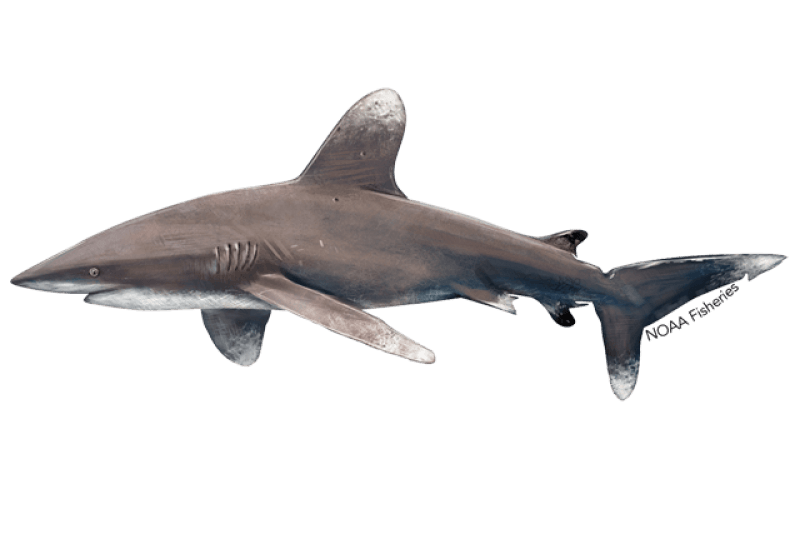
Oceanic whitetip sharks are large-bodied sharks with a stocky build, and have a distinctive pattern of mottled white markings on the tips of their dorsal, pectoral, and tail fins. These markings are why they are called “whitetip” sharks. Their dorsal fins are rounded and their pectoral fins are long and paddle-like. The color of their bodies varies depending on where they live. They are generally-grayish bronze to brown, while their undersides are whitish with some individuals having a yellow tinge.
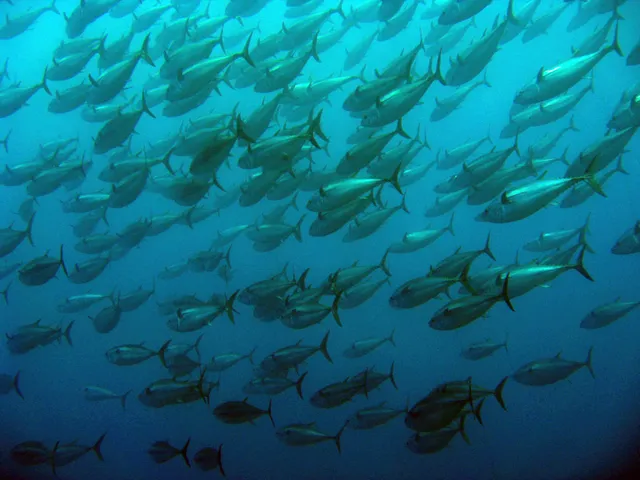
Behavior and Diet The oceanic whitetip shark is considered a top predator, eating at the top of the food chain. They are opportunistic, feeding primarily on bony fish and cephalopods, such as squid. However, they also reportedly feed on large pelagic sportfish (e.g., tuna, marlin), sea birds, other sharks and rays, marine mammals, and even garbage.
Where They Live The oceanic whitetip shark is found throughout the world in tropical and sub-tropical waters. It is a pelagic species, generally found offshore in the open ocean, on the outer continental shelf, or around oceanic islands in deep water areas. Although they can make deep dives and have been recorded in depths to 1,082 meters (3,549 feet), they typically live in the upper part of the water column, from the surface to about 200 meters (656 feet deep). Oceanic whitetip sharks have a strong preference for the surface mixed layer in warm waters above 20°C, and are therefore considered a surface-dwelling shark.
World map providing approximate representation of the oceanic whitetip shark's range Lifespan & Reproduction Generally, the maximum age of oceanic whitetip sharks is estimated to range 25-36 years.. Female oceanic whitetip sharks reach maturity between 6 and 9 years of age (depending on geographic location) and give birth to live young after a lengthy gestation period of 10 to 12 months. The reproductive cycle is thought to be biennial, with sharks giving birth on alternate years to litters ranging from 1 to 14 pups (average of 6), though some information suggests reproduction could be annual in some cases. There is also a likely correlation between female size and number of pups per litter, with larger sharks producing more offspring.
Threats Commercial Fishing and Bycatch The primary threat to the oceanic whitetip shark is incidental bycatch in commercial fisheries using longlines, purse seines, and gillnets (among other gear types). Because of their preferred distribution in warm, tropical waters, and their tendency to remain at the surface, oceanic whitetip sharks have high encounter and mortality rates in fisheries throughout their range.
Harvest for international trade Their large, distinct fins are also highly valued in the international shark fin trade.
Appearance
The oceanic whitetip shark is considered a top predator, eating at the top of the food chain. They are opportunistic, feeding primarily on bony fish and cephalopods, such as squid. However, they also reportedly feed on large pelagic sportfish (e.g., tuna, marlin), sea birds, other sharks and rays, marine mammals, and even garbage.
Where They Live The oceanic whitetip shark is found throughout the world in tropical and sub-tropical waters. It is a pelagic species, generally found offshore in the open ocean, on the outer continental shelf, or around oceanic islands in deep water areas. Although they can make deep dives and have been recorded in depths to 1,082 meters (3,549 feet), they typically live in the upper part of the water column, from the surface to about 200 meters (656 feet deep). Oceanic whitetip sharks have a strong preference for the surface mixed layer in warm waters above 20°C, and are therefore considered a surface-dwelling shark.
World map providing approximate representation of the oceanic whitetip shark's range Lifespan & Reproduction Generally, the maximum age of oceanic whitetip sharks is estimated to range 25-36 years.. Female oceanic whitetip sharks reach maturity between 6 and 9 years of age (depending on geographic location) and give birth to live young after a lengthy gestation period of 10 to 12 months. The reproductive cycle is thought to be biennial, with sharks giving birth on alternate years to litters ranging from 1 to 14 pups (average of 6), though some information suggests reproduction could be annual in some cases. There is also a likely correlation between female size and number of pups per litter, with larger sharks producing more offspring.
Threats Commercial Fishing and Bycatch The primary threat to the oceanic whitetip shark is incidental bycatch in commercial fisheries using longlines, purse seines, and gillnets (among other gear types). Because of their preferred distribution in warm, tropical waters, and their tendency to remain at the surface, oceanic whitetip sharks have high encounter and mortality rates in fisheries throughout their range.
Harvest for international trade Their large, distinct fins are also highly valued in the international shark fin trade.
Scientific Classification Kingdom Animalia Phylum Chordata Class Chondrichthyes Order Carcharhiniformes Family Carcharhinidae Genus Carcharhinus Species longimanus Last updated by NOAA Fisheries on 06/12/2025
Biology
The oceanic whitetip shark is found throughout the world in tropical and sub-tropical waters. It is a pelagic species, generally found offshore in the open ocean, on the outer continental shelf, or around oceanic islands in deep water areas. Although they can make deep dives and have been recorded in depths to 1,082 meters (3,549 feet), they typically live in the upper part of the water column, from the surface to about 200 meters (656 feet deep). Oceanic whitetip sharks have a strong preference for the surface mixed layer in warm waters above 20°C, and are therefore considered a surface-dwelling shark.
World map providing approximate representation of the oceanic whitetip shark's range Lifespan & Reproduction Generally, the maximum age of oceanic whitetip sharks is estimated to range 25-36 years.. Female oceanic whitetip sharks reach maturity between 6 and 9 years of age (depending on geographic location) and give birth to live young after a lengthy gestation period of 10 to 12 months. The reproductive cycle is thought to be biennial, with sharks giving birth on alternate years to litters ranging from 1 to 14 pups (average of 6), though some information suggests reproduction could be annual in some cases. There is also a likely correlation between female size and number of pups per litter, with larger sharks producing more offspring.
Threats Commercial Fishing and Bycatch The primary threat to the oceanic whitetip shark is incidental bycatch in commercial fisheries using longlines, purse seines, and gillnets (among other gear types). Because of their preferred distribution in warm, tropical waters, and their tendency to remain at the surface, oceanic whitetip sharks have high encounter and mortality rates in fisheries throughout their range.
Harvest for international trade Their large, distinct fins are also highly valued in the international shark fin trade.
Scientific Classification Kingdom Animalia Phylum Chordata Class Chondrichthyes Order Carcharhiniformes Family Carcharhinidae Genus Carcharhinus Species longimanus Last updated by NOAA Fisheries on 06/12/2025
Where they live
Range
The oceanic whitetip shark is found throughout the world in tropical and sub-tropical waters. It is a pelagic species, generally found offshore in the open ocean, on the outer continental shelf, or around oceanic islands in deep water areas. Although they can make deep dives and have been recorded in depths to 1,082 meters (3,549 feet), they typically live in the upper part of the water column, from the surface to about 200 meters (656 feet deep). Oceanic whitetip sharks have a strong preference for the surface mixed layer in warm waters above 20°C, and are therefore considered a surface-dwelling shark.
World map providing approximate representation of the oceanic whitetip shark's range Lifespan & Reproduction Generally, the maximum age of oceanic whitetip sharks is estimated to range 25-36 years.. Female oceanic whitetip sharks reach maturity between 6 and 9 years of age (depending on geographic location) and give birth to live young after a lengthy gestation period of 10 to 12 months. The reproductive cycle is thought to be biennial, with sharks giving birth on alternate years to litters ranging from 1 to 14 pups (average of 6), though some information suggests reproduction could be annual in some cases. There is also a likely correlation between female size and number of pups per litter, with larger sharks producing more offspring.
Habitat
See the NOAA species profile for habitat detail for this entry.
Ocean City & Mid-Atlantic context
From Ocean City, Maryland, use this Oceanic Whitetip Shark profile as NOAA Mid-Atlantic directory context—not a promise you will meet the species on every charter.
Always verify current Maryland and federal size, season, and bag rules for your exact date and coordinates before you keep any catch.
Source facts and imagery are adapted from the NOAA Fisheries species profile for Oceanic Whitetip Shark.
What charter to book from Ocean City
Oceanic Whitetip Shark may show on Ocean City shark, wreck, or offshore days depending on season and permits—confirm HMS/state rules before you book or keep fish.
Possible / related
Inshore charter — Possible overlap depending on season, water, and boat program.
Recovery Action Under the ESA, NOAA Fisheries must develop and implement recovery plans for the conservation and survival of listed species. The ultimate goal of each plan is to recover the species to the point at which it no longer requires the protections of the ESA and can be delisted.
We developed the Oceanic Whitetip Shark Recovery Plan based on available data and scientific literature, as well as input provided at two recovery planning workshops for the oceanic whitetip shark—one on April 23-24, 2019 in Honolulu, Hawaiߵi, and another on November 13 and 14, 2019 in Miami, Florida. The purpose of these workshops was to gather information, facts, and perspectives on how to recover the oceanic whitetip shark, including identifying potential recovery criteria and actions to address ongoing threats to the oceanic whitetip shark. Participants included federal and state agencies, scientific experts, commercial fishermen, conservation partners, and non-governmental organizations.
Recovery Planning Workshop Agenda - Honolulu, Hawaiߵi (PDF, 3 page) Recovery Planning Workshop Summary - Honolulu, Hawaiߵi (PDF, 18 pages) Recovery Planning Workshop Agenda - Miami, Florida (PDF, 3 pages) Recovery Planning Workshop Summary - Miami, Florida (PDF, 21 pages) We adopted the final Oceanic Whitetip Shark Recovery Plan in July 2024. The plan recommends the following major actions:
Improve knowledge and understanding of oceanic whitetip shark population status, abundance trends, and genetic structure. Improve knowledge and understanding of oceanic whitetip shark distribution, movement, and habitat use. Improve knowledge and understanding of the demographics and life history of oceanic whitetip sharks. Minimize fisheries bycatch and mortality of oceanic whitetip sharks by determining and addressing the frequency of capture and severity of fishing interactions in commercial, artisanal, and recreational fisheries. Minimize fisheries bycatch and mortality of oceanic whitetip sharks in international fisheries and trade through enhanced international coordination and collaboration with relevant international organizations, such as Regional Fishery Management Organizations (RFMOs). Determine the effects of the international shark fin trade on oceanic whitetip shark populations in all management units, and take management actions to minimize, and/or eliminate if necessary, the amount of oceanic whitetip shark fins in trade. Improve species-specific monitoring and reporting of oceanic whitetip sharks in commercial and artisanal fisheries by RFMOs and individual countries to provide a better understanding of the effects of illegal, unreported, and unregulated (IUU) fishing, improve estimates of catch and discards, and measure progress towards recovery. Minimize fishing mortality of oceanic whitetip sharks through effective development, implementation, and enforcement of international and domestic measures, such as legislation and regulations. Develop and implement outreach and education strategies and programs to increase public and stakeholder (including fishermen) awareness on the status and recovery needs of the oceanic whitetip shark. Learn more about the Oceanic Whitetip Shark Recovery Plan
Learn more about oceanic whitetip shark biology, ecology, status, and threats
Implementation The Recovery Implementation Strategy is a flexible, operational document that steps-down the recovery actions in the recovery plan into more specifically defined activities that implement and support the recovery actions. The Recovery Implementation Strategy is intended to assist NOAA Fisheries and other stakeholders in planning and implementing activities to carry out the recovery actions in the recovery plan. The activities identified in the Recovery Implementation Strategy can be modified and adapted over time based on the progress of recovery and the availability of resources or new data or literature.
Learn more about the Oceanic Whitetip Shark Recovery Implementation Strategy >
Recovery Contacts Kristen Koyama , Oceanic Whitetip Shark Recovery Coordinator
Harvest
See the NOAA wild-caught fishery section for landings and gear notes when published for this species.
Landings and management details matter most for the waters where Oceanic Whitetip Shark is actually fished—see the
NOAA species profile
.