Lampris guttatus, Lampris spp. , also known as Moonfish. U.S. wild-caught opah is a smart seafood choice because it is sustainably managed and responsibly harvested under U.S. regulations.
Source: Species facts, status language, and imagery adapted from the NOAA Fisheries species profile (last updated 06/26/2026). Ocean City charter and Maryland
record notes are editorial orientation for OCEANCITY.MD readers. Always confirm current seasons, sizes, and
bag limits before you fish—rules change.
Maryland’s Atlantic recreational seasons/sizes/creel summary does not publish a dedicated line for Opah. Verify COMAR, DNR public notices, and federal rules for your exact waters before you keep fish.
Rule
Maryland / applicable detail
Maryland minimum size
Not listed — no dedicated Opah line on the MD Atlantic recreational table
Maryland daily creel (bag)
Not listed — no MD species-specific bag for Opah
Maryland open season
Not listed on the MD Atlantic Ocean / Coastal Bays summary table
Verify
Check DNR eRegulations, COMAR, and NOAA for your date and coordinates before you keep fish.
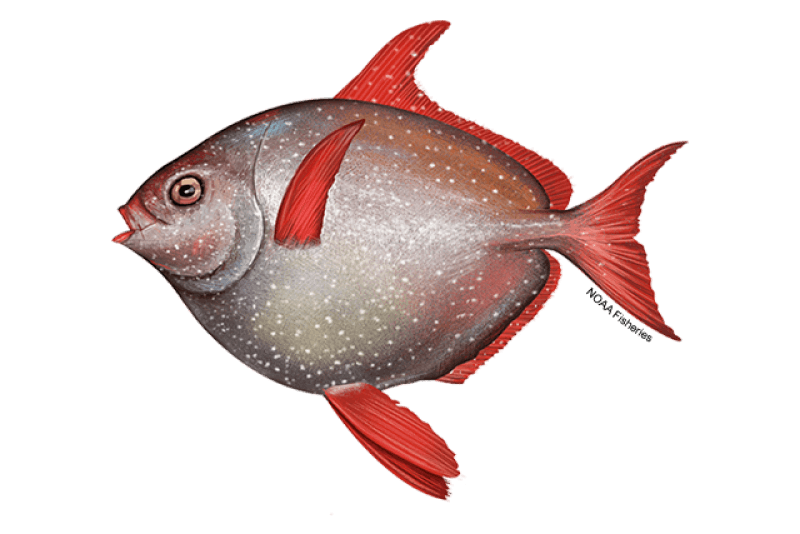
Opah are an unusual looking fish—they have a round, flat body that’s silvery gray in color.
Toward the belly, the silver shades to a rose red, dotted with white spots.
Their fins and mouth are red, and their large eyes are encircled with gold.
Biology Because opah are not a major commercial seafood species and they live in the deep ocean, scientists know very little about their biology and ecology.
Scientists assume opah share general characteristics with other Pacific Ocean pelagic fish.
Scientists estimate that opah grow quickly.
Appearance
Because opah are not a major commercial seafood species and they live in the deep ocean, scientists know very little about their biology and ecology.
Scientists assume opah share general characteristics with other Pacific Ocean pelagic fish.
Scientists estimate that opah grow quickly.
Although they’re not sure of opah’s exact life span, scientists age opah by their fin rays, assuming fin ray marks are formed annually.
Most opah caught in longline fisheries are estimated to be between 1 and 6 years old.
They average about 100 pounds with a diameter of 3 feet.
Opah spawn in warm surface waters throughout the year in the tropics and more seasonally in cooler waters.
Opah seem to be very productive, potentially spawning many times throughout the spawning season.
Opah are capable of traveling long distances, often in response to changing oceanic conditions such as temperature.
Where They Live Range Opah are found in tropical and temperate waters around the world.
Habitat Opah live in deep open ocean waters.
Fishery Management NOAA Fisheries and the Western Pacific Fishery Management Council manage this fishery in the Pacific Islands.
Managed under the Fishery Ecosystem Plan for the Pelagic Fisheries of the Western Pacific : No management measures specifically apply to opah.
However, general management measures apply to the fisheries that harvest opah.
Fishermen are required to have permits and record their catch.
Gear restrictions and operational requirements to minimize bycatch and potential gear conflicts among different fisheries.
A limit on the number of permits for Hawaii and American Samoa longline fisheries controls participation in the fishery.
Longline fishing is prohibited in some areas to protect endangered Hawaiian monk seals, reduce conflicts between fishermen, and prevent localized stock depletion (when a large quantity of fish are removed from an area).
These zones are enforced through the NOAA Fisheries vessel monitoring system program (longline boats must be equipped with a satellite transponder that provides real-time position updates and tracks vessel movements).
Hawaii- and American Samoa–based longline vessels must carry onboard observers when requested by NOAA Fisheries, in part to record interactions with sea turtles, seabirds, and marine mammals.
Annual training in safe handling and release techniques for protected species is required, and all vessels must carry and use specific equipment for handling and releasing these animals.
Harvest Commercial fishery: In 2021, commercial landings of opah in Hawaii totaled 460,000 pounds and were valued at $1.8 million, according to the NOAA Fisheries commercial fishing landings database .
While there is no directed fishery for opah, they are harvested in small but significant quantities.
U.S. fishermen catch them incidentally in tuna and swordfish fisheries around the U.S.
Pacific Islands and off southern California.
Gear types, habitat impacts, and bycatch: In Hawaii, opah are caught using longlines set deep below the surface to target bigeye tuna.
Off California, they're taken incidentally in the California drift gillnet fishery targeting swordfish.
Recreational fishery: Although not commonly caught, opah are prized by deepwater recreational anglers for their unique colors and light flavor.
Scientific Classification Kingdom Animalia Phylum Chordata Class Actinopterygii Order Lampriformes Family Lampridae Genus Lampris Species guttatus Last updated by NOAA Fisheries on 06/26/2026
Biology
Opah are found in tropical and temperate waters around the world.
Habitat Opah live in deep open ocean waters.
Fishery Management NOAA Fisheries and the Western Pacific Fishery Management Council manage this fishery in the Pacific Islands.
Managed under the Fishery Ecosystem Plan for the Pelagic Fisheries of the Western Pacific : No management measures specifically apply to opah.
However, general management measures apply to the fisheries that harvest opah.
Fishermen are required to have permits and record their catch.
Gear restrictions and operational requirements to minimize bycatch and potential gear conflicts among different fisheries.
A limit on the number of permits for Hawaii and American Samoa longline fisheries controls participation in the fishery.
Longline fishing is prohibited in some areas to protect endangered Hawaiian monk seals, reduce conflicts between fishermen, and prevent localized stock depletion (when a large quantity of fish are removed from an area).
These zones are enforced through the NOAA Fisheries vessel monitoring system program (longline boats must be equipped with a satellite transponder that provides real-time position updates and tracks vessel movements).
Hawaii- and American Samoa–based longline vessels must carry onboard observers when requested by NOAA Fisheries, in part to record interactions with sea turtles, seabirds, and marine mammals.
Annual training in safe handling and release techniques for protected species is required, and all vessels must carry and use specific equipment for handling and releasing these animals.
Harvest Commercial fishery: In 2021, commercial landings of opah in Hawaii totaled 460,000 pounds and were valued at $1.8 million, according to the NOAA Fisheries commercial fishing landings database .
While there is no directed fishery for opah, they are harvested in small but significant quantities.
U.S. fishermen catch them incidentally in tuna and swordfish fisheries around the U.S.
Pacific Islands and off southern California.
Gear types, habitat impacts, and bycatch: In Hawaii, opah are caught using longlines set deep below the surface to target bigeye tuna.
Off California, they're taken incidentally in the California drift gillnet fishery targeting swordfish.
Recreational fishery: Although not commonly caught, opah are prized by deepwater recreational anglers for their unique colors and light flavor.
Scientific Classification Kingdom Animalia Phylum Chordata Class Actinopterygii Order Lampriformes Family Lampridae Genus Lampris Species guttatus Last updated by NOAA Fisheries on 06/26/2026
Where they live
Range
Opah are found in tropical and temperate waters around the world.
Habitat Opah live in deep open ocean waters.
Habitat
NOAA Fisheries and the Western Pacific Fishery Management Council manage this fishery in the Pacific Islands.
Managed under the Fishery Ecosystem Plan for the Pelagic Fisheries of the Western Pacific : No management measures specifically apply to opah.
However, general management measures apply to the fisheries that harvest opah.
Fishermen are required to have permits and record their catch.
Gear restrictions and operational requirements to minimize bycatch and potential gear conflicts among different fisheries.
A limit on the number of permits for Hawaii and American Samoa longline fisheries controls participation in the fishery.
Longline fishing is prohibited in some areas to protect endangered Hawaiian monk seals, reduce conflicts between fishermen, and prevent localized stock depletion (when a large quantity of fish are removed from an area).
These zones are enforced through the NOAA Fisheries vessel monitoring system program (longline boats must be equipped with a satellite transponder that provides real-time position updates and tracks vessel movements).
Hawaii- and American Samoa–based longline vessels must carry onboard observers when requested by NOAA Fisheries, in part to record interactions with sea turtles, seabirds, and marine mammals.
Annual training in safe handling and release techniques for protected species is required, and all vessels must carry and use specific equipment for handling and releasing these animals.
Harvest Commercial fishery: In 2021, commercial landings of opah in Hawaii totaled 460,000 pounds and were valued at $1.8 million, according to the NOAA Fisheries commercial fishing landings database .
While there is no directed fishery for opah, they are harvested in small but significant quantities.
U.S. fishermen catch them incidentally in tuna and swordfish fisheries around the U.S.
Pacific Islands and off southern California.
Gear types, habitat impacts, and bycatch: In Hawaii, opah are caught using longlines set deep below the surface to target bigeye tuna.
Off California, they're taken incidentally in the California drift gillnet fishery targeting swordfish.
Recreational fishery: Although not commonly caught, opah are prized by deepwater recreational anglers for their unique colors and light flavor.
Scientific Classification Kingdom Animalia Phylum Chordata Class Actinopterygii Order Lampriformes Family Lampridae Genus Lampris Species guttatus Last updated by NOAA Fisheries on 06/26/2026
Ocean City & Mid-Atlantic context
From Ocean City, Maryland, use this Opah profile as NOAA Mid-Atlantic directory context—not a promise you will meet the species on every charter.
Always verify current Maryland and federal size, season, and bag rules for your exact date and coordinates before you keep any catch.
Source facts and imagery are adapted from the NOAA Fisheries species profile for Opah.
What charter to book from Ocean City
Opah may appear on Ocean City trips depending on season and habitat—use the NOAA biology below and book the charter archetype that matches how you will actually fish.
Possible / related
Bay guide — Possible overlap depending on season, water, and boat program.
Inshore charter — Possible overlap depending on season, water, and boat program.
Commercial fishery: In 2021, commercial landings of opah in Hawaii totaled 460,000 pounds and were valued at $1.8 million, according to the NOAA Fisheries commercial fishing landings database .
While there is no directed fishery for opah, they are harvested in small but significant quantities.
U.S. fishermen catch them incidentally in tuna and swordfish fisheries around the U.S.
Pacific Islands and off southern California.
Gear types, habitat impacts, and bycatch: In Hawaii, opah are caught using longlines set deep below the surface to target bigeye tuna.
Off California, they're taken incidentally in the California drift gillnet fishery targeting swordfish.
Recreational fishery: Although not commonly caught, opah are prized by deepwater recreational anglers for their unique colors and light flavor.
Scientific Classification Kingdom Animalia Phylum Chordata Class Actinopterygii Order Lampriformes Family Lampridae Genus Lampris Species guttatus Last updated by NOAA Fisheries on 06/26/2026
Harvest
See the NOAA wild-caught fishery section for landings and gear notes when published for this species.
Landings and management details matter most for the waters where Opah is actually fished—see the
NOAA species profile
.
Seafood facts
Fact
Detail
Sustainability
U.S. wild-caught opah is a smart seafood choice because it is sustainably managed and responsibly harvested under U.S. regulations.
Availability
Year-round, but landings seem to peak from April through August.
Source
U.S. wild-caught from Hawaii, California, and surrounding high seas.
Taste
Opah has a rich, creamy taste. The flavor is distinctive, a cross between tuna and swordfish.
Texture
Firm and fatty with large flakes.
Color
Raw flesh ranges from dark red to orange to pink, and turns white when cooked.
Health
Opah is a rich source of omega-3s, protein, niacin, vitamins B6 and B12, phosphorus, and selenium. It is also low in sodium.
After a real OC boat day or market stop for Opah, Seafood after boat days covers
dock buffer and cook-your-catch pacing.