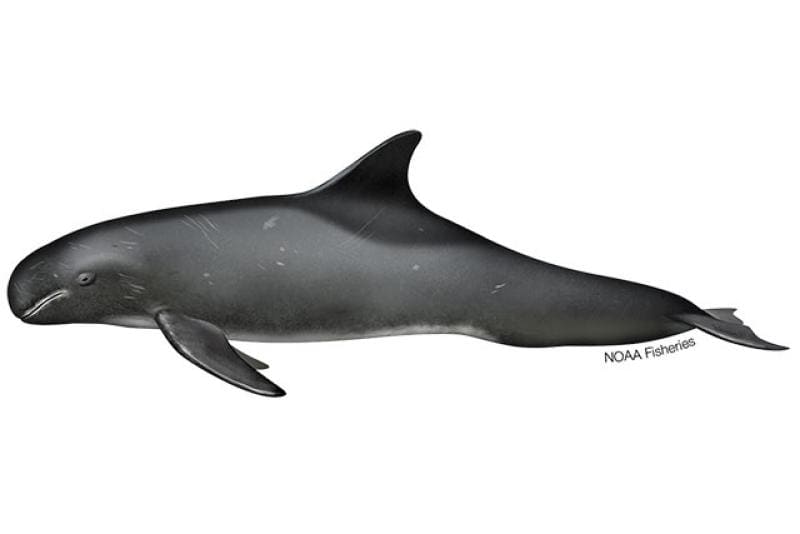
Feresa attenuata . Despite its common name, the pygmy killer whale is a small member of the oceanic dolphin family. They are often confused with false killer whales and melon-headed whales. This spec
Source: Species facts, status language, and imagery adapted from the NOAA Fisheries species profile (last updated 02/12/2026). Ocean City charter and Maryland
record notes are editorial orientation for OCEANCITY.MD readers. Always confirm current seasons, sizes, and
bag limits before you fish—rules change.
Region: New England/Mid-Atlantic,
Pacific Islands,
Southeast
Category: Protected species · Mid-Atlantic
Maryland likelihood: 1★ out of 5
About the species
Despite its common name, the pygmy killer whale is a small member of the oceanic dolphin family. They are often confused with false killer whales and melon-headed whales. This species is found primarily in deep waters throughout tropical and subtropical areas of the world. Until a live animal was discovered in 1954, pygmy killer whales were known only from two fossil skulls for over a century. Very little information is known about this species, and they are considered naturally rare.
Although they face threats from entanglement in fishing gear, pygmy killer whales in the United States are not endangered or threatened. Like all marine mammals, they are protected under the Marine Mammal Protection Act .
Maryland record catch
Confirm whether Maryland DNR publishes an Atlantic state-record category for Pygmy Killer Whale on the current sport-fish record board.
Pygmy Killer Whale is a protected marine species in U.S. waters. Do not harvest. This guide is biology and Ocean City context only—not a fishing target.
Pygmy killer whales can reach a length of 8.5 feet and weigh up to 496 pounds. They are about 2.6 feet long as newborns and reach adulthood at 6.5 feet. They have a small head with a rounded melon (or forehead) that extends in front of the mouth, and they have no discernable rostrum. Their dorsal fin is relatively large and tall and is located behind the mid-back. They have relatively long, pointed, tapering flippers (pectoral fins), and their body is dark gray to black. Their most distinctive features are some small white areas on the lips and belly. They have a fairly prominent, narrow cape that dips only slightly below the dorsal fin and a light gray ventral band.
Pygmy killer whales are easily confused with melon-headed whales because of their similar appearance. The best ways to distinguish between the two species are the pygmy killer whale’s frequent paired white tooth rakes, and the clear demarcation between the pygmy killer whale’s darker cape and lighter lateral pigmentation.
Behavior and Diet Pygmy killer whales usually occur in groups of 12 to 50 individuals but have been seen in groups up to several hundred individuals. Both sexes may remain in their birth groups throughout their lives. They are generally less active than other oceanic dolphins and are frequently seen "logging"—resting in groups at the surface with all animals oriented the same way.
Where They Live Pygmy killer whales prefer deeper areas of warmer tropical and subtropical waters where their prey is concentrated. They have a circumglobal range from 40º North to 35º South. They may occasionally occur relatively close to shore around oceanic islands. In the United States, they can be found in Hawai‘i, the northern Gulf of America, and the western North Atlantic. In Hawaiߵi, there are resident populations off Oߵahu, Penguin Bank, and Hawaiߵi Island.
Lifespan & Reproduction Reproductive biology is poorly known in this species. Its estimated lifespan is unknown.
Threats Entanglement Pygmy killer whales can become entangled or captured in commercial fishing gear, such as gillnets, though there is no reported bycatch from U.S. fisheries.
Appearance
Pygmy killer whales usually occur in groups of 12 to 50 individuals but have been seen in groups up to several hundred individuals. Both sexes may remain in their birth groups throughout their lives. They are generally less active than other oceanic dolphins and are frequently seen "logging"—resting in groups at the surface with all animals oriented the same way.
Where They Live Pygmy killer whales prefer deeper areas of warmer tropical and subtropical waters where their prey is concentrated. They have a circumglobal range from 40º North to 35º South. They may occasionally occur relatively close to shore around oceanic islands. In the United States, they can be found in Hawai‘i, the northern Gulf of America, and the western North Atlantic. In Hawaiߵi, there are resident populations off Oߵahu, Penguin Bank, and Hawaiߵi Island.
Lifespan & Reproduction Reproductive biology is poorly known in this species. Its estimated lifespan is unknown.
Threats Entanglement Pygmy killer whales can become entangled or captured in commercial fishing gear, such as gillnets, though there is no reported bycatch from U.S. fisheries.
Ocean Noise Underwater noise pollution can interrupt the normal behavior of pygmy killer whales, which rely on sound to communicate. As ocean noise increases from human sources, communication space decreases—the whales cannot hear each other, or discern other signals in their environment as they do in an undisturbed ocean.
Sound can disturb important activities, such as feeding, migrating, and socializing. Scientific research has documented that ocean noise also causes marine mammals to change the frequency or amplitude of their calls, decrease foraging behavior, become displaced from preferred habitat, or increase the level of stress hormones in their bodies. If loud enough, noise can cause temporary or permanent hearing loss.
Scientific Classification Kingdom Animalia Phylum Chordata Class Mammalia Order Cetacea Family Delphinidae Genus Feresa Species attenuata Last updated by NOAA Fisheries on 02/12/2026
Biology
Pygmy killer whales prefer deeper areas of warmer tropical and subtropical waters where their prey is concentrated. They have a circumglobal range from 40º North to 35º South. They may occasionally occur relatively close to shore around oceanic islands. In the United States, they can be found in Hawai‘i, the northern Gulf of America, and the western North Atlantic. In Hawaiߵi, there are resident populations off Oߵahu, Penguin Bank, and Hawaiߵi Island.
Lifespan & Reproduction Reproductive biology is poorly known in this species. Its estimated lifespan is unknown.
Threats Entanglement Pygmy killer whales can become entangled or captured in commercial fishing gear, such as gillnets, though there is no reported bycatch from U.S. fisheries.
Ocean Noise Underwater noise pollution can interrupt the normal behavior of pygmy killer whales, which rely on sound to communicate. As ocean noise increases from human sources, communication space decreases—the whales cannot hear each other, or discern other signals in their environment as they do in an undisturbed ocean.
Sound can disturb important activities, such as feeding, migrating, and socializing. Scientific research has documented that ocean noise also causes marine mammals to change the frequency or amplitude of their calls, decrease foraging behavior, become displaced from preferred habitat, or increase the level of stress hormones in their bodies. If loud enough, noise can cause temporary or permanent hearing loss.
Scientific Classification Kingdom Animalia Phylum Chordata Class Mammalia Order Cetacea Family Delphinidae Genus Feresa Species attenuata Last updated by NOAA Fisheries on 02/12/2026
Where they live
Range
Pygmy killer whales prefer deeper areas of warmer tropical and subtropical waters where their prey is concentrated. They have a circumglobal range from 40º North to 35º South. They may occasionally occur relatively close to shore around oceanic islands. In the United States, they can be found in Hawai‘i, the northern Gulf of America, and the western North Atlantic. In Hawaiߵi, there are resident populations off Oߵahu, Penguin Bank, and Hawaiߵi Island.
Lifespan & Reproduction Reproductive biology is poorly known in this species. Its estimated lifespan is unknown.
Habitat
See the NOAA species profile for habitat detail for this entry.
Ocean City & Mid-Atlantic context
From Ocean City, Maryland, use this Pygmy Killer Whale profile as NOAA Mid-Atlantic directory context—not a promise you will meet the species on every charter.
Pygmy Killer Whale is protected. Do not harvest. Report unusual strandings or entanglements through official channels.
Source facts and imagery are adapted from the NOAA Fisheries species profile for Pygmy Killer Whale.
What charter to book from Ocean City
Pygmy Killer Whale is not a standard Ocean City charter harvest target. Use this profile for NOAA biology and Mid-Atlantic context only.
Not typical from OC
Bay guide — Not a typical Ocean City bay guide target for Pygmy Killer Whale.
Inshore charter — Not a typical Ocean City inshore charter target for Pygmy Killer Whale.
Casting / light tackle — Not a typical Ocean City casting / light tackle target for Pygmy Killer Whale.
Trolling charter — Not a typical Ocean City trolling charter target for Pygmy Killer Whale.
Nearshore wreck / bottom — Not a typical Ocean City nearshore wreck / bottom target for Pygmy Killer Whale.
Offshore charter — Not a typical Ocean City offshore charter target for Pygmy Killer Whale.
Head / party boat — Not a typical Ocean City head / party boat target for Pygmy Killer Whale.
Start with the charter directory trip-type picker so you compare boats inside the right
archetype—not a bay-guide quote against a canyon invoice.
Reducing Interactions with Fishing Gear Pygmy killer whales can be entangled or caught as bycatch in fishing gear, such as gillnets. NOAA Fisheries is committed to minimizing bycatch in U.S. fisheries to ensure they remain sustainable and to protect species such as the pygmy killer whale.
Learn more about bycatch and fisheries interactions
Overseeing Marine Mammal Health and Stranding Response We work with volunteer networks in all coastal states to respond to marine mammal strandings including all whales. When stranded animals are found alive, NOAA Fisheries and our partners assess the animal’s health and determine the best course of action. When stranded animals are found dead, our scientists work to understand and investigate the cause of death. Although the cause often remains unknown, scientists can sometimes attribute strandings to disease, harmful algal blooms, vessel strikes, fishing gear entanglements, pollution exposure, and underwater noise. Some strandings can serve as indicators of ocean health, giving insight into larger environmental issues that may also have implications for human health and welfare.
Learn more about the Marine Mammal Health and Stranding Response Program
Marine Mammal Unusual Mortality Events Pygmy killer whales have never been part of a declared unusual mortality event. Under the Marine Mammal Protection Act , an unusual mortality event is defined as "a stranding that is unexpected; involves a significant die-off of any marine mammal population; and demands immediate response." To understand the health of marine mammal populations, scientists study unusual mortality events.
Addressing Ocean Noise Increasing evidence suggests that exposure to intense underwater sound in some settings may cause some cetaceans to strand and ultimately die. NOAA Fisheries is investigating all aspects of acoustic communication and hearing in marine animals, as well as the effects of sound on behavior and hearing. In 2016, we issued marine mammal acoustic technical guidance for assessing the effects of anthropogenic sound on marine mammal hearing.
Regulatory History Pygmy killer whales are protected under the MMPA.
Harvest
See the NOAA wild-caught fishery section for landings and gear notes when published for this species.
Landings and management details matter most for the waters where Pygmy Killer Whale is actually fished—see the
NOAA species profile
.