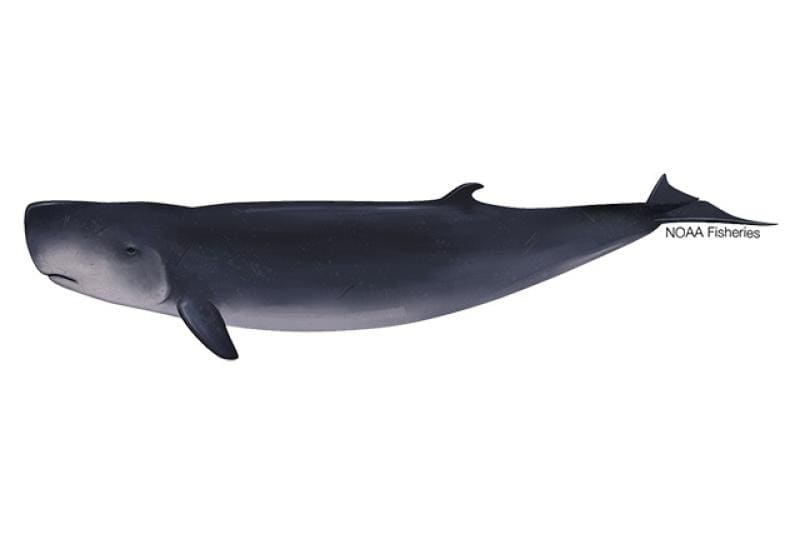
Kogia breviceps . Pygmy sperm whales are toothed whales named after the waxy substance—spermaceti—found in their heads. The spermaceti is an oil sac that helps the whales focus sound. Like squid, py
Source: Species facts, status language, and imagery adapted from the NOAA Fisheries species profile (last updated 02/12/2026). Ocean City charter and Maryland
record notes are editorial orientation for OCEANCITY.MD readers. Always confirm current seasons, sizes, and
bag limits before you fish—rules change.
Region: New England/Mid-Atlantic,
Pacific Islands,
Southeast,
West Coast
Category: Protected species · Mid-Atlantic
Maryland likelihood: 1★ out of 5
About the species
Pygmy sperm whales are toothed whales named after the waxy substance—spermaceti—found in their heads. The spermaceti is an oil sac that helps the whales focus sound. Like squid, pygmy sperm whales can produce a dark, ink-like liquid that helps them escape from predators.
Pygmy sperm whales are found in temperate and tropical seas worldwide. They look very similar to dwarf sperm whales , making it very difficult to distinguish between the two species in the field. Both species are poorly known due to the limited availability of information and their cryptic appearance at sea.
Pygmy sperm whales, like all marine mammals, are protected under the Marine Mammal Protection Act . NOAA Fisheries and its partners are working to conserve pygmy sperm whales and further our understanding of this species through research and conservation activities.
Maryland record catch
Confirm whether Maryland DNR publishes an Atlantic state-record category for Pygmy Sperm Whale on the current sport-fish record board.
Pygmy Sperm Whale is a protected marine species in U.S. waters. Do not harvest. This guide is biology and Ocean City context only—not a fishing target.
Pygmy sperm whales have a small, compact body with a small and rounded dorsal fin. Each individual whale’s dorsal fin is a slightly different shape. While on the water’s surface, pygmy sperm whales have a low profile because their head and back are somewhat flat. Their head is sometimes described as shark-like because of their pointed snout and narrow, underslung lower jaw.
Pygmy sperm whales have wrinkled skin and a brown to blue-gray back. Their underside is paler with white or pink tones. They do not have teeth in their upper jaw but have 10 to 16 pairs of teeth in the lower jaw. Their eyes are dark and bulging, and they have a marking behind the eye that is often called a false gill because it looks like a fish's gill cover or slit.
Pygmy sperm whales can sometimes be confused with dwarf sperm whales , their closest relative. These two types of whales were not distinguished as separate species until 1966. In the wild, it is very difficult to distinguish between them because they have similar appearances, behavior, and geographic ranges.
Behavior and Diet Pygmy sperm whales are usually seen either alone or in small groups of six to seven individuals. These groups can vary based on age and sex, but little else is known about their social organization.
Pygmy sperm whales spend very little time at the water’s surface and almost never approach vessels. When they are seen at the surface, they are usually either swimming slowly or lying still (also known as “logging”). They will slowly sink and disappear from view without showing their flukes before diving back into the water. While they do have a blowhole, they do not have a visible blow at the surface.
Pygmy sperm whales’ use of the "squid tactic" makes them unique among other types of whales except dwarf sperm whales. Each pygmy sperm whale has a sac filled with dark liquid in its intestine. The whale can release more than 3 gallons of dark, reddish-brown liquid, or “ink,” from this sac. The liquid creates a dark cloud in the water to help protect the whales when they feel threatened or are trying to escape predators.
Appearance
Pygmy sperm whales are usually seen either alone or in small groups of six to seven individuals. These groups can vary based on age and sex, but little else is known about their social organization.
Pygmy sperm whales spend very little time at the water’s surface and almost never approach vessels. When they are seen at the surface, they are usually either swimming slowly or lying still (also known as “logging”). They will slowly sink and disappear from view without showing their flukes before diving back into the water. While they do have a blowhole, they do not have a visible blow at the surface.
Pygmy sperm whales’ use of the "squid tactic" makes them unique among other types of whales except dwarf sperm whales. Each pygmy sperm whale has a sac filled with dark liquid in its intestine. The whale can release more than 3 gallons of dark, reddish-brown liquid, or “ink,” from this sac. The liquid creates a dark cloud in the water to help protect the whales when they feel threatened or are trying to escape predators.
Pygmy sperm whales can dive at least 1,000 feet in search of food. They typically feed in mid- and deep-water environments, as well as near the ocean floor. They eat cephalopods (e.g., squid and octopus), crustaceans (e.g., crabs and shrimp), and fish. The whales use echolocation to locate prey. This means that, like bats, pygmy sperm whales use sound to navigate and "see" the world around them. They do so by producing sounds from their melons (or foreheads) that reflect off the objects around them, which the whales perceive as echoes.
Where They Live Pygmy sperm whales have a wide distribution. They live in tropical, subtropical, and temperate waters in oceans and seas around the world. They are most common off coasts and along continental shelves (the edges of continents lying under the ocean).
In the United States, pygmy sperm whales live off the coasts of Hawaiߵi, the Pacific Northwest, the North Atlantic, and the northern Gulf of America (formerly Gulf of Mexico). They may be most common off the southeastern coasts, as the most strandings have occurred there.
In the Southern Hemisphere, pygmy sperm whales live in the Tasman Sea and the waters around Chile, South Africa, and Uruguay. In the Northern Hemisphere, outside of the U.S., they live in the waters around the Netherlands, northwestern Europe, the Azores, Nova Scotia, and Japan. Their migration patterns are currently unknown.
Lifespan & Reproduction Pygmy sperm whales can live up to 23 years. They reach sexual maturity when they are 4 to 5 years old. The mating and calving season lasts about 9 months and peaks in March through August in the Northern Hemisphere. Pregnancy lasts for about 9 to 11 months, and females can give birth multiple years in a row. Calves are weaned after 1 year.
Threats Entanglement in Fishing Gear One of the main threats to pygmy sperm whales is becoming entangled or captured in commercial fishing gear such as trap lines, pots, and gillnets. Once entangled, they may swim for long distances dragging attached gear, potentially resulting in fatigue, compromised feeding ability, or severe injury. These conditions can lead to reduced reproductive success and death.
Hunting Historically, pygmy sperm whales were hunted during the 19th century. While they are no longer hunted in the United States, commercial harpoon fisheries in Indonesia, the Lesser Antilles, and Japan continue to take pygmy sperm whales.
Vessel Strikes Accidental vessel strikes can injure or kill pygmy sperm whales. They are vulnerable to vessel strikes throughout their range, but the risk is higher in some areas with heavy ship traffic.
Marine Debris Like many marine animals, pygmy sperm whales can ingest marine debris. They could mistake debris in the deep scattering layer where they feed for prey and incidentally ingest it, leading to possible injury or death. Some stranded pygmy sperm whales have been found with plastic and other garbage blocking their stomachs.
Ocean Noise Underwater noise pollution can interrupt the normal behavior of pygmy sperm whales, which rely on sound to communicate. As ocean noise increases from human sources, communication space decreases; the whales cannot hear each other, or discern other signals in their environment as they used to in an undisturbed ocean.
Different levels of sound can disturb important activities, such as feeding, migrating, and socializing. Mounting evidence from scientific research has documented that ocean noise also causes marine mammals to change the frequency or amplitude of calls, decrease foraging behavior, become displaced from preferred habitat, or increase the level of stress hormones in their bodies. If loud enough, noise can cause permanent or temporary hearing loss.
Scientific Classification Kingdom Animalia Phylum Chordata Class Mammalia Order Cetacea Family Kogiidae Genus Kogia Species breviceps Last updated by NOAA Fisheries on 02/12/2026
Biology
Pygmy sperm whales have a wide distribution. They live in tropical, subtropical, and temperate waters in oceans and seas around the world. They are most common off coasts and along continental shelves (the edges of continents lying under the ocean).
In the United States, pygmy sperm whales live off the coasts of Hawaiߵi, the Pacific Northwest, the North Atlantic, and the northern Gulf of America (formerly Gulf of Mexico). They may be most common off the southeastern coasts, as the most strandings have occurred there.
In the Southern Hemisphere, pygmy sperm whales live in the Tasman Sea and the waters around Chile, South Africa, and Uruguay. In the Northern Hemisphere, outside of the U.S., they live in the waters around the Netherlands, northwestern Europe, the Azores, Nova Scotia, and Japan. Their migration patterns are currently unknown.
Lifespan & Reproduction Pygmy sperm whales can live up to 23 years. They reach sexual maturity when they are 4 to 5 years old. The mating and calving season lasts about 9 months and peaks in March through August in the Northern Hemisphere. Pregnancy lasts for about 9 to 11 months, and females can give birth multiple years in a row. Calves are weaned after 1 year.
Threats Entanglement in Fishing Gear One of the main threats to pygmy sperm whales is becoming entangled or captured in commercial fishing gear such as trap lines, pots, and gillnets. Once entangled, they may swim for long distances dragging attached gear, potentially resulting in fatigue, compromised feeding ability, or severe injury. These conditions can lead to reduced reproductive success and death.
Hunting Historically, pygmy sperm whales were hunted during the 19th century. While they are no longer hunted in the United States, commercial harpoon fisheries in Indonesia, the Lesser Antilles, and Japan continue to take pygmy sperm whales.
Vessel Strikes Accidental vessel strikes can injure or kill pygmy sperm whales. They are vulnerable to vessel strikes throughout their range, but the risk is higher in some areas with heavy ship traffic.
Marine Debris Like many marine animals, pygmy sperm whales can ingest marine debris. They could mistake debris in the deep scattering layer where they feed for prey and incidentally ingest it, leading to possible injury or death. Some stranded pygmy sperm whales have been found with plastic and other garbage blocking their stomachs.
Ocean Noise Underwater noise pollution can interrupt the normal behavior of pygmy sperm whales, which rely on sound to communicate. As ocean noise increases from human sources, communication space decreases; the whales cannot hear each other, or discern other signals in their environment as they used to in an undisturbed ocean.
Different levels of sound can disturb important activities, such as feeding, migrating, and socializing. Mounting evidence from scientific research has documented that ocean noise also causes marine mammals to change the frequency or amplitude of calls, decrease foraging behavior, become displaced from preferred habitat, or increase the level of stress hormones in their bodies. If loud enough, noise can cause permanent or temporary hearing loss.
Scientific Classification Kingdom Animalia Phylum Chordata Class Mammalia Order Cetacea Family Kogiidae Genus Kogia Species breviceps Last updated by NOAA Fisheries on 02/12/2026
Where they live
Range
Pygmy sperm whales have a wide distribution. They live in tropical, subtropical, and temperate waters in oceans and seas around the world. They are most common off coasts and along continental shelves (the edges of continents lying under the ocean).
In the United States, pygmy sperm whales live off the coasts of Hawaiߵi, the Pacific Northwest, the North Atlantic, and the northern Gulf of America (formerly Gulf of Mexico). They may be most common off the southeastern coasts, as the most strandings have occurred there.
Habitat
See the NOAA species profile for habitat detail for this entry.
Ocean City & Mid-Atlantic context
From Ocean City, Maryland, use this Pygmy Sperm Whale profile as NOAA Mid-Atlantic directory context—not a promise you will meet the species on every charter.
Pygmy Sperm Whale is protected. Do not harvest. Report unusual strandings or entanglements through official channels.
Source facts and imagery are adapted from the NOAA Fisheries species profile for Pygmy Sperm Whale.
What charter to book from Ocean City
Pygmy Sperm Whale is not a standard Ocean City charter harvest target. Use this profile for NOAA biology and Mid-Atlantic context only.
Not typical from OC
Bay guide — Not a typical Ocean City bay guide target for Pygmy Sperm Whale.
Inshore charter — Not a typical Ocean City inshore charter target for Pygmy Sperm Whale.
Casting / light tackle — Not a typical Ocean City casting / light tackle target for Pygmy Sperm Whale.
Trolling charter — Not a typical Ocean City trolling charter target for Pygmy Sperm Whale.
Nearshore wreck / bottom — Not a typical Ocean City nearshore wreck / bottom target for Pygmy Sperm Whale.
Offshore charter — Not a typical Ocean City offshore charter target for Pygmy Sperm Whale.
Head / party boat — Not a typical Ocean City head / party boat target for Pygmy Sperm Whale.
Start with the charter directory trip-type picker so you compare boats inside the right
archetype—not a bay-guide quote against a canyon invoice.