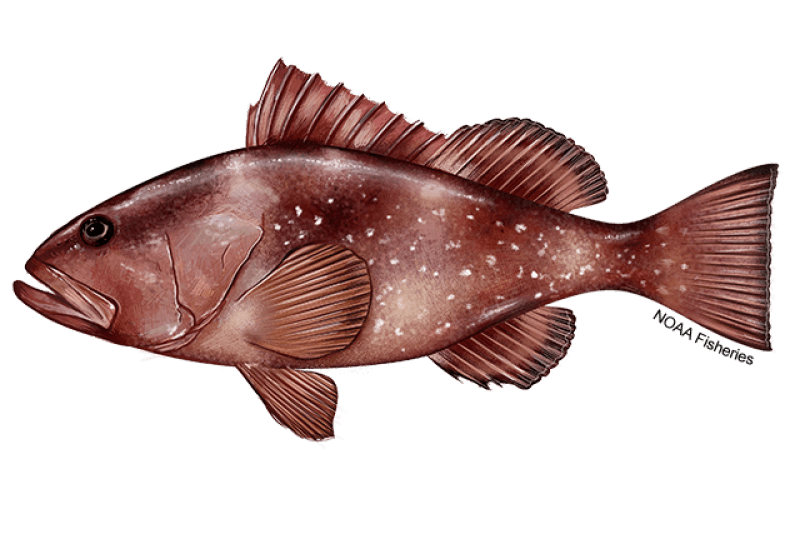
Epinephelus morio , also known as Grouper, Cherna americana, Negre. Although some populations are below target levels, U.S. wild-caught red grouper is still a smart seafood choice because it is sustainably managed and responsibly harvested under U.
Source: Species facts, status language, and imagery adapted from the NOAA Fisheries species profile (last updated 06/25/2026). Ocean City charter and Maryland
record notes are editorial orientation for OCEANCITY.MD readers. Always confirm current seasons, sizes, and
bag limits before you fish—rules change.
Illustration/photo: NOAA Fisheries — Red Grouper (Epinephelus morio).
Quick facts
Region: New England/Mid-Atlantic,
Southeast
Category: Fish · Mid-Atlantic
Maryland likelihood: 1★ out of 5
About the species
Although some populations are below target levels, U.S. wild-caught red grouper is still a smart seafood choice because it is sustainably managed and responsibly harvested under U.S. regulations.
Maryland record catch
Confirm whether Maryland DNR publishes an Atlantic state-record category for Red Grouper on the current sport-fish record board.
Maryland lists red grouper in the snapper grouper complex grouper set: recreational limit is 1 of any species or combination of listed groupers—verify COMAR 08.02.05.29.
Rule
Maryland / applicable detail
Maryland minimum size
None (grouper group)
Maryland daily creel (bag)
1 grouper aggregate
Maryland open season
Open year-round
Verify
Confirm current DNR Atlantic / COMAR tables before you keep fish—rules change.
Red grouper have robust bodies with small scales. Their head and body are dark reddish brown, shading pink or reddish below with occasional white spots on the sides and black spots on the cheeks. They have large mouths with a lower jaw that often projects slightly beyond their upper jaw, with bands of slender, sharp teeth, and usually a few stout, fixed canines. Their large mouths allow them to eat their prey whole. Biology Red grouper grow slowly, up to almost 50 inches long and more than 50 pounds. The oldest recorded red grouper in the South Atlantic was 26 years old and the oldest recorded in the Gulf of America was 29 years old. They are protogynous hermaphrodites—they begin life as females and sexually mature when they reach 4 to 6 years of age. Some later transform into males, most often between the ages of 7 and 15. The proportion of males in the population increases with age. They spawn frequently, close to 26 times a year, in shallow waters from February through June. Red grouper feed on a wide variety of fish, octopus, and crustaceans, including shrimp, lobsters, and mantis shrimp. They are among the top predators in reef community food webs and may control some aspects of community balance in reef systems. Red grouper are unspecialized and opportunistic feeders—they eat any convenient prey. They engulf prey whole by opening their large mouths, dilating their gill covers, rapidly drawing in a current of water, and inhaling the food. Smaller grouper are preyed on by the same predators that eat snappers, including jacks, other groupers, sharks, barracudas, and morays. Large sharks and carnivorous marine mammals prey on adult red grouper. Where They Live Range Red grouper are found in the western Atlantic Ocean from Massachusetts through the Gulf of America and south to Brazil. Habitat Red grouper are referred to as shallow-water grouper because they’re common in waters 10 to 60 feet deep. Juveniles prefer grass beds, rock formations, and reefs in shallow, nearshore waters. They move offshore as they mature. Adults are most commonly found around ledges, crevices, and caverns of rocky limestone reefs, and also near lower-profile, live-bottom (sponges, corals and sea squirts) areas. Adults may school or move together as groups, but only for short distances. Red grouper play a significant role in their underwater environment by acting as “marine engineers.” They excavate flat-bottom areas creating habitat for themselves and other commercially important species, such as spiny lobster , black grouper , red porgy, and vermilion snapper . Fishery Management NOAA Fisheries and the South Atlantic , Gulf , and Caribbean Fishery Management Councils manage the red grouper fishery: In the South Atlantic, managed under the Snapper-Grouper Fishery Management Plan : Commercial fishermen must have a permit to fish, land, or sell red grouper. Managers limit the number of available permits to control the number of fishermen harvesting red grouper. Annual catch limits are used for red grouper in the commercial and recreational fisheries. These fisheries are closed when their annual catch limit is projected to be met. Both the commercial and recreational fisheries have size limits to reduce harvest of immature red grouper. The commercial and recreational fishing seasons are closed from January through April to protect red grouper during their peak spawning period. Gear restrictions are used to reduce bycatch and protect habitat. There are eight deep-water marine protected areas and several spawning special management zones to protect habitats. The Oculina Experimental Closed Area is closed to fishing for and possession of all snappers and groupers to protect deepwater coral habitat and the reef fish it supports. A rebuilding plan to rebuild the stock to the target population level is in place with a target date of 2022. In the Gulf of America, managed under the Reef Fish Fishery Management Plan : Commercial vessels must have a reef fish permit and individual fishing quota (IFQ) to harvest red grouper. The annual catch limit is allocated between the commercial (76 percent) and recreational (24 percent) fisheries. The IFQ program ( catch shares ) allocates the commercial catch limit among shareholders with measures to prevent fishermen from harvesting more than their individual allocation. To reduce bycatch, there are restrictions on the type of gear fishermen may use and where they can fish. Minimum size limits protect immature red grouper. Year-round and/or seasonal area closures for commercial and recreational sectors to protect spawning groupers. Commercial data reporting requirements. In the U.S. Caribbean, managed under the Puerto Rico Fishery Management Plan , the St. Croix Fishery Management Plan , and the St. Thomas and St. John Fishery Management Plan : Managed with other groupers under each fishery management plan: Grouper 4 complex in Puerto Rico (black, red, tiger, yellowfin, and yellowmouth groupers), Grouper 5 complex in St. Croix (black, red, tiger, and yellowfin groupers), and Grouper 4 (black, red, tiger, and yellowfin groupers) complex in St. Thomas and St. John. Commercial and recreational annual catch limits for the Grouper 5 complex in Puerto Rico and commercial annual catch limits for the two Grouper 4 complexes in St. Croix and St. Thomas/S. John. Seasonal closure for red grouper in federal waters around Puerto Rico, St. Croix, and St. Thomas/St. John from February 1 through April 30 each year. Harvest Commercial fishery: In 2024, commercial landings of red grouper totaled 2.8 million pounds and were valued at $16 million, according to the NOAA Fisheries commercial fishing landings database . Gear types, habitat impacts, and bycatch: Commercial fishermen mainly use hook-and-line gear, including longlines and handlines, to harvest red grouper. Trawl gear, fish traps, and bottom longlines are prohibited in some areas to reduce bycatch. Several areas are closed to all fishing to protect snappers and groupers, including red grouper. Sea turtles and other reef fishes, such as snappers and groupers, can be incidentally caught while fishing for red grouper. In certain areas, fishermen are required to use circle hooks to improve the chance of survival of any unintentionally caught fish and to reduce turtle hookings. Commercial and charterboat/headboat reef fish fishermen must use appropriate release gear and follow handling protocols to increase the chance of survival for any incidentally caught sea turtles . Fishermen are encouraged to use venting tools or fish descenders when fish are caught showing signs of barotrauma. Barotrauma occurs when reef fish are quickly brought to the surface by hook-and-line and the gas in their swimbladders expands. Venting tools help deflate the expanded abdominal cavity, potentially reduce injury to the fish, and make it easier to return to deep water. Recreational fishery: Red grouper is a popular fish among recreational fishermen in the South Atlantic and Gulf of America. In 2024, recreational anglers landed 2.8 million pounds of red grouper, according to the NOAA Fisheries recreational fishing landings database . In the South Atlantic: Annual catch limits and accountability measures. Bag and size limits. The fishery is closed during the spawning season (from January through April). In the Gulf of America: Annual catch limits and accountability measures. Bag and size limits. The fishery is closed during the spawning season (from February 1 through March 31) in deep water to protect spawning aggregations. In the U.S. Caribbean: Annual catch limits. Seasonal closure from February 1 through April 30. Bag and vessel limits.
*Executive Order 14172, “Restoring Names That Honor American Greatness” (Jan. 20, 2025), directs that the Gulf of Mexico be renamed the Gulf of America. On August 7, 2025, NOAA Fisheries and the National Ocean Service amended regulations in the Code of Federal Regulations to reflect the renaming. The name change did not result in any changes to, and had no effect on the applicability or enforceability of, any existing regulations. This website continues to use “Gulf of Mexico” when quoting statutes or previously published materials.
Scientific Classification Kingdom Animalia Phylum Chordata Class Actinopterygii Order Perciformes Family Serranidae Genus Epinephelus Species morio Last updated by NOAA Fisheries on 06/25/2026
Appearance
Red grouper grow slowly, up to almost 50 inches long and more than 50 pounds. The oldest recorded red grouper in the South Atlantic was 26 years old and the oldest recorded in the Gulf of America was 29 years old. They are protogynous hermaphrodites—they begin life as females and sexually mature when they reach 4 to 6 years of age. Some later transform into males, most often between the ages of 7 and 15. The proportion of males in the population increases with age. They spawn frequently, close to 26 times a year, in shallow waters from February through June. Red grouper feed on a wide variety of fish, octopus, and crustaceans, including shrimp, lobsters, and mantis shrimp. They are among the top predators in reef community food webs and may control some aspects of community balance in reef systems. Red grouper are unspecialized and opportunistic feeders—they eat any convenient prey. They engulf prey whole by opening their large mouths, dilating their gill covers, rapidly drawing in a current of water, and inhaling the food. Smaller grouper are preyed on by the same predators that eat snappers, including jacks, other groupers, sharks, barracudas, and morays. Large sharks and carnivorous marine mammals prey on adult red grouper. Where They Live Range Red grouper are found in the western Atlantic Ocean from Massachusetts through the Gulf of America and south to Brazil. Habitat Red grouper are referred to as shallow-water grouper because they’re common in waters 10 to 60 feet deep. Juveniles prefer grass beds, rock formations, and reefs in shallow, nearshore waters. They move offshore as they mature. Adults are most commonly found around ledges, crevices, and caverns of rocky limestone reefs, and also near lower-profile, live-bottom (sponges, corals and sea squirts) areas. Adults may school or move together as groups, but only for short distances. Red grouper play a significant role in their underwater environment by acting as “marine engineers.” They excavate flat-bottom areas creating habitat for themselves and other commercially important species, such as spiny lobster , black grouper , red porgy, and vermilion snapper . Fishery Management NOAA Fisheries and the South Atlantic , Gulf , and Caribbean Fishery Management Councils manage the red grouper fishery: In the South Atlantic, managed under the Snapper-Grouper Fishery Management Plan : Commercial fishermen must have a permit to fish, land, or sell red grouper. Managers limit the number of available permits to control the number of fishermen harvesting red grouper. Annual catch limits are used for red grouper in the commercial and recreational fisheries. These fisheries are closed when their annual catch limit is projected to be met. Both the commercial and recreational fisheries have size limits to reduce harvest of immature red grouper. The commercial and recreational fishing seasons are closed from January through April to protect red grouper during their peak spawning period. Gear restrictions are used to reduce bycatch and protect habitat. There are eight deep-water marine protected areas and several spawning special management zones to protect habitats. The Oculina Experimental Closed Area is closed to fishing for and possession of all snappers and groupers to protect deepwater coral habitat and the reef fish it supports. A rebuilding plan to rebuild the stock to the target population level is in place with a target date of 2022. In the Gulf of America, managed under the Reef Fish Fishery Management Plan : Commercial vessels must have a reef fish permit and individual fishing quota (IFQ) to harvest red grouper. The annual catch limit is allocated between the commercial (76 percent) and recreational (24 percent) fisheries. The IFQ program ( catch shares ) allocates the commercial catch limit among shareholders with measures to prevent fishermen from harvesting more than their individual allocation. To reduce bycatch, there are restrictions on the type of gear fishermen may use and where they can fish. Minimum size limits protect immature red grouper. Year-round and/or seasonal area closures for commercial and recreational sectors to protect spawning groupers. Commercial data reporting requirements. In the U.S. Caribbean, managed under the Puerto Rico Fishery Management Plan , the St. Croix Fishery Management Plan , and the St. Thomas and St. John Fishery Management Plan : Managed with other groupers under each fishery management plan: Grouper 4 complex in Puerto Rico (black, red, tiger, yellowfin, and yellowmouth groupers), Grouper 5 complex in St. Croix (black, red, tiger, and yellowfin groupers), and Grouper 4 (black, red, tiger, and yellowfin groupers) complex in St. Thomas and St. John. Commercial and recreational annual catch limits for the Grouper 5 complex in Puerto Rico and commercial annual catch limits for the two Grouper 4 complexes in St. Croix and St. Thomas/S. John. Seasonal closure for red grouper in federal waters around Puerto Rico, St. Croix, and St. Thomas/St. John from February 1 through April 30 each year. Harvest Commercial fishery: In 2024, commercial landings of red grouper totaled 2.8 million pounds and were valued at $16 million, according to the NOAA Fisheries commercial fishing landings database . Gear types, habitat impacts, and bycatch: Commercial fishermen mainly use hook-and-line gear, including longlines and handlines, to harvest red grouper. Trawl gear, fish traps, and bottom longlines are prohibited in some areas to reduce bycatch. Several areas are closed to all fishing to protect snappers and groupers, including red grouper. Sea turtles and other reef fishes, such as snappers and groupers, can be incidentally caught while fishing for red grouper. In certain areas, fishermen are required to use circle hooks to improve the chance of survival of any unintentionally caught fish and to reduce turtle hookings. Commercial and charterboat/headboat reef fish fishermen must use appropriate release gear and follow handling protocols to increase the chance of survival for any incidentally caught sea turtles . Fishermen are encouraged to use venting tools or fish descenders when fish are caught showing signs of barotrauma. Barotrauma occurs when reef fish are quickly brought to the surface by hook-and-line and the gas in their swimbladders expands. Venting tools help deflate the expanded abdominal cavity, potentially reduce injury to the fish, and make it easier to return to deep water. Recreational fishery: Red grouper is a popular fish among recreational fishermen in the South Atlantic and Gulf of America. In 2024, recreational anglers landed 2.8 million pounds of red grouper, according to the NOAA Fisheries recreational fishing landings database . In the South Atlantic: Annual catch limits and accountability measures. Bag and size limits. The fishery is closed during the spawning season (from January through April). In the Gulf of America: Annual catch limits and accountability measures. Bag and size limits. The fishery is closed during the spawning season (from February 1 through March 31) in deep water to protect spawning aggregations. In the U.S. Caribbean: Annual catch limits. Seasonal closure from February 1 through April 30. Bag and vessel limits.
*Executive Order 14172, “Restoring Names That Honor American Greatness” (Jan. 20, 2025), directs that the Gulf of Mexico be renamed the Gulf of America. On August 7, 2025, NOAA Fisheries and the National Ocean Service amended regulations in the Code of Federal Regulations to reflect the renaming. The name change did not result in any changes to, and had no effect on the applicability or enforceability of, any existing regulations. This website continues to use “Gulf of Mexico” when quoting statutes or previously published materials.
Scientific Classification Kingdom Animalia Phylum Chordata Class Actinopterygii Order Perciformes Family Serranidae Genus Epinephelus Species morio Last updated by NOAA Fisheries on 06/25/2026
Biology
Red grouper are found in the western Atlantic Ocean from Massachusetts through the Gulf of America and south to Brazil. Habitat Red grouper are referred to as shallow-water grouper because they’re common in waters 10 to 60 feet deep. Juveniles prefer grass beds, rock formations, and reefs in shallow, nearshore waters. They move offshore as they mature. Adults are most commonly found around ledges, crevices, and caverns of rocky limestone reefs, and also near lower-profile, live-bottom (sponges, corals and sea squirts) areas. Adults may school or move together as groups, but only for short distances. Red grouper play a significant role in their underwater environment by acting as “marine engineers.” They excavate flat-bottom areas creating habitat for themselves and other commercially important species, such as spiny lobster , black grouper , red porgy, and vermilion snapper . Fishery Management NOAA Fisheries and the South Atlantic , Gulf , and Caribbean Fishery Management Councils manage the red grouper fishery: In the South Atlantic, managed under the Snapper-Grouper Fishery Management Plan : Commercial fishermen must have a permit to fish, land, or sell red grouper. Managers limit the number of available permits to control the number of fishermen harvesting red grouper. Annual catch limits are used for red grouper in the commercial and recreational fisheries. These fisheries are closed when their annual catch limit is projected to be met. Both the commercial and recreational fisheries have size limits to reduce harvest of immature red grouper. The commercial and recreational fishing seasons are closed from January through April to protect red grouper during their peak spawning period. Gear restrictions are used to reduce bycatch and protect habitat. There are eight deep-water marine protected areas and several spawning special management zones to protect habitats. The Oculina Experimental Closed Area is closed to fishing for and possession of all snappers and groupers to protect deepwater coral habitat and the reef fish it supports. A rebuilding plan to rebuild the stock to the target population level is in place with a target date of 2022. In the Gulf of America, managed under the Reef Fish Fishery Management Plan : Commercial vessels must have a reef fish permit and individual fishing quota (IFQ) to harvest red grouper. The annual catch limit is allocated between the commercial (76 percent) and recreational (24 percent) fisheries. The IFQ program ( catch shares ) allocates the commercial catch limit among shareholders with measures to prevent fishermen from harvesting more than their individual allocation. To reduce bycatch, there are restrictions on the type of gear fishermen may use and where they can fish. Minimum size limits protect immature red grouper. Year-round and/or seasonal area closures for commercial and recreational sectors to protect spawning groupers. Commercial data reporting requirements. In the U.S. Caribbean, managed under the Puerto Rico Fishery Management Plan , the St. Croix Fishery Management Plan , and the St. Thomas and St. John Fishery Management Plan : Managed with other groupers under each fishery management plan: Grouper 4 complex in Puerto Rico (black, red, tiger, yellowfin, and yellowmouth groupers), Grouper 5 complex in St. Croix (black, red, tiger, and yellowfin groupers), and Grouper 4 (black, red, tiger, and yellowfin groupers) complex in St. Thomas and St. John. Commercial and recreational annual catch limits for the Grouper 5 complex in Puerto Rico and commercial annual catch limits for the two Grouper 4 complexes in St. Croix and St. Thomas/S. John. Seasonal closure for red grouper in federal waters around Puerto Rico, St. Croix, and St. Thomas/St. John from February 1 through April 30 each year. Harvest Commercial fishery: In 2024, commercial landings of red grouper totaled 2.8 million pounds and were valued at $16 million, according to the NOAA Fisheries commercial fishing landings database . Gear types, habitat impacts, and bycatch: Commercial fishermen mainly use hook-and-line gear, including longlines and handlines, to harvest red grouper. Trawl gear, fish traps, and bottom longlines are prohibited in some areas to reduce bycatch. Several areas are closed to all fishing to protect snappers and groupers, including red grouper. Sea turtles and other reef fishes, such as snappers and groupers, can be incidentally caught while fishing for red grouper. In certain areas, fishermen are required to use circle hooks to improve the chance of survival of any unintentionally caught fish and to reduce turtle hookings. Commercial and charterboat/headboat reef fish fishermen must use appropriate release gear and follow handling protocols to increase the chance of survival for any incidentally caught sea turtles . Fishermen are encouraged to use venting tools or fish descenders when fish are caught showing signs of barotrauma. Barotrauma occurs when reef fish are quickly brought to the surface by hook-and-line and the gas in their swimbladders expands. Venting tools help deflate the expanded abdominal cavity, potentially reduce injury to the fish, and make it easier to return to deep water. Recreational fishery: Red grouper is a popular fish among recreational fishermen in the South Atlantic and Gulf of America. In 2024, recreational anglers landed 2.8 million pounds of red grouper, according to the NOAA Fisheries recreational fishing landings database . In the South Atlantic: Annual catch limits and accountability measures. Bag and size limits. The fishery is closed during the spawning season (from January through April). In the Gulf of America: Annual catch limits and accountability measures. Bag and size limits. The fishery is closed during the spawning season (from February 1 through March 31) in deep water to protect spawning aggregations. In the U.S. Caribbean: Annual catch limits. Seasonal closure from February 1 through April 30. Bag and vessel limits.
*Executive Order 14172, “Restoring Names That Honor American Greatness” (Jan. 20, 2025), directs that the Gulf of Mexico be renamed the Gulf of America. On August 7, 2025, NOAA Fisheries and the National Ocean Service amended regulations in the Code of Federal Regulations to reflect the renaming. The name change did not result in any changes to, and had no effect on the applicability or enforceability of, any existing regulations. This website continues to use “Gulf of Mexico” when quoting statutes or previously published materials.
Scientific Classification Kingdom Animalia Phylum Chordata Class Actinopterygii Order Perciformes Family Serranidae Genus Epinephelus Species morio Last updated by NOAA Fisheries on 06/25/2026
Where they live
Range
Red grouper are found in the western Atlantic Ocean from Massachusetts through the Gulf of America and south to Brazil. Habitat Red grouper are referred to as shallow-water grouper because they’re common in waters 10 to 60 feet deep. Juveniles prefer grass beds, rock formations, and reefs in shallow, nearshore waters. They move offshore as they mature. Adults are most commonly found around ledges, crevices, and caverns of rocky limestone reefs, and also near lower-profile, live-bottom (sponges, corals and sea squirts) areas. Adults may school or move together as groups, but only for short distances. Red grouper play a significant role in their underwater environment by acting as “marine engineers.” They excavate flat-bottom areas creating habitat for themselves and other commercially important species, such as spiny lobster , black grouper , red porgy, and vermilion snapper . Fishery Management NOAA Fisheries and the South Atlantic , Gulf , and Caribbean Fishery Management Councils manage the red grouper fishery: In the South Atlantic, managed under the Snapper-Grouper Fishery Management Plan : Commercial fishermen must have a permit to fish, land, or sell red grouper. Managers limit the number of available permits to control the number of fishermen harvesting red grouper. Annual catch limits are used for red grouper in the commercial and recreational fisheries. These fisheries are closed when their annual catch limit is projected to be met. Both the commercial and recreational fisheries have size limits to reduce harvest of immature red grouper. The commercial and recreational fishing seasons are closed from January through April to protect red grouper during their peak spawning period. Gear restrictions are used to reduce bycatch and protect habitat. There are eight deep-water marine protected areas and several spawning special management zones to protect habitats. The Oculina Experimental Closed Area is closed to fishing for and possession of all snappers and groupers to protect deepwater coral habitat and the reef fish it supports. A rebuilding plan to rebuild the stock to the target population level is in place with a target date of 2022. In the Gulf of America, managed under the Reef Fish Fishery Management Plan : Commercial vessels must have a reef fish permit and individual fishing quota (IFQ) to harvest red grouper. The annual catch limit is allocated between the commercial (76 percent) and recreational (24 percent) fisheries. The IFQ program ( catch shares ) allocates the commercial catch limit among shareholders with measures to prevent fishermen from harvesting more than their individual allocation. To reduce bycatch, there are restrictions on the type of gear fishermen may use and where they can fish. Minimum size limits protect immature red grouper. Year-round and/or seasonal area closures for commercial and recreational sectors to protect spawning groupers. Commercial data reporting requirements. In the U.S. Caribbean, managed under the Puerto Rico Fishery Management Plan , the St. Croix Fishery Management Plan , and the St. Thomas and St. John Fishery Management Plan : Managed with other groupers under each fishery management plan: Grouper 4 complex in Puerto Rico (black, red, tiger, yellowfin, and yellowmouth groupers), Grouper 5 complex in St. Croix (black, red, tiger, and yellowfin groupers), and Grouper 4 (black, red, tiger, and yellowfin groupers) complex in St. Thomas and St. John. Commercial and recreational annual catch limits for the Grouper 5 complex in Puerto Rico and commercial annual catch limits for the two Grouper 4 complexes in St. Croix and St. Thomas/S. John. Seasonal closure for red grouper in federal waters around Puerto Rico, St. Croix, and St. Thomas/St. John from February 1 through April 30 each year. Harvest Commercial fishery: In 2024, commercial landings of red grouper totaled 2.8 million pounds and were valued at $16 million, according to the NOAA Fisheries commercial fishing landings database . Gear types, habitat impacts, and bycatch: Commercial fishermen mainly use hook-and-line gear, including longlines and handlines, to harvest red grouper. Trawl gear, fish traps, and bottom longlines are prohibited in some areas to reduce bycatch. Several areas are closed to all fishing to protect snappers and groupers, including red grouper. Sea turtles and other reef fishes, such as snappers and groupers, can be incidentally caught while fishing for red grouper. In certain areas, fishermen are required to use circle hooks to improve the chance of survival of any unintentionally caught fish and to reduce turtle hookings. Commercial and charterboat/headboat reef fish fishermen must use appropriate release gear and follow handling protocols to increase the chance of survival for any incidentally caught sea turtles . Fishermen are encouraged to use venting tools or fish descenders when fish are caught showing signs of barotrauma. Barotrauma occurs when reef fish are quickly brought to the surface by hook-and-line and the gas in their swimbladders expands. Venting tools help deflate the expanded abdominal cavity, potentially reduce injury to the fish, and make it easier to return to deep water. Recreational fishery: Red grouper is a popular fish among recreational fishermen in the South Atlantic and Gulf of America. In 2024, recreational anglers landed 2.8 million pounds of red grouper, according to the NOAA Fisheries recreational fishing landings database . In the South Atlantic: Annual catch limits and accountability measures. Bag and size limits. The fishery is closed during the spawning season (from January through April). In the Gulf of America: Annual catch limits and accountability measures. Bag and size limits. The fishery is closed during the spawning season (from February 1 through March 31) in deep water to protect spawning aggregations. In the U.S. Caribbean: Annual catch limits. Seasonal closure from February 1 through April 30. Bag and vessel limits.
*Executive Order 14172, “Restoring Names That Honor American Greatness” (Jan. 20, 2025), directs that the Gulf of Mexico be renamed the Gulf of America. On August 7, 2025, NOAA Fisheries and the National Ocean Service amended regulations in the Code of Federal Regulations to reflect the renaming. The name change did not result in any changes to, and had no effect on the applicability or enforceability of, any existing regulations. This website continues to use “Gulf of Mexico” when quoting statutes or previously published materials.
Habitat
NOAA Fisheries and the South Atlantic , Gulf , and Caribbean Fishery Management Councils manage the red grouper fishery: In the South Atlantic, managed under the Snapper-Grouper Fishery Management Plan : Commercial fishermen must have a permit to fish, land, or sell red grouper. Managers limit the number of available permits to control the number of fishermen harvesting red grouper. Annual catch limits are used for red grouper in the commercial and recreational fisheries. These fisheries are closed when their annual catch limit is projected to be met. Both the commercial and recreational fisheries have size limits to reduce harvest of immature red grouper. The commercial and recreational fishing seasons are closed from January through April to protect red grouper during their peak spawning period. Gear restrictions are used to reduce bycatch and protect habitat. There are eight deep-water marine protected areas and several spawning special management zones to protect habitats. The Oculina Experimental Closed Area is closed to fishing for and possession of all snappers and groupers to protect deepwater coral habitat and the reef fish it supports. A rebuilding plan to rebuild the stock to the target population level is in place with a target date of 2022. In the Gulf of America, managed under the Reef Fish Fishery Management Plan : Commercial vessels must have a reef fish permit and individual fishing quota (IFQ) to harvest red grouper. The annual catch limit is allocated between the commercial (76 percent) and recreational (24 percent) fisheries. The IFQ program ( catch shares ) allocates the commercial catch limit among shareholders with measures to prevent fishermen from harvesting more than their individual allocation. To reduce bycatch, there are restrictions on the type of gear fishermen may use and where they can fish. Minimum size limits protect immature red grouper. Year-round and/or seasonal area closures for commercial and recreational sectors to protect spawning groupers. Commercial data reporting requirements. In the U.S. Caribbean, managed under the Puerto Rico Fishery Management Plan , the St. Croix Fishery Management Plan , and the St. Thomas and St. John Fishery Management Plan : Managed with other groupers under each fishery management plan: Grouper 4 complex in Puerto Rico (black, red, tiger, yellowfin, and yellowmouth groupers), Grouper 5 complex in St. Croix (black, red, tiger, and yellowfin groupers), and Grouper 4 (black, red, tiger, and yellowfin groupers) complex in St. Thomas and St. John. Commercial and recreational annual catch limits for the Grouper 5 complex in Puerto Rico and commercial annual catch limits for the two Grouper 4 complexes in St. Croix and St. Thomas/S. John. Seasonal closure for red grouper in federal waters around Puerto Rico, St. Croix, and St. Thomas/St. John from February 1 through April 30 each year. Harvest Commercial fishery: In 2024, commercial landings of red grouper totaled 2.8 million pounds and were valued at $16 million, according to the NOAA Fisheries commercial fishing landings database . Gear types, habitat impacts, and bycatch: Commercial fishermen mainly use hook-and-line gear, including longlines and handlines, to harvest red grouper. Trawl gear, fish traps, and bottom longlines are prohibited in some areas to reduce bycatch. Several areas are closed to all fishing to protect snappers and groupers, including red grouper. Sea turtles and other reef fishes, such as snappers and groupers, can be incidentally caught while fishing for red grouper. In certain areas, fishermen are required to use circle hooks to improve the chance of survival of any unintentionally caught fish and to reduce turtle hookings. Commercial and charterboat/headboat reef fish fishermen must use appropriate release gear and follow handling protocols to increase the chance of survival for any incidentally caught sea turtles . Fishermen are encouraged to use venting tools or fish descenders when fish are caught showing signs of barotrauma. Barotrauma occurs when reef fish are quickly brought to the surface by hook-and-line and the gas in their swimbladders expands. Venting tools help deflate the expanded abdominal cavity, potentially reduce injury to the fish, and make it easier to return to deep water. Recreational fishery: Red grouper is a popular fish among recreational fishermen in the South Atlantic and Gulf of America. In 2024, recreational anglers landed 2.8 million pounds of red grouper, according to the NOAA Fisheries recreational fishing landings database . In the South Atlantic: Annual catch limits and accountability measures. Bag and size limits. The fishery is closed during the spawning season (from January through April). In the Gulf of America: Annual catch limits and accountability measures. Bag and size limits. The fishery is closed during the spawning season (from February 1 through March 31) in deep water to protect spawning aggregations. In the U.S. Caribbean: Annual catch limits. Seasonal closure from February 1 through April 30. Bag and vessel limits.
*Executive Order 14172, “Restoring Names That Honor American Greatness” (Jan. 20, 2025), directs that the Gulf of Mexico be renamed the Gulf of America. On August 7, 2025, NOAA Fisheries and the National Ocean Service amended regulations in the Code of Federal Regulations to reflect the renaming. The name change did not result in any changes to, and had no effect on the applicability or enforceability of, any existing regulations. This website continues to use “Gulf of Mexico” when quoting statutes or previously published materials.
Scientific Classification Kingdom Animalia Phylum Chordata Class Actinopterygii Order Perciformes Family Serranidae Genus Epinephelus Species morio Last updated by NOAA Fisheries on 06/25/2026
Ocean City & Mid-Atlantic context
From Ocean City, Maryland, use this Red Grouper profile as NOAA Mid-Atlantic directory context—not a promise you will meet the species on every charter.
Always verify current Maryland and federal size, season, and bag rules for your exact date and coordinates before you keep any catch.
Source facts and imagery are adapted from the NOAA Fisheries species profile for Red Grouper.
What charter to book from Ocean City
Red Grouper may appear on Ocean City trips depending on season and habitat—use the NOAA biology below and book the charter archetype that matches how you will actually fish.
Possible / related
Bay guide — Possible overlap depending on season, water, and boat program.
Inshore charter — Possible overlap depending on season, water, and boat program.
Commercial fishery: In 2024, commercial landings of red grouper totaled 2.8 million pounds and were valued at $16 million, according to the NOAA Fisheries commercial fishing landings database . Gear types, habitat impacts, and bycatch: Commercial fishermen mainly use hook-and-line gear, including longlines and handlines, to harvest red grouper. Trawl gear, fish traps, and bottom longlines are prohibited in some areas to reduce bycatch. Several areas are closed to all fishing to protect snappers and groupers, including red grouper. Sea turtles and other reef fishes, such as snappers and groupers, can be incidentally caught while fishing for red grouper. In certain areas, fishermen are required to use circle hooks to improve the chance of survival of any unintentionally caught fish and to reduce turtle hookings. Commercial and charterboat/headboat reef fish fishermen must use appropriate release gear and follow handling protocols to increase the chance of survival for any incidentally caught sea turtles . Fishermen are encouraged to use venting tools or fish descenders when fish are caught showing signs of barotrauma. Barotrauma occurs when reef fish are quickly brought to the surface by hook-and-line and the gas in their swimbladders expands. Venting tools help deflate the expanded abdominal cavity, potentially reduce injury to the fish, and make it easier to return to deep water. Recreational fishery: Red grouper is a popular fish among recreational fishermen in the South Atlantic and Gulf of America. In 2024, recreational anglers landed 2.8 million pounds of red grouper, according to the NOAA Fisheries recreational fishing landings database . In the South Atlantic: Annual catch limits and accountability measures. Bag and size limits. The fishery is closed during the spawning season (from January through April). In the Gulf of America: Annual catch limits and accountability measures. Bag and size limits. The fishery is closed during the spawning season (from February 1 through March 31) in deep water to protect spawning aggregations. In the U.S. Caribbean: Annual catch limits. Seasonal closure from February 1 through April 30. Bag and vessel limits.
*Executive Order 14172, “Restoring Names That Honor American Greatness” (Jan. 20, 2025), directs that the Gulf of Mexico be renamed the Gulf of America. On August 7, 2025, NOAA Fisheries and the National Ocean Service amended regulations in the Code of Federal Regulations to reflect the renaming. The name change did not result in any changes to, and had no effect on the applicability or enforceability of, any existing regulations. This website continues to use “Gulf of Mexico” when quoting statutes or previously published materials.
Scientific Classification Kingdom Animalia Phylum Chordata Class Actinopterygii Order Perciformes Family Serranidae Genus Epinephelus Species morio Last updated by NOAA Fisheries on 06/25/2026
Harvest
See the NOAA wild-caught fishery section for landings and gear notes when published for this species.
Landings and management details matter most for the waters where Red Grouper is actually fished—see the
NOAA species profile
.
Seafood facts
Fact
Detail
Sustainability
Although some populations are below target levels, U.S. wild-caught red grouper is still a smart seafood choice because it is sustainably managed and responsibly harvested under U.S. regulations.
Availability
Year-round.
Source
U.S. wild-caught from Massachusetts to the Gulf of America (formerly Gulf of Mexico).
Taste
Red grouper has a mild but distinct flavor, somewhere between bass and halibut. Red grouper is sweeter and milder than black grouper, and many consider red grouper the tastier of the two.
Texture
Very firm, moist, and flaky.
Color
Raw and cooked meat is white.
Health
Red grouper is low in saturated fat, and a good source of vitamins B6 and B12, phosphorus, potassium, protein, and selenium.
After a real OC boat day or market stop for Red Grouper, Seafood after boat days covers
dock buffer and cook-your-catch pacing.