Grampus griseus . Risso's dolphins, sometimes called gray dolphins, are found in the temperate and tropical zones of all the world’s oceans. These cetaceans generally prefer deeper offshore waters,
Source: Species facts, status language, and imagery adapted from the NOAA Fisheries species profile (last updated 03/06/2025). Ocean City charter and Maryland
record notes are editorial orientation for OCEANCITY.MD readers. Always confirm current seasons, sizes, and
bag limits before you fish—rules change.
Region: Alaska,
New England/Mid-Atlantic,
Pacific Islands,
Southeast,
West Coast
Category: Protected species · Mid-Atlantic
Maryland likelihood: 2★ out of 5
About the species
Risso's dolphins, sometimes called gray dolphins, are found in the temperate and tropical zones of all the world’s oceans. These cetaceans generally prefer deeper offshore waters, especially near the continental shelf edge and slope, where they can dive to at least 1,000 feet and hold their breath for 30 minutes. They are also very active on the ocean surface.
Risso's dolphins are typically found in groups of between 10 and 30 animals, though they have been reported as solitary individuals, in pairs, or in loose aggregations in the hundreds or thousands. Occasionally, this species associates with other dolphins and whales. They are sometimes considered part of a subfamily referred to as “blackfish,” which also includes false killer whales , pygmy killer whales , melon-headed whales , long-finned pilot whales , and short-finned pilot whales .
Risso’s dolphins in the United States are not endangered or threatened. Like all marine mammals, they are protected under the Marine Mammal Protection Act (MMPA). NOAA Fisheries and its partners are working to conserve Risso’s dolphins and further our understanding of this species through research and conservation activities.
Maryland record catch
Confirm whether Maryland DNR publishes an Atlantic state-record category for Risso’s Dolphin on the current sport-fish record board.
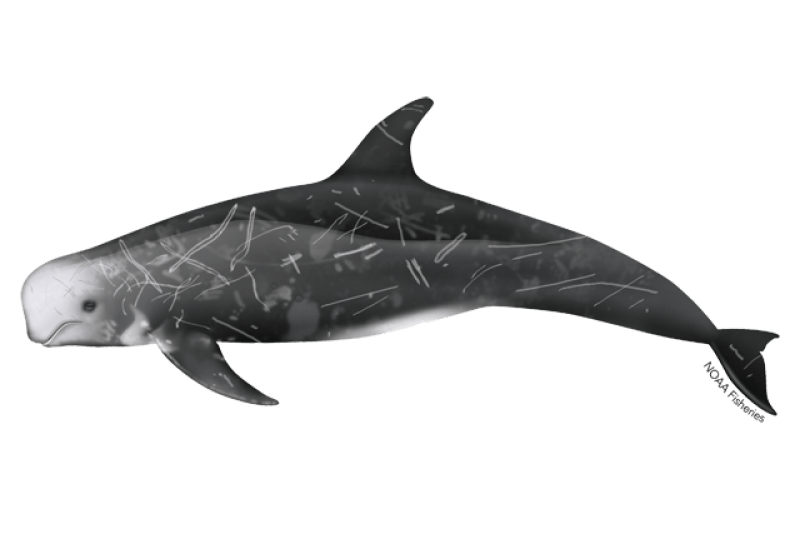
Risso's dolphins have a robust body with a narrow tailstock. These medium-sized cetaceans can reach lengths of approximately 8.5 to 13 feet and weigh 660 to 1,100 pounds. Males and females are usually about the same size. They have a bulbous head with a vertical crease and an indistinguishable rostrum. They have a tall, curved, sickle-shaped dorsal fin located mid-way down their back.
Calves have a dark cape and saddle, with little or no scarring on their body. As Risso's dolphins age, their coloration lightens from black, dark gray, or brown to pale gray or almost white. Adult bodies are usually heavily scarred, with scratches caused from teeth raking between dolphins, as well as circular markings from prey (e.g., squid), cookie-cutter sharks, and lampreys. Mature adults swimming just under the water's surface usually appear white.
Risso’s dolphins have two to seven pairs of peg-like teeth in the front of their lower jaw to capture prey and usually none in their upper jaw. This low number of teeth is unusual when compared with other cetaceans.
Behavior and Diet Risso's dolphins are typically found in groups that average between 10 and 30 animals, but they have been reported as solitary individuals, in pairs, or in loose aggregations of hundreds and thousands. Occasionally, this species associates with other dolphins and whales, such as bottlenose dolphins , gray whales , northern right whale dolphins , and Pacific white-sided dolphins .
When at the surface, they have a small inconspicuous blow if backlit (which is more distinct after long dives), and their head partially emerges at a 45° angle. Before diving, they usually take 10 to 12 breaths at 15- to 20-second intervals and will often display their tails (known as flukes). Risso’s dolphins are very active on the surface, often leaping out of the water, slapping their pectoral flippers or tails on the water's surface, and raising their heads vertically out of the water (known as spyhopping). They occasionally 'porpoise'—or move in and out of the water in a series of high-speed leaps—most often when being pursued or hunted by predators.
Risso's dolphins can dive to at least 1,000 feet and hold their breath for 30 minutes, but they usually make shorter dives of just a few minutes. They feed on fish (e.g., anchovies), krill, and cephalopods (e.g., squid, octopus, and cuttlefish) mainly at night, when their prey is closer to the surface. Most of their diet consists of squid, and they have been known to move into continental shelf waters when following their preferred prey.
Appearance
Risso's dolphins are typically found in groups that average between 10 and 30 animals, but they have been reported as solitary individuals, in pairs, or in loose aggregations of hundreds and thousands. Occasionally, this species associates with other dolphins and whales, such as bottlenose dolphins , gray whales , northern right whale dolphins , and Pacific white-sided dolphins .
When at the surface, they have a small inconspicuous blow if backlit (which is more distinct after long dives), and their head partially emerges at a 45° angle. Before diving, they usually take 10 to 12 breaths at 15- to 20-second intervals and will often display their tails (known as flukes). Risso’s dolphins are very active on the surface, often leaping out of the water, slapping their pectoral flippers or tails on the water's surface, and raising their heads vertically out of the water (known as spyhopping). They occasionally 'porpoise'—or move in and out of the water in a series of high-speed leaps—most often when being pursued or hunted by predators.
Risso's dolphins can dive to at least 1,000 feet and hold their breath for 30 minutes, but they usually make shorter dives of just a few minutes. They feed on fish (e.g., anchovies), krill, and cephalopods (e.g., squid, octopus, and cuttlefish) mainly at night, when their prey is closer to the surface. Most of their diet consists of squid, and they have been known to move into continental shelf waters when following their preferred prey.
Where They Live Risso's dolphins have a cosmopolitan distribution, meaning they can be found worldwide in temperate, subtropical, and tropical oceans and seas from latitudes 64° North to 46° South. Their preferred habitats appear to be mid-temperate waters of the continental shelf and slope between 30° and 45° latitude. They prefer areas of deeper waters (3,300 feet) with steep bottom topography, but they are known to inhabit shallow coastal areas as well.
In the Northern Hemisphere, their range includes the Gulf of Alaska, Gulf of America, Gulf of Mexico, Northwest Atlantic from Florida to Newfoundland, Azores, Norway, Japan, Russia, and the Red Sea. In addition, they are known to inhabit the Mediterranean Sea, are rare in the Black Sea, and do not appear to inhabit the Persian Gulf and some other very shallow, enclosed bodies of water. In the Southern Hemisphere, their range includes Argentina, Australia, Chile, South Africa, and New Zealand.
Little is known of their migration patterns or movements, but Risso’s dolphins may be affected by movements of spawning squid and oceanographic conditions.
Lifespan & Reproduction Risso’s dolphins have an estimated lifespan of at least 35 years. Individuals become sexually mature when they reach a length of about 8.5 to 9 feet. Breeding and calving may occur year-round and the gestation period lasts approximately 13 to 14 months. The peak of the breeding and calving season may vary geographically (especially in the North Pacific), with most animal births occurring from summer to fall in Japanese waters and from fall to winter in California waters. Newborn calves are usually 3.5 to 5.5 feet in length and weigh about 45 pounds.
Threats Entanglement One of the main threats to Risso’s dolphins is becoming entangled or captured in commercial fishing gear such as gillnets, longlines, and trawls.
Hunting Risso’s dolphins are directly hunted for meat and oil in Indonesia, Japan, the Caribbean (the Lesser Antilles), Sri Lanka, and the Solomon Islands.
Ocean Noise Underwater noise threatens Risso's dolphin populations, interrupting their normal behavior and driving them away from areas important to their survival. Increasing evidence suggests that exposure to intense underwater sound in some settings may cause this species to strand and ultimately die.
Contaminants Contaminants enter ocean waters from many sources, including oil and gas development, wastewater discharges, urban runoff, and other industrial processes. Once in the environment, these contaminants move up the food chain and accumulate in predators at the top, such as Risso’s dolphins. Because of their long lifespan and blubber stores, Risso’s dolphins accumulate contaminants including trace metals and organochlorines like PCBs and DDTs in their bodies, threatening their immune and reproductive systems. Coastal populations generally are more susceptible.
Scientific Classification Kingdom Animalia Phylum Chordata Class Mammalia Order Cetacea Family Delphinidae Genus Grampus Species griseus Last updated by NOAA Fisheries on 03/06/2025
Biology
Risso's dolphins have a cosmopolitan distribution, meaning they can be found worldwide in temperate, subtropical, and tropical oceans and seas from latitudes 64° North to 46° South. Their preferred habitats appear to be mid-temperate waters of the continental shelf and slope between 30° and 45° latitude. They prefer areas of deeper waters (3,300 feet) with steep bottom topography, but they are known to inhabit shallow coastal areas as well.
In the Northern Hemisphere, their range includes the Gulf of Alaska, Gulf of America, Gulf of Mexico, Northwest Atlantic from Florida to Newfoundland, Azores, Norway, Japan, Russia, and the Red Sea. In addition, they are known to inhabit the Mediterranean Sea, are rare in the Black Sea, and do not appear to inhabit the Persian Gulf and some other very shallow, enclosed bodies of water. In the Southern Hemisphere, their range includes Argentina, Australia, Chile, South Africa, and New Zealand.
Little is known of their migration patterns or movements, but Risso’s dolphins may be affected by movements of spawning squid and oceanographic conditions.
Lifespan & Reproduction Risso’s dolphins have an estimated lifespan of at least 35 years. Individuals become sexually mature when they reach a length of about 8.5 to 9 feet. Breeding and calving may occur year-round and the gestation period lasts approximately 13 to 14 months. The peak of the breeding and calving season may vary geographically (especially in the North Pacific), with most animal births occurring from summer to fall in Japanese waters and from fall to winter in California waters. Newborn calves are usually 3.5 to 5.5 feet in length and weigh about 45 pounds.
Threats Entanglement One of the main threats to Risso’s dolphins is becoming entangled or captured in commercial fishing gear such as gillnets, longlines, and trawls.
Hunting Risso’s dolphins are directly hunted for meat and oil in Indonesia, Japan, the Caribbean (the Lesser Antilles), Sri Lanka, and the Solomon Islands.
Ocean Noise Underwater noise threatens Risso's dolphin populations, interrupting their normal behavior and driving them away from areas important to their survival. Increasing evidence suggests that exposure to intense underwater sound in some settings may cause this species to strand and ultimately die.
Contaminants Contaminants enter ocean waters from many sources, including oil and gas development, wastewater discharges, urban runoff, and other industrial processes. Once in the environment, these contaminants move up the food chain and accumulate in predators at the top, such as Risso’s dolphins. Because of their long lifespan and blubber stores, Risso’s dolphins accumulate contaminants including trace metals and organochlorines like PCBs and DDTs in their bodies, threatening their immune and reproductive systems. Coastal populations generally are more susceptible.
Scientific Classification Kingdom Animalia Phylum Chordata Class Mammalia Order Cetacea Family Delphinidae Genus Grampus Species griseus Last updated by NOAA Fisheries on 03/06/2025
Where they live
Range
Risso's dolphins have a cosmopolitan distribution, meaning they can be found worldwide in temperate, subtropical, and tropical oceans and seas from latitudes 64° North to 46° South. Their preferred habitats appear to be mid-temperate waters of the continental shelf and slope between 30° and 45° latitude. They prefer areas of deeper waters (3,300 feet) with steep bottom topography, but they are known to inhabit shallow coastal areas as well.
In the Northern Hemisphere, their range includes the Gulf of Alaska, Gulf of America, Gulf of Mexico, Northwest Atlantic from Florida to Newfoundland, Azores, Norway, Japan, Russia, and the Red Sea. In addition, they are known to inhabit the Mediterranean Sea, are rare in the Black Sea, and do not appear to inhabit the Persian Gulf and some other very shallow, enclosed bodies of water. In the Southern Hemisphere, their range includes Argentina, Australia, Chile, South Africa, and New Zealand.
Habitat
See the NOAA species profile for habitat detail for this entry.
Ocean City & Mid-Atlantic context
From Ocean City, Maryland, use this Risso’s Dolphin profile as NOAA Mid-Atlantic directory context—not a promise you will meet the species on every charter.
Risso’s Dolphin is protected. Do not harvest. Report unusual strandings or entanglements through official channels.
Source facts and imagery are adapted from the NOAA Fisheries species profile for Risso’s Dolphin.
What charter to book from Ocean City
Risso’s Dolphin is not a standard Ocean City charter harvest target. Use this profile for NOAA biology and Mid-Atlantic context only.
Not typical from OC
Bay guide — Not a typical Ocean City bay guide target for Risso’s Dolphin.
Inshore charter — Not a typical Ocean City inshore charter target for Risso’s Dolphin.
Casting / light tackle — Not a typical Ocean City casting / light tackle target for Risso’s Dolphin.
Trolling charter — Not a typical Ocean City trolling charter target for Risso’s Dolphin.
Nearshore wreck / bottom — Not a typical Ocean City nearshore wreck / bottom target for Risso’s Dolphin.
Offshore charter — Not a typical Ocean City offshore charter target for Risso’s Dolphin.
Head / party boat — Not a typical Ocean City head / party boat target for Risso’s Dolphin.
Start with the charter directory trip-type picker so you compare boats inside the right
archetype—not a bay-guide quote against a canyon invoice.