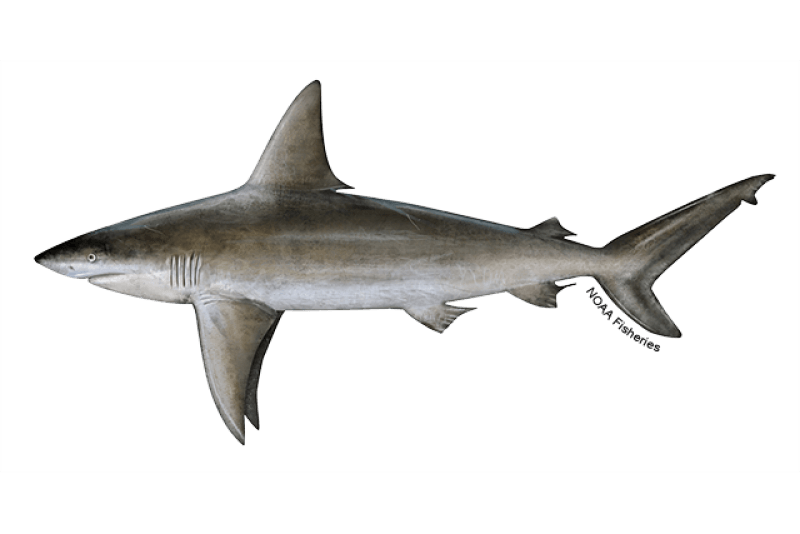
Carcharhinus plumbeus , also known as Thickskin shark, Brown shark. The sandbar shark is one of the largest shark species found in coastal waters. True to their name, sandbar sharks prefer sandy or muddy areas in temperate and tropical waters throu
Source: Species facts, status language, and imagery adapted from the NOAA Fisheries species profile (last updated 06/29/2026). Ocean City charter and Maryland
record notes are editorial orientation for OCEANCITY.MD readers. Always confirm current seasons, sizes, and
bag limits before you fish—rules change.
The sandbar shark is one of the largest shark species found in coastal waters. True to their name, sandbar sharks prefer sandy or muddy areas in temperate and tropical waters throughout the world. They are closely related to dusky, bignose, and bull sharks.
A small number of vessels in the U.S. Atlantic Ocean and Gulf of America (formerly Gulf of Mexico) are permitted to fish for sandbar sharks as part of a shark research fishery. These are the only vessels that are allowed to fish for, land, and sell sandbar sharks. The data collected have been used in a variety of stock assessments and have assisted managers in understanding the fishery as a whole.
The sandbar shark is one of the primary shark species, in addition to other animals (e.g., groupers, seals and dolphins, other large fish) that fishermen and anglers believe are behind rising depredation rates . Shark depredation is the partial or complete removal of a hooked fish by a shark directly from a fishing line before the line can be retrieved. NOAA Fisheries is funding research to address depredation.
Maryland record catch
Confirm whether Maryland DNR publishes an Atlantic state-record category for Sandbar Shark on the current sport-fish record board.
Maryland’s Atlantic recreational seasons/sizes/creel summary does not publish a dedicated line for Sandbar Shark. Verify COMAR, DNR public notices, and federal rules for your exact waters before you keep fish.
Rule
Maryland / applicable detail
Maryland minimum size
Not listed — no dedicated Sandbar Shark line on the MD Atlantic recreational table
Maryland daily creel (bag)
Not listed — no MD species-specific bag for Sandbar Shark
Maryland open season
Not listed on the MD Atlantic Ocean / Coastal Bays summary table
Verify
Check DNR eRegulations, COMAR, and NOAA for your date and coordinates before you keep fish.
Sandbar sharks have brownish-gray bodies and white bellies. They have a tall dorsal fin on their back and large pectoral fins on either side of their body. Their snouts are rounded and shorter than the average shark. They have a ridge of skin along their mid back known as the interdorsal ridge .
Biology Sandbar sharks are estimated to live approximately 30 years. Both males and females reach maturity around 13 to 14 years old. After 8 to 12 months of gestation, females give birth to live young in shallow, nearshore nursery grounds. Sandbar shark pups measure around 2 feet at birth. As adults, they can measure up to 8 feet long and weigh as much as 200 pounds.
Sandbar sharks are opportunistic feeders that eat bony fish, smaller sharks, octopuses, squid, eels, skates, rays, shrimp, and crabs.
Where They Live Range Sandbar sharks are found in temperate and tropical waters worldwide. They are common along the eastern U.S. coast from Cape Cod to Florida. Their range also includes the Gulf of America and parts of the Caribbean.
Habitat Sandbar sharks live along the ocean bottom in shallow coastal waters, including in bays, harbors, and estuaries. They occasionally travel offshore to depths of up to 810 feet.
Fishery Management NOAA Fisheries manages sandbar sharks under the Consolidated Highly Migratory Species Fishery Management Plan . While retaining sandbar sharks is generally prohibited in federal waters, several commercial vessels are permitted to harvest sandbar sharks in the shark research fishery . The shark research fishery allows NOAA Fisheries to leverage the small annual quota available to sustainably harvest sandbar sharks to collect vital scientific information. Shark research fishery participants must have a NOAA Fisheries-approved observer on board, and comply with permit requirements, annual quotas, trip limits, gear restrictions, finning prohibitions, closed areas, and reporting requirements. A rebuilding plan was implemented in 2005 with the goal of rebuilding the stock by 2070.
Appearance
Sandbar sharks are estimated to live approximately 30 years. Both males and females reach maturity around 13 to 14 years old. After 8 to 12 months of gestation, females give birth to live young in shallow, nearshore nursery grounds. Sandbar shark pups measure around 2 feet at birth. As adults, they can measure up to 8 feet long and weigh as much as 200 pounds.
Sandbar sharks are opportunistic feeders that eat bony fish, smaller sharks, octopuses, squid, eels, skates, rays, shrimp, and crabs.
Where They Live Range Sandbar sharks are found in temperate and tropical waters worldwide. They are common along the eastern U.S. coast from Cape Cod to Florida. Their range also includes the Gulf of America and parts of the Caribbean.
Habitat Sandbar sharks live along the ocean bottom in shallow coastal waters, including in bays, harbors, and estuaries. They occasionally travel offshore to depths of up to 810 feet.
Fishery Management NOAA Fisheries manages sandbar sharks under the Consolidated Highly Migratory Species Fishery Management Plan . While retaining sandbar sharks is generally prohibited in federal waters, several commercial vessels are permitted to harvest sandbar sharks in the shark research fishery . The shark research fishery allows NOAA Fisheries to leverage the small annual quota available to sustainably harvest sandbar sharks to collect vital scientific information. Shark research fishery participants must have a NOAA Fisheries-approved observer on board, and comply with permit requirements, annual quotas, trip limits, gear restrictions, finning prohibitions, closed areas, and reporting requirements. A rebuilding plan was implemented in 2005 with the goal of rebuilding the stock by 2070.
Sandbar sharks can only be sold to federally permitted shark dealers while the shark research fishery is open. Shark dealers are required to attend Atlantic shark identification workshops to help them better identify shark species.
There is no recreational fishery for sandbar sharks. If a fisherman catches one unintentionally, they must release it immediately, with minimal injury, and without removing it from the water.
Scientific Classification Kingdom Animalia Phylum Chordata Class Chondrichthyes Order Carcharhiniformes Family Carcharhinidae Genus Carcharhinus Species plumbeus Last updated by NOAA Fisheries on 06/29/2026
Biology
Sandbar sharks are found in temperate and tropical waters worldwide. They are common along the eastern U.S. coast from Cape Cod to Florida. Their range also includes the Gulf of America and parts of the Caribbean.
Habitat Sandbar sharks live along the ocean bottom in shallow coastal waters, including in bays, harbors, and estuaries. They occasionally travel offshore to depths of up to 810 feet.
Fishery Management NOAA Fisheries manages sandbar sharks under the Consolidated Highly Migratory Species Fishery Management Plan . While retaining sandbar sharks is generally prohibited in federal waters, several commercial vessels are permitted to harvest sandbar sharks in the shark research fishery . The shark research fishery allows NOAA Fisheries to leverage the small annual quota available to sustainably harvest sandbar sharks to collect vital scientific information. Shark research fishery participants must have a NOAA Fisheries-approved observer on board, and comply with permit requirements, annual quotas, trip limits, gear restrictions, finning prohibitions, closed areas, and reporting requirements. A rebuilding plan was implemented in 2005 with the goal of rebuilding the stock by 2070.
Sandbar sharks can only be sold to federally permitted shark dealers while the shark research fishery is open. Shark dealers are required to attend Atlantic shark identification workshops to help them better identify shark species.
There is no recreational fishery for sandbar sharks. If a fisherman catches one unintentionally, they must release it immediately, with minimal injury, and without removing it from the water.
Scientific Classification Kingdom Animalia Phylum Chordata Class Chondrichthyes Order Carcharhiniformes Family Carcharhinidae Genus Carcharhinus Species plumbeus Last updated by NOAA Fisheries on 06/29/2026
Where they live
Range
Sandbar sharks are found in temperate and tropical waters worldwide. They are common along the eastern U.S. coast from Cape Cod to Florida. Their range also includes the Gulf of America and parts of the Caribbean.
Habitat Sandbar sharks live along the ocean bottom in shallow coastal waters, including in bays, harbors, and estuaries. They occasionally travel offshore to depths of up to 810 feet.
Habitat
NOAA Fisheries manages sandbar sharks under the Consolidated Highly Migratory Species Fishery Management Plan . While retaining sandbar sharks is generally prohibited in federal waters, several commercial vessels are permitted to harvest sandbar sharks in the shark research fishery . The shark research fishery allows NOAA Fisheries to leverage the small annual quota available to sustainably harvest sandbar sharks to collect vital scientific information. Shark research fishery participants must have a NOAA Fisheries-approved observer on board, and comply with permit requirements, annual quotas, trip limits, gear restrictions, finning prohibitions, closed areas, and reporting requirements. A rebuilding plan was implemented in 2005 with the goal of rebuilding the stock by 2070.
Sandbar sharks can only be sold to federally permitted shark dealers while the shark research fishery is open. Shark dealers are required to attend Atlantic shark identification workshops to help them better identify shark species.
There is no recreational fishery for sandbar sharks. If a fisherman catches one unintentionally, they must release it immediately, with minimal injury, and without removing it from the water.
Scientific Classification Kingdom Animalia Phylum Chordata Class Chondrichthyes Order Carcharhiniformes Family Carcharhinidae Genus Carcharhinus Species plumbeus Last updated by NOAA Fisheries on 06/29/2026
Ocean City & Mid-Atlantic context
From Ocean City, Maryland, use this Sandbar Shark profile as NOAA Mid-Atlantic directory context—not a promise you will meet the species on every charter.
Always verify current Maryland and federal size, season, and bag rules for your exact date and coordinates before you keep any catch.
Source facts and imagery are adapted from the NOAA Fisheries species profile for Sandbar Shark.
What charter to book from Ocean City
Sandbar Shark may show on Ocean City shark, wreck, or offshore days depending on season and permits—confirm HMS/state rules before you book or keep fish.
Possible / related
Inshore charter — Possible overlap depending on season, water, and boat program.