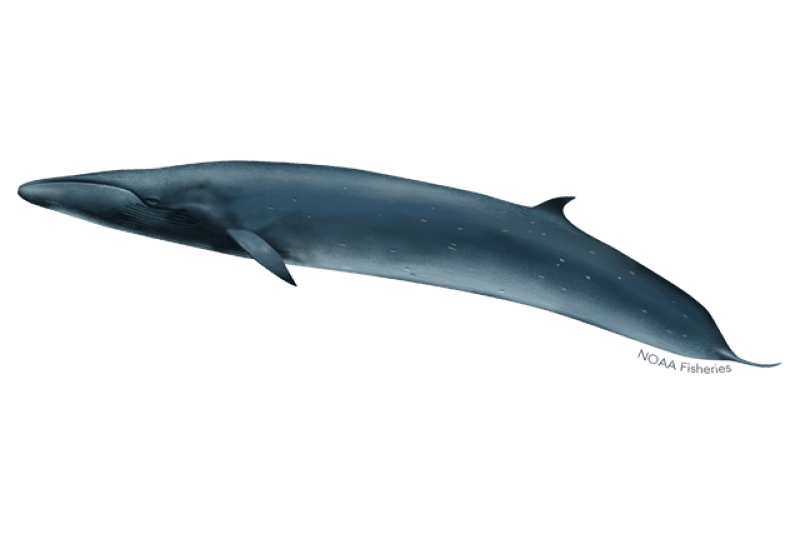
Balaenoptera borealis . Sei whales are members of the baleen or “great” whale family, called rorquals . Sei whales occur in subtropical, temperate, and subpolar waters around the world. Often found with p
Source: Species facts, status language, and imagery adapted from the NOAA Fisheries species profile (last updated 03/23/2026). Ocean City charter and Maryland
record notes are editorial orientation for OCEANCITY.MD readers. Always confirm current seasons, sizes, and
bag limits before you fish—rules change.
Illustration/photo: NOAA Fisheries — Sei Whale (Balaenoptera borealis).
Quick facts
Length: 40 to 60 feet
Lifespan: 50 to 70 years
Region: Alaska,
New England/Mid-Atlantic,
Pacific Islands,
Southeast,
West Coast
Category: Protected species · Mid-Atlantic
Maryland likelihood: 2★ out of 5
About the species
Sei whales are members of the baleen or “great” whale family, called rorquals . Sei whales occur in subtropical, temperate, and subpolar waters around the world. Often found with pollock in Norway, the name "sei" comes from the Norwegian word for pollock, "seje."
The global sei whale population was greatly decreased by historical commercial whaling during the 19th and 20th centuries. An estimated 300,000 sei whales were killed for their meat and oil.
Member countries of the International Whaling Commission (IWC) agreed to cease sei whale catches in the North Pacific in 1975 and in the Antarctic in 1979. In 1982, the IWC decided to cease commercial whaling on all whale species and populations from the 1985/1986 season onward. Although whaling is no longer a major threat, some whaling of this species continues today in Japan. Vessel strikes and entanglement pose the biggest threat to sei whales today.
NOAA Fisheries and our partners are dedicated to conserving and rebuilding the sei whale population. We use a variety of innovative techniques to study, protect, and rescue these endangered whales. We engage our partners as we develop regulations and management plans that foster healthy fisheries and reduce the risk of entanglements, create whale-safe shipping practices, and reduce ocean noise.
Maryland record catch
Confirm whether Maryland DNR publishes an Atlantic state-record category for Sei Whale on the current sport-fish record board.
Sei whales have a long, sleek body that is dark bluish-gray to black in color and white or cream-colored on the underside. The body is often covered in oval-shaped scars (probably caused from cookie-cutter shark and lamprey bites) and sometimes has subtle "mottling," or discolored spots or blotches.
Sei whales have a tall, hooked dorsal fin located about two-thirds of the way down their back. Sei whales have 219 to 410 baleen plates (long plates made out of keratin, the same material as our fingernails, instead of teeth) that are dark in color with gray/white fine inner fringes in their enormous mouths. They also have 30 to 65 relatively short accordion-like creases, or throat grooves, that extend from below the mouth to the naval area. The number of throat grooves and baleen plates may differ depending on geographic population.
At the water's surface, sei whales can be recognized by a columnar or bushy blow that is about 10 to 13 feet high. The dorsal fin usually appears at the same time as the blowhole when the animal surfaces to breathe.
Behavior and Diet Sei whales are usually observed alone or in small groups of two to five animals. They are fast swimmers that can reach speeds of over 34 miles per hour.
Sei whales dive differently than most whales. They do not arch their backs or show their flukes before diving; they simply sink below the surface. They often leave “fluke prints”—smooth circles on the surface created by the movement of the fluke underwater.
An average sei whale eats about 2,000 pounds of food per day. They can dive 5 to 20 minutes to feed on plankton (including copepods and krill), small schooling fish, and cephalopods (including squid) by both gulping and skim feeding. They prefer to feed at dawn and may exhibit unpredictable behavior, like cutting back and forth through prey swarms with sudden turns, rolls, and varied speeds, while foraging and feeding on prey.
Appearance
Sei whales are usually observed alone or in small groups of two to five animals. They are fast swimmers that can reach speeds of over 34 miles per hour.
Sei whales dive differently than most whales. They do not arch their backs or show their flukes before diving; they simply sink below the surface. They often leave “fluke prints”—smooth circles on the surface created by the movement of the fluke underwater.
An average sei whale eats about 2,000 pounds of food per day. They can dive 5 to 20 minutes to feed on plankton (including copepods and krill), small schooling fish, and cephalopods (including squid) by both gulping and skim feeding. They prefer to feed at dawn and may exhibit unpredictable behavior, like cutting back and forth through prey swarms with sudden turns, rolls, and varied speeds, while foraging and feeding on prey.
Where They Live Sei whales have a wide distribution and live in subtropical, temperate, and subpolar waters around the world. They prefer temperate waters in the mid-latitudes, and can be found in the Atlantic, Indian, and Pacific Oceans. During the summer, they are commonly found in the Gulf of Maine, and on Georges Bank and Stellwagen Bank off the U.S. coast in the western North Atlantic. The movement patterns of sei whales are not well known, but they are typically observed in deeper waters far from the coastline. Sei whales have an unpredictable distribution. Many whales may be found in one area for a period and then not return for years or decades. This behavior is unusual for large whales, who generally have a predictable distribution.
World map providing approximate representation of the sei whale's range. Lifespan & Reproduction Sei whales become sexually mature at 6 to 12 years of age when they reach about 45 feet in length. They generally mate and give birth during the winter in lower latitudes.
Females breed every 2 to 3 years, with a gestation period of 11 to 13 months. Calves are about 15 feet long and weigh about 1,500 pounds at birth. Mothers nurse their calves for 6 to 9 months before weaning them at their preferred feeding grounds.
Threats Vessel Strikes Inadvertent vessel strikes can injure or kill sei whales. The projected increase in ship traffic arising from the opening of trans-polar shipping routes (as arctic sea ice melts) will likely increase the risk of vessel strikes as well as ambient noise and pollution.
Entanglement One of the main threats to sei whales is getting caught in fishing gear. They can become entangled in gear such as traps, pots, and gillnets. Once entangled, whales may swim for long distances with gear attached, resulting in fatigue, compromised feeding ability, or severe injury. These conditions can lead to reduced reproductive success and death.
Ocean Noise Underwater noise threatens whale populations, interrupting their normal behavior and driving them away from areas important to their survival. Increasing evidence suggests that exposure to intense underwater sound in some settings may cause some whales to strand and ultimately die.
Changing Environmental Conditions The impacts of climate change on baleen whales may result from altered oceanographic conditions, as well as the timing and distribution of sea ice coverage. Changes in prey distribution could lead to changes in foraging behavior, nutritional stress, and diminished reproduction for sei whales. Additionally, changing water temperature and currents could impact the timing of environmental cues important for navigation and foraging.
Scientific Classification Kingdom Animalia Phylum Chordata Class Mammalia Order Cetacea Family Balaenopteridae Genus Balaenoptera Species borealis Last updated by NOAA Fisheries on 03/23/2026
Biology
Sei whales have a wide distribution and live in subtropical, temperate, and subpolar waters around the world. They prefer temperate waters in the mid-latitudes, and can be found in the Atlantic, Indian, and Pacific Oceans. During the summer, they are commonly found in the Gulf of Maine, and on Georges Bank and Stellwagen Bank off the U.S. coast in the western North Atlantic. The movement patterns of sei whales are not well known, but they are typically observed in deeper waters far from the coastline. Sei whales have an unpredictable distribution. Many whales may be found in one area for a period and then not return for years or decades. This behavior is unusual for large whales, who generally have a predictable distribution.
World map providing approximate representation of the sei whale's range. Lifespan & Reproduction Sei whales become sexually mature at 6 to 12 years of age when they reach about 45 feet in length. They generally mate and give birth during the winter in lower latitudes.
Females breed every 2 to 3 years, with a gestation period of 11 to 13 months. Calves are about 15 feet long and weigh about 1,500 pounds at birth. Mothers nurse their calves for 6 to 9 months before weaning them at their preferred feeding grounds.
Threats Vessel Strikes Inadvertent vessel strikes can injure or kill sei whales. The projected increase in ship traffic arising from the opening of trans-polar shipping routes (as arctic sea ice melts) will likely increase the risk of vessel strikes as well as ambient noise and pollution.
Entanglement One of the main threats to sei whales is getting caught in fishing gear. They can become entangled in gear such as traps, pots, and gillnets. Once entangled, whales may swim for long distances with gear attached, resulting in fatigue, compromised feeding ability, or severe injury. These conditions can lead to reduced reproductive success and death.
Ocean Noise Underwater noise threatens whale populations, interrupting their normal behavior and driving them away from areas important to their survival. Increasing evidence suggests that exposure to intense underwater sound in some settings may cause some whales to strand and ultimately die.
Changing Environmental Conditions The impacts of climate change on baleen whales may result from altered oceanographic conditions, as well as the timing and distribution of sea ice coverage. Changes in prey distribution could lead to changes in foraging behavior, nutritional stress, and diminished reproduction for sei whales. Additionally, changing water temperature and currents could impact the timing of environmental cues important for navigation and foraging.
Scientific Classification Kingdom Animalia Phylum Chordata Class Mammalia Order Cetacea Family Balaenopteridae Genus Balaenoptera Species borealis Last updated by NOAA Fisheries on 03/23/2026
Where they live
Range
Sei whales have a wide distribution and live in subtropical, temperate, and subpolar waters around the world. They prefer temperate waters in the mid-latitudes, and can be found in the Atlantic, Indian, and Pacific Oceans. During the summer, they are commonly found in the Gulf of Maine, and on Georges Bank and Stellwagen Bank off the U.S. coast in the western North Atlantic. The movement patterns of sei whales are not well known, but they are typically observed in deeper waters far from the coastline. Sei whales have an unpredictable distribution. Many whales may be found in one area for a period and then not return for years or decades. This behavior is unusual for large whales, who generally have a predictable distribution.
World map providing approximate representation of the sei whale's range. Lifespan & Reproduction Sei whales become sexually mature at 6 to 12 years of age when they reach about 45 feet in length. They generally mate and give birth during the winter in lower latitudes.
Habitat
See the NOAA species profile for habitat detail for this entry.
Ocean City & Mid-Atlantic context
From Ocean City, Maryland, use this Sei Whale profile as NOAA Mid-Atlantic directory context—not a promise you will meet the species on every charter.
Sei Whale is protected. Do not harvest. Report unusual strandings or entanglements through official channels.
Source facts and imagery are adapted from the NOAA Fisheries species profile for Sei Whale.
What charter to book from Ocean City
Sei Whale is not a standard Ocean City charter harvest target. Use this profile for NOAA biology and Mid-Atlantic context only.
Not typical from OC
Bay guide — Not a typical Ocean City bay guide target for Sei Whale.
Inshore charter — Not a typical Ocean City inshore charter target for Sei Whale.
Casting / light tackle — Not a typical Ocean City casting / light tackle target for Sei Whale.
Trolling charter — Not a typical Ocean City trolling charter target for Sei Whale.
Nearshore wreck / bottom — Not a typical Ocean City nearshore wreck / bottom target for Sei Whale.
Offshore charter — Not a typical Ocean City offshore charter target for Sei Whale.
Head / party boat — Not a typical Ocean City head / party boat target for Sei Whale.
Start with the charter directory trip-type picker so you compare boats inside the right
archetype—not a bay-guide quote against a canyon invoice.
Recovery Action Under the ESA, NOAA Fisheries develops and implements recovery plans for the conservation and survival of listed species. The Recovery Plan for the Sei Whale was published in December 2011. The plan aims to recover the species, with an interim goal of down-listing the sei whale status from "endangered" to "threatened."
The major actions recommended in the plan are:
Reduce or eliminate injury or mortality caused by ship collision Reduce or eliminate injury and mortality caused by fisheries and fishing gear Protect habitats essential to the survival and recovery of sei whales Minimize effects of vessel disturbance Continue international ban on hunting and other directed take Monitor the population size and trends in abundance Maximize efforts to free entangled or stranded sei whales Acquire scientific information from dead specimens Learn more about the recovery plan for sei whales
Harvest
See the NOAA wild-caught fishery section for landings and gear notes when published for this species.
Landings and management details matter most for the waters where Sei Whale is actually fished—see the
NOAA species profile
.