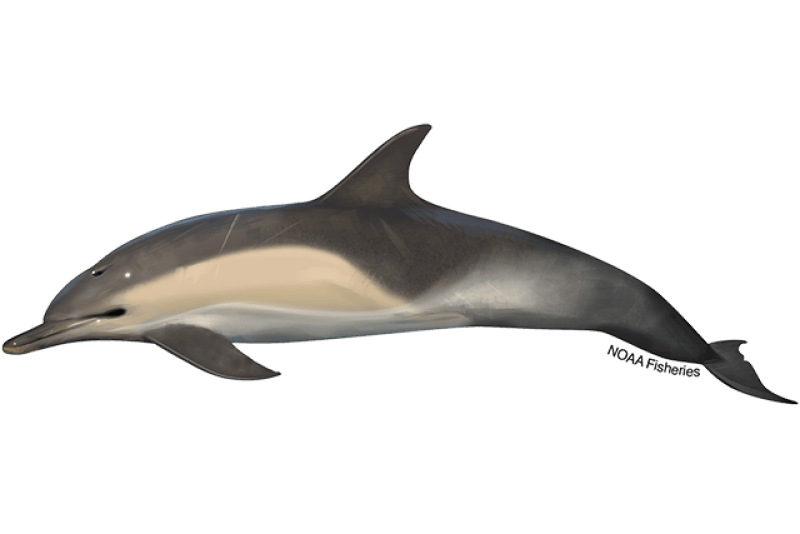
Delphinus delphis . Short-beaked common dolphins are one of the most abundant and familiar dolphins in the world. This highly social and energetic species is widely distributed in sub-tropical to temp
Source: Species facts, status language, and imagery adapted from the NOAA Fisheries species profile (last updated 03/06/2025). Ocean City charter and Maryland
record notes are editorial orientation for OCEANCITY.MD readers. Always confirm current seasons, sizes, and
bag limits before you fish—rules change.
Illustration/photo: NOAA Fisheries — Short-Beaked Common Dolphin (Delphinus delphis).
Quick facts
Length: About 6 feet
Lifespan: About 40 years
Region: New England/Mid-Atlantic,
Pacific Islands,
Southeast,
West Coast
Category: Protected species · Mid-Atlantic
Maryland likelihood: 4★ out of 5
About the species
Short-beaked common dolphins are one of the most abundant and familiar dolphins in the world. This highly social and energetic species is widely distributed in sub-tropical to temperate waters. Short-beaked common dolphins are often found in association with underwater ridges, seamounts, and continental shelves where upwelling (a process in which deep, cold, nutrient-rich water rises toward the surface) occurs and prey is abundant.
Short-beaked common dolphins are closely related to—and easily confused with— long-beaked common dolphins . Once thought to be a single species, the two species differ slightly in size, appearance, and habitat preference.
Short-beaked common dolphins in the United States are not endangered or threatened. Like all marine mammals, they are protected under the Marine Mammal Protection Act (MMPA).
Maryland record catch
Confirm whether Maryland DNR publishes an Atlantic state-record category for Short-Beaked Common Dolphin on the current sport-fish record board.
Short-Beaked Common Dolphin is a protected marine species in U.S. waters. Do not harvest. This guide is biology and Ocean City context only—not a fishing target.
Short-beaked common dolphins range from 6 to 8 feet long and weigh, on average, 170 pounds. Adult males are slightly larger than females. They have a rounded forehead (known as a melon), a moderately long rostrum, and 40 to 57 pairs of small, sharp teeth in each jaw. Their bodies are sleek with a relatively tall, triangular dorsal fin in the middle of their back.
Short-beaked common dolphins can be identified by their distinctive color pattern, which is often referred to as an “hourglass pattern.” A dark gray cape extends along the back from the head to just below the dorsal fin where a "V" is visible on either side of the body, creating an hourglass image. Forward of the dorsal fin, behind the head, is a yellow/tan panel that contrasts with the dark cape on their back. The side of the body behind the dorsal fin is light gray, and narrow. A dark stripe extends from the lower jaw to the flipper, which includes a complex facial color pattern. The eye is not typically within the stripe, but still stands out due to a patch of dark pigment around the eye.
The color patterns of young and juvenile short-beaked common dolphins are somewhat more muted and paler than older, adult dolphins. Considerable variation in color patterns are evident within populations but more markedly different coloration patterns are evident in other geographic areas.
Behavior and Diet Short-beaked common dolphins are usually found in large social groups averaging hundreds of individuals and are occasionally seen in larger groups—known as mega-pods—consisting of thousands of animals (up to 10,000 individuals). These large groups are thought to consist of sub-groups of 20 to 30 individuals that are possibly related or separated by age and/or sex.
Short-beaked common dolphins are often active at the surface. These highly social and energetic dolphins commonly leap out of the water at high speeds, flip end-over-end, and somersault in the air. They may also swim alongside ships riding the bow for long periods of time. This “bow riding” behavior has also been observed alongside large whales.
Short-beaked common dolphins usually rest during the day and feed at night. They can dive to approximately 1,000 feet but typically dive to about 100 feet to feed on schooling fish and cephalopods (e.g., squid) that migrate towards the surface at night. Short-beaked common dolphins associate with schools of tuna and seabird-feeding flocks, especially in the eastern tropical Pacific Ocean. They have also been observed in mixed groups with spinner dolphins and striped dolphins .
Appearance
Short-beaked common dolphins are usually found in large social groups averaging hundreds of individuals and are occasionally seen in larger groups—known as mega-pods—consisting of thousands of animals (up to 10,000 individuals). These large groups are thought to consist of sub-groups of 20 to 30 individuals that are possibly related or separated by age and/or sex.
Short-beaked common dolphins are often active at the surface. These highly social and energetic dolphins commonly leap out of the water at high speeds, flip end-over-end, and somersault in the air. They may also swim alongside ships riding the bow for long periods of time. This “bow riding” behavior has also been observed alongside large whales.
Short-beaked common dolphins usually rest during the day and feed at night. They can dive to approximately 1,000 feet but typically dive to about 100 feet to feed on schooling fish and cephalopods (e.g., squid) that migrate towards the surface at night. Short-beaked common dolphins associate with schools of tuna and seabird-feeding flocks, especially in the eastern tropical Pacific Ocean. They have also been observed in mixed groups with spinner dolphins and striped dolphins .
Where They Live Short-beaked common dolphins prefer sub-tropical to temperate waters that are primarily offshore. They can be found along the continental slope in waters between approximately 300 to 6,500 feet deep. In the western North Atlantic, they are often associated with the Gulf Stream current. Short-beaked common dolphins are often associated with underwater geologic features such as underwater ridges and seamounts where upwelling occurs, increasing nutrient concentrations and supporting higher productivity. The abundance and distribution of short-beaked common dolphins vary based on interannual changes, oceanographic conditions, and seasons. They can be found on the continental shelf or farther offshore. On the U.S. west coast, these dolphins are primarily associated with the California Current and are abundant off California year-round from nearshore to about 300 miles offshore. On the U.S. east coast, they are more common north of Cape Hatteras, North Carolina. From summer through autumn, large aggregations of short-beaked common dolphins can be found near Georges Bank (extending from Cape Cod, Massachusetts, to Nova Scotia, Canada), Newfoundland, and the Scotian Shelf. Other distinct populations can be found off of northern Europe, Newfoundland, Africa, Japan, southern Australia, New Zealand, the Black Sea, the Mediterranean Sea, and the southwestern Pacific.
Lifespan & Reproduction Short-beaked common dolphins have an estimated lifespan of up to 35 years. On average, males become sexually mature at 10 years and females at 8 years, although individuals may become sexually mature between 5 and 12 years. Off the California coast, calving takes place during the winter months after a 10- to 11-month gestation period, whereas calving takes place year-round in the eastern tropical Pacific Ocean. Every 2 to 3 years, adult females give birth to a single calf that is about 2.5 to 3 feet long. Calves begin to wean after about 1 year, but remain dependent on their mother for an additional year or more.
Threats Entanglement in Fishing Gear One of the main threats to short-beaked common dolphins is getting caught in fishing gear. They can become entangled in commercial fishing gear such as gillnets, seines, trawls, trap pots, and longlines. In many fisheries in the Atlantic Ocean, short-beaked common dolphins are caught as bycatch, and they have the highest mortality rate of all cetaceans affected by the drift gillnet fishery operating off the coast of California.
Hunting Russia, Japan, and nations bordering the Black Sea and the Mediterranean Sea, hunt short-beaked common dolphins for their meat and oil.
Scientific Classification Kingdom Animalia Phylum Chordata Class Mammalia Order Cetacea Family Delphinidae Genus Delphinus Species delphis Last updated by NOAA Fisheries on 03/06/2025
Biology
Short-beaked common dolphins prefer sub-tropical to temperate waters that are primarily offshore. They can be found along the continental slope in waters between approximately 300 to 6,500 feet deep. In the western North Atlantic, they are often associated with the Gulf Stream current. Short-beaked common dolphins are often associated with underwater geologic features such as underwater ridges and seamounts where upwelling occurs, increasing nutrient concentrations and supporting higher productivity. The abundance and distribution of short-beaked common dolphins vary based on interannual changes, oceanographic conditions, and seasons. They can be found on the continental shelf or farther offshore. On the U.S. west coast, these dolphins are primarily associated with the California Current and are abundant off California year-round from nearshore to about 300 miles offshore. On the U.S. east coast, they are more common north of Cape Hatteras, North Carolina. From summer through autumn, large aggregations of short-beaked common dolphins can be found near Georges Bank (extending from Cape Cod, Massachusetts, to Nova Scotia, Canada), Newfoundland, and the Scotian Shelf. Other distinct populations can be found off of northern Europe, Newfoundland, Africa, Japan, southern Australia, New Zealand, the Black Sea, the Mediterranean Sea, and the southwestern Pacific.
Lifespan & Reproduction Short-beaked common dolphins have an estimated lifespan of up to 35 years. On average, males become sexually mature at 10 years and females at 8 years, although individuals may become sexually mature between 5 and 12 years. Off the California coast, calving takes place during the winter months after a 10- to 11-month gestation period, whereas calving takes place year-round in the eastern tropical Pacific Ocean. Every 2 to 3 years, adult females give birth to a single calf that is about 2.5 to 3 feet long. Calves begin to wean after about 1 year, but remain dependent on their mother for an additional year or more.
Threats Entanglement in Fishing Gear One of the main threats to short-beaked common dolphins is getting caught in fishing gear. They can become entangled in commercial fishing gear such as gillnets, seines, trawls, trap pots, and longlines. In many fisheries in the Atlantic Ocean, short-beaked common dolphins are caught as bycatch, and they have the highest mortality rate of all cetaceans affected by the drift gillnet fishery operating off the coast of California.
Hunting Russia, Japan, and nations bordering the Black Sea and the Mediterranean Sea, hunt short-beaked common dolphins for their meat and oil.
Scientific Classification Kingdom Animalia Phylum Chordata Class Mammalia Order Cetacea Family Delphinidae Genus Delphinus Species delphis Last updated by NOAA Fisheries on 03/06/2025
Where they live
Range
Short-beaked common dolphins prefer sub-tropical to temperate waters that are primarily offshore. They can be found along the continental slope in waters between approximately 300 to 6,500 feet deep. In the western North Atlantic, they are often associated with the Gulf Stream current. Short-beaked common dolphins are often associated with underwater geologic features such as underwater ridges and seamounts where upwelling occurs, increasing nutrient concentrations and supporting higher productivity. The abundance and distribution of short-beaked common dolphins vary based on interannual changes, oceanographic conditions, and seasons. They can be found on the continental shelf or farther offshore. On the U.S. west coast, these dolphins are primarily associated with the California Current and are abundant off California year-round from nearshore to about 300 miles offshore. On the U.S. east coast, they are more common north of Cape Hatteras, North Carolina. From summer through autumn, large aggregations of short-beaked common dolphins can be found near Georges Bank (extending from Cape Cod, Massachusetts, to Nova Scotia, Canada), Newfoundland, and the Scotian Shelf. Other distinct populations can be found off of northern Europe, Newfoundland, Africa, Japan, southern Australia, New Zealand, the Black Sea, the Mediterranean Sea, and the southwestern Pacific.
Lifespan & Reproduction Short-beaked common dolphins have an estimated lifespan of up to 35 years. On average, males become sexually mature at 10 years and females at 8 years, although individuals may become sexually mature between 5 and 12 years. Off the California coast, calving takes place during the winter months after a 10- to 11-month gestation period, whereas calving takes place year-round in the eastern tropical Pacific Ocean. Every 2 to 3 years, adult females give birth to a single calf that is about 2.5 to 3 feet long. Calves begin to wean after about 1 year, but remain dependent on their mother for an additional year or more.
Habitat
See the NOAA species profile for habitat detail for this entry.
Ocean City & Mid-Atlantic context
From Ocean City, Maryland, use this Short-Beaked Common Dolphin profile as NOAA Mid-Atlantic directory context—not a promise you will meet the species on every charter.
Short-Beaked Common Dolphin is protected. Do not harvest. Report unusual strandings or entanglements through official channels.
Source facts and imagery are adapted from the NOAA Fisheries species profile for Short-Beaked Common Dolphin.
What charter to book from Ocean City
Short-Beaked Common Dolphin is not a standard Ocean City charter harvest target. Use this profile for NOAA biology and Mid-Atlantic context only.
Not typical from OC
Bay guide — Not a typical Ocean City bay guide target for Short-Beaked Common Dolphin.
Inshore charter — Not a typical Ocean City inshore charter target for Short-Beaked Common Dolphin.
Casting / light tackle — Not a typical Ocean City casting / light tackle target for Short-Beaked Common Dolphin.
Trolling charter — Not a typical Ocean City trolling charter target for Short-Beaked Common Dolphin.
Nearshore wreck / bottom — Not a typical Ocean City nearshore wreck / bottom target for Short-Beaked Common Dolphin.
Offshore charter — Not a typical Ocean City offshore charter target for Short-Beaked Common Dolphin.
Head / party boat — Not a typical Ocean City head / party boat target for Short-Beaked Common Dolphin.
Start with the charter directory trip-type picker so you compare boats inside the right
archetype—not a bay-guide quote against a canyon invoice.