Globicephala macrorhynchus . Short-finned pilot whales are found globally in tropical and temperate oceans. They are one of two species of pilot whale, along with the long-finned pilot whale . The two species
Source: Species facts, status language, and imagery adapted from the NOAA Fisheries species profile (last updated 04/07/2026). Ocean City charter and Maryland
record notes are editorial orientation for OCEANCITY.MD readers. Always confirm current seasons, sizes, and
bag limits before you fish—rules change.
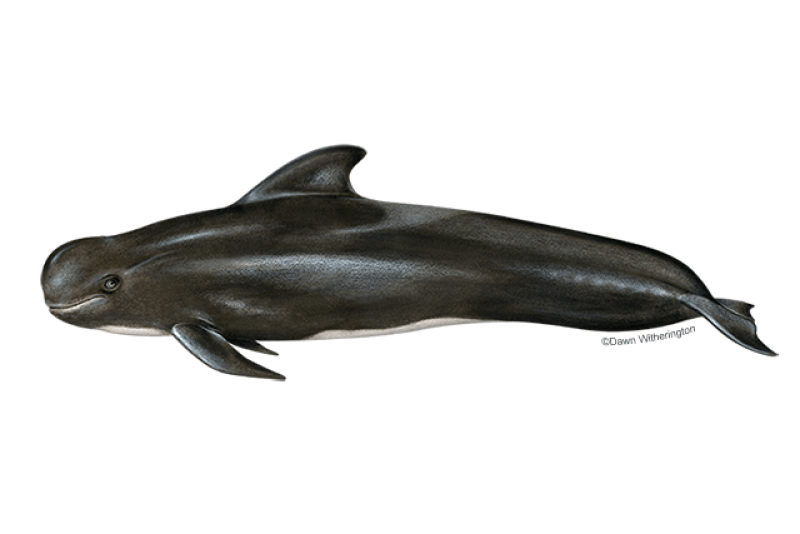
Illustration/photo: NOAA Fisheries — Short-Finned Pilot Whale (Globicephala macrorhynchus).
Quick facts
Length: 12 to 24 feet
Lifespan: 35 to 60 years
Region: Alaska,
New England/Mid-Atlantic,
Pacific Islands,
Southeast,
West Coast
Category: Protected species · Mid-Atlantic
Maryland likelihood: 2★ out of 5
About the species
Short-finned pilot whales are found globally in tropical and temperate oceans. They are one of two species of pilot whale, along with the long-finned pilot whale . The two species differ slightly in physical size, flipper lengths, and coloration patterns.. In the field and at sea, it is very difficult to tell the difference between the two species.
Short-finned pilot whales are long-lived, slow to reproduce, and highly social. They live in stable female-based groups of about 15 to 30 animals composed of close family relatives, but pods of up to several hundred individuals have been seen. They tend to live in localized, resident populations, although some populations have wider ranges. Their diet consists primarily of squid, with a small amount of fish. They are commonly found along the coast close to the continental shelf, although some populations have been found to extend into deep, open ocean environments such as in the eastern tropical Pacific Ocean. Pilot whales are often involved in mass strandings which is perhaps due to their strong social bonds.
Five stocks of short-finned pilot whales are recognized in U.S. waters, which live along the U.S. east and west coasts, around the Hawaiian Islands, and in waters around Puerto Rico and the U.S. Virgin Islands. On the west coast, short-finned pilot whales were once commonly seen, with an apparent resident population around Santa Catalina Island. After a strong El Niño in 1982 and 1983, short-finned pilot whales virtually disappeared from this area, and there are now thought to be about 800 animals in the West Coast stock. About 18,700 animals comprise the East Coast stock, around 1,300 in the Gulf of America* (formerly Gulf of Mexico) stock, about 19,000 animals in the Hawaiian stock, and an unknown population size for the Puerto Rico and U.S. Virgin Islands stock.
Maryland record catch
Confirm whether Maryland DNR publishes an Atlantic state-record category for Short-Finned Pilot Whale on the current sport-fish record board.
Short-Finned Pilot Whale is a protected marine species in U.S. waters. Do not harvest. This guide is biology and Ocean City context only—not a fishing target.
The short-finned pilot whale has a large bulbous melon head with no obvious rostrum. Their dorsal fin is situated about one-third of the way back from the head, is low with a wide base and falcate shape. Their flippers are slender and pointed, smaller than those of long-finned pilot whales. Their body is black to dark grayish-brown, and has a large gray saddle behind the dorsal fin and a gray to white anchor-shaped patch on their chest. They have 7-9 short, sharply pointed teeth in each tooth row. Adult male short-finned pilot whales are significantly larger than females, with a larger head and very large, hooked dorsal fins.
Behavior and Diet Short-finned pilot whales feed mainly on squid, but they may also feed on octopus and fish, all from moderately deep water of 1,000 feet or more. When they are traveling and foraging, a pilot whale group can spread out over an area a half-mile wide.
Short-finned pilot whales often occur in groups of 25 to 50 animals. Males have more than one mate—typically a group has one mature male for every eight mature females. Males generally leave their birth group, while females may stay in theirs for their entire lives.
They are known as the “cheetahs of the deep sea” for their deep, high-speed dives to chase and capture large squid.
Where They Live Short-finned pilot whales prefer warmer tropical and temperate waters. They can be found at varying distances from shore but typically prefer deeper waters. Areas with a high density of squid are their main foraging habitats.
World map providing approximate representation of the short-finned pilot whale's range. Lifespan & Reproduction Short-finned pilot whales mature at around 10 years of age. The maximum lifespan is 45 years for males and 60 years for females.
Appearance
Short-finned pilot whales feed mainly on squid, but they may also feed on octopus and fish, all from moderately deep water of 1,000 feet or more. When they are traveling and foraging, a pilot whale group can spread out over an area a half-mile wide.
Short-finned pilot whales often occur in groups of 25 to 50 animals. Males have more than one mate—typically a group has one mature male for every eight mature females. Males generally leave their birth group, while females may stay in theirs for their entire lives.
They are known as the “cheetahs of the deep sea” for their deep, high-speed dives to chase and capture large squid.
Where They Live Short-finned pilot whales prefer warmer tropical and temperate waters. They can be found at varying distances from shore but typically prefer deeper waters. Areas with a high density of squid are their main foraging habitats.
World map providing approximate representation of the short-finned pilot whale's range. Lifespan & Reproduction Short-finned pilot whales mature at around 10 years of age. The maximum lifespan is 45 years for males and 60 years for females.
Females have calves every 5 to 8 years. Older females do not give birth as often as younger females. They are pregnant for about 15 months, then nurse for at least 2 years. The last calf born to a mother may be nursed for as long as 15 years.
Threats Fisheries Bycatch Short-finned pilot whales can become entangled in fishing gear, either swimming off with the gear attached or becoming anchored. They can get hooked, captured or entangled in many different gear types, including gillnets, pelagic longlines, and trawls. Hooked whales may swim off with attached gear that can compromise feeding ability or lead to severe injury, which may result in reduced reproductive success and death. Whales captured in trawl nets often drown as they cannot reach the surface to breathe.
Hunting Short-finned pilot whales are directly targeted and hunted in Japan and the Lesser Antilles.
Vessel Strikes Vessel strikes can injure or kill short-finned pilot whales. Short-finned pilot whales with scars indicative of vessel strikes have been observed in Hawaiian waters.
*Executive Order 14172, “Restoring Names That Honor American Greatness” (Jan. 20, 2025), directs that the Gulf of Mexico be renamed the Gulf of America. On August 7, 2025, NOAA Fisheries and the National Ocean Service amended regulations in the Code of Federal Regulations to reflect the renaming. The name change did not result in any changes to, and had no effect on the applicability or enforceability of, any existing regulations. This website continues to use “Gulf of Mexico” when quoting statutes or previously published materials.
Scientific Classification Kingdom Animalia Phylum Chordata Class Mammalia Order Cetacea Family Delphinidae Genus Globicephala Species macrorhynchus Last updated by NOAA Fisheries on 04/07/2026
Biology
Short-finned pilot whales prefer warmer tropical and temperate waters. They can be found at varying distances from shore but typically prefer deeper waters. Areas with a high density of squid are their main foraging habitats.
World map providing approximate representation of the short-finned pilot whale's range. Lifespan & Reproduction Short-finned pilot whales mature at around 10 years of age. The maximum lifespan is 45 years for males and 60 years for females.
Females have calves every 5 to 8 years. Older females do not give birth as often as younger females. They are pregnant for about 15 months, then nurse for at least 2 years. The last calf born to a mother may be nursed for as long as 15 years.
Threats Fisheries Bycatch Short-finned pilot whales can become entangled in fishing gear, either swimming off with the gear attached or becoming anchored. They can get hooked, captured or entangled in many different gear types, including gillnets, pelagic longlines, and trawls. Hooked whales may swim off with attached gear that can compromise feeding ability or lead to severe injury, which may result in reduced reproductive success and death. Whales captured in trawl nets often drown as they cannot reach the surface to breathe.
Hunting Short-finned pilot whales are directly targeted and hunted in Japan and the Lesser Antilles.
Vessel Strikes Vessel strikes can injure or kill short-finned pilot whales. Short-finned pilot whales with scars indicative of vessel strikes have been observed in Hawaiian waters.
*Executive Order 14172, “Restoring Names That Honor American Greatness” (Jan. 20, 2025), directs that the Gulf of Mexico be renamed the Gulf of America. On August 7, 2025, NOAA Fisheries and the National Ocean Service amended regulations in the Code of Federal Regulations to reflect the renaming. The name change did not result in any changes to, and had no effect on the applicability or enforceability of, any existing regulations. This website continues to use “Gulf of Mexico” when quoting statutes or previously published materials.
Scientific Classification Kingdom Animalia Phylum Chordata Class Mammalia Order Cetacea Family Delphinidae Genus Globicephala Species macrorhynchus Last updated by NOAA Fisheries on 04/07/2026
Where they live
Range
Short-finned pilot whales prefer warmer tropical and temperate waters. They can be found at varying distances from shore but typically prefer deeper waters. Areas with a high density of squid are their main foraging habitats.
World map providing approximate representation of the short-finned pilot whale's range. Lifespan & Reproduction Short-finned pilot whales mature at around 10 years of age. The maximum lifespan is 45 years for males and 60 years for females.
Habitat
See the NOAA species profile for habitat detail for this entry.
Ocean City & Mid-Atlantic context
From Ocean City, Maryland, use this Short-Finned Pilot Whale profile as NOAA Mid-Atlantic directory context—not a promise you will meet the species on every charter.
Short-Finned Pilot Whale is protected. Do not harvest. Report unusual strandings or entanglements through official channels.
Source facts and imagery are adapted from the NOAA Fisheries species profile for Short-Finned Pilot Whale.
What charter to book from Ocean City
Short-Finned Pilot Whale is not a standard Ocean City charter harvest target. Use this profile for NOAA biology and Mid-Atlantic context only.
Not typical from OC
Bay guide — Not a typical Ocean City bay guide target for Short-Finned Pilot Whale.
Inshore charter — Not a typical Ocean City inshore charter target for Short-Finned Pilot Whale.
Casting / light tackle — Not a typical Ocean City casting / light tackle target for Short-Finned Pilot Whale.
Trolling charter — Not a typical Ocean City trolling charter target for Short-Finned Pilot Whale.
Nearshore wreck / bottom — Not a typical Ocean City nearshore wreck / bottom target for Short-Finned Pilot Whale.
Offshore charter — Not a typical Ocean City offshore charter target for Short-Finned Pilot Whale.
Head / party boat — Not a typical Ocean City head / party boat target for Short-Finned Pilot Whale.
Start with the charter directory trip-type picker so you compare boats inside the right
archetype—not a bay-guide quote against a canyon invoice.